POLLUTION MATTERS: GOOD GARBAGE 3-5

GOOD GARBAGE

POLLUTION MATTERS: GOOD GARBAGE

Learning Description

In this lesson, students will examine the effects of pollution on the ecosystem through music! This project includes students creating new lyrics to a song about pollution. Students will step into the role of lyricists and use music to help others understand the causes and effects of pollution around them.


Learning Targets

GRADE BAND: 3,5
CONTENT FOCUS: MUSIC & SCIENCE
LESSON DOWNLOADS:

Download PDF of this Lesson

"I Can" Statements

“I Can…”

  • I can write song lyrics that explain the various types of pollution.
  • I can create an adaptation for a song that relates to pollution and its effects on the environment.
  • I can rehearse and perform a song for an audience.
  • I can explain the effects of pollution on people and the environment.

Essential Questions

  • How can I use music to evaluate and communicate information about the effects of pollution on people and the environment?
  • What are the effects of pollution on people and the environment?


Georgia Standards

Curriculum Standards

Grade 3:

S3L2. Obtain, evaluate, and communicate information about the effects of pollution (air, land, and water) and humans on the environment.

a. Ask questions to collect information and create records of sources and effects of pollution on the plants and animals.

b. Explore, research, and communicate solutions, such as conservation of resources and recycling of materials, to protect plants and animals.

Arts Standards

Grade 3:

VA3PR.1 Creates artworks based on personal experience and selected themes.

VA3PR.2 Understands and applies media, techniques, and processes of two-dimensional art processes (drawing, painting, printmaking, mixed-media) using tools and materials in a safe and appropriate manner to develop skills.

VA3AR.1 Discusses his or her artwork and the artwork of others.


South Carolina Standards

Curriculum Standards

Grade 5:

5-ESS3-1. Evaluate potential solutions to problems that individual communities face in protecting the Earth’s resources and environment.

Arts Standards

Anchor Standard 1: I can use the elements and principles of art to create artwork.

Anchor Standard 2: I can use different materials, techniques, and processes to make art.

Anchor Standard 4: I can organize work for presentation and documentation to reflect specific content, ideas, skills, and or media.


Key Vocabulary

Content Vocabulary

  • Compare/contrast - To find similarities and differences between two things
  • Cause and effect - A relationship between two events or situations where one event (the cause) directly results in the other event (the effect)
  • Pollution - The introduction of harmful or toxic substances, known as pollutants, into the environment
  • Conservation - The careful management, protection, and preservation of natural resources, the environment, and wildlife to prevent depletion, degradation, or extinction
  • Environment - The conditions and factors surrounding an organism or group of organisms, influencing their development, behavior, and survival. It includes both biotic factors (living elements like plants, animals, bacteria) and abiotic factors (non-living elements like sunlight, temperature, water, soil, and air)
  • Air pollution - Harmful gases and particles are released into the atmosphere, often from vehicle exhaust, factories, and power plants. Common pollutants include carbon dioxide (CO₂), sulfur dioxide (SO₂), nitrogen oxides (NOx), and particulate matter
  • Land pollution - Chemicals, pesticides, and waste materials contaminate the soil, often due to improper waste disposal, use of pesticides, or industrial spills. This affects soil quality, plant life, and can contaminate crops.
  • Water pollution - contaminants enter water bodies like rivers, lakes, and oceans, often from agricultural runoff, industrial waste, sewage, and oil spills. This pollution harms aquatic life and can make water unsafe for human consumption.

Arts Vocabulary

  • Color - An element of art with three properties: 1) Hue: the name of the color, e.g. red, yellow, etc., 2) Intensity: the purity and strength of the color (brightness or dullness), 3) Value: the lightness or darkness of the color (shades and tints)
  • Warm colors - Yellow, orange, red (and shades of each)
  • Cool colors - Purple/violet, blue, green (and shades of each)
  • Shape - A flat, enclosed line that is always two-dimensional and can be either geometric or organic
  • Texture - The surface quality, or "feel" of an object, such as roughness, smoothness, or softness. Actual texture can be felt while simulated textures are implied by the way the artist renders areas of the picture.
  • Contrast - The arrangement of opposite elements in a composition (light vs. dark, rough vs. smooth, etc.) Similar to variety, which refers to the differences in a work, achieved by using different shapes, textures, colors and values.
  • Landscape - A type of art that shows a wide expanse of land and shows depth through a background, middle ground, and foreground
  • Background - The area of the artwork that appears furthest away and is smallest
  • Middle ground - The area of the artwork that appears in the middle of the picture plane between the background and middle ground
  • Foreground - The area of the artwork that appears closest and is largest


Materials


Instructional Design

Opening/Activating Strategy

Teacher pre-work: Review the list Suggested Collected Items with students, and ask students to find five or six items to bring into the classroom.

  • Review the items that students brought in. With the class, use Padlet (padlet.com) to generate ideas on how the items can be reused.
  • As a whole class, use the Carbon Footprint Calculator or http://footprint.wwf.org.uk/ to determine students’ carbon footprint. Discuss students’ reactions and how their footprint can be improved.

Work Session

Part 1

  • Listen to the song “Good Garbage” by Tom Chapin.
  • Discuss in whole group vocabulary such as compost, biodegradable/non-biodegradable, recycle, reuse and reduce.
  • As a whole group, discuss the author’s purpose of writing the song. Why is it catchy? Discuss the melody, rhythm, tempo, lyrics, chorus, verse, rhyme, etc.
  • Tell students that they will write a verse about pollution to the tune of another song.
  • As a whole group, discuss well-known songs that students may like to use to create/write a class pollution song.
    • Discuss the form of the song (rondo form would be chorus-verse 1-chorus-verse 2-chorus-verse 3-chorus-verse 4-chorus, etc.), rhythm, and tempo of the various songs to ensure that it matches the topic: Pollution and conservation.

Part 2

  • After the song has been selected, write a chorus collaboratively as a class. The chorus should be generic.
  • Divide the class into four groups. Have students create verses for the four categories: Air, land, water, and conservation. Facilitate the writing process.
    • Remind students to communicate their main idea (air, water, or land pollution or conservation) and use supporting details in their lyrics.
    • Students must use at least four relevant facts about their topic in their verse.
    • Students must define their topic (i.e. air pollution) in their verse.
    • Students’ lyrics must fit the form of the song the class selected (tempo, rhyme scheme, melody, rhythm, etc.).

Part 3

  • Review “Good Garbage” song as a whole group.
  • Have the students revise or edit their verses for their song.

Optional: Come up with music for the class song using Quaver or GarageBand.  

Closing Reflection

  • Have students perform the class song. Review audience etiquette and expectations prior to performances.
    • The song will be performed in rondo form: Whole class will sing the chorus, group one will sing their verse, whole class will sing the chorus, group two will sing their verse, whole class will sing the chorus, groups three will sing their verse, whole class will sing the chorus, group four will sing their verse, whole class will sing the chorus.
    • Audience members should discuss the main idea and supporting details of the lyrics of each verse after the performance.


Assessments

Formative

  • Teacher will check for appropriate usage of unit vocabulary during lyric writing.
  • Teacher will observe students’ ability to identify the melody, rhythm, tempo, lyrics, chorus, verse, and rhyme in “Good Garbage”.

Summative

  • Students’ verses meet the following criteria:
    • Use at least four relevant facts about their topic in their verse.
    • Define the topic (i.e. air pollution) in their verse.
    • Fit the form of the song the class selected (tempo, rhyme scheme, melody, rhythm, etc.)


Differentiation 

Accelerated: 

  • Students can also create their own instruments to create their music for their group’s songs or use body percussion (stomping, snapping, clapping, etc.)
  • Have students come up with music for their verse using Quaver or GarageBand.

Remedial:

  • Provide students with the lyrics from the “Good Garbage” song to use as a model for writing their verses including sentence frames and a word bank.
  • Have students choose three to five key vocabulary words from the vocabulary list generated in project one to include in their verse.


Additional Resources


Credits

U.S. Department of Education- STEM + the Art of Integrated Learning

Ideas contributed by: Jill McNally, Alisa Moore, Julie Palmieri, Edited by Dr. Carla Cohen, Edited by Jessica Espinoza and Katy Betts

*This integrated lesson provides differentiated ideas and activities for educators that are aligned to a sampling of standards. Standards referenced at the time of publishing may differ based on each state’s adoption of new standards.

Revised and copyright:  June 2025 @ ArtsNOW


GEOMETRY: COMPOSING MUSIC WITH DYNAMICS, PITCH, AND GEOMETRY 4

COMPOSING MUSIC WITH DYNAMICS, PITCH, AND GEOMETRY

GEOMETRY: COMPOSING MUSIC WITH DYNAMICS, PITCH, AND GEOMETRY

Learning Description

In this lesson, students will create musical phrases that focus on dynamics and pitch to represent the number of sides and types of angles present in polygons.


Learning Targets

GRADE BAND: 4
CONTENT FOCUS: MUSIC & MATH
LESSON DOWNLOADS:

Download PDF of this Lesson

"I Can" Statements

“I Can…”

  • I can use dynamics and/or pitch to represent the three different types of angles.
  • I can use body percussion to represent the number and length of sides in a polygon.

Essential Questions

  • How can music represent geometric concepts?
  • What are the different types of angles and what are their defining characteristics?


Georgia Standards

Curriculum Standards

4.GSR.7.1 Recognize angles as geometric shapes formed when two rays share a common endpoint. Draw right, acute, and obtuse angles based on the relationship of the angle measure to 90 degrees.
4.GSR.8.1 Explore, investigate, and draw points, lines, line segments, rays, angles (right, acute, obtuse), perpendicular lines, parallel lines, and lines of symmetry. Identify these in two-dimensional figures.
4.GSR.8.2 Classify, compare, and contrast polygons based on lines of symmetry, the presence or absence of parallel or perpendicular line segments, or the presence or absence of angles of a specified size and based on side lengths.

Arts Standards

ESGM4.CR.2 Compose and arrange music within specified guidelines.
ESGM4.PR.2 Perform a varied repertoire of music on instruments, alone and with others.
ESGM4.RE.1 Listen to, analyze, and describe music.
ESGM4.CN.1 Connect music to the other fine arts and disciplines outside the arts.


South Carolina Standards

Curriculum Standards

4.G.1 Draw points, lines, line segments, rays, angles (i.e., right, acute, obtuse), and parallel and perpendicular lines. Identify these in two-dimensional figures.
4.G.2 Classify quadrilaterals based on the presence or absence of parallel or perpendicular lines.
4.G.3 Recognize right triangles as a category, and identify right triangles.
4.G.4 Recognize a line of symmetry for a two-dimensional figure as a line across the figure such that the figure can be folded along the line into matching parts. Identify line symmetric figures and draw lines of symmetry.

Arts Standards

Anchor Standard 1: I can arrange and compose music.
Anchor Standard 4: I can play instruments alone and with others.
Anchor Standard 6: I can analyze music.
Anchor Standard 9: I can relate music to other arts disciplines, other subjects, and career paths.


Key Vocabulary

Content Vocabulary

  • Right angle - An angle whose measure is exactly 90°
  • Acute angle - An angle whose measure is between 0° and 90°
  • Obtuse angle - An angle whose measure is between 91° and 180°
  • Equilateral triangle - A three-sided figure with sides of equal length
  • Isosceles triangle - A three-sided figure with two sides of equal length
  • Scalene triangle - A three-sided figure with no sides equal in length
  • Parallelogram - A quadrilateral with both pairs of opposite sides parallel
  • Pentagon - A five-sided polygon
  • Rectangle - A parallelogram with four right angles
  • Rhombus - A parallelogram with four sides of equal length
  • Square - A plane figure with four equal straight sides and four equal angles
  • Trapezoid - A quadrilateral with at least one pair of parallel sides

Arts Vocabulary

  • Steady beat - A constant, regular pulse that remains the same throughout a piece of music
  • Rhythm - The pattern of sounds and silences, organized over time
  • Tempo - How fast or slow the beat of music is
  • Dynamics - How loud or soft a sound is
  • Pitch - How high or low a sound is
  • Body percussion - Using your body to produce various sounds through movements such as clapping, snapping, stomping, and tapping
  • Rest - A symbol that represents a period of silence; during a rest, no note is played or sung, but the rhythm or timing continues


Materials

  • Cards with various polygons on them
  • Paper
  • Pencils


Instructional Design

Opening/Activating Strategy

  • Begin by leading the class in a body-percussion warm-up.
    • Start with clapping.
      • Clap your hands together in a slow, steady beat (e.g., 1-2-3-4).
      • Speed it up gradually after 30 seconds, then slow it down again, focusing on keeping the rhythm steady.
    • Add upper arm taps.
    • Alternate between clapping and tapping your upper arms with an open hand.
      Example pattern:

      • Clap (both hands) - Tap upper arms (both hands) - Clap - Tap upper arms
      • Repeat this for one minute, focusing on rhythm and coordination.
    • Move to stomps.
      • Stomp alternating feet in a slow, steady beat (e.g., 1-2-3-4).
      • Speed it up gradually after 30 seconds, then slow it down again, focusing on keeping the rhythm steady.
    • Now alternate between stomping your feet and clapping your hands.
      Example pattern:

      • Stomp right foot - Clap hands - Stomp left foot - Clap hands
      • Keep the rhythm steady and try to make each stomp and clap equally strong.
    • Snap-Clap-Tap Combo
      • Pattern: Combine snapping your fingers, clapping, and tapping your legs.
        Example pattern:

        • Snap (right hand) - Snap (left hand) - Clap - Tap thighs (both hands)
        • Repeat and gradually speed up the tempo.
      • Practice a full body rhythm pattern.
        • Example pattern:
          • Stomp right foot
          • Tap upper arms (both hands)
          • Clap
          • Snap (right hand)
          • Stomp left foot
          • Tap thighs
          • Clap
          • Snap (left hand)

Debrief the warm-up discussing tempo, rhythm, and pitch of the different sounds students made with their bodies.

Work Session

  • Review the different types of angles–obtuse, acute, and right.
  • Next, clap three times, once quietly, once at a medium volume, and once loudly. Ask students which clap would represent which type of angle.
    • Students should arrive at the conclusion that the quiet clap would represent the smallest angle, acute, and the loudest clap would represent the largest angle, obtuse.
    • Project a pattern of angles on the board. Lead students in various body percussion movements that change dynamics based on the size of the angle.
  • Ask students to turn and talk with a partner about how pitch through body percussion (reminding students to think back to the activator) could be used to represent the three different types of angles.
    • Ask several partners to share their responses. Students might say a snap is higher in pitch than a stomp, so the snap would represent an acute angle.
  • Divide students into small groups. Assign each group a polygon.
    • Each group must determine the types of angles present in their polygon.
    • Ask students to determine how they will distinguish between the three different types of angles using dynamics or pitch.
    • Next, ask students to use a different type of body percussion to represent each side of their polygon.
      • A composition might look like this:

Trapezoid: Four claps (top side), stomp (obtuse angle), two claps (side), snap (acute angle), six claps (bottom side), snap (acute angle), two claps (side).

  • In this musical phrase, the number of claps represents the length of the sides. The snap is quieter than the stomp, so the snap represents the acute angles and the stomps represent the obtuse angles.
  • Encourage students to keep a steady beat throughout their performance. The teacher can play a steady beat in the background to support students if desired.
  • Now, each group must create a musical phrase using body percussion that demonstrates three polygons of their choice.

Discuss how composers use “rests” between beats to create a separation between musical phrases. Students can choose to use a rest between each polygon’s musical phrase.

Closing Reflection

  • Students will perform their musical phrases for the class. Discuss appropriate audience etiquette and participation prior to performances.
    • Optional: Students can share their key with the audience before the performances or the audience can try to decipher the key.
  • As each group performs, challenge the audience to draw the polygon and the angles being represented.
  • After each performance, the performing group will share their polygons with the class and discuss how their composition demonstrated the various polygons that inspired their choreography.


Assessments

Formative

  • Teachers will assess understanding throughout the lesson by observing:
    • Students’ ability to follow along with the activator
    • Discussion of tempo, pitch and dynamics
    • Ability to connect types of angles to pitch and dynamics
    • Collaboration with group members to create a musical phrase to represent their polygon

Summative

  • Students can use dynamics and/or pitch to represent the three different types of angles.
  • Students can use body percussion to represent the number and length of sides in a polygon.
  • Students can explain how their musical choices reflect mathematical concepts.


Differentiation

Accelerated: 

  • Challenge students to demonstrate symmetry in their composition and then draw what that would look like in geometric form with the line of symmetry drawn.

Remedial:

  • Focus on either using dynamics only to represent angles.
  • Create a musical phrase to represent a polygon together as a class before having students work in groups to create their own.


Credits

U.S. Department of Education- STEM + the Art of Integrated Learning
Ideas contributed by: Katy Betts

*This integrated lesson provides differentiated ideas and activities for educators that are aligned to a sampling of standards. Standards referenced at the time of publishing may differ based on each state’s adoption of new standards.

Revised and copyright:  June 2025 @ ArtsNOW


VOLUME OF RIGHT RECTANGULAR PRISMS : EXPLORING VOLUME THROUGH MUSICAL DYNAMICS 5

EXPLORING VOLUME THROUGH MUSICAL DYNAMICS

VOLUME OF RIGHT RECTANGULAR PRISMS: EXPLORING VOLUME THROUGH MUSICAL DYNAMICS

Learning Description

Students will learn and apply the formula for finding the volume of a rectangular prism (V = l × w × h) by integrating mathematical concepts with dynamics through an original musical composition.


Learning Targets

GRADE BAND: 5
CONTENT FOCUS: MUSIC & MATH
LESSON DOWNLOADS:

Download PDF of this Lesson

"I Can" Statements

“I Can…”

  • I can represent the dimensions and volume of a rectangular prism through musical composition.
  • I can explain how the dynamics in each musical composition reflect the dimensions and volume of the corresponding rectangular prism.

Essential Questions

  • How can we represent the dimensions and volume of a rectangular prism through musical composition?
  • How does the dynamics in each musical composition reflect the dimensions and volume of the corresponding rectangular prism?


Georgia Standards

Curriculum Standards

5.GSR.8: Examine properties of polygons and rectangular prisms, classify polygons by their properties, and discover volume of right rectangular prisms.

Arts Standards

ESGM5.RE.1 Listen to, analyze, and describe music.

b. Describe music using appropriate vocabulary.

ESGM5.CR.2 Compose and arrange music within specified guidelines.


South Carolina Standards

Curriculum Standards

5.MDA.3 Understand the concept of volume measurement.

a. Recognize volume as an attribute of right rectangular prisms;

b. Relate volume measurement to the operations of multiplication and addition by packing right rectangular prisms and then counting the layers of standard unit cubes;

c. Determine the volume of right rectangular prisms using the formula derived from packing right rectangular prisms and counting the layers of standard unit cubes.

Arts Standards

Anchor Standard 1: I can arrange and compose music.

Anchor Standard 6: I can analyze music.


Key Vocabulary

Content Vocabulary

  • Two-dimensional shape - An object with height and width
  • Volume - The amount of space occupied by a three-dimensional object or shape
  • Height - The perpendicular distance from the base of a shape or object to its topmost point
  • Length - The distance from one end of an object to the other along its longest side
  • Width - The measurement of the shorter side of an object or shape when compared to its length; it is usually the horizontal dimension
  • Right rectangular prism - A three-dimensional geometric shape with the following characteristics:
    • Faces: It has six faces, all of which are rectangles.
    • Right Angles: Each of its edges meets at a right angle (90°), making it a "right" prism.
    • Parallel and Perpendicular: Opposite faces are parallel, and adjacent faces are perpendicular.
    • Vertices and Edges: It has 8 vertices (corners) and 12 edges.

Arts Vocabulary

  • Dynamics - Loud and soft sounds; volume
    • Piano - Soft
    • Pianissimo - Very soft
    • Mezzo-forte - Moderately loud
    • Forte - Loud
    • Fortissimo - Very loud
    • Crescendo - Get louder
    • Decrescendo - Get softer (synonymous with diminuendo)
  • Form/Composition - The organization of a piece (how the music is put together)


Materials


Instructional Design

Opening/Activating Strategy

  • Begin by reviewing the formula for finding the volume of a rectangular prism (V = l × w × h).
  • Discuss the three dimensions of the rectangular prism: Length (l), width (w), and height (h).
  • Explain that students will integrate this mathematical concept into the creation of a musical composition.

Work Session

  • Choose a specific rectangular prism model or display a visual representation on the whiteboard.
  • Guide students through the process of calculating the volume using the formula.
  • Emphasize the importance of accurately identifying and labeling the dimensions in cubic units.
  • Play an example of music with varying dynamics (soft to loud). A good example is In the Hall of the Mountain King.
    • Ask students what emotions they felt at various points in the piece and why.
    • Ask students how the tempo (speed of the music) changed. What did this make them feel?
    • Ask students how the dynamics (volume of the music) changed. What did this make them feel?
    • Introduce musical terms related to dynamics:
      • Crescendo (gradually getting louder) and decrescendo (gradually getting softer)
      • Piano - Soft
      • Pianissimo - Very soft
      • Mezzo-forte - Moderately loud
      • Forte - Loud
      • Fortissimo - Very loud
      • Crescendo - Get louder
      • Decrescendo - Get softer (synonymous with diminuendo)
    • Connect the concept of volume in mathematics to the dynamic levels in music. The smaller the volume, the softer the sound.
    • Introduce students to various body percussion techniques–clapping, snapping, stomping, patting, tapping, etc.
    • Divide the class into small groups.
    • Provide each group with four rectangular prism models or visual representations.
    • Instruct students to create a short musical composition using body percussion that mirrors the dimensions and volume of the given rectangular prisms.
      • Compositions should include one body percussion sound for each dimension and one for the volume. This will mean that students must calculate the volume for each prism. There will be 16 sounds total in the composition.
      • Encourage creativity in using dynamics to represent the mathematical dimensions. Students should connect that the smaller the volume or dimensions the softer the sound.


Closing Reflection

  • Each group will perform their musical composition for the class. After each performance, discuss how changes in dynamics reflected the dimensions and volume of the corresponding rectangular prism.
  • Reflect as a class on how dynamics connect to mathematical concepts like volume.


Assessments

Formative

  • The teacher will observe students’ ability to recognize changes in dynamics during listening to a musical sample.
  • The teacher will make observations during the musical composition activity, focusing on the incorporation of volume-related dynamics.
  • The teacher will solicit informal reflections through question and answer from students on the relationship between volume in mathematics and dynamics in music.


Summative

  • Students can compose a musical piece using body percussion that demonstrates their understanding of volume through their use of dynamics.
  • Students will submit their calculations for all four assigned prisms.


Differentiation 

Accelerated: 

  • Allow students to incorporate “found sound” (making sounds with objects that are readily available like tapping pencils together or tearing paper) into their compositions.
  • Allow students to use Incredibox to compose their pieces.
  • Have students record and explain their pieces using a platform such as Flipgrid.

Remedial:

  • Reduce the number of prisms students must calculate and use in their composition from four to two.
  • Scaffold the lesson by creating a composition for one prism together as a class talking through the process of choosing body percussion and dynamics.


Credits 

U.S. Department of Education- STEM + the Art of Integrated Learning

Ideas contributed by: SAIL Grant Teacher Leaders

*This integrated lesson provides differentiated ideas and activities for educators that are aligned to a sampling of standards. Standards referenced at the time of publishing may differ based on each state’s adoption of new standards.

Revised and copyright:  June 2025 @ ArtsNOW


EARTH’S CHANGING SURFACE THAT’S A RAP: CONSTRUCTIVE AND DESTRUCTIVE FORCES 5-6

THAT'S A RAP: CONSTRUCTIVE AND DESTRUCTIVE FORCES

THAT'S A RAP: CONSTRUCTIVE AND DESTRUCTIVE FORCES

Learning Description

Students will demonstrate their understanding of rhyme schemes to create a rap on constructive and destructive forces using stanzas, verses, and a chorus. Students will perform their raps for other students to identify rhyming words/vocabulary words.


Learning Targets

GRADE BAND: 5,6
CONTENT FOCUS: MUSIC & SCIENCE
LESSON DOWNLOADS:

Download PDF of this Lesson

"I Can" Statements

“I Can…”

  • I can explain how constructive and destructive forces change or shape Earth’s surface.
  • I can understand and create lyrics using a simple rhyme scheme (AABB).
  • I can understand music has different sections and that some repeat (chorus) and some change (verse).
  • I can create a rap incorporating constructive/destructive vocabulary.

Essential Questions

  • How do constructive forces change or shape Earth’s surface?
  • How can music be used to represent constructive/destructive forces?
  • How can levels in dance be used to represent place value?


Georgia Standards

Curriculum Standards

Grade 5:

S5E1. Obtain, evaluate, and communicate information to identify surface features on the Earth caused by constructive and/or destructive processes.

a. Construct an argument supported by scientific evidence to identify surface features (examples could include deltas, sand dunes, mountains, volcanoes) as being caused by constructive and/or destructive processes (examples could include deposition, weathering, erosion, and impact of organisms).

b. Develop simple interactive models to collect data that illustrate how changes in surface features are/were caused by constructive and/or destructive processes.

Arts Standards

Grade 5:

M5GM.1 Singing, alone and with others, a varied repertoire of music.

M5GM.5 Composing and arranging music within specified guidelines.

M5GM.8 Understanding relationships between music, the other arts, and disciplines outside the arts.


South Carolina Standards

Curriculum Standards

Grade 6:

6-ESS2-2. Construct an explanation based on evidence for how geoscience processes have changed Earth’s surface at varying time and spatial scales.

Arts Standards

Anchor Standard 1: I can arrange and compose music.

Anchor Standard 3: I can sing alone and with others.


Key Vocabulary

Content Vocabulary

  • Constructive force - A natural process that builds up the Earth's surface, creating new landforms and adding to existing ones
  • Destructive force - A natural process that breaks down or wears away the Earth's surface, destroying or altering landforms
  • Weathering - The breakdown of rocks into smaller fragments without changing their chemical composition; it can be caused by wind, rain, hail, snow, water
  • Erosion - The natural process by which soil, rock, or other surface materials are worn away and transported from one location to another by agents such as water, wind, ice, or gravity
  • Deposition - The geological process by which sediments, soil, and rocks that are transported by wind, water, ice, or gravity are dropped or settled in a new location

Arts Vocabulary

  • Form/Composition - The organization of a piece (how the music is put together)
  • Rondo - A musical form in which one section (A) repeats between two or more contrasting sections
  • Tempo - The speed of the beat
  • Beat - The pulse underlying music
  • Rhythm - Long and short sounds and silences
  • Dynamics - Loud and soft sounds; volume


Materials


Instructional Design

Opening/Activating Strategy

In order to be successful in this unit students should be able to define constructive and destructive forces.  Students should understand that landforms can change quickly or slowly over time. Students should be able to identify surface features caused by constructive and destructive forces.

  • Review science vocabulary with students.
  • Discuss the following musical terms:
    • Beat - The pulse underlying music
    • Tempo - The speed of the beat
    • Rhythm - Long and short sounds and silences
    • Dynamics - Loud and soft sounds; volume
  • Have students join in with you creating a steady beat with claps. Continue with an eight count of snaps, taps, and stomps. Vary the tempo and the dynamics. Ask students what you are doing as you make these changes.
    • Tell students that body percussion is using your body to make sounds, such as clapping, snapping, stomping, etc.
  • Model for students how to use a simple sentence to form an eight count beat (My name is Chloe, and I like to play disc golf). It may help to write 1 2 3 4 5 6 7 8 on the board and point to each beat as you say the sentence rhythmically.
  • Have students work with a partner to create their own sentence spoken to an eight count.


Work Session

  • Show students a section of a Flocabulary on forces.
  • Discuss with students how the rap is delivered to the audience.
    • Ask students to make observations about the rhythm, beat, tempo, and dynamics.
  • Play the Flocabulary again and have students write down examples of rhyming words found throughout.
  • Review with students how a stanza rhyme scheme is formated (AABB).
    • Remind students of soft rhyming words (taste and place).
  • Work collaboratively as a class to write a chorus for the class song about constructive and destructive forces.
    • The chorus must:
      • Have four lines of eight beats each.
      • Follow the rhyme scheme AABB.
    • Next, tell students that they will work in small groups to create a verse about either a constructive or destructive force.
      • The verse must:
        • Have four lines of eight beats each.
        • Follow the rhyme scheme AABB.
        • Include relevant vocabulary words correctly.
      • Circulate to work with students as they compose their verses.
    • Explain to students that rondo form in music is a form in which one section (A) repeats between two or more contrasting sections.
      • For example, the chorus is Section A, verse one is Section B, verse two is Section C, and so on. The chorus, or section A, repeats between each verse, so the form looks like this: Section A, Section B, Section A, Section C, Section A, Section D…
    • Tell students that they will perform their class song in rondo form.
      • Together as a whole class, the class should perform the chorus (Section A) then take turns performing the verses.
      • Have the class keep a steady beat using body percussion throughout the performance.


Closing Reflection

  • Ask students to complete a 3-2-1 ticket out the door:
    • Three things they learned about constructive and destructive forces
    • Two musical terms they used and how they used them
    • One question they still have (about the musical or scientific terms)


Assessments

Formative

  • Teacher observation of students’ discussion and ability to identify musical elements in the Flocabulary rap
  • Teacher observation and “check-ins” throughout students’ composition time
  • 3-2-1 ticket out the door


Summative

  • Students will be assessed by the teacher using a rubric to identify the elements of their rap


Differentiation 

Accelerated: 

  • Students will use Incredibox to compose a beat to accompany their rap.
  • Two groups will create a new choreographic sequence that compares their numbers to each other, digit by digit.

Remedial:

  • Allow students access to sentence stems if needed.


Credits 

U.S. Department of Education- STEM + the Art of Integrated Learning

Ideas contributed by: SAIL grant teacher leaders

*This integrated lesson provides differentiated ideas and activities for educators that are aligned to a sampling of standards. Standards referenced at the time of publishing may differ based on each state’s adoption of new standards.

Revised and copyright:  June 2025 @ ArtsNOW


EARTH’S CHANGING SURFACE EXPLORING CONSTRUCTION AND DESTRUCTION THROUGH MUSIC AND MOOD 5-6

EARTH’S CHANGING SURFACE EXPLORING CONSTRUCTION AND DESTRUCTION THROUGH MUSIC AND MOOD

EARTH’S CHANGING SURFACE EXPLORING CONSTRUCTION AND DESTRUCTION THROUGH MUSIC AND MOOD

Learning Description

Students will listen to a variety of musical compositions and identify the tone and mood. Students will analyze how musical sounds relate to constructive or destructive processes using a four or eight count beat. Then, students will create an original composition that demonstrates constructive and destructive forces.


Learning Targets

GRADE BAND: 5-6
CONTENT FOCUS: MUSIC & SCIENCE
LESSON DOWNLOADS:

Download PDF of this Lesson

"I Can" Statements

“I Can…”

  • I can identify surface features caused by destructive and constructive processes.
  • I can explain destructive and constructive processes shaping Earth’s crust through music

Essential Questions

  • What are the constructive/destructive processes that shape the Earth’s crust?
  • How can I use music to model the impact of destructive processes on Earth’s surface?


Georgia Standards

Curriculum Standards

Grade 5:

S5E1. Obtain, evaluate, and communicate information to identify surface features on the Earth caused by constructive and/or destructive processes.
a. Construct an argument supported by scientific evidence to identify surface features (examples could include deltas, sand dunes, mountains, volcanoes) as being caused by constructive and/or destructive processes (examples could include deposition, weathering, erosion, and impact of organisms).
b. Develop simple interactive models to collect data that illustrate how changes in surface features are/were caused by constructive and/or destructive processes.

Arts Standards

Grade 5:

ESGM5.RE.1 Listen to, analyze, and describe music.
a. Distinguish between repeating and contrasting sections, phrases, and formal structures (e.g. AB, ABA, verse/refrain, rondo, introduction, coda, theme/variations). b. Describe music using appropriate vocabulary (e.g. fortissimo/pianissimo, presto/largo/moderato/allegro/adagio, legato/staccato, major/minor), intervals (e.g. step, skip, repeat, leap), timbre adjectives (e.g. dark/bright), and texture (e.g. unison/harmony).
ESGM5.PR.2 Perform a varied repertoire of music on instruments, alone and with others. a. Perform rhythmic patterns with body percussion and a variety of instruments using appropriate technique.


South Carolina Standards

Curriculum Standards

Grade 6:

6-ESS2-2. Construct an explanation based on evidence for how geoscience processes have changed Earth’s surface at varying time and spatial scales.

Arts Standards

Anchor Standard 6: I can analyze music.
Anchor Standard 4: I can play instruments alone and with others.


Key Vocabulary

Content Vocabulary

  • Constructive force - A natural process that builds up the Earth's surface, creating new landforms and adding to existing ones
  • Destructive force - A natural process that breaks down or wears away the Earth's surface, destroying or altering landforms
  • Weathering - The breakdown of rocks into smaller fragments without changing their chemical composition; it can be caused by wind, rain, hail, snow, water
  • Erosion - The natural process by which soil, rock, or other surface materials are worn away and transported from one location to another by agents such as water, wind, ice, or gravity
  • Deposition - The geological process by which sediments, soil, and rocks that are transported by wind, water, ice, or gravity are dropped or settled in a new location

Arts Vocabulary

  • Tempo - The speed of the beat
  • Beat - The pulse underlying music.
  • Form/Composition - The organization of a piece (how the music is put together)
  • Dynamics - Loud and soft sounds; volume
    • Crescendo - Get louder
    • Decrescendo - Get softer (synonymous with diminuendo)


Materials

Two educational posters explain Earth’s changing surface. The left poster lists rapid (volcano, earthquake, tsunami, landslide) and slow changes (weathering, erosion). The right poster illustrates construction and destruction with clear drawings.

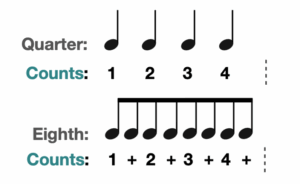
Chart showing quarter notes (1, 2, 3, 4) and eighth notes (1 + 2 + 3 + 4 +), illustrating how music and mood are shaped by rhythm—building and breaking patterns like construction and destruction.

Four illustrations labeled

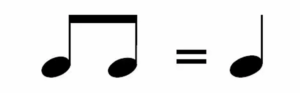
A musical note on the left equals two musical notes connected by a beam on the right, illustrating that two eighth notes equal one quarter note.

https://www.libertyparkmusic.com/how-to-count-8th-notes-and-16th-notes/

https://www.incredibox.com/demo/ and https://musiclab.chromeexperiments.com/Shared-Piano/#3u3j9FYWb for acceleration


Instructional Design

Opening/Activating Strategy

In order to be successful in this unit students should be able to define constructive and destructive forces.  Students should understand that landforms can change quickly or slowly over time. Students should be able to identify surface features caused by constructive and destructive forces.

    • The teacher will display the following picture with the class to open discussion. Students and teacher will used “Think-Pair-Share” strategy to discuss the following guided questions (See/Think/Wonder Artful Thinking Routine):
      • Have students silently observe the image.
      • Ask students:
        • What do you see?
        • What do you think caused this to happen?
        • What do you wonder? Do you think this happened quickly or slowly over time? Why?

A large crack runs through the middle of a paved road, caused by an earthquake. People gather around the damaged area, inspecting the deep fissure and the surrounding destruction.

  • The teacher will give a brief description (definition) of the difference between a constructive and destructive force.
  • Students will listen to the teacher’s definition and then identify from the picture, which geological process would this be identified as (constructive or deconstructive). Students will state the reason for their choice.
  • Students will orally give their own definition of a constructive or destructive process to build their understanding.
  • Students will then engage in a variation of the See/Think/Wonder strategy using Hear/Think/Wonder as they respond to a song.
    • Tell the students we will listen to a piece composed by Gustov Holst entitled, “Mars” from The Planet. Play the first 1:20 minutes.
      • First time: Hear–Ask students to just listen to the sample and reflect on how the example makes them feel. What emotions come up? What instruments/sounds did they hear? What was the tempo?
      • Second time: Think–Ask students to listen for structural clues. How do the sections/sounds relate to one another (or do they)? Are there musical/sound questions posed and answered? Are any sounds/music repeating? What would it look like if the sounds were captured on paper?
      • Third time: Wonder–Ask questions about context. The composer wrote this music to represent a specific environment. What do you think he was thinking of and why?


Work Session

  • Review science and music vocabulary including tempo, beat, and dynamics.
  • Demonstrate the difference between quarter notes and eighth notes using body percussion and/or instruments. An eighth note would be played faster and four count would be played slower changing the tempo of the piece.
    • Show students the following image for clarity.

Chart showing quarter notes (1, 2, 3, 4) and eighth notes (1 + 2 + 3 + 4 +), illustrating how music and mood are shaped by rhythm—building and breaking patterns like construction and destruction.

  • Lead students in an echoing exercise using body percussion.
    • Perform an eight count of claps (one eighth note per clap). Students echo.
    • Perform an eight count of snaps (one eighth note per snap). Students echo.
    • Perform an eight count of alternating claps and snaps (one eighth note per each). Students echo.
    • Now, slow the tempo down so that each clap is a quarter note (four claps total). Students echo.
    • Using quarter notes, alternate claps and stomps (clap-stomp-clap-stomp). Students echo.
  • Next, add dynamics (how loud or soft a sound is).
    • Perform an eight count of claps (one eighth note per clap) starting loud and getting soft. This is called a decrescendo. Students echo.
    • Perform an eight count of alternating claps and stomps (one eighth note per each) starting soft and getting loud. This is called a crescendo. Students echo.
  • Show a couple images of constructive and destructive forces.
    • Ask students whether they think this shows a process that happens quickly or slowly. Then ask students whether they would compose a body percussion piece with eighth notes or quarter notes. Would they use a combination (starting fast and gradually slowing down)?
    • Ask students what the volume would be. Would they use a crescendo or a decrescendo?
  • Divide students into small groups. Tell students that they will compose a body percussion piece to demonstrate a constructive or destructive force.
  • Assign groups a constructive or destructive force to show.
    • Students should consider what the force would sound like and choose body percussion based on that information.
    • Pass out musical note cards to students (one set per group–eight cards total). Students must use four cards total in their composition.
      • Ask students to think about how fast or slow the constructive or destructive force occurs. Does it slow down over time like a volcano? Or speed up?
      • Remind students that two eighth notes equals one quarter note.

A musical note on the left equals two musical notes connected by a beam on the right, illustrating that two eighth notes equal one quarter note.

  • Students must decide the dynamics of their piece (how loud or soft) and if it should have a crescendo or decrescendo. Does the constructive or destructive force get louder or softer as it occurs?
  • Both the dynamics and the choice of composition (eighth notes and quarter notes) should directly connect to the constructive or destructive force they are showing.
  • Students will share their performance and receive peer feedback to improve their performance.
  • Students will go back to make necessary changes to improve their performance.
  • Allow time for students to rehearse.


Closing Reflection

  • Students will record finished performances using Flipgrid to later share with their peers. After performing, students should explain how they showed the constructive or destructive force through dynamics and tempo.
  • Alternatively, students can present in person. The audience can then identify how the group showed their force through dynamics and tempo.


Assessments

Formative

  • Teacher will observe students’ responses during See, Think, Wonder and Hear, Think, Wonder.
  • Teacher will observe students’ ability to distinguish between an eighth note and a quarter note.
  • Teacher will check-in with students as they compose their pieces to determine if they understand the connection between musical concepts, such as dynamics and tempo, and their assigned constructive or destructive force.


Summative

  • Students can create an original composition that demonstrates that they understand their assigned constructive or destructive force through their use of tempo and dynamics.
  • Students can verbally explain their constructive or destructive force and how they used tempo and dynamics to communicate the force’s process.


Differentiation

Accelerated: 

Remedial:

    • Students will use picture cards (see materials) to create their compositions. Students can sort the cards to represent the movement that would represent a constructive/destructive force of their choice.


 Credits

U.S. Department of Education- STEM + the Art of Integrated Learning

Ideas contributed by: SAIL grant teacher leaders

*This integrated lesson provides differentiated ideas and activities for educators that are aligned to a sampling of standards. Standards referenced at the time of publishing may differ based on each state’s adoption of new standards.

Revised and copyright:  June 2025 @ ArtsNOW