
MEDITATION THROUGH ART (SUMI-E PAINTING) 4

MEDITATION THROUGH ART (SUMI-E PAINTING)

MEDITATION THROUGH ART (SUMI-E PAINTING)

Learning Description

Students will use meditation and concentration techniques to create a Sumi-e-painting and a chop (signature) using brushstrokes, line, and value.


Learning Targets

GRADE BAND: 4
CONTENT FOCUS: VISUAL ARTS & HEALTH
LESSON DOWNLOADS:

Download PDF of this Lesson

"I Can" Statements

“I Can…”

  • I can create a variety of lines using Sumi-e painting techniques.
  • I can discuss the connection between Sumi-e painting and meditation and concentration.
  • I can create a Sumi-e painting using a variety of brushstrokes.
  • I can create a personal chop to use as my signature.
  • I can explain what the Four Gentlemen are.

Essential Questions

  • What is sumi-painting?
  • How does sumi-painting connect to meditation and concentration?
  • What is a chop?
  • What are the Four Gentlemen?


Georgia Standards

Curriculum Standards

HE4.1 Students will comprehend concepts related to health promotion and disease prevention to enhance health.

HE4.1.c Describe basic health concepts of mental and emotional well-being.

Arts Standards

VA5.CR.1 Engage in the creative process to generate and visualize ideas by using subject matter and symbols to communicate meaning.

VA5.PR.1 Plan and participate in appropriate exhibition(s) of works of art to develop identity of self as artist.

VA5.CR.5 Demonstrate an understanding of the safe and appropriate use of materials, tools, and equipment for a variety of artistic processes.

VA5.RE.1 Use a variety of approaches for art criticism and to critique personal works of art and the artwork of others to enhance visual literacy.

VA5.CN.3 Develop life skills through the study and production of art (e.g. collaboration, creativity, critical thinking, communication).


South Carolina Standards

Curriculum Standards

Standard 6: “Students will demonstrate the ability to use goal-setting skills to enhance health” (NHES, 2007).

M-4.6.1 Develop a plan to reduce and manage stress.

Arts Standards

Anchor Standard 1: I can use the elements and principles of art to create artwork.

Benchmark VA.CR I can combine several elements of art to express ideas.

Indicator VA.CR NM.1.2 I can combine several elements of art to construct 2D or 3D artwork.

Anchor Standard 2: I can use different materials, techniques, and processes to make art.

Benchmark VA.CR NM.2 I can use some materials, techniques, and tools to create artwork.

Indicator VA.CR NM.2.1 I can use two-dimensional art materials to explore ways to make art.

Anchor Standard 4: I can organize work for presentation and documentation to reflect specific content, ideas, skills, and or media.

Benchmark VA.P NL.4 I can show and describe the idea of my artwork.

Indicator VA.P NL.4.2 I can describe my artwork.


Key Vocabulary

Content Vocabulary

  • Meditation - A mental practice that involves focusing your attention and eliminating distractions to achieve a state of calm, clarity, and awareness
  • Mindfulness - The ability to be present and fully engaged with whatever one is doing in the moment

Arts Vocabulary

  • Sumi-e-painting - A traditional Japanese ink painting style that uses black ink to create simple, expressive images—often of nature—using minimal brushstrokes
  • “Four Gentlemen” - In Chinese art, the “Four Gentlemen” or “Four Noble Ones” (Chinese: 四君子; pinyin: Sì Jūnzǐ), literally meaning "Four Junzi", is a collective term referring to four plants: the plum blossom, the orchid, the bamboo, and the chrysanthemum. The term compares the four plants to Confucian junzi, or "gentlemen".
  • Brushstrokes - A mark made by a paintbrush drawn across a surface
  • Chop - Artist’s signature
  • Monochromatic - Tints and shades of one color
  • Line - A continuous mark made on some surface by a moving point. It may be two dimensional, like a pencil mark on a paper or it may be three dimensional (wire) or implied (the edge of a shape or form) often it is an outline, contour or silhouette.
  • Value - This describes the lightness or darkness of a color. Value is needed to express volume.

A horizontal gradient bar displaying eight equally sized rectangles, transitioning smoothly from white to black through shades of gray—evoking the subtle transitions of sumi-e painting and the calm focus of meditation.

  • Balance - This is a sense of stability in the body of work. Balance can be created by repeating the same shapes and by creating a feeling of equal visual weight.
  • Contrast - The arrangement of opposite elements in a composition (light vs. dark, rough vs. smooth, etc.) Similar to variety, which refers to the differences in a work, achieved by using different shapes, textures, colors and values.
  • Printmaking - The art or technique of making prints, especially as practiced in engraving, etching, dry point, woodcut or serigraphy

Materials

  • Paper (newsprint for practice and rice paper for project)
  • Pencil
  • Watercolors
  • Water cups
  • Brushes
  • Paint palettes
  • Wet wipes/baby wipes
  • India ink
  • Foam printing plate
  • Red stamp pad, ink, or tempera paint (for chop)
  • Examples of Japanese Sumi-e paintings
  • Video to introduce Sumi-e painting


Instructional Design

Opening/Activating Strategy

  • Introduce the idea of Japanese Sumi-e painting to students. Show students the video to introduce Sumi-e painting.
  • Share how it is the art of relaxation and meditation.
  • Engage students in a “Think, Pair Share” about the process of Sumi-e painting.

Work Session

  • Discuss the “Four Gentlement”. Tell students that the “Four Gentlement” are four plants that a sumi-e painter must study and master to become a true artist.
    • The Four Gentlemen are: bamboo, wild orchid, chrysanthemum, and plum blossom branch.
    • Each plant requires years of dedicated practice under skilled guidance. They are called “gentlemen” because they embody elegance, refinement, and grace.
    • In sumi-e, each plant is created through a series of specific brushstrokes.
  • Show students examples of each type of painting. Ask students to see if they can identify the different types of brushstrokes needed to create each plant.
  • Guide the students in creating and practicing the different brushstrokes needed to create the “Four Gentlemen”.
  • Allow students time to practice their brushstrokes.
  • Discuss the importance of line, contrast, value, and balance in sumi-paintings. Ask students whether they think the brush strokes could represent different emotions.
  • Allow students time to generate ideas for their Sumi-e painting. Emphasize using different types of lines, contrast, value, and balance in their paintings.
    • Engage students in a “Think, Pair share” about their ideas for their painting.
  • After the students have had time to practice and generate ideas for their project, pass out the project paper and have the students begin creating their artwork.
  • Remind students to try to stay in the present and practice mindfulness while they are creating their artworks.
  • Once the projects are done and dry, ask students to reflect on the process. What was challenging? What do they feel most proud of in their work?
  • Next, turn the focus to creating a chop for their signature.
  • Cut and distribute a 1X1 inch square foam printing plate.
  • Discuss the importance of a chop (signature). Explain to students that a chop does not have to contain letters. Instead, they can create a personal symbol to act as their signature.
  • Have students generate ideas for their chop.
  • Discuss the idea of printmaking and how letters must be written backwards so that when it is printed it will print correctly.
  • Once they have chosen their design, have them use a dull pencil to etch it into their foam plate.
  • Let them practice pulling the print a few times with red ink or paint before they add it to their Sumi-e painting
  • Lastly, have them add their chop to their painting to finish their project.
  • For added drama, have them mount their projects on red paper.
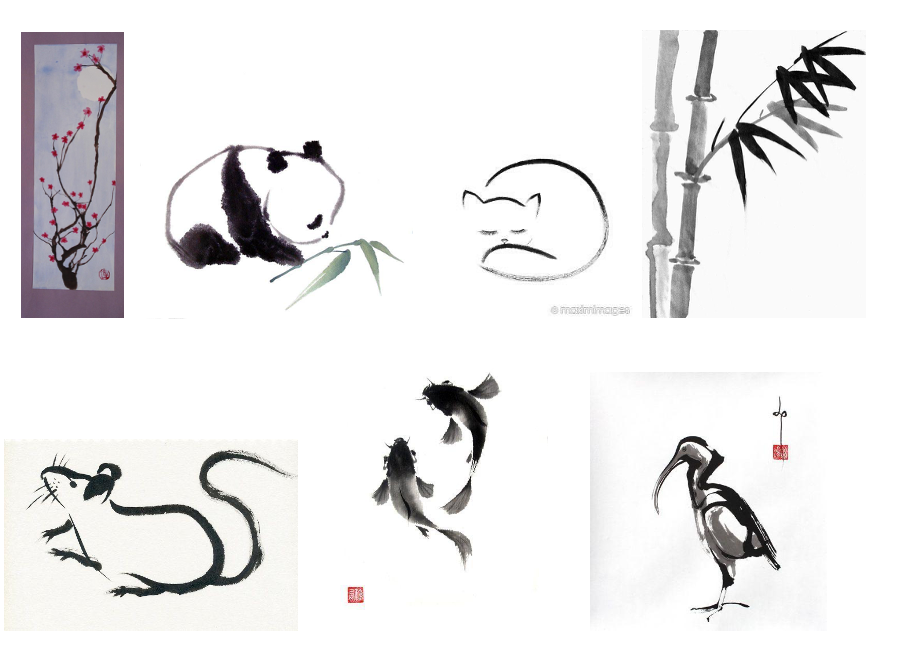
A collage of minimalist Chinese ink art inspired by sumi-e painting, featuring a plum blossom branch, a panda with bamboo, a sleeping cat, bamboo stalks, a rat, two koi fish, and a bird on a branch—a meditation in brushstrokes.


Closing Reflection

  • Provide students the opportunity to share their sumi-paintings and discuss how it felt to intentionally stay present and be mindful during the process. Let them discuss their process and decision making. Use “Think, pair share” to facilitate discussion.
  • Allow time for students to explain their chop, as well.
  • Have students complete a 3-2-1 reflection at the end of the project. 3-2-1: list three things they learned about the process of Sumi-painting, two things they noticed about themselves during the process, and one question they have about the lesson.


Assessments

Formative

  • Observe students’ responses to discussion.
  • Observe students’ process in their sketchbooks.
  • Use a Think-Pair-Share activity with students at the beginning, middle and end of the project so that they can give each other feedback.
  • 3-2-1: list three things they learned about the process of Sumi-painting, two things they noticed about themselves during the process, and one question they have about the lesson.

Summative


Differentiation

Accelerated: 

  • Require students to include all four types of brushstrokes in their composition.
  • Have students create a story to accompany their paintings.

Remedial:

  • This project will be differentiated by process. Students will work towards the same goal but will be given different levels of skills, support, and length of time spent on tasks.
  • Students can focus on one or two types of brushstrokes rather than all four.


Additional Resources


Credits

U.S. Department of Education- STEM + the Art of Integrated Learning

Ideas contributed by: SAIL Grant Teacher Leaders–Chad Itnyre, Kristen Alvarez, Leah Patel, Lucerito Gonzalez, Tamu Clayton, Sandra Cash, Erin Smullen

*This integrated lesson provides differentiated ideas and activities for educators that are aligned to a sampling of standards. Standards referenced at the time of publishing may differ based on each state’s adoption of new standards.

Revised and copyright:  August 2025 @ ArtsNOW


STARS & PLANETS: PLANET MUSIC & MOVEMENT RESPONSES 4

PLANET MUSIC & MOVEMENT RESPONSES

STARS & PLANETS:PLANET MUSIC & MOVEMENT RESPONSES

Learning Description

Students will listen to music and identify various musical components, relate those components to attributes of planets. Students will then create movements to demonstrate those attributes with music.


Learning Targets

GRADE BAND: 4
CONTENT FOCUS: MUSIC & SCIENCE
LESSON DOWNLOADS:

Download PDF of this Lesson

"I Can" Statements

“I Can…”

  • I can listen and respond to music with words and movement as it relates to attributes of the planets.

Essential Questions

  • How do the physical characteristics of stars differ from those of planets, and what methods can we use to observe and understand these differences?


Georgia Standards

Curriculum Standards

S4E1: Obtain, evaluate, and communicate information to compare and contrast the physical attributes of stars and planets.

Arts Standards

ESGM4.RE.1 Listen to, analyze, and describe music.
ESGM4.RE.2 Evaluate music and music performances.


Key Vocabulary

Content Vocabulary

  • (Composition) Gaseous - A planet composed of mostly gasses
  • (Composition) Rocky - A planet composed of mostly rocks
  • Orbit - The path an object takes in space
  • Planet - Large natural objects that orbit around a star
  • Relative size - How the size of one object compares to another
  • Satellite - Any object that orbits another object
  • Star - A massive, luminous sphere held together by its own gravity
  • Telescope - A tool used to observe far away objects

Arts Vocabulary

  • Composer - The person who writes the music
  • Gustav Holst - (1874–1934) An English composer, arranger, and teacher, best known for his orchestral suite "The Planets"
  • Tempo - The speed of the beat
    • Allegro - Fast
    • Adagio - Slow
  • Dynamics - Loud and soft sounds; volume
    • Crescendo - Get louder
    • Decrescendo - Get softer (synonymous with diminuendo)
    • Piano - Soft
    • Forte - Loud

Materials


Instructional Design

Opening/Activating Strategy

  • Play a portion of Gustav Holst’s composition “Earth, The Bringer of Life”
  • Engage students in the Hear, Think, Wonder Artful Thinking Routine.
    • What do you hear?
    • What do you think about what you’ve heard?
    • What do you wonder about this piece?

Introduce the composer as Gustav Holst, born in 1874 in England. Tell students that he was most famous for his orchestral composition called “The Planets”.

Work Session

Teacher Note: Students will have already learned about planet attributes: Terrestrial/rocky, gaseous, size, rotation speed (slow or fast), and color.

  • Teach or review musical vocabulary:
    • Tempo - The speed of the beat
      • Allegro - Fast
      • Adagio - Slow
    • Dynamics - Loud and soft sounds; volume
      • Crescendo - Get louder
      • Decrescendo - Get softer (synonymous with diminuendo)
      • Piano - Soft
      • Forte - Loud
    • Review listening skills as they relate to music.
    • Set a purpose for listening:
      • Say to students, “When you listen to the next piece of music I want you to listen for how loud or soft the music is. Is it fast or slow? Does it start slow and get faster or start fast and get slower? Or start softly and become LOUD?!”
      • Tell students that it is the song they listened to earlier. It is a composition that is written about one of the planets.
      • Ask students to think about what they know about planets and how the tempo (fast and slow) and dynamics (loud and soft) might tell the listener about the planet.
      • Play EARTH, The Bringer of Life.
        • Ask students:
          • What did you notice about the tempo? Dynamics?
          • Does it remind you of any specific planet?
          • Why does that tempo or dynamic remind you of that?
        • Lead students to attributes of planets such as cold, hot, big/small (in relation to Earth), rocky, gaseous, fast spinning or slow spinning.
          • Example: Slow spinning could be represented with slow music.
        • Divide students into small groups. Assign each group a planet (other than Earth).
        • Have each group listen to Gustav Holst’s composition on that planet.
          • As they listen, have students record observations about the tempo and dynamics. Students should explain how the tempo and dynamics connect to the attributes of the planet.
          • Students should then imagine that they are composers tasked with writing music to express the attributes of that planet.
            • Students should decide the following:
              • What tempo would it be?
              • What would the dynamics be?
              • What instruments would they use?

Closing Reflection

Play a small section of each musical composition. Allow students time to share their observations about the tempo and dynamics and how they see it connecting to the attributes of that planet.


Assessments

Formative

  • Teachers will observe students’:
    • Responses during class discussion
    • Ability to identify attributes of planets
    • Ability to identify the tempo and dynamics in music

Summative

  • Students can connect musical concepts like tempo and dynamics to attributes of planets.
  • Students can explain the attributes of their assigned planets.
  • Students can describe how they would represent their planet using tempo and attributes.


Differentiation

Acceleration: 

Students can create their own musical composition using body percussion (stomping, clapping, snapping, etc.) and/or found sound (using objects around them such as pencils or crumpling paper) for their planet.

Remediation:

Create a class key for what a fast or slow tempo or loud or soft dynamics might represent to support students as they analyze music.


Credits

U.S. Department of Education- STEM + the Art of Integrated Learning

Ideas contributed by: SAIL Grant Teacher Leaders

*This integrated lesson provides differentiated ideas and activities for educators that are aligned to a sampling of standards. Standards referenced at the time of publishing may differ based on each state’s adoption of new standards.

Revised and copyright:  June 2025 @ ArtsNOW


STARS & PLANETS: COSMIC COLORS–CRAFTING THE SOLAR SYSTEM THROUGH ART 4

COSMIC COLORS–CRAFTING THE SOLAR SYSTEM THROUGH ART

STARS & PLANETS:COSMIC COLORS–CRAFTING THE SOLAR SYSTEM THROUGH ART

Learning Description

In this visual arts lesson, students will use oil pastels to create a vibrant representation of the solar system, focusing on the unique physical attributes of each planet. Through a discussion on planetary characteristics, students will learn to apply elements of art, such as value for lightness and darkness, line and shape for planetary outlines and orbits, and texture to mimic surfaces like Venus's smoothness or Jupiter's gas swirls.


Learning Targets

GRADE BAND: 4
CONTENT FOCUS: VISUAL ARTS & SCIENCE
LESSON DOWNLOADS:

Download PDF of this Lesson

"I Can" Statements

“I Can…”

  • I can create a model of the physical attributes of planets in our solar system using the elements of art.
  • I can use texture, line, shape, and color to depict the composition of stars and planets.

Essential Questions

  • How do the physical characteristics of stars differ from those of planets, and what methods can we use to observe and understand these differences?
  • How can I use elements of art to create a depiction of planets in our solar system?


Georgia Standards

Curriculum Standards

S4E1: Obtain, evaluate, and communicate information to compare and contrast the physical attributes of stars and planets.

Arts Standards

VA4.CR.2 Create works of art based on selected themes.
VA4.CR.3 Understand and apply media, techniques, processes, and concepts of two dimensional art.
a. Apply drawing and painting techniques with a variety of media (e.g. pencil, crayon, pastel, charcoal, tempera, watercolor, acrylic).


Key Vocabulary

Content Vocabulary

  • Planet - Large natural objects that orbit around a star
  • (Composition) Gaseous - A planet composed of mostly gasses
  • (Composition) Rocky - A planet composed of mostly rocks
  • Relative size - How the size of one object compares to another
  • Satellite - Any object that orbits another object
  • Star - A massive, luminous sphere held together by its own gravity
  • Telescope - A tool used to observe far away objects

Arts Vocabulary

  • Blending technique - Mixing two colors or shades of oil pastels by layering them
  • Rubbing - Placing a piece of paper over something that has texture and rubbing a drawing utensil lightly over the paper to reveal the texture underneath
  • Color - An element of art with three properties: 1) Hue: the name of the color, e.g. red, yellow, etc.; 2) Intensity: the purity and strength of the color (brightness or dullness); 3) Value: the lightness or darkness of the color (shades and tints)
  • Value - This describes the lightness or darkness of a color. Value is needed to express volume.
  • Texture - The surface quality, or "feel" of an object, such as roughness, smoothness, or softness. Actual texture can be felt while simulated textures are implied by the way the artist renders areas of the picture.
  • Shape - A flat, enclosed line that is always two-dimensional and can be either geometric or organic
  • Line - A continuous mark made on some surface by a moving point. It may be two dimensional, like a pencil mark on a paper or it may be three dimensional (wire) or implied (the edge of a shape or form) often it is an outline, contour or silhouette.
  • Composition - How an artist uses the the elements to create a work of art
  • Proportion - The size relationships between different parts of an artwork. It determines how each element relates to the others in terms of size, scale, and placement.
  • Perspective - Representing objects and spaces in a way that mimics how we perceive them in the real world

Materials


Instructional Design

Opening/Activating Strategy

  • Group students in small groups of three to four. Give each group an element of art (line, shape, color, value, texture, space, and form).
  • Discuss the definitions of each element of art using the Elements of Art
  • Show students the images below. Have students share how they see their group’s element of art in the images.
    • Discuss how each planet is more than one color and/or shade.
    • Discuss how each planet looks different and how the order of the planets is depicted.

Illustration of the solar system featuring the Sun, eight planets, and Pluto, all aligned with their orbits against a starry background filled with shimmering stars.


Illustration of the solar system with the Sun at the center, planets like Earth, Saturn, Jupiter, and Neptune orbiting in elliptical paths, and distant stars twinkling in the background of space.


Work Session

  • Discuss different ways the planets’ order can be depicted. Refer to the pictures from the opening activity.
  • Discuss how space in art is depicted. This is creating the illusion that some things are closer than others.
    • Discuss how each image is shown from a different perspective. How space is represented will depend on the perspective students choose.
    • Another resource to use for examples of perspective is from David A. Hardy.
  • Discuss how/why not all of the planets are the same size and color. Proportion is one of the principles of design in art; talk to students about how this is shown in the images of the planets (relative size).
  • Discuss the different compositions of planets. Ask students how this can be represented using texture. Students can represent gaseous planets with a smooth texture and blending using oil pastels and rocky planets by doing a texture rubbing on a rough surface.
  • Model for students how to blend their colors. This is a great time to discuss how value is demonstrated in art. You can use this video to demonstrate how to combine light values and darker values to create the illusion of form.
  • Refer back to initial images from activator. Ask students to observe how the space on the paper is used. Remind them to use the whole space on their paper when creating their artwork. Remind students to consider how they will also represent the size of the planets on their paper (proportion).
  • Have students sketch their design of the solar system first and then begin coloring/shading/creating texture rubbings of the planets with oil pastels.
  • After students have completed their artwork, have students sign their work and display it for future use.
  • If using neon oil pastels, after all models have been displayed, allow students to use black lights to observe other students’ models/artwork.

Closing Reflection

  • Compare and contrast the models.
  • Discuss how blending (and texture rubbings) allowed for the models to be more accurate than in other depictions of planets.
  • In groups, have students identify how they used the elements of art.


Assessments

Formative

  • Teachers will assess student learning throughout the lesson by observing students’:
    • Ability to identify the elements of art in images of planets
    • Ability to describe the attributes of planets

Summative

Use rubric to assess student work: VA - Lesson 3 Rubric.


DIFFERENTIATION

Acceleration: 

Advanced students can be asked to include items such as the asteroid belt in their models.

Remediation:

Allow remedial students to see a different type of model to assist them with ordering the planets, or students can choose one planet to model.


ADDITIONAL RESOURCES


CREDITS

U.S. Department of Education- STEM + the Art of Integrated Learning

Ideas contributed by: SAIL Grant Teacher Leaders

*This integrated lesson provides differentiated ideas and activities for educators that are aligned to a sampling of standards. Standards referenced at the time of publishing may differ based on each state’s adoption of new standards.

Revised and copyright:  June 2025 @ ArtsNOW


STARS & PLANETS: STARS VERSUS PLANETS–MEET & GREET 4

STARS VERSUS PLANETS–MEET & GREET

STARS & PLANETS: STARS VERSUS PLANETS–MEET & GREET

Learning Description

In this theater integration lesson, students will compare stars and planets, identifying their similarities and differences. They will use this knowledge to design a character, drawing inspiration from the distinct physical attributes of either a star or a planet. This task will allow them to apply their understanding creatively. By doing so, they will deepen their grasp of the unique characteristics that distinguish stars from planets.


Learning Targets

GRADE BAND: 4
CONTENT FOCUS: THEATRE & SCIENCE
LESSON DOWNLOADS:

Download PDF of this Lesson

"I Can" Statements

“I Can…”

  • I can communicate the physical attributes of stars and planets.
  • I can use vocal elements, body, and movement to communicate attributes of the star and planet character I am representing.

Essential Questions

  • How are stars and planets alike and different?
  • How can I use my body and voice to personify a star or planet?


Georgia Standards

Curriculum Standards

S4E1: Obtain, evaluate, and communicate information to compare and contrast the physical attributes of stars and planets. c. Construct an explanation of the differences between stars and planets.

Arts Standards

TA4.PR.1 Act by communicating and sustaining roles in formal and informal environments. a. Use vocal elements (e.g. inflection, pitch, volume, articulation) to communicate a character’s thoughts, emotions, and actions. b. Use body and movement to communicate a character’s thoughts and emotions.


Key Vocabulary

Content Vocabulary

  • (Composition) Gaseous - A planet composed of mostly gasses
  • (Composition) Rocky - A planet composed of mostly rocks
  • Orbit - The path an object takes in space
  • Planet - Large natural objects that orbit around a star
  • Relative size - How the size of one object compares to another
  • Satellite - Any object that orbits another object
  • Star - A massive, luminous sphere held together by its own gravity
  • Telescope - A tool used to observe far away objects

Arts Vocabulary

  • Voice - Actors use their voice to be heard by the audience clearly. Actors must also apply vocal choices such as pitch, tempo, and volume to the character they are dramatizing.
  • Body - Actors use their body to become a character through body posture and movement. What your mind thinks, what your emotions feel, all of this is supposed to show up in your body.
  • Inflection - Changing your voice to convey different feelings or ideas
  • Pitch - The highness or lowness of a voice
  • Volume - How loud or soft a voice is
  • Articulation - How clearly or precisely words are pronounced
  • Levels - How high or low an actor moves; the three levels are low, middle, high


Materials


Instructional Design

Opening/Activating Strategy

  • Watch the Video: Planets’ and stars’ size comparison.
  • Engage students in the See, Think, Wonder Artful Thinking Routine.
    • Ask students:
      • What do you see?
      • What do you think about what you see?
      • What do you wonder about?
    • Review similarities and differences between stars and planets.
    • Create a T-chart or Venn Diagram together as a class.

Work Session

  • Give students a name tag of either the name of a planet or a star.
  • Ask students:
    • If you were given an acting role to “be” this planet or star, how would you use your voice to represent your role? What volume would you use? What pitch would you use?
    • As your star or planet, how would you move your body? What level would you be at–high, middle, low?
    • How would you move? What would your facial expression be?
    • What adjectives would you use to describe yourself?
  • Students will create their character based upon their previous knowledge and what was reviewed in “mini-lesson.” Students can plan their “character” using the Planning Character Profile graphic organizer.
    • Example of character notes: Star–HUGE, produces light, hotter and bigger, and appears to twinkle
    • The student could stand stretched out in an X and bounce. “X” shape represents taking up as much space as possible (HUGE); bouncing represents appearing to twinkle.
    • They might use a booming, angry voice to represent hot and large.
  • Students should then create a short “bio” about themselves written in the first person. They will use this to introduce themselves to other characters in the class. They should include relevant details about their attributes in their bios.
  • Have students form an inner circle and outer circle. The inner circle will face the outer circle so that students are face to face.
  • Play music; instruct the circles to rotate in opposite directions while the music plays. When the music stops, the students will stop and introduce themselves using their bios to the student across from them.
    • Remind students to use their voices and bodies to stay in character.
    • Continue this process as time allows.

Closing Reflection

  • Have students engage in the following reflection:
    • Share about someone/something you met today. Do you think you would be friends? Why or why not? (Do they have similarities to you? Do they have differences from you?)
    • Have students complete the following exit ticket - Name someone you met today.  How are you alike? How are you different? Record your answers.


Assessments

Formative

  • Observation of students’ discussion and Planning Character Profile
  • Exit ticket

Summative

  • Students’ written bios demonstrating they understand the attributes of their star or planet
  • Students’ performances demonstrating that they can use their voices and bodies to communicate characteristics of their character (star or planet)


Differentiation

Acceleration: 

  • Students do not use their names with introductions; the other person must then guess who they are meeting.
  • Technology extension: Students record their introduction by creating a Flipgrid video (or other source), and students watch each other's introductions.

Remediation:

  • Pull students into a small group for filling out the Planning Character Profile.


Credits

U.S. Department of Education- STEM + the Art of Integrated Learning
Ideas contributed by: SAIL Grant Teacher Leaders, Kate Bertram

*This integrated lesson provides differentiated ideas and activities for educators that are aligned to a sampling of standards. Standards referenced at the time of publishing may differ based on each state’s adoption of new standards.

Revised and copyright:  June 2025 @ ArtsNOW


STARS & PLANETS: EXPLORING PLANETS THROUGH TELESCOPES, EYES, & DANCE 4

EXPLORING PLANETS THROUGH TELESCOPES, EYES, & DANCE

STARS & PLANETS:EXPLORING PLANETS THROUGH TELESCOPES, EYES, & DANCE

Learning Description

In this lesson, students will compare and contrast the view of planets through a telescope and the naked eye. Opportunities will be provided for students to have a discussion about the importance of being able to see the planets through the lens of a telescope. The students will then use their observations to describe the physical attributes of the planets that have been observed through dance.


Learning Targets

GRADE BAND: 4
CONTENT FOCUS: DANCE & SCIENCE
LESSON DOWNLOADS:

Download PDF of this Lesson

"I Can" Statements

“I Can…”

  • I can describe the distant objects that can be seen using various technological advances
  • I can describe the physical attributes of the planets.
  • I can create a piece of choreography to model attributes of planets in the solar system.

Essential Questions

  • How have changes in technology helped change the type of information we gain from the sky?
  • How can I describe the physical attributes of the planets in the solar system?
  • How can I demonstrate attributes of planets through the use of dance?


Georgia Standards

Curriculum Standards

S4E1: Obtain, evaluate, and communicate information to compare and contrast the physical attributes of stars and planets.

Arts Standards

ESD4.CR.1 Demonstrate an understanding of the choreographic process.
ESD4.CR.2.a Use movement to express an idea or feeling.
ESD4.PR.2.a Demonstrate attentiveness, full participation, and cooperation with others in the dance learning and performing environment.


Key Vocabulary

Content Vocabulary

  • (Composition) Gaseous - A planet composed of mostly gasses
  • (Composition) Rocky - A planet composed of mostly rocks
  • International Space Station - A large spacecraft that orbits Earth and serves as a multinational research laboratory. It is a collaborative project involving five participating space agencies: NASA (United States), Roscosmos (Russia), JAXA (Japan), ESA (Europe), and CSA (Canada)
  • Orbit - The path an object takes in space
  • Planet - Large natural objects that orbit around a star
  • Relative size - How the size of one object compares to another
  • Satellite - Any object that orbits another object
  • Star - A massive, luminous sphere held together by its own gravity
  • Telescope - A tool used to observe far away objects

Arts Vocabulary

  • Choreography - The sequence of steps and movements in dance
  • Flowing - Energy in dance that is smooth, continuous, and graceful
  • Percussive - Energy in dance that is sharp and typically rhythmic
  • Vibratory - Energy in dance that consist of rapid, repeated, trembling, or shaking actions
  • Suspended - Energy in dance that give the illusion of defying gravity
  • Sustained - Energy in dance that are made with deliberate slowness
  • Pathway - The direction that a dancer moves through space
  • Locomotor - Movement that involves traveling from one location to another
  • Non-locomotor - Movement that does not involve traveling across the space


Materials


Instructional Design

Opening/Activating Strategy

Work Session

  • The teacher will lead the students on a solar system walk, using this website and these photographs to view planets in space.
  • The teacher will pose the following questions to the class:
    • If you could be any planet in the solar system, which would you choose?
    • If you could share your favorite planet with a partner, but only use movements and not words, could you do it?
  • As a class, create movements that represent Earth’s attributes.
    • Using this website, project a current view of Earth from space.
    • Ask students:
      • Would our movements be flowing, percussive, vibratory, suspended, sustained? Show students examples of each.
      • Would our movements be locomotor or non-locomotor?
        • If our movement is locomotor, what pathway would we take?
      • Create five movements together as a class that represent the attributes of Earth for the Earth choreography.
    • Allow students to choose their favorite planet and work with a partner to create a choreography of at least five movements.
      • Movements must represent the planet (i.e., size, color, shape, location, rotation, inner(closest), outer (farthest), gassy, rocky, etc).
      • Students should plan their choreography in their STEAM journals or on paper. Students should decide what type of movements they will use to communicate the attributes of the planet.
    • Students will record their movements in their notebook.
    • Partners will perform their choreography for another group. The other group will decide which planet they are representing and why (two guesses only).
      • As students identify which planet they think is being presented, ask students to use dance vocabulary like percussive or vibratory to support their answer.
      • Allow groups to take turns presenting.

Closing Reflection

  • Invite partner-groups to share their movements with the class.
  • Revisit the solar system walk; students should explain one of the movements they chose for their planet and which photograph they chose to use as the inspiration for their movements.
  • Ask students why is it important to see a planet through the lens of a telescope versus with the naked eye?


Assessments

Formative

  • Teachers will assess student learning through:
    • Observation of movements/dance vocabulary
    • Class discussion

Summative

Rubric


Differentiation

Acceleration: 

Students will construct an explanation of why they chose to use the image they did to represent the designated planet. Students will be asked to provide information as to when the technology used to photograph the planet was introduced, how the image has provided information about the planet, and what information was provided about the planet from the given instrument. 

Remediation:

Allow students to work in groups of four and create three movements for each planet instead of five.


Credits

U.S. Department of Education- STEM + the Art of Integrated Learning

Ideas contributed by: SAIL Grant Teacher Leaders, Lybria Rivers, Brenda Williams

*This integrated lesson provides differentiated ideas and activities for educators that are aligned to a sampling of standards. Standards referenced at the time of publishing may differ based on each state’s adoption of new standards.

Revised and copyright:  June 2025 @ ArtsNOW