
MEDITATION THROUGH ART (SUMI-E PAINTING)
Learning Description
Students will use meditation and concentration techniques to create a Sumi-e-painting and a chop (signature) using brushstrokes, line, and value.
Learning Targets
"I Can" Statements
“I Can…”
- I can create a variety of lines using Sumi-e painting techniques.
- I can discuss the connection between Sumi-e painting and meditation and concentration.
- I can create a Sumi-e painting using a variety of brushstrokes.
- I can create a personal chop to use as my signature.
- I can explain what the Four Gentlemen are.
Essential Questions
- What is sumi-painting?
- How does sumi-painting connect to meditation and concentration?
- What is a chop?
- What are the Four Gentlemen?
Georgia Standards
Curriculum Standards
HE4.1 Students will comprehend concepts related to health promotion and disease prevention to enhance health.
HE4.1.c Describe basic health concepts of mental and emotional well-being.
Arts Standards
VA5.CR.1 Engage in the creative process to generate and visualize ideas by using subject matter and symbols to communicate meaning.
VA5.PR.1 Plan and participate in appropriate exhibition(s) of works of art to develop identity of self as artist.
VA5.CR.5 Demonstrate an understanding of the safe and appropriate use of materials, tools, and equipment for a variety of artistic processes.
VA5.RE.1 Use a variety of approaches for art criticism and to critique personal works of art and the artwork of others to enhance visual literacy.
VA5.CN.3 Develop life skills through the study and production of art (e.g. collaboration, creativity, critical thinking, communication).
South Carolina Standards
Curriculum Standards
Standard 6: “Students will demonstrate the ability to use goal-setting skills to enhance health” (NHES, 2007).
M-4.6.1 Develop a plan to reduce and manage stress.
Arts Standards
Anchor Standard 1: I can use the elements and principles of art to create artwork.
Benchmark VA.CR I can combine several elements of art to express ideas.
Indicator VA.CR NM.1.2 I can combine several elements of art to construct 2D or 3D artwork.
Anchor Standard 2: I can use different materials, techniques, and processes to make art.
Benchmark VA.CR NM.2 I can use some materials, techniques, and tools to create artwork.
Indicator VA.CR NM.2.1 I can use two-dimensional art materials to explore ways to make art.
Anchor Standard 4: I can organize work for presentation and documentation to reflect specific content, ideas, skills, and or media.
Benchmark VA.P NL.4 I can show and describe the idea of my artwork.
Indicator VA.P NL.4.2 I can describe my artwork.
Key Vocabulary
Content Vocabulary
- Meditation - A mental practice that involves focusing your attention and eliminating distractions to achieve a state of calm, clarity, and awareness
- Mindfulness - The ability to be present and fully engaged with whatever one is doing in the moment
Arts Vocabulary
- Sumi-e-painting - A traditional Japanese ink painting style that uses black ink to create simple, expressive images—often of nature—using minimal brushstrokes
- “Four Gentlemen” - In Chinese art, the “Four Gentlemen” or “Four Noble Ones” (Chinese: 四君子; pinyin: Sì Jūnzǐ), literally meaning "Four Junzi", is a collective term referring to four plants: the plum blossom, the orchid, the bamboo, and the chrysanthemum. The term compares the four plants to Confucian junzi, or "gentlemen".
- Brushstrokes - A mark made by a paintbrush drawn across a surface
- Chop - Artist’s signature
- Monochromatic - Tints and shades of one color
- Line - A continuous mark made on some surface by a moving point. It may be two dimensional, like a pencil mark on a paper or it may be three dimensional (wire) or implied (the edge of a shape or form) often it is an outline, contour or silhouette.
- Value - This describes the lightness or darkness of a color. Value is needed to express volume.

- Balance - This is a sense of stability in the body of work. Balance can be created by repeating the same shapes and by creating a feeling of equal visual weight.
- Contrast - The arrangement of opposite elements in a composition (light vs. dark, rough vs. smooth, etc.) Similar to variety, which refers to the differences in a work, achieved by using different shapes, textures, colors and values.
- Printmaking - The art or technique of making prints, especially as practiced in engraving, etching, dry point, woodcut or serigraphy
Materials
- Paper (newsprint for practice and rice paper for project)
- Pencil
- Watercolors
- Water cups
- Brushes
- Paint palettes
- Wet wipes/baby wipes
- India ink
- Foam printing plate
- Red stamp pad, ink, or tempera paint (for chop)
- Examples of Japanese Sumi-e paintings
- Video to introduce Sumi-e painting
Instructional Design
Opening/Activating Strategy
- Introduce the idea of Japanese Sumi-e painting to students. Show students the video to introduce Sumi-e painting.
- Share how it is the art of relaxation and meditation.
- Engage students in a “Think, Pair Share” about the process of Sumi-e painting.
Work Session
- Discuss the “Four Gentlement”. Tell students that the “Four Gentlement” are four plants that a sumi-e painter must study and master to become a true artist.
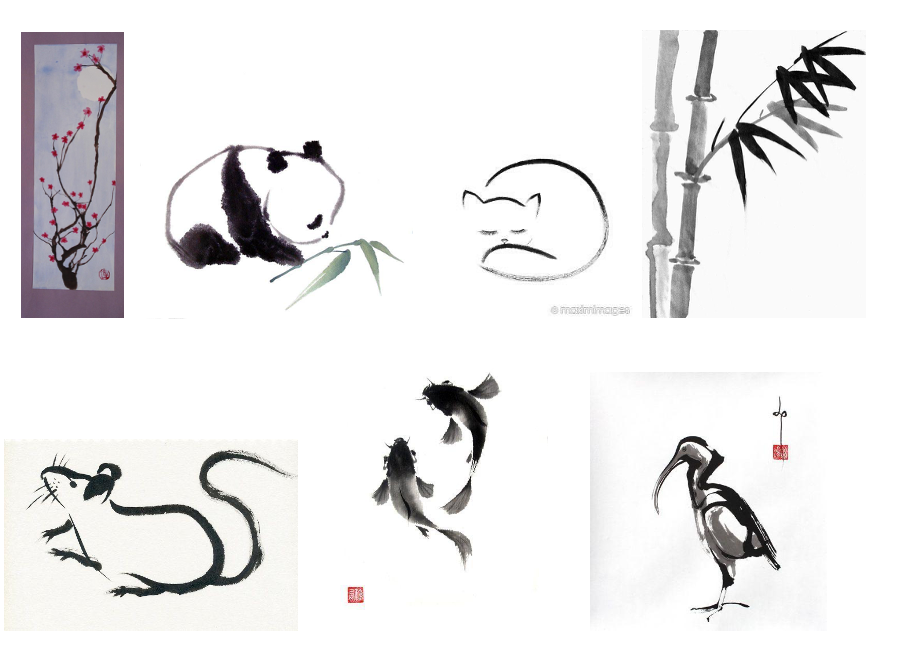
- The Four Gentlemen are: bamboo, wild orchid, chrysanthemum, and plum blossom branch.
- Each plant requires years of dedicated practice under skilled guidance. They are called “gentlemen” because they embody elegance, refinement, and grace.
- In sumi-e, each plant is created through a series of specific brushstrokes.
- Show students examples of each type of painting. Ask students to see if they can identify the different types of brushstrokes needed to create each plant.
- Guide the students in creating and practicing the different brushstrokes needed to create the “Four Gentlemen”.
- Allow students time to practice their brushstrokes.
- Discuss the importance of line, contrast, value, and balance in sumi-paintings. Ask students whether they think the brush strokes could represent different emotions.
- Allow students time to generate ideas for their Sumi-e painting. Emphasize using different types of lines, contrast, value, and balance in their paintings.
- Engage students in a “Think, Pair share” about their ideas for their painting.
- After the students have had time to practice and generate ideas for their project, pass out the project paper and have the students begin creating their artwork.
- Remind students to try to stay in the present and practice mindfulness while they are creating their artworks.
- Once the projects are done and dry, ask students to reflect on the process. What was challenging? What do they feel most proud of in their work?
- Next, turn the focus to creating a chop for their signature.
- Cut and distribute a 1X1 inch square foam printing plate.
- Discuss the importance of a chop (signature). Explain to students that a chop does not have to contain letters. Instead, they can create a personal symbol to act as their signature.
- Have students generate ideas for their chop.
- Discuss the idea of printmaking and how letters must be written backwards so that when it is printed it will print correctly.
- Once they have chosen their design, have them use a dull pencil to etch it into their foam plate.
- Let them practice pulling the print a few times with red ink or paint before they add it to their Sumi-e painting
- Lastly, have them add their chop to their painting to finish their project.
- For added drama, have them mount their projects on red paper.
Closing Reflection
- Provide students the opportunity to share their sumi-paintings and discuss how it felt to intentionally stay present and be mindful during the process. Let them discuss their process and decision making. Use “Think, pair share” to facilitate discussion.
- Allow time for students to explain their chop, as well.
- Have students complete a 3-2-1 reflection at the end of the project. 3-2-1: list three things they learned about the process of Sumi-painting, two things they noticed about themselves during the process, and one question they have about the lesson.
Assessments
Formative
- Observe students’ responses to discussion.
- Observe students’ process in their sketchbooks.
- Use a Think-Pair-Share activity with students at the beginning, middle and end of the project so that they can give each other feedback.
- 3-2-1: list three things they learned about the process of Sumi-painting, two things they noticed about themselves during the process, and one question they have about the lesson.
Summative
Differentiation
|
Accelerated:
Remedial:
|
Additional Resources
Credits
U.S. Department of Education- STEM + the Art of Integrated Learning
Ideas contributed by: SAIL Grant Teacher Leaders–Chad Itnyre, Kristen Alvarez, Leah Patel, Lucerito Gonzalez, Tamu Clayton, Sandra Cash, Erin Smullen
*This integrated lesson provides differentiated ideas and activities for educators that are aligned to a sampling of standards. Standards referenced at the time of publishing may differ based on each state’s adoption of new standards.
Revised and copyright: August 2025 @ ArtsNOW