
MY FAVORITE STUFFED ANIMAL STILL LIFE 4

MY FAVORITE STUFFED ANIMAL STILL LIFE

MY FAVORITE STUFFED ANIMAL STILL LIFE

Learning Description

Students will learn about the art of still life while connecting it to a favorite stuffed animal. Students will learn how we connect with objects that make us feel happy and safe.


Learning Targets

GRADE BAND: 4
CONTENT FOCUS: VISUAL ARTS & HEALTH
LESSON DOWNLOADS:

Download PDF of this Lesson

"I Can" Statements

“I Can…”

  • I can use my observation skills to create a still life based on a stuffed animal.

Essential Questions

  • How can I use the Elements of Art to draw a still life?


Georgia Standards

Curriculum Standards

HE4.1 Students will comprehend concepts related to health promotion and disease prevention to enhance health.

HE4.1.c Describe basic health concepts of mental and emotional well-being.

Arts Standards

VA4.CR.1 Engage in the creative process to generate and visualize ideas by using subject matter and symbols to communicate meaning.

VA4.PR.1 Plan and participate in appropriate exhibition(s) of works of art to develop identity of self as artist.

VA4.CR.5 Demonstrate an understanding of the safe and appropriate use of materials, tools, and equipment for a variety of artistic processes.

VA4.RE.1 Use a variety of approaches for art criticism and to critique personal


South Carolina Standards

Curriculum Standards

Standard 6: “Students will demonstrate the ability to use goal-setting skills to enhance health” (NHES, 2007).

M-4.6.1 Develop a plan to reduce and manage stress.

Arts Standards

Anchor Standard 1: I can use the elements and principles of art to create artwork.

Benchmark VA.CR I can combine several elements of art to express ideas.

Indicator VA.CR NM.1.2 I can combine several elements of art to construct 2D or 3D artwork.

Anchor Standard 2: I can use different materials, techniques, and processes to make art.

Benchmark VA.CR NM.2 I can use some materials, techniques, and tools to create artwork.

Indicator VA.CR NM.2.1 I can use two-dimensional art materials to explore ways to make art.

Anchor Standard 4: I can organize work for presentation and documentation to reflect specific content, ideas, skills, and or media.

Benchmark VA.P NL.4 I can show and describe the idea of my artwork.

Indicator VA.P NL.4.2 I can describe my artwork.


Key Vocabulary

Content Vocabulary

  • Security - The feeling of safety, stability, and confidence

Arts Vocabulary

  • Still life - A type of artwork—most often a painting, drawing, or photograph—that depicts inanimate objects arranged in a composition
  • Line - A continuous mark made on some surface by a moving point. It may be two dimensional, like a pencil mark on a paper or it may be three dimensional (wire) or implied (the edge of a shape or form) often it is an outline, contour or silhouette.
  • Shape - A flat, enclosed line that is always two-dimensional and can be either geometric or organic
  • Form - An object that is three-dimensional and encloses volume (cubes, spheres, and cylinders are examples of various forms)
  • Texture - The surface quality, or "feel" of an object, such as roughness, smoothness, or softness. Actual texture can be felt while simulated textures are implied by the way the artist renders areas of the picture.
  • Color - An element of art with three properties: 1) Hue: the name of the color, e.g. red, yellow, etc.; 2) Intensity: the purity and strength of the color (brightness or dullness); 3) Value: the lightness or darkness of the color (shades and tints)
  • Value - This describes the lightness or darkness of a color. Value is needed to express volume.
  • Space - The distance or area between, around, above or within things. Positive space refers to the subject or areas of interest in an artwork, while negative space is the area around the subject of an artwork. It can be a description for both two and three-dimensional portrayals.

Materials


Instructional Design

Opening/Activating Strategy

Work Session

  • Lead a discussion around how objects can carry meaning and make us feel secure and safe. Ask students if they have or had a favorite stuffed animal that gave them a sense of security.
  • Students will need to bring to school either a favorite stuffed animal or a picture of one.
  • Demonstrate how to use simple lines and shapes to begin building the artwork before adding the fine details and colors.
  • Students will practice drawing sketches of their stuffed animal before beginning the final drawing.
  • Students will start with a pencil and the trace over with a sharpie. However, they will have a choice in how they add color. Students must include a background created from memory or imagination.


Closing Reflection

Have students think about their stuffed animal and how it makes them feel. Students will write a few sentences about why it is special to them. They can also describe their favorite memory with it, or what feelings they wanted to show in their artwork.


Assessments

Formative

  • The teacher will observe whether students:
    • Are using the elements of arts in a way that aids in the creation of their artwork.
    • Are using appropriate lines and shapes that correctly represent the size and shape of their stuffed animal.

Summative


Differentiation

Accelerated: 

  • Students can turn the artwork into a short story or comic in which the stuffed animal is the main character.


Remedial:

  • These students may use shape tracers as guides to begin creating their shapes for the more detailed version.


Credits

U.S. Department of Education- STEM + the Art of Integrated Learning

Ideas contributed by: SAIL Grant Teacher Leaders–Chad Itnyre, Kristen Alvarez, Leah Patel, Lucerito Gonzalez, Tamu Clayton, Sandra Cash, Erin Smullen

*This integrated lesson provides differentiated ideas and activities for educators that are aligned to a sampling of standards. Standards referenced at the time of publishing may differ based on each state’s adoption of new standards.

Revised and copyright:  August 2025 @ ArtsNOW
 

POSITIVE AFFIRMATION WATERCOLOR ART 4

POSITIVE AFFIRMATION WATERCOLOR ART

POSITIVE AFFIRMATION WATERCOLOR ART

Learning Description

Students will create a watercolor artwork using words of affirmation.They will partition their paper with tape and paint the negative space with various watercolor techniques, fostering self-expression, creativity, and artistic exploration.


Learning Targets

GRADE BAND: 4
CONTENT FOCUS: VISUAL ARTS & HEALTH
LESSON DOWNLOADS:

Download PDF of this Lesson

"I Can" Statements

“I Can…”

  • I can create a watercolor artwork incorporating words of affirmation expressing self-confidence and positivity through visual art.

Essential Questions

  • How can visual arts and positive affirmations work together to promote self-confidence and well-being?


Georgia Standards

Curriculum Standards

HE4.1 Students will comprehend concepts related to health promotion and disease prevention to enhance health.

HE4.1.c Describe basic health concepts of mental and emotional well-being.

HE4.5 Students will demonstrate the ability to use decision-making skills to enhance health.

Arts Standards

VA4.CR.1 Engage in the creative process to generate and visualize ideas by using subject matter and symbols to communicate meaning.

VA4.CR.3 Understand and apply media, techniques, processes, and concepts of two-dimensional art.

VA4.PR.1 Plan and participate in appropriate exhibition(s) of works of art to develop identity of self as artist.

VA4.CR.5 Demonstrate an understanding of the safe and appropriate use of materials, tools, and equipment for a variety of artistic processes.


South Carolina Standards

Curriculum Standards

Standard 2: “Students will analyze the influence of family, peers, culture, media, technology, and other factors on health behaviors” (NHES, 2007).

I-4.2.1 Analyze ways that protective factors promote health and safety (e.g., positive outlook, healthy self-concept, good relationships with parents).

Standard 6: “Students will demonstrate the ability to use goal-setting skills to enhance health” (NHES, 2007).

M-4.6.1 Develop a plan to reduce and manage stress.

Arts Standards

Anchor Standard 1: I can use the elements and principles of art to create artwork.

Benchmark VA.CR I can combine several elements of art to express ideas.

Indicator VA.CR NM.1.2 I can combine several elements of art to construct 2D or 3D artwork.

Anchor Standard 2: I can use different materials, techniques, and processes to make art.

Benchmark VA.CR NM.2 I can use some materials, techniques, and tools to create artwork.

Indicator VA.CR NM.2.1 I can use two-dimensional art materials to explore ways to make art.

Anchor Standard 4: I can organize work for presentation and documentation to reflect specific content, ideas, skills, and or media.

Benchmark VA.P NL.4 I can show and describe the idea of my artwork.

Indicator VA.P NL.4.2 I can describe my artwork.


Key Vocabulary

Content Vocabulary

  • Positive affirmation - A short, intentional statement that affirms something constructive or empowering about yourself
  • Resilience - The ability to adapt, recover, and grow stronger in the face of challenges, stress, or adversity
  • Self-confidence - The belief in your own abilities, qualities, and judgment, which allows you to approach challenges and opportunities with assurance rather than doubt

Arts Vocabulary

  • Color - An element of art with three properties: 1) Hue: the name of the color, e.g. red, yellow, etc.; 2) Intensity: the purity and strength of the color (brightness or dullness); 3) Value: the lightness or darkness of the color (shades and tints)
  • Texture - The surface quality, or "feel" of an object, such as roughness, smoothness, or softness. Actual texture can be felt while simulated textures are implied by the way the artist renders areas of the picture.
  • Positive space - The subject or areas of interest in an artwork
  • Negative space - The area around the subject of an artwork
  • Watercolor techniques
  • Wet-on-wet - A painting technique where wet paint is applied onto a wet surface (either pre-wetted paper or another area of wet paint)
  • Wet-on-dry - A painting technique where wet paint is applied onto dry paper (or a dry painted layer)
  • Blending - A painting technique where two or more colors are smoothly merged together so they transition gradually without harsh lines
  • Lifting - A painting technique where paint is removed from the paper—either while it’s still wet or after it has dried—to create lighter areas, highlights, or texture
  • Resist - A technique where specific areas of a paper being painted with watercolor are protected from absorbing paint using a resist material, such as wax (like a crayon or oil pastel) or tape

Materials

  • Masking tape or painter's tape
  • Watercolor paper or heavyweight paper
  • Watercolor paints
  • Paintbrushes (various sizes)
  • Water cups
  • Paper towels
  • Examples of watercolor techniques (e.g., wet-on-wet, wet-on-dry - video on techniques)
  • Other materials for chosen watercolor techniques, such as salt, plastic wrap, crayons, etc.


Instructional Design

Opening/Activating Strategy

Introduction:

  • Begin by discussing the importance of positive affirmations and how they can influence our thoughts and feelings.
  • Show examples of watercolor artworks, explaining how artists use color and texture to convey meaning and emotion.


Guided Discussion:

  • Lead a guided discussion about positive affirmations, asking students to share examples of affirmations they find inspiring or uplifting.
  • Discuss the impact of positive words on our mindset and self-esteem, emphasizing the importance of using affirmations to promote self-confidence and resilience.

Work Session

Artistic Exploration:

  • Provide each student with a sheet of watercolor paper or heavyweight paper.
  • Instruct students to tear off small strips of masking tape or painter's tape to create the outline of the letters of their chosen positive affirmation on the paper.
  • Encourage students to be creative with the placement and design of their affirmations, considering the overall composition of their artwork.


Watercolor Techniques:

  • Demonstrate various watercolor techniques to the class, such as wet-on-wet, wet-on-dry, blending, salt added to water color, lifting, and plastic wrap over wet.
  • Allow students time to experiment with different techniques on the blank spaces surrounding their taped affirmation words.
  • Encourage students to use a variety of colors and brushstrokes to create visual interest and texture in their artworks.


Affirmation Reveal:

  • Once the watercolor paintings have dried completely, instruct students to carefully remove the masking tape to reveal the negative space of their affirmation words.
  • Discuss the visual impact of the contrast between the painted background and the untouched affirmation words, emphasizing how the words stand out as a focal point in the artwork.


Closing Reflection

Sharing and Reflection:

  • After completing their artworks, invite students to share their creations with the class.
  • Ask students to describe the positive affirmations they chose and explain why they selected them.
  • Facilitate a discussion reflecting on the experience, asking questions, such as, "How did creating art with positive affirmations make you feel?" and, "What positive messages do you hope others will take away from your artwork?".


Closure:

  • Summarize the key concepts learned during the lesson, emphasizing the power of positive affirmations and artistic expression in promoting self-confidence and well-being.


Assessments

Formative

Teachers will assess students throughout the lesson by observing students’ discussion responses, planning, and artmaking process.

Summative


Differentiation

Accelerated: 

  • Invite students to write short stories or poems inspired by their affirmation artworks, exploring themes of resilience, self-love, and personal growth.
  • Research other artists who use words or text in their artwork, such as Jenny Holzer or Barbara Kruger, and discuss how their work relates to the use of positive affirmations.


Remedial:

  • Assist students with brainstorming positive affirmations.
  • Assist students with creating the letters/layout of their affirmations.

Credits

U.S. Department of Education- STEM + the Art of Integrated Learning

Ideas contributed by: Chad Itnyre, Kristen Alvarez, Leah Patel, Lucerito Gonzalez, Tamu Clayton, Sandra Cash, Erin Smullen

*This integrated lesson provides differentiated ideas and activities for educators that are aligned to a sampling of standards. Standards referenced at the time of publishing may differ based on each state’s adoption of new standards.

Revised and copyright:  August 2025 @ ArtsNOW


DATA PORTRAIT 4

DATA PORTRAIT

DATA PORTRAIT

Learning Description

This lesson will focus on achieving accurate self perception as well as recognizing strengths, needs and values. Students will create a data-based self portrait that focuses on their unique aspects.


Learning Targets

GRADE BAND: 4
CONTENT FOCUS: VISUAL ARTS & HEALTH
LESSON DOWNLOADS:

Download PDF of this Lesson

"I Can" Statements

“I Can…”

  • I can create a self portrait using symbols.
  • I can use the Elements of Art and Principles of Design to add detail and interest to my portrait.

Essential Questions

  • How can I represent myself through symbols?
  • How can I use the Elements of Art to convey meaning?


Georgia Standards

Curriculum Standards

HE4.1 Students will comprehend concepts related to health promotion and disease prevention to enhance health.

HE4.1.c Describe basic health concepts of mental and emotional well-being

Arts Standards

VA4.CR.1 Engage in the creative process to generate and visualize ideas by using subject matter and symbols to communicate meaning.

VA4.PR.1 Plan and participate in appropriate exhibition(s) of works of art to develop identity of self as artist.

VA4.CR.5 Demonstrate an understanding of the safe and appropriate use of materials, tools, and equipment for a variety of artistic processes.

VA4.RE.1 Use a variety of approaches for art criticism and to critique personal works of art and the artwork of others to enhance visual literacy.

VA4.CN.3 Develop life skills through the study and production of art (e.g. collaboration, creativity, critical thinking, communication).


South Carolina Standards

Curriculum Standards

Standard 2: “Students will analyze the influence of family, peers, culture, media, technology, and other factors on health behaviors” (NHES, 2007).

I-4.2.1 Analyze ways that protective factors promote health and safety (e.g., positive outlook, healthy self-concept, good relationships with parents).

M-4.2.1 Explain ways that peers can influence an individual’s self-concept.

Arts Standards

Anchor Standard 1: I can use the elements and principles of art to create artwork.

Benchmark VA.CR I can combine several elements of art to express ideas.

Indicator VA.CR NM.1.2 I can combine several elements of art to construct 2D or 3D artwork.

Anchor Standard 2: I can use different materials, techniques, and processes to make art.

Benchmark VA.CR NM.2 I can use some materials, techniques, and tools to create artwork.

Indicator VA.CR NM.2.1 I can use two-dimensional art materials to explore ways to make art.

Anchor Standard 4: I can organize work for presentation and documentation to reflect specific content, ideas, skills, and or media.

Benchmark VA.P NL.4 I can show and describe the idea of my artwork.

Indicator VA.P NL.4.2 I can describe my artwork.


Key Vocabulary

Content Vocabulary

  • Self-awareness - Knowing your own thoughts, feelings, strengths, and challenges; understanding who you are and how you react to things
  • Strength - Something someone is good at or a positive quality someone possesses that helps them in life
  • Needs - The important things you must have to live and feel well—like food, water, safety, love, and support
  • Values - The beliefs and ideas that matter most to you
  • Unique - Being one of a kind

Arts Vocabulary

  • Symbols - Visuals that represent meaning
  • Balance - This is a sense of stability in the body of work. Balance can be created by repeating the same shapes and by creating a feeling of equal visual weight.
  • Portrait - A visual representation of a person
  • Self-portrait - A visual representation of oneself
  • Space - The distance or area between, around, above or within things. Positive space refers to the subject or areas of interest in an artwork, while negative space is the area around the subject of an artwork. It can be a description for both two and three-dimensional portrayals.
  • Proportion - The size relationships between different parts of an artwork. It determines how each element relates to the others in terms of size, scale, and placement.

Materials

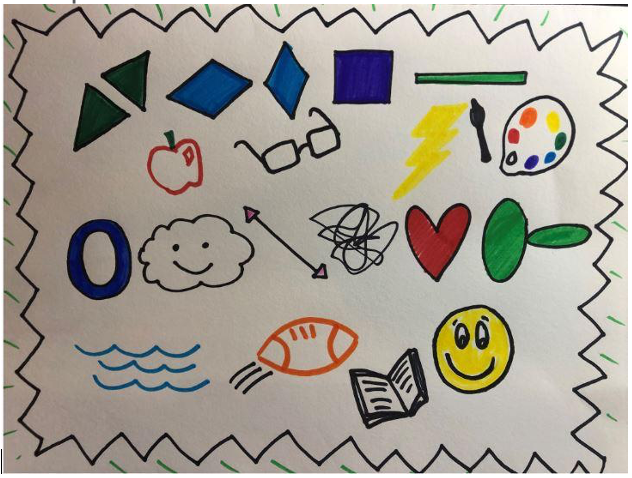
A hand-drawn collage forms a playful data portrait, featuring various icons: geometric shapes, an apple, glasses, lightning bolt, paint palette, cloud, heart, leaf, waves, football, smiling face, and an open book on a white background.


Instructional Design

Opening/Activating Strategy

  • Students will view examples of portraits that are more traditional versus abstract.
  • Next, discuss how using symbols is an alternative way to represent oneself.
    • Ask students for some examples of personal strengths and symbols that could represent them (i.e. a heart for kindness, a brain for intelligence, etc.).
    • Tell students that they will be creating a self-portrait using symbols to represent personal strengths.

Work Session

  • Students will create a list of characteristics that make them unique. Students should try to generate at least eight ideas.
  • Students will then create symbols that represent those characteristics.
    • Students should spend time developing their symbols. These symbols could be abstract or representational.
    • Students will need to create a master key showing what each symbol represents.
  • Show students an example of a finished “data portrait”.
    • Discuss with students how the space is used; emphasize that students should use the whole space to create their portrait.
    • Ask students to brainstorm how they could represent the characteristics that are most important. Students may say that these symbols might be in the middle of the artwork or might be the largest.
    • Discuss how to create balance in the artwork so that it feels unified.
  • Students should plan their artwork before beginning. Students should be intentional with how they use the space.
  • Next, students will choose their materials and begin creating their artwork.


Closing Reflection

  • Students will share their portraits either in small groups or through a gallery walk.
    • Ask students to try to “read” and analyze what each symbol represents.
  • Facilitate a discussion about what students learned about themselves and each other through this project.
  • Provide time for students to share why they chose some of their symbols and what they visually represent.


Assessments

Formative

Assess students’ learning by observing students’ responses to discussion questions and conferencing with students throughout the planning and artmaking process.

Summative


Differentiation

Accelerated: 

  • Have students create additional symbols.
  • Have students include a background.


Remedial:

  • Assist students in creating their list of characteristics and help brainstorm examples of symbols.


Credits

U.S. Department of Education- STEM + the Art of Integrated Learning

Ideas contributed by: SAIL Grant Teacher Leaders–Chad Itnyre, Kristen Alvarez, Leah Patel, Lucerito Gonzalez, Tamu Clayton, Sandra Cash, Erin Smullen

*This integrated lesson provides differentiated ideas and activities for educators that are aligned to a sampling of standards. Standards referenced at the time of publishing may differ based on each state’s adoption of new standards.

Revised and copyright:  August 2025 @ ArtsNOW


WHAT’S YOUR PERSPECTIVE? 4

WHAT’S YOUR PERSPECTIVE?

WHAT’S YOUR PERSPECTIVE?

Learning Description

In this lesson, students will create a Calder-inspired mobile that explores positive and negative perspectives. Students begin by reflecting on experiences from different viewpoints and discuss how perspective affects perception. They will examine how color can convey mood by looking at Jim Dine’s works, then select color schemes to represent positive and negative perspectives. This lesson emphasizes reflection, creativity, and the expressive potential of color and form.


Learning Targets

GRADE BAND: 4
CONTENT FOCUS: VISUAL ARTS & HEALTH
LESSON DOWNLOADS:

Download PDF of this Lesson

"I Can" Statements

“I Can…”

  • I can reflect on experiences from positive and negative perspectives.
  • I can choose and apply color schemes to express different moods.
  • I can represent personal feelings through art.

Essential Questions

  • How can perspective (positive or negative) change the way we see an experience?
  • How does color affect the mood or feeling of an artwork?
  • In what ways can art represent personal experiences or feelings?


Georgia Standards

Curriculum Standards

HE4.1 Students will comprehend concepts related to health promotion and disease prevention to enhance health.

HE4.1.c Describe basic health concepts of mental and emotional well-being.

Arts Standards

VA4.CR.1 Engage in the creative process to generate and visualize ideas by using subject matter and symbols to communicate meaning.

VA4.PR.1 Plan and participate in appropriate exhibition(s) of works of art to develop identity of self as artist.

VA4.CR.5 Demonstrate an understanding of the safe and appropriate use of materials, tools, and equipment for a variety of artistic processes.

VA4.RE.1 Use a variety of approaches for art criticism and to critique personal works of art and the artwork of others to enhance visual literacy.

VA4.CN.3 Develop life skills through the study and production of art (e.g. collaboration, creativity, critical thinking, communication).


South Carolina Standards

Curriculum Standards

Standard 2: “Students will analyze the influence of family, peers, culture, media, technology, and other factors on health behaviors” (NHES, 2007).

I-4.2.1 Analyze ways that protective factors promote health and safety (e.g., positive outlook, healthy self-concept, good relationships with parents).

Arts Standards

Anchor Standard 1: I can use the elements and principles of art to create artwork.

Benchmark VA.CR I can combine several elements of art to express ideas.

Indicator VA.CR NM.1.2 I can combine several elements of art to construct 2D or 3D artwork.

Anchor Standard 2: I can use different materials, techniques, and processes to make art.

Benchmark VA.CR NM.2 I can use some materials, techniques, and tools to create artwork.

Indicator VA.CR NM.2.2 I can use three-dimensional art materials and techniques to make art.

Anchor Standard 4: I can organize work for presentation and documentation to reflect specific content, ideas, skills, and or media.

Benchmark VA.P NL.4 I can show and describe the idea of my artwork.

Indicator VA.P NL.4.2 I can describe my artwork.


Key Vocabulary

Content Vocabulary

  • Positive - A viewpoint, attitude, or experience that focuses on benefits, opportunities, or constructive aspects
  • Negative - A viewpoint, attitude, or experience that focuses on drawbacks, challenges, or problems
  • Perspective - A particular way of looking at or thinking about something; a viewpoint or attitude that influences how a person sees and interprets experiences

Arts Vocabulary

  • Mobile - A type of hanging sculpture made of balanced or suspended parts that move freely in the air
  • Color scheme - A planned combination of colors used together in artwork to create a certain look, mood, or effect

Materials

  • Example of a mobile by Alexander Calder, such as, “Mariposa”
  • Examples of Jim Dine’s work that have different color schemes, such as “Four Hearts” and “Two Hearts in a Forest”
  • 12x18 white mixed media (or heavier) paper
  • Templates of circles in multiple sizes
  • Tempera paint or watercolors
  • Water cups
  • Paint brushes
  • Popsicle sticks (two per student)
  • Yarn in various colors


Instructional Design

Opening/Activating Strategy

Work Session

  • Tell students that they will be creating a mobile inspired by Calder that represents a positive and a negative perspective.
  • First, discuss what the words “positive” and "negative" mean.
  • Next, ask students to reflect on an experience that they could have looked at with a positive perspective or with a negative perspective. Ask them which they chose. Ask them to consider how their experiences might have been different if they had looked at it from the other perspective.
    • Provide time for students to share with a partner.
  • Show students two examples of Jim Dine’s work that have different color schemes, such as “Four Hearts” and “Two Hearts in a Forest”.
    • Ask students to reflect on how different color schemes change the artwork.
  • Next, have students select a color scheme for a positive perspective and a color scheme for a negative perspective.
  • Pass out 12x18 paper, scissors, circle templates, and tempera paint or watercolors.
  • Have students trace four different sized circles on their paper and cut them out.
  • Using the color schemes students selected, have students paint one side of each circle with one color scheme and the other side with the other color scheme. Encourage expressive application of paint. Optional: Look at examples of abstract artwork, particularly examples of Abstract Expressionism, with students.
  • After the paint is dry, have students draw a spiral in each circle starting in the center and going out to the edge. Using scissors, students will cut along the spiral lines.
  • Pass out yarn to each table and two popsicle sticks to each student.
    • Students should paint their popsicle sticks on both sides.
    • When dry, have students use the yarn to attach the popsicle stick in an “X”.
  • Next, have students cut four pieces of yarn–all different lengths. Students should tie each piece of yarn to each end of the popsicle sticks. Then, they should attach one end of each of their spirals to the hanging ends of the yarn.


Closing Reflection

  • Display students’ mobiles by hanging them around the classroom. Have students observe each other’s work.
  • Allow time for students to discuss their color choices and how they reflect positivity or negativity.


Assessments

Formative

Assess students’ learning by observing students’ responses to discussion questions and conferencing with students throughout the planning and artmaking process.

Summative


Differentiation

Accelerated: 

  • Have students use their understanding of radius to create their own hand-drawn circles for their mobiles.
  • Have students add lines and patterns to their circles that represent positivity and negativity using oil pastels. Students will add a watercolor wash over the oil pastel.


Remedial:

  • Reduce the number of circles students will include in their mobiles.
  • Provide pre-cut materials for students.


Credits

U.S. Department of Education- STEM + the Art of Integrated Learning

Ideas contributed by: Katy Betts

*This integrated lesson provides differentiated ideas and activities for educators that are aligned to a sampling of standards. Standards referenced at the time of publishing may differ based on each state’s adoption of new standards.

Revised and copyright:  August 2025 @ ArtsNOW


EXPRESSING IDENTITY THROUGH PATTERN AND COLOR 4

EXPRESSING IDENTITY THROUGH PATTERN AND COLOR

EXPRESSING IDENTITY THROUGH PATTERN AND COLOR

Learning Description

In this lesson, students will study Yayoi Kusama’s artwork to learn how patterns are created through repeated lines and shapes. Students will create a composition from a word that represents a personal strength, add a variety of patterns, and apply watercolor combining personal reflection with design.


Learning Targets

GRADE BAND: 4
CONTENT FOCUS: VISUAL ARTS & HEALTH
LESSON DOWNLOADS:

Download PDF of this Lesson

"I Can" Statements

“I Can…”

  • I can identify how artists use lines, shapes, and repetition to make patterns.
  • I can create my own patterns using lines and shapes.
  • I can design an artwork that shows one of my personal strengths.
  • I can use color to express emotion and meaning in my artwork.

Essential Questions

  • How do artists use lines, shapes, and repetition to create patterns?
  • How can patterns and colors be used to express emotions or ideas?
  • In what ways can art reflect personal identity and strengths?


Georgia Standards

Curriculum Standards

HE4.1 Students will comprehend concepts related to health promotion and disease prevention to enhance health.

HE4.1.c Describe basic health concepts of mental and emotional well-being.

HE4.5 Students will demonstrate the ability to use decision-making skills to enhance health.

Arts Standards

VA4.CR.1 Engage in the creative process to generate and visualize ideas by using subject matter and symbols to communicate meaning.

VA4.CR.3 Understand and apply media, techniques, processes, and concepts of two-dimensional art.

VA4.PR.1 Plan and participate in appropriate exhibition(s) of works of art to develop identity of self as artist.

VA4.CR.5 Demonstrate an understanding of the safe and appropriate use of materials, tools, and equipment for a variety of artistic processes.


South Carolina Standards

Curriculum Standards

Standard 2: “Students will analyze the influence of family, peers, culture, media, technology, and other factors on health behaviors” (NHES, 2007).

I-4.2.1 Analyze ways that protective factors promote health and safety (e.g., positive outlook, healthy self-concept, good relationships with parents).

Arts Standards

Anchor Standard 1: I can use the elements and principles of art to create artwork.

Benchmark VA.CR I can combine several elements of art to express ideas.

Indicator VA.CR NM.1.2 I can combine several elements of art to construct 2D or 3D artwork.

Anchor Standard 2: I can use different materials, techniques, and processes to make art.

Benchmark VA.CR NM.2 I can use some materials, techniques, and tools to create artwork.

Indicator VA.CR NM.2.1 I can use two-dimensional art materials to explore ways to make art.

Anchor Standard 4: I can organize work for presentation and documentation to reflect specific content, ideas, skills, and or media.

Benchmark VA.P NL.4 I can show and describe the idea of my artwork.

Indicator VA.P NL.4.2 I can describe my artwork.


Key Vocabulary

Content Vocabulary

  • Strength - A positive quality, ability, or trait that a person does well and can rely on in different situations

Arts Vocabulary

  • Pattern - Repetition of specific visual elements such as a unit of shape or form
  • Line - A continuous mark made on some surface by a moving point. It may be two dimensional, like a pencil mark on a paper or it may be three dimensional (wire) or implied (the edge of a shape or form) often it is an outline, contour or silhouette.
  • Shape - A flat, enclosed line that is always two-dimensional and can be either geometric or organic
  • Variety - The differences in a work, achieved by using different shapes, textures, colors and values
  • Line quality - Thickness or thinness of a line

Materials

  • Examples of Yayoi Kusama’s artwork, such as “Flowers” and “Petals”
  • Small pieces of paper, such as 3x5 cards
  • Permanent markers
  • Pencils
  • 8x8 inch white mixed media paper
  • Watercolor paints
  • Paintbrushes
  • Water cups
  • Color wheel


Instructional Design

Opening/Activating Strategy

  • Show students examples of Yayoi Kusama’s artwork, such as “Flowers” and “Petals”.
  • Ask students to notice the lines and shapes that Kusama makes in these artworks.
  • Discuss how patterns are created by repeating lines and shapes.
  • Pass out 3x5 notecards to students. Have each student make a simple pattern on the notecard.
  • Students should then share their different patterns with the students at their tables.

Work Session

  • Discuss with students how each person has strengths and weaknesses. Have students brainstorm a list of their strengths. Students should select one for their artwork.
  • Pass out 8x8 square paper to students. Have the students write the word in pencil on their paper so that the letters overlap.
  • Tell students to be sure each letter touches at least two sides of their paper.

A minimalist artwork featuring overlapping, roughly drawn circles and curved lines in pencil on a light gray background, using subtle pattern to create an abstract and airy composition while expressing identity.

  • Next, have students go over their lines with permanent markers.
  • Have students use lines to create patterns with their markers. Encourage students to use a variety of patterns and line qualities.
  • Students should fill each of the shapes that they made with their overlapping letters.

Abstract black ink doodle art featuring various patterns such as wavy lines, spirals, dots, and swirls—subtly expressing identity through intricate designs and faint green color accents within the detailed artwork.

  • Next, discuss how different colors can evoke different emotions. Show students a color wheel and ask students to consider what each color makes them feel.
  • Students should then select at least three colors for their artwork.
  • Using watercolor paints, students will paint in various shapes of their artwork.

Abstract drawing featuring intersecting curved lines dividing sections filled with color and pattern. Sections in purple, blue, and green showcase waves, swirls, circles, and zigzags, creating a playful sense of identity throughout the piece.


Closing Reflection

  • Have students share their artwork using the following reflection questions:
    • What did you show in your work?
    • What types of patterns did you use?
    • What were some of the challenges you faced as you created your artwork?


Assessments

Formative

  • Teachers will assess students throughout the lesson by observing responses to discussion questions, creation of patterns, and artmaking process.

Summative


Differentiation

Accelerated: 

  • Have students research how pattern is used in art. They can then incorporate their favorite patterns in their artwork.


Remedial:

  • Provide guided practice on how to create several different types of patterns.
  • Provide example patterns for students to choose from.


Credits

U.S. Department of Education- STEM + the Art of Integrated Learning

Ideas contributed by: Katy Betts

*This integrated lesson provides differentiated ideas and activities for educators that are aligned to a sampling of standards. Standards referenced at the time of publishing may differ based on each state’s adoption of new standards.

Revised and copyright:  August 2025 @ ArtsNOW