
Exploring Plane Figures Through Music Composition 2-3

EXPLORING PLANE FIGURES THROUGH MUSIC COMPOSITION

EXPLORING PLANE FIGURES THROUGH MUSIC COMPOSITION

Learning Description

In this lesson, students will compose speeches to demonstrate their understanding of plane figures and perform them using body percussion in rondo form as whole-class composition.


Learning Targets

GRADE BAND: 2-3
CONTENT FOCUS: MUSIC & MATH
LESSON DOWNLOADS:

Download PDF of this Lesson

"I Can" Statements

“I Can…”

  • I can create and accurately perform an original speech composition about a plane figure and perform it in rondo form.
  • I can create and accurately perform a body percussion ostinato.

Essential Questions

  • How can music composition help us understand mathematical concepts?
  • What is rondo form in music?


Georgia Standards

Curriculum Standards

Grade 2:

Math

2.GSR.7: Draw and partition shapes and other objects with specific attributes and conduct observations of everyday items and structures to identify how shapes exist in the world.

2.GSR.7.1 Describe, compare and sort 2-D shapes including polygons, triangles, quadrilaterals, pentagons, hexagons, and 3-D shapes including rectangular prisms and cones, given a set of attributes.


ELA

ELAGSE2W2 Write informative/explanatory texts in which they introduce a topic, use facts and definitions to develop points, and provide a concluding statement or section.


Grade 3:

Math

3.GSR.6: Identify the attributes of polygons, including parallel segments, perpendicular segments, right angles, and symmetry.

3.GSR.6.1 Identify perpendicular line segments, parallel line segments, and right angles, identify these in polygons, and solve problems involving parallel line segments, perpendicular line segments, and right angles.


ELA

ELAGSE3W2 Write informative/explanatory texts to examine a topic and convey ideas and information clearly. 

  1. Introduce a topic and group related information together; include illustrations when useful to aiding comprehension. 
  2. Develop the topic with facts, definitions, and details. 
  3. Use linking words and phrases (e.g., also, another, and, more, but) to connect ideas within categories of information. 
  4. Provide a concluding statement or section.

Arts Standards

Grade 2:

ESGM2.PR.1b. Echo simple singing and speech patterns.

ESGM2.PR.2b. Perform steady beat and simple rhythmic patterns with appropriate technique using body percussion and classroom instruments.

ESGM2.RE.1 Listen to, analyze, and describe music.


Grade 3:

ESGM3.PR.1b. Echo simple singing and speech patterns and perform call and response songs.

ESGM3.PR.2b. Perform steady beat and simple rhythmic patterns with appropriate technique using body percussion and classroom instruments.

ESGM3.RE.1 Listen to, analyze, and describe music.


South Carolina Standards

Curriculum Standards

Grade 2:

Math

2.G.1 Identify triangles, quadrilaterals, hexagons, and cubes. Recognize and draw shapes having specified attributes, such as a given number of angles or a given number of equal faces.


ELA

WRITING - Meaning, Context, and Craft

Standard 2: Write informative/explanatory texts to examine and convey complex ideas and information clearly and accurately through the effective selection, organization, and analysis of content.

2.1 Explore print and multimedia sources to write informative/explanatory texts that introduce a topic, use facts and definitions to develop points, and provide a concluding statement or section.


Grade 3:

Math

3.G.1 Understand that shapes in different categories (e.g., rhombus, rectangle, square, and other 4-sided shapes) may share attributes (e.g., 4-sided figures) and the shared attributes can define a larger category (e.g., quadrilateral). Recognize rhombuses, rectangles, and squares as examples of quadrilaterals, and draw examples of quadrilaterals that do not belong to any of these subcategories.


ELA

WRITING - Meaning, Context, and Craft

Standard 2: Write informative/explanatory texts to examine and convey complex ideas and information clearly and accurately through the effective selection, organization, and analysis of content.

2.1 Write informative/explanatory texts that: 

  1. introduce a topic clearly; 
  2. use relevant information from multiple print and multimedia sources; 
  3. provide a general observation and focus; 
  4. group related information logically; 
  5. develop the topic with facts, definitions, concrete details, quotations, or other information and examples related to the topic; k. use precise language and domain-specific vocabulary to inform or explain the topic

Arts Standards

Anchor Standard 1: I can arrange and compose music.

Anchor Standard 3: I can sing alone and with others.

Anchor Standard 6: I can analyze music.


Key Vocabulary

Content Vocabulary

  • Plane figure - A flat, closed figure that is in a plane; may be composed of straight lines, curved lines, or both 
  • Vertices - A vertex (plural: vertices) is a point where two or more lines, edges, or rays meet
  • Polygon - A geometric shape that has more than two sides


Arts Vocabulary

  • Rondo - A form of composition in which the first section recurs throughout the piece, alternating with different sections (e.g., A-B-A-C-A, etc.); found especially in compositions of the Baroque and Classical eras
  • Ostinato - A repeated pattern (plural: ostinati)
  • Body Percussion - Sounds produced by striking or scraping parts of the body; typically includes snapping, clapping, patting, and stamping
  • Phrase - Musical sentence or unit, commonly a  passage of four or eight measures; a dependent division of music, much like a single line of poetry in that it does not have a sense of completion in itself


Materials

  • Plane figure cards (individual cards with one figure on each) 
  • Large paper and markers 
  • Visual of four 8-beat phrases
  • Visual of text for section A of the rondo to be displayed after chant is learned
  • Sound source (iPod, iPhone, computer, speakers, etc.) 
  • Recording of musical composition in rondo form (or create your own using found sounds or body percussion)


Instructional Design

Opening/Activating Strategy

  • Perform two sounds, some of which are the same (e.g., clap-clap) and some of which are different (e.g., tap-clap). 
  • Have students identify what they hear as the same or different. 
    • Explain that students will be focusing on hearing parts that are the same and parts that are different.
  • Play a musical composition in rondo form, challenging students to listen for repeated sections. 
    • To help students hear the same and different sections, you may want to have them keep the beat one place for the A sections, a different place for the B section, and a different place for the C section (e.g., A = pat legs, B = clap, C = tap shoulders).
  • Identify the form heard in composition as rondo form. Use letters to help students understand the same and different sections (e.g., A B A C A). Explain that students will now become composers of their own piece to illustrate rondo form.


Work Session

  • Have students establish a simple 2- or 4-beat body percussion ostinato (e.g., pat-clap or pat-clap-clap-clap). 
  • While students perform the body percussion ostinato, teach the following chant by rote (teacher speaks, students echo). You may also want to have a visual displayed to aid reading. 


Plane figures are around us everyday. 

Just count the sides and angles to see what’s on display. 

Vertices and angle size, they’re important too, 

So let’s gather ‘round and see what you can do! 


  • To facilitate student success in learning the chant aurally, begin by speaking the entire chant, then speak the first phrase (first 8 beats) and have students echo. 
  • Continue speaking each phrase and having students echo. 
  • Then combine two phrases (16 beats) and have students echo. 
  • Once students are comfortable with 8- and 16-beat phrases, speak the entire chant. 
    • This becomes the A section of the class composition. 

*Teacher note: If maintaining the body percussion ostinato while saying the chant is too difficult, have one group perform the ostinato while the other group speaks.

  • Analyze the structure of the chant (32 beats long with the last word on the last beat 7). A visual such as follows may be helpful in guiding students’ analysis. 
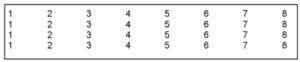
  • To help students understand the chant’s length and structure, point to each number while speaking the chant. 
  • Analyze the rhyme scheme of the chant, marking on the visual of the chant to          facilitate understanding. 
    • Teachers may want to use one color marker for “everyday” and “display” and a different color marker for “too” and “do.”
  • Divide students into small groups. Give each group a card with a plane figure on it. 
    • Have students create a chant about their plane figure (rectangle, triangle, square, trapezoid, quadrilateral, hexagon, etc.). 
      • Their chant should be the same length and use the same rhyme scheme as the A section (e.g., 4 phrases of 8 beats each; rhyming words at the end of phrases 1 and 2; different rhyming words at the end of phrases 3 and 4).
      • Have ample space in the room so student groups can move far enough apart during the creating process to enable careful listening and minimize distraction from other groups. 
      • Have students write their chants (text only) on large paper. Writing their composition in 4 lines may facilitate understanding of the 4 phrases. 
    • Combine compositions with the original chant to create a rondo form. The original chant is the A section while the student creations become the alternating sections.


Closing Reflection

  • Have students find a “rondo” pattern in the classroom (e.g., poster - wall - poster - window - poster = A B A C A). 
  • Have students describe rondo form in their own words. 
  • Challenge students to find other examples of rondo form in music.


Assessments

Formative

Teachers will assess students’ learning by observing students’ engagement and participation while the class identifies the same and different sections of music, performs a body percussion ostinato to accompany speech, identifies the rhyme scheme of a chant, and creates sentences and say them over 8 beats.


Summative

CHECKLIST

  • Students can create and accurately perform an original speech composition about a plane figure using the prescribed form. 
  • Students can create and accurately perform a body percussion ostinato to accompany the speech composition.


Differentiation

Acceleration: 

  • Have students record their creations. 
  • Have students create additional sections about different plane figures.
  • Challenge students to create and notate simple melodies for their text. 
  • Have students listen to music in rondo form to discern the different sections. 
  • Have students transfer their spoken text to body percussion (e.g., clap the rhythm of the words rather than speaking the words).
  • Experiment with and discuss various textures in music. For example, have half the students maintain the ostinato while the other group performs their chant on body percussion; then have only the chant performed on body percussion. Discuss what happens to the texture as other parts are added or deleted.
  • To connect to dance, have students create movement compositions to share while they say their chant.

Remediation: 

    • Rather than creating a rondo, have students work together to create one section about a plane figure. The form then becomes A B A (with the A section being the chant initially presented and the B section being the newly created chant).
    • If writing a 32-beat chant is too challenging, use the first half of the chant as the A section, thereby making the chant 16 beats long. Alternating sections then will be 16 beats long (rather than 32 beats).  
    • If keeping the body percussion ostinato on two levels (pat-clap) is challenging, have students keep the beat on one level (e.g., pat legs).

ADDITIONAL RESOURCES

  • Websites such as rhymezone.com may be helpful in finding rhyming words.
  • Short pieces in rondo form include “Fossils” by Camille Saint-Saens (ABACA), “La Raspa” (ABACADA), “Für Elise” by Ludwig van Beethoven (ABACA), “Rondo alla Turca” by Wolfgang Amadeus Mozart, and “The Entertainer” by Scott Joplin (Introduction ABACA).
  • YouTube includes recordings of music that also show the rondo form.
  • Rondo Form video 


*This integrated lesson provides differentiated ideas and activities for educators that are aligned to a sampling of standards. Standards referenced at the time of publishing may differ based on each state’s adoption of new standards.

Ideas contributed by and updated by: Maribeth Yoder-White 

Revised and copyright:  June 2024 @ ArtsNOW

Fun with Fractions 2-3

FUN WITH FRACTIONS

FUN WITH FRACTIONS

Learning Description

In this lesson, students will use fractions to describe the sounds that they hear in music. Students will then use fractions to create their own music.


Learning Targets

GRADE BAND: 2-3
CONTENT FOCUS: MUSIC & MATH
LESSON DOWNLOADS:

Download PDF of this Lesson

"I Can" Statements

“I Can…”

  • I can create music to represent fractions.
  • I can identify and write fractions based on musical examples.

Essential Questions

  • How can musical composition help us understand fractions?


Georgia Standards

Curriculum Standards

Grade 3: 

3.NR.4: Represent fractions with denominators of 2, 3, 4, 6 and 8 in multiple ways within a framework using visual models.

Arts Standards

Grade 3: 

ESGM3.CR.2 Compose and arrange music within specified guidelines.


ESGM3.PR.2a. Perform steady beat and simple rhythmic patterns using body percussion and a variety of instruments with appropriate technique.


ESGM3.RE.1b. Describe music using appropriate vocabulary (e.g. upward/downward, forte/piano, presto/largo, long/short), appropriate mood (e.g. happy/sad), and timbre adjectives (e.g. dark/bright, heavy/light).


South Carolina Standards

Curriculum Standards

Grade 3:

3.NSF.1 Develop an understanding of fractions (i.e., denominators 2, 3, 4, 6, 8, 10) as numbers. 

  1. A fraction (called a unit fraction) is the quantity formed by one part when a whole is partitioned into equal parts; 
  2. A fraction is the quantity formed by parts of size

Arts Standards

Anchor Standard 1: I can arrange and compose music.

Anchor Standard 4: I can play instruments alone and with others.

Anchor Standard 6: I can analyze music.


Key Vocabulary

Content Vocabulary

  • Numerator -  The top number of a fraction
  • Denominator - The bottom number of a fraction

Arts Vocabulary

  • Found sound - Sounds created from unexpected sources; for example, using classroom objects (rulers, pencils, chairs, etc.) as musical instruments
  • Timbre - The quality of sound; the component of a tone that causes different instruments to sound different from each other, even when playing the same note; for example, instrumental timbre and vocal timbre
  • Body percussion - Sounds produced using the body (e.g., claps, snaps, pats, stamps)
  • Unpitched Instruments - Instruments that are tuned to specific pitches (e.g., drum, maracas, rhythm sticks, triangle, etc.)


Materials

  • Assortment of unpitched instruments (or found sound objects like an empty can or tapping two pencils together)  
  • Writing utensils  
  • Paper (or individual white boards) for students
  • Fraction cards


Instructional Design

Opening/Activating Strategy

  • Have students listen to various classroom instruments, body percussion, and/or found sounds and label them as same and different. 
    • For example, perform two claps and have students identify these as “same.” Tap a chair once and a water bottle once and have students identify as “different.”
  • Explain to students that timbre is the component of a tone that causes different instruments to sound different from each other, even when playing the same note; for example, instrumental timbre and vocal timbre.
    • Extend the opening to have students listen to various sounds performed on classroom instruments, body percussion, and/or found sound and describe the timbres, grouping instruments into families. 
    • Families could be woods, metals, and drums (or other “families,” such as if sounds were produced by tapping, scraping, or shaking as appropriate).


Work Session

  • Model the “sound detective” game. 
    • Have students draw a short horizontal line on their whiteboard or blank paper. 
    • Using a steady beat, play four of the same sounds on the same instrument. 
      • Have students write the number “4” on their whiteboard under the line. 
        • Identify this as the denominator indicating that there were four total sounds. 
      • Lead students to understanding that 4 identical sounds were heard; thus, to represent the sound fractionally, they would write a 4 on top of the line as well (that is, 4 of the 4 sounds were the same). 
        • Identify top number as numerator.
  • Follow this same process for additional 4-beat patterns, changing the number of “different” sounds and challenging students to represent these sounds fractionally. 
    • For example, if 3 of the 4 beats were played on a metal instrument, the sound could be represented as 3/4. 
  • Explore other ways of making sounds different from each other (e.g., loud and soft sounds—dynamics). 
  • Divide students into small groups. Distribute fraction cards to groups. 
    • Have students create a rhythm representing the fraction on their card and perform for peers. 
    • Have classmates identify what is heard. The denominator will need to be identified beforehand.


ELA Extension:

  • Use children’s poems to further explore fractions. 
    • Examples: 
      • “Mary Had a Little Lamb” has two lines that include rhyming words, so 2/4 lines (or 1/2) of the poem uses rhyming words. 
      • “Rain, Rain, Go Away” has four lines that use rhyming words, so 4/4 of the lines of the poem use rhyming words. 
    • To aid musical skill development, have students play the rhythm of the poem on their instruments.
    • Assign rhyming words to the same instrument so students make the connection between the sounds in the words and the sounds the instrument makes.
    • Suggested poems include:


Rain, Rain go away.                            Mary had a little lamb.

Come again another day.                     Its fleece was white as snow.

All the children want to play.             And everywhere that Mary went,

Rain, rain, go away.                           The lamb was sure to go.


Cock-a-doodle-doo,                           A wise old owl lived in the oak;

My dame has lost her shoe,               The more he saw the less he spoke.

My master’s lost his fiddling stick,   The less he spoke the more he heard.

        Sing cock-a-doodle-doo.           Why aren’t we all like that wise old bird?


Closing Reflection

  • Facilitate a class discussion reflecting on the process. 
  • Ask students how music helped them understand fractions.
  • Ask students if they can think of other things from the lesson that they could represent in terms of fractions. 
    • Examples could include three out of four students liked the sound of tapping on a can better than tapping two pencils together.


Assessments

Formative

Teachers will assess students’ learning by observing whether students can identify body percussion, found sound, and/or unpitched percussion instrument sounds as the same and different and whether students can count sounds and represent them with numbers.


Summative

CHECKLIST

  • Students can create music to accurately represent fractions.
  • Students can identify and write fractions based on musical examples.


Differentiation

Acceleration: 

  • Challenge students to use higher denominators (beats in the musical composition) and more than two types of instruments.
  • Students can create their own compositions and then represent them by writing the equation showing the addition of all fractions in their composition.
  • Have students write poetry using rhyme schemes illustrating fractions. 
  • Divide students into pairs. Have them create rhythms representing the two fractions they are holding. Have classmates identify the two fractions heard. 


Remediation:

  • Have students work with a partner to write numbers describing the sounds heard. 
  • Have students work with a partner to identify rhyming words.
  • Perform body percussion and other sounds in front of students so they can see and hear the same and different sounds and sound sources.

*This integrated lesson provides differentiated ideas and activities for educators that are aligned to a sampling of standards. Standards referenced at the time of publishing may differ based on each state’s adoption of new standards.

 Ideas contributed and updated by:  Maribeth Yoder-White

 Revised and copyright:  June 2024 @ ArtsNOW

Jazz It Up 4-5

JAZZ IT UP

JAZZ IT UP

Learning Description

In this lesson, students will delve into the world of jazz music to gain insights into the Harlem Renaissance. They will analyze and create improvisational pieces, incorporating key elements of jazz.


Learning Targets

GRADE BAND: 4-5
CONTENT FOCUS: MUSIC & SOCIAL STUDIES
LESSON DOWNLOADS:

Download PDF of this Lesson

"I Can" Statements

“I Can…”

  • I can maintain body percussion ostinato.
  • I can improvise using body percussion, scat syllables, and/or found sound.
  • I can create an 8-beat verbal phrase reiterating what I learned in the lesson.

Essential Questions

  • How can learning about a genre of music teach us about the historical context in which it was created?


Georgia Standards

Curriculum Standards

Grade 5: 

SS5H2 Describe U.S. involvement in World War I and post-World War I America.
Describe the cultural developments and individual contributions in the 1920s of the Jazz Age (Louis Armstrong), the Harlem Renaissance (Langston Hughes), baseball (Babe Ruth), the automobile (Henry Ford), and transatlantic flight (Charles Lindbergh).

Arts Standards

Grade 5:

ESGM5.CR.1 Improvise melodies, variations, and accompaniments.
ESGM5.PR.2 Perform a varied repertoire of music on instruments, alone and with others.
ESGM5.RE.1 Listen to, analyze, and describe music.
ESGM5.RE.2 Evaluate music and music performances.
ESGM5.CN.1 Connect music to the other fine arts and disciplines outside the arts.


South Carolina Standards

Curriculum Standards

Grade 5: 

5.2.CX Contextualize the post-war economic climate on the cultural landscape throughout the United States and South Carolina.

Arts Standards

Anchor Standard 2: I can improvise music.
Anchor Standard 4: I can play instruments alone and with others.
Anchor Standard 6: I can analyze music.
Anchor Standard 7: I can evaluate music.
Anchor Standard 9: I can relate music to other arts disciplines, other subjects, and career paths.


Key Vocabulary

Content Vocabulary

  • Harlem Renaissance - an intellectual, cultural, and artistic movement that emerged in the 1920s and 1930s, primarily centered in the Harlem neighborhood of New York City
  • Jazz - A genre of music that originated in the early 20th century, primarily within African American communities in New Orleans

Arts Vocabulary

  • Found sound - Using everyday objects in the environment to create sound
  • Ostinato - Repeated pattern
  • Patsching - A body percussion technique that involves rhythmically striking the thigh with the palm of the hand, usually near the knee
  • Syncopation - Shifting of the accent to a weak beat or an off beat
  • Scat singing - A vocal jazz style using improvised nonsense syllables performed with an improvised melody, usually over instrumental accompaniment


Materials

  • Found sound possibilities (pencils to tap on desk, etc.)
  • Jazz recordings (“Black and Tan Fantasy,” Duke Ellington; “When the Saints go Marching in,” Louis Armstrong; “Minnie the Moocher,” Cab Calloway)
  • Sound source (computer and speakers)


Instructional Design

Opening/Activating Strategy

  • Listen to an example of a jazz piece, such as “Black and Tan Fantasy” by Duke Ellington.
  • Have students describe what they heard.
  • Lead students to noticing the following elements:
    • Syncopation (use visual and/or patsching on beats and clapping on off-beats to aid understanding)
    • Highly rhythmic
    • Varied instruments (trumpet, saxophone, piano, drums)
    • Improvisation


Work Session

  • Arrange students in a circle. Facilitate a call and echo response using body percussion, found sound, movement and/or scat syllables, having students lead if they are comfortable.
  • Explain that this type of sound is known as "call and response", a musical technique in which one instrument, voice, or part of a band answers another by repeating the sound.
  • The alternation between leader and chorus is a defining characteristic of African music, present in music intended for work, play, mourning, etc., and is a common element in jazz.
  • Demonstrate by singing “Over my Head” or listen to an example of call and response, such as Cab Calloway's "Minnie the Moocher".
  • Expand echoing/call and response to an improvisation “jam session”.
    • First, challenge students to create 8-beat body percussion (or found sound) ostinato to repeat under improvisations.
      • Use an 8-beat visual (1 2 3 4 5 6 7 8) to help students understand phrase length.
    • While students maintain ostinato, improvise using body percussion, found sound, and/or scat (nonsense) syllables.
    • Lead students to understanding of similarities and differences between renditions, helping them understand that improvisations feed off of and into other improvisations.
    • Invite students to improvise, using the 8-beat visual to help students understand phrase length.
    • Begin by improvising a phrase and having students improvise response.
    • Challenge students to end their improvisations on beat seven to allow the next person time to think and to provide a final point for their improvisation (1 2 3 4 5 6 7 -).
    • Challenge students to relate their improvisation to what you are doing (perhaps by taking part of your pattern and using it in their pattern) so that their pattern compliments (sounds good with) the improvisation they just heard.
    • Discuss how the improvisations were similar yet different.
    • Discuss how such improvisation is a kind of "riffing". In jazz, musicians may riff off of each other's melody when improvising solos.
  • Listen to Louis Armstrong’s “When the Saints Go Marching In”, helping students notice how the musicians are able to expand and complicate a melody or theme by listening to another member of a group play a solo and responding to them through their own solo.
    • Often the main melody in jazz acts as a recurring theme in a piece of music, and the other sections of a piece work to "riff" off of, expand on, or veer away from the main melody, but the main melody is audible and/or usually comes back.
  • Briefly describe the evolution of jazz as an original American music that largely originated with African Americans. The need for self-expression stemmed from the African musical heritage where music was (and is) very important in maintaining and continuing the culture.
    • When Africans were brought to America, they brought along the tradition of using music to accompany and define their lives.
    • Jazz originated in New Orleans, a town with a tradition of celebration. All kinds of music existed there—blues, church music, folk music, ragtime, military marching bands, African drumming, and many dance styles. When these musics blended into one, jazz was born.
    • In the early 1920s, many African American artists, writers, musicians, and performers lived in a New York City neighborhood called Harlem and were part of a cultural movement known as the Harlem Renaissance. A large migration from the South to the North after World War I brought many African Americans to Harlem.
    • Jazz was a relatively new type of music in the 1920’s and 1930’s but was becoming very popular in Harlem, which was home to many musicians. Several other American cities (New Orleans, Chicago) also had rich jazz scenes where people could go to jazz clubs, music clubs, dance halls, and concert halls to hear jazz. Some of the most famous venues include the Apollo Theater, The Cotton Club, Lennox Lounge and the Savoy Ballroom.


Closing Reflection

  • As a closing assessment activity, have students work individually or in small groups to create 8-beat speeches reiterating something from the lesson content (e.g., “jazz…an American creation”).
  • Use the same format as before, sitting or standing in circle and maintaining body percussion ostinato while students speak their creations.


Assessments

Formative

Teachers will assess students’ understanding of the content throughout the lesson by observing students’ participation in the activator, participation in “call and response” riffing and “jam sessions”, and analysis of music.


Summative

CHECKLIST

  • Students can maintain body percussion ostinato.
  • Students can improvise using body percussion, scat syllables, and/or found sound.
  • Students can create 8-beat verbal phrase reiterating lesson content.


DIFFERENTIATION 

Acceleration: 

  • Have students explore scat singing using Frank Holder’s “Scat Singing” (available on iTunes).  Listen to recordings of contemporary jazz artists (e.g., Wynton Marsalis).
  • Compare and contrast their jazz styles to the jazz “pioneers.”
  • Use a Venn diagram to compare/contrast various renditions of the same jazz piece.
  • Have students research various jazz pioneers (Louis Armstrong, Dizzy Gillespie, Duke Ellington, etc.), focusing on the social and cultural entities impacting their lives and music.
  • Divide students into small groups. Have each person write a short paragraph (3-4 sentences) about a given topic. Exchange papers with other people in the group; after reading each paper, have each student use the basic content of their peer’s writing but modify it somewhat. Compare and contrast with original writing, using as an example of “riffing.”

Remediation: 

  • Limit the focus of the characteristics of jazz to one or two that the students will explore, such as “call and response” and improvisation, rather than focusing on multiple elements of jazz.
  • Provide visuals to help aid in comprehension.

*This integrated lesson provides differentiated ideas and activities for educators that are aligned to a sampling of standards. Standards referenced at the time of publishing may differ based on each state’s adoption of new standards.

Ideas contributed by: Maribeth Yoder-White.

Revised and copyright: September 2024 @ ArtsNOW