Carnival of the Animals K-1

CARNIVAL OF THE ANIMALS

CARNIVAL OF THE ANIMALS

Learning Description

Students will expand knowledge about music vocabulary through exploration of The Carnival of the Animals, composed by Camille Saint-Saëns. Students will be able to use key music terms in discussions with their peers and in persuasive writing.


Learning Targets

GRADE BAND: K-1
CONTENT FOCUS: MUSIC & ELA
LESSON DOWNLOADS:

Download PDF of this Lesson

"I Can" Statements

“I Can…”

  • I can use musical vocabulary to describe music I hear.
  • I can use musical vocabulary to share my opinion about music.

Essential Questions

  • How can you write to describe and share your opinion about music you hear?


Georgia Standards

Curriculum Standards

Kindergarten:

ELAGSEKW1 Use a combination of drawing, dictating, and writing to compose opinion pieces in which they tell a reader the topic or the name of the book they are “writing” about and state an opinion or preference about the topic or book (e.g., My favorite book is…).


Grade 1: 

ELAGSE1W1 Write opinion pieces in which they introduce the topic or the name of the book they are writing about, state an opinion, supply a reason for the opinion, and provide some sense of closure.


WIDA English Language Proficiency Standards:

Standard 1: English language learners communicate for Social and Instructional purposes within the school setting. 

Standard 2: English language learners communicate information, ideas, and concepts necessary for academic success in the content area of Language Arts.


Arts Standards

Kindergarten:

MKGM.6: Listening to, analyzing, and describing music.

MKGM.10: Moving, alone and with others, to a varied repertoire of music.


Grade 1:

M1GM.6: Listening to, analyzing, and describing music.

M1GM.10: Moving, alone and with others, to a varied repertoire of music.


South Carolina Standards

Curriculum Standards

Kindergarten:

Standard 1: Write arguments to support claims with clear reasons and relevant evidence. 

1.1 Use a combination of drawing, dictating, and writing to state the topic and communicate an opinion about it.


Grade 1:

Standard 1: Write arguments to support claims with clear reasons and relevant evidence. 

1.1 Explore print and multimedia sources to write opinion pieces that introduce the topic, state an opinion, give a reason for the opinion, and provide a sense of closure.


Arts Standards

Anchor Standard 6: I can analyze music.

Benchmark GM.R NL.6 I can identify contrasts in music.

Benchmark GM.R NM.6 I can identify the elements of music. 

Anchor Standard 7: I can evaluate music.

GM.R NL.7.1 I can listen and respond to music.


Key Vocabulary

Content Vocabulary

  • Opinion writing - A form of writing in which the author expresses their personal views or opinions on a particular topic or issue; it is characterized by the use of persuasive language and supporting arguments to convey the author's stance

Arts Vocabulary

  • Tone color (Timbre) - The quality of sound; component of a sound that causes different instruments to sound different from each other
  • Pitch - Relative highness or lowness of a tone in relation to other tones
  • Tempo - The speed at which a music piece is performed
  • Dynamics - Volume of sound (loudness, quietness
  • Movement - A self-contained part of a musical composition or musical form


Materials

    • Recording of The Carnival of the Animals composed by Camille Saint-Saëns
    • Book illustrating The Carnival of the Animals
    • Writing paper
    • Chart paper
    • Marker
    • Large pictures of each animal
    • Pencils
    • Pitched percussion instruments (xylophone, tone bars, etc)


    Instructional Design

    Opening/Activating Strategy

    • As a group, have students brainstorm animals they might find at a carnival. If needed, project an image of a carnival for students.
    • Discuss what a carnival is and what animals you might see there. 
    • Have students turn and talk to their neighbor to discuss their favorite animal.


    Work Session

      • Have a recording preset to use the selections of The Carnival of the Animals you want students to hear. Place the large pictures of the animals on chart paper and hang up for students to see.
      • Have students sit in a circle on the floor.
      • Discuss that music has different qualities, including timbre, pitch, tempo, and dynamics. 
        • For example, small animals such as a bird or frog may make soft, high-pitched, thin or shrill sounds, while larger animals like an alligator may make loud, low-pitched, thick or rumbling sounds.
        • Play two different sounds that demonstrate the difference in high and low pitch (use pitched percussion instruments or recordings of pitched percussion instruments if possible).
        • Discuss the sounds that animals make using these musical terms. Playing audio clips may be helpful. 
      • After the students understand the different types of sound, play the first selection from The Carnival of the Animals.
      • Have students stand under the picture of the animal that they think matches the sounds. 
        • Have students move like the animal would move. 
        • Ask students to explain why they chose the animal that they did.
        • Ask students to describe the music using the terms timbre, pitch, tempo, and dynamics; write the words students say on chart paper.
      • After the animal has been identified, read the passage of the book that matches the animal and discuss qualities of the animal that are illustrated by the music.
      • Repeat this process for the other animals.
      • When all the music has been played, tell students to select their favorite animal from the music and book, The Carnival of the Animals
        • Kindergarten will use a combination of drawing, dictating and writing to convey their opinions. Encourage students to support their opinion with one to two reasons why they chose that animal.
        • First grade will convey their opinions through writing. Students should be sure to provide closure to their writing after they have stated their opinions and at least one reason for their opinions.
        • Students should use at least one musical term (timbre, pitch, tempo, and/or dynamics) in their opinion writing.


      Closing Reflection

      Allow students to share their opinions with the class. Establish agreed-upon guidelines for sharing and listening.

      Assessments

      Formative

      Teachers will assess students’ understanding by observing students’ responses during class discussion, students’ identification of the animals in The Carnival of the Animals using musical vocabulary, and students’ discussion of their favorite animals and reasons for their opinions.


      Summative

      CHECKLIST

      • Students can use musical vocabulary to describe music they hear.
      • Students can use musical vocabulary to share their opinions about music through drawing, dictating, and writing.
       

      Differentiation

      Acceleration: 

      • Students can choose a new animal and create a musical composition to represent its characteristics using musical vocabulary.
      • Once students have picked their favorite animal from The Carnival of Animals, they will conduct research (through internet or book resources) to gather factual information about their animal to include in their opinion writing. Gifted Assessments Students will use mechanics to develop persuasive writing that includes facts and opinions.


      Remediation:

      • ESOL Modifications and Adaptations: ESOL teachers will conduct a mini lesson on opinions and persuasion, allowing students to role play (ex: persuading their parents for an extra cookie or staying up later on a school night).
      • Special Education Modifications and Adaptations: Ask each student to name their favorite animal from the story. Record responses using a tally chart and ask students to identify the animal with the greatest number of votes. Work in small groups or as a whole to list attributes of the animal with the greatest amount of votes. Correlate the attributes to the musical vocabulary and then use the attributes to write or dictate two to three sentences about the animal.


      ADDITIONAL RESOURCES

      • Recordings and illustrated books of The Carnival of the Animals are commercially available. One example is Saint-Saens, C. & Turner, B. C. (1998). Carnival of the animals. New York, NY: Henry Holt and Co. 
      • Audio recordings of the various movements are available through streaming online music sites like http:// www.grooveshark.com (search: Carnival of the Animals).
      • Full recording and descriptions of each of the 14 movements: http:// en.wikipedia.org/wiki/
      • The Carnival of the Animals Animal Sound Clips from the U.S. Fish and Wildlife Service: http://www.fws.gov/video/sound.html
      • Ballet company performances of The Carnival of the Animals: http://YouTube.com.

      *This integrated lesson provides differentiated ideas and activities for educators that are aligned to a sampling of standards. Standards referenced at the time of publishing may differ based on each state’s adoption of new standards.

      Ideas contributed by: Sandi Evans. Modifications, Extensions, and Adaptations Contributed by: Peggy Barnes, Candy Bennett, Lindsey Elrod, Jennifer Plummer, and Vilma Thomas. Reviewed by Emily Threlkeld. Updated by Maribeth Yoder-White.

      Revised and copyright:  June 2024 @ ArtsNOW


      Counting with Cups K-1

      COUNTING WITH CUPS

      COUNTING WITH CUPS

      Learning Description

      Help students recognize and cultivate creative and critical thinking using various activities that connect math and music! Consider valuable curriculum connections that assist in the development of problem solving skills through fun and engaging learning experiences.


      Learning Targets

      GRADE BAND: K-1
      CONTENT FOCUS: MUSIC & MATH
      LESSON DOWNLOADS:

      Download PDF of this Lesson

      "I Can" Statements

      “I Can…”

      • I can identify, speak, and move to a steady beat.
      • I can demonstrate my understanding of counting, patterns, and addition through music.
      • I can compose music.
      • I can explain how I used math to create my musical composition.

      Essential Questions

      • How can connecting math and music aid students in their problem solving abilities and cultivate creative and critical thinking?


      Georgia Standards

      Curriculum Standards

      Kindergarten:

      K.NR.5.1 Compose (put together) and decompose (break apart) numbers up to 10 using objects and drawings.

      K.NR.5.2 Represent addition and subtraction within 10 from a given authentic situation using a variety of representations and strategies.

      K.NR.5.3 Use a variety of strategies to solve addition and subtraction problems within 10.

      K.PAR.6.1 Create, extend, and describe repeating patterns with numbers and shapes, and explain the rationale for the pattern.


      Grade 1: 

      1.NR.2.1 Use a variety of strategies to solve addition and subtraction problems within 20.

      1.PAR.3.1 Investigate, create, and make predictions about repeating patterns with a core of up to 3 elements resulting from repeating an operation, as a series of shapes, or a number string.

      Arts Standards

      Kindergarten:

      ESGMK.CR.1 Improvise melodies, variations, and accompaniments.

      ESGMK.CR.2 Compose and arrange music within specified guidelines.

      ESGMK.PR.2 Perform a varied repertoire of music on instruments, alone and with others.

      ESGMK.RE.1 Listen to, analyze, and describe music.

      ESGMK.RE.2 Evaluate music and music performances.

      ESGMK.CN.1 Connect music to the other fine arts and disciplines outside the arts.


      Grade 1:

      ESGM1.CR.1 Improvise melodies, variations, and accompaniments.

      ESGM1.CR.2 Compose and arrange music within specified guidelines.

      ESGM1.PR.2 Perform a varied repertoire of music on instruments, alone and with others.

      ESGM1.RE.1 Listen to, analyze, and describe music.

      ESGM1.RE.2 Evaluate music and music performances.

      ESGM1.CN.1 Connect music to the other fine arts and disciplines outside the arts.


      South Carolina Standards

      Curriculum Standards

      Kindergarten:

      K.NS.1 Count forward by ones and tens to 100.

      K.ATO.3 Compose and decompose numbers up to 10 using objects, drawings, and equations.

      K.ATO.6 Describe simple repeating patterns using AB, AAB, ABB, and ABC type patterns.


      Grade 1: 

      1.ATO.2 Solve real-world/story problems that include three whole number addends whose sum is less than or equal to 20.

      1.ATO.5 Recognize how counting relates to addition and subtraction.

      1.ATO.9 Create, extend and explain using pictures and words for: a. repeating patterns (e.g., AB, AAB, ABB, and ABC type patterns); b. growing patterns (between 2 and 4 terms/figures).

      Arts Standards

      Anchor Standard 1: I can arrange and compose music.

      Anchor Standard 2: I can improvise music.

      Anchor Standard 4: I can play instruments alone and with others.

      Anchor Standard 6: I can analyze music.

      Anchor Standard 7: I can evaluate music.

      Anchor Standard 9: I can relate music to other arts disciplines, other subjects, and career paths.


      Key Vocabulary

      Content Vocabulary

      • Pattern - A repeated sequence that can be found in various contexts, such as art, mathematics, nature, etc; it involves a sequence of elements (like shapes, colors, numbers, or sounds) that follow a particular order or rule
      • Addition - A basic mathematical operation that involves combining two or more numbers to get a total or sum

      Arts Vocabulary

      • Body percussion - Sounds produced by striking or scraping parts of the body; typically includes snapping, clapping, patting, and stamping
      • Steady beat - An unchanging continuous pulse
      • Timbre - The unique quality of a sound; also known as tone color or tone quality
      • Dynamics - Volume of sound (loudness, quietness)
      • Found sound - Sounds produced by non-traditional sound sources in the environment (e.g., scraping a ruler along a binder spine, tapping a pencil on a desk)
      • Phrase - A musical sentence
      • Retrograde - A musical line which is the reverse of a previously or simultaneously stated line
      • Rondo - A form of composition in which the first section recurs throughout the piece, alternating with different sections (e.g., A-B-A-B-A or A-B-A-C-A, etc.). This form is found especially in compositions of the Baroque and Classical eras.
      • Tempo - The speed of the beat


      Materials

      • Variety of unpitched percussion instruments (can be “found sound”, such as, scraping a ruler along a binder spine, tapping a pencil on a desk)
      • Plastic cups in various colors and sizes
      • Rhythm sticks or dowel rods
      • Sound source (e.g., computer and speaker)
      • Musical recordings
      • Large pads and markers
      • Paper and writing utensils (pencils, markers, crayons, etc.)
      • Note cards with mathematical equations


      Instructional Design

      Opening/Activating Strategy

      Classroom Tips - You may find it helpful to discuss proper use of, and care for, instruments prior to use. Discuss “resting” position, meaning no sound at all from instruments. Also discuss moving through “space” without touching anything else around. Pretend you are in a bubble and cannot touch anything or anyone in your surroundings.


      • Turn on music with a steady beat that is easy for students to follow (or, simply play a steady beat without accompanying music).
      • Students stand in the space (no formation).
      • Leader claps (or plays) the beat while students walk to the pulse.
      • Leader plays four beats (while students move); then students stop and clap four beats (same tempo as leader).
      • Continue the game, moving around the room freely.
      • Have students stop in front of someone and clap their partner’s hands for the second set of four claps.
      • Thus, the sequence becomes:
        • Move to leader’s beat (set 1 = 4 beats)
        • Stop and clap beat alone (set 2 = 4 beats)
        • Move to the leader's beat (set 3 = 4 beats)
          • Stop and clap your partner's hands (set 4 = 4 beats).
      • Have students move to a new partner each time.
      • Extend the sequence by adding additional movements and/or body percussion for subsequent sets of four beats (e.g., move to leader’s beat; clap beat alone; move to leader’s beat; clap partner’s hands; move to leader’s beat; pat beat; etc.).


      Work Session

      Wake-up and Warm-up  

      • Tell students that they will continue the activator, but now, they will turn it into a mathematical equation!
        • Example: 4+4=8
      • Experiment with different tempos and different numbers of beats (i.e., slower tempo, use body percussion or instruments to show 3+3=6).
      • Introduce a variety of rhythm instruments if available (rhythm sticks, drum, wood block, triangle, tambourine). Otherwise, use objects around the classroom, such as scraping a ruler along a binder spine, tapping a pencil on a desk.
      • Take time to discuss the various shapes of each instrument (compare and contrast both shapes and sounds—timbre).
      • Use students to demonstrate to group various equations that can be solved.
      • Teacher will have two students play 5+5=10.
      • Arrange students in pairs and pass out equations. Then have students “play” equations and have partners solve the equations.
        • For example if a notecard shows 4+4=8, one student would play 4 beats with one instrument or body percussion (such as clapping) and the other student would have to solve by saying “you demonstrated 4+4=8”.
        • Then switch roles.
        • Then challenge the students to just play the answer (for example, 8). The other student must find a way to “play” 8, such as 2+2+2+2.


      Question and Answer

      • The format of this strategy will have the question being asked on the first eight beats and the answer on the second eight beats); reverse. Display visuals of numbers.
        1 2 3 4 5 6 7 8
        1 2 3 4 5 6 7 -
        • Have students speak numbers in a given tempo.
        • Have students clap once on each number while speaking; repeat, eliminating speech.
      • Divide the class into two groups.
      • Have students clap twice on one number of their choice; extend to clapping twice on two numbers.
      • Now, incorporate questions and answers. Leader provides a question via clapping the first eight beats; students use part of the question in their answer in the second eight beats (e.g., “use the first part of my question as the first part of your answer”).
        • Extend to other body percussion, found sound, and/or unpitched percussion.
      • Try the strategy using pairs instead of two groups. Divide students into pairs, with one person providing the question and another, the answer; reverse.
      • Incorporate movement; add to a recording if desired (for example, “Hora Agadati” or “Jai Ho”).
        • Have students walk eight beats and then “answer” using body percussion for the next eight beats.
      • Tell students that a phrase in music is a musical sentence. Ask mathematical questions such as, if each phase is eight beats and we have two phases, how many total beats?
      • Extend to ask questions about the patterns.
        • If we walk the first phase, use body percussion the next phrase and then walk the next phrases, that could be called A B A pattern.
      • Have students work in pairs to create a “composition” using rhythm instruments that has four phrases (each phrase must have four beats).
      • Have them label the phrases with capital letters to show the pattern and then show equations for “how they play” each phrase (as demonstrated in the previous activity).


      Composing with Cups

      • Display different colored cups and have students reach consensus about desired sound for each (e.g., blue – quarter note, yellow – eighth notes, clear – quarter rest).
      • Introduce silently, having students use creative and critical thinking to figure out the values (number of sounds for each cup) independently first.
      • Teacher should lead this activity in silence, changing cups (number of sounds) and even length of phrase prior to any discussion.
      • Pause and discuss what students observed about the values of each cup.
      • Next, have individual students create rhythmic patterns for others to perform using the different colored cups.
      • Have students “conduct” their patterns by leading other students in performing them.
      • Variations:
        • Experiment with performing multiple patterns at the same time (having two groups perform simultaneously), reading in retrograde (reverse order), adding dynamics (loud/soft), etc.
        • Add to a recording as desired (such as Sousa’s “Stars and Stripes Together”).
        • Have one group stand behind another group. Have the group standing behind the other group perform a pattern. The group in front will try to recreate it. This can also be done with the two groups facing each other if needed.
      • Finally, have students work in small groups or with a partner to create their own composition with cups. Students should be able to explain mathematical concepts embedded in their composition, such as addition and patterns.


      Closing Reflection

      • Students will perform their compositions for the group. Discuss appropriate audience participation prior to performances.
      • Ask the audience to help identify mathematical connections.


      Assessments

      Formative

      Teachers will assess students’ understanding of the content throughout the lesson by observing students’ participation in the activator, ability to “play mathematical equations”, ability to move and speak to a steady beat, and collaboration with groups to compose a musical piece.


      Summative

      CHECKLIST

      • Students can identify, speak, and move to a steady beat.
      • Students can demonstrate understanding of mathematical concepts, such as patterns and addition, through music.
      • Students can compose music.
      • Students can explain how they used math to create their musical compositions.


      DIFFERENTIATION 

      Acceleration: 

      • Challenge students to add dynamics to and/or change the tempo of their performances and discuss how these changes alter the music.

      Remediation: 

      • Scaffold the lesson by composing together as a class and discussing how pattern and addition were used.
      • Reduce the length of the composition students create at the end of the lesson to one phrase of four beats.

      *This integrated lesson provides differentiated ideas and activities for educators that are aligned to a sampling of standards. Standards referenced at the time of publishing may differ based on each state’s adoption of new standards.

      Ideas contributed by: Pamela Walker and Maribeth Yoder-White.

      Revised and copyright: September 2024 @ ArtsNOW


      Dr. Seuss is on the Loose K-2

      Description

      The rhythmic and melodic elements of Theodor Geisel’s children’s literature provide many opportunities for knowledge of language, vocabulary acquisition and use, and creative expression and communication in music. The two books chosen in this lesson, Dr. Seuss’s ABC and P.D. Eastman’s Go, Dog. Go!, are two of many which can provide successful learning experiences. With this lesson, words are lifted off the page and into the children’s world of enduring understanding, giving them the tools needed for the most complex creativity.

      SHARE
      FACEBOOK

      Exploring Habitats Through Music Composition 2-3

      EXPLORING HABITATS THROUGH MUSIC COMPOSITION

      EXPLORING HABITATS THROUGH MUSIC COMPOSITION

      Learning Description

      Through composition of original speech pieces, students will develop skills and understandings in science, language arts, and music. Teamwork and creativity are necessary to create a chant that demonstrates understanding of plant and animal life in various habitats. Musical skills addressed in this lesson include improvising, composing, listening, speaking, and moving.


      Learning Targets

      GRADE BAND: 2-3
      CONTENT FOCUS: MUSIC & SCIENCE
      LESSON DOWNLOADS:

      Download PDF of this Lesson

      "I Can" Statements

      “I Can…”

      • I can create and accurately perform an original speech composition in rondo form about my assigned habitat.
      • I can create and accurately perform a body percussion ostinato to accompany my speech composition.
      • I can aurally and visually identify rondo form in musical compositions.

      Essential Questions

      • How can music composition help us understand and remember habitats?


      Georgia Standards

      Curriculum Standards

      Grade 3:

      S3L1. Obtain, evaluate, and communicate information about the similarities and differences between plants, animals, and habitats found within geographic regions (Blue Ridge Mountains, Piedmont, Coastal Plains, Valley and Ridge, and Appalachian Plateau) of Georgia.


      1. Construct an explanation of how external features and adaptations (camouflage, hibernation, migration, mimicry) of animals allow them to survive in their habitat.
      2. Use evidence to construct an explanation of why some organisms can thrive in one habitat and not in another.

      Arts Standards

      Grade 2:

      ESGM2.CR.1 Improvise melodies, variations, and accompaniments.

      ESGM2.CR.2 Compose and arrange music within specified guidelines.

      ESGM2.PR.2 Perform a varied repertoire of music on instruments, alone and with others.

      ESGM2.RE.1 Listen to, analyze, and describe music.

      ESGM2.RE.2 Evaluate music and music performances.

      ESGM2.CN.1 Connect music to the other fine arts and disciplines outside the arts.


      Grade 3:

      ESGM3.CR.1 Improvise melodies, variations, and accompaniments.

      ESGM3.CR.2 Compose and arrange music within specified guidelines.

      ESGM3.PR.2 Perform a varied repertoire of music on instruments, alone and with others.

      ESGM3.RE.1 Listen to, analyze, and describe music.

      ESGM3.RE.2 Evaluate music and music performances.

      ESGM3.CN.1 Connect music to the other fine arts and disciplines outside the arts.


      South Carolina Standards

      Curriculum Standards

      Grade 3:

      3-LS3-1. Analyze and interpret data to provide evidence that plants and animals have inherited traits that vary within a group of similar organisms.

      3-LS4-3. Construct an argument with evidence that in a particular habitat some organisms can thrive, struggle to survive, or fail to survive.

      Arts Standards

      Anchor Standard 1: I can arrange and compose music.

      Anchor Standard 2: I can improvise music.

      Anchor Standard 4: I can play instruments alone and with others.

      Anchor Standard 6: I can analyze music.

      Anchor Standard 7: I can evaluate music.

      Anchor Standard 9: I can relate music to other arts disciplines, other subjects, and career paths.


      Key Vocabulary

      Content Vocabulary

      • Habitat - The natural environment of an organism; place that is natural for the life and growth of an organism
      • Organism - A living thing, like an animal, plant, fungus, bacterium, or protist
      • Adaptation - How organisms change or adjust to new conditions
      • Environment - All external conditions, influences, and factors that affect and interact with living organisms

      Arts Vocabulary

      • Rondo - A form of composition in which the first section recurs throughout the piece, alternating with different sections (e.g., A-B-A-B-A or A-B-A-C-A, etc.); this form is found especially in compositions of the Baroque and Classical eras
      • Ostinato - A repeated pattern (plural: ostinati)
      • Body percussion - Sounds produced by striking or scraping parts of the body; typically includes snapping, clapping, patting, and stomping
      • Phrase - Musical sentence or unit, commonly a passage of four or eight measures; a dependent division of music, much like a single line of poetry in that it does not have a sense of completion in itself; usually two or more phrases balance each other
      • Texture - The thickness or thinness of sound


      Materials

      • Habitat cards (individual cards with one habitat on each)
      • Cutouts of shapes (or shapes can be written on the board)
      • Visual of A section text (to be displayed after chant is learned)
      • Sound source (computer and speakers)
      • Recording of musical composition in rondo form (this could be a song that is structured verse-chorus-verse-chorus)
      • Large paper and markers


      Instructional Design

      Opening/Activating Strategy

      Classroom Tips: Arrange groups so that students can move away from each other during the creating process to enable careful listening and minimize distraction from other groups.


      • Play a musical composition in rondo form, challenging students to listen for repeated sections. (NOTE: Music with text may facilitate students’ discernment of repetition and contrast.)
      • Identify form heard in composition as rondo form.
      • Demonstrate different body percussion techniques, such as snapping, clapping, patting, and stomping. Have students follow your movements.
      • Challenge students to establish a simple two, four, or eight beat body percussion ostinato.


      Work Session

      • Explain that students will now become composers of their own speech piece to illustrate rondo form.
      • While students perform the body percussion ostinato that they created, teach the following chant by rote (teacher speaks, students echo).


      Habitats define life and growth within a place
      Where animals and plants naturally live in their space.
      Each is connected by the environment in which they live; 
      Contributing uniquely, they all have something to give.

      • To facilitate student success in learning the chant aurally, begin by speaking the entire chant, then speak the first phrase (first eight beats) and have students echo.
      • Continue speaking each phrase and having students echo. Then combine two phrases (16 beats) and have students echo.
      • Once students are comfortable with 8- and 16-beat phrases, speak the entire chant.
      • This becomes the A section of the class composition.
      • Analyze the structure of the chant (32 beats long with the last word on beat 31).
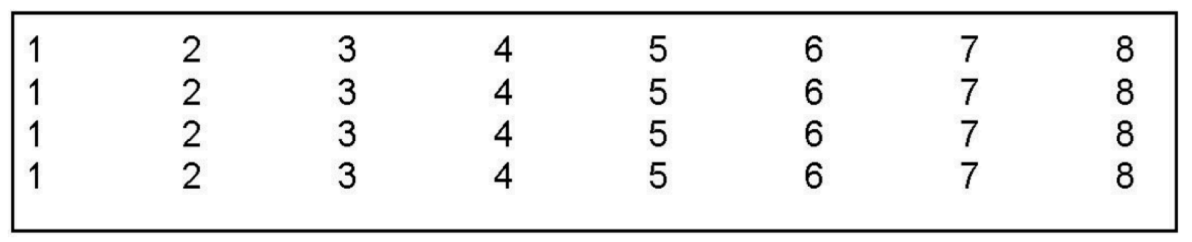
      • A visual such as follows may be helpful in guiding students’ analysis.
      A rectangular grid with four identical rows, each containing the numbers 1 through 8 in order, separated by spaces. Reminiscent of music composition, the grid is outlined with a black border.


      • To help students understand the chant’s length and structure, point to each number while speaking the chant.
      • Analyze the rhyme scheme of the chant, marking on the visual of the chant to facilitate understanding.
      • Divide students into small groups and give each group a habitat card (such as mountains, marsh/swamp, coast, etc.).
      • Working in small groups, have students create a chant about their habitat.
      • Their chant must be the same length and use the same rhyme scheme as the A section.
      • Once students are satisfied with their composition, have them write it down (text only) on large paper.
      • Encourage students to write their composition in four lines to facilitate understanding of the four phrases.


      Closing Reflection

      • Combine group compositions with the original chant to create a rondo form.
      • The original chant is the A section while student creations become the alternating sections.
      • Use shapes drawn on board or cut from construction paper (or cogni-tiles) and letters to illustrate each section in rondo form.
      • Allow time for students to comment on the compositional efforts of others, perhaps noticing distinctive rhythms and/or word choice.
      • Discuss the characteristics of each of the habitats performed.


      Assessments

      Formative

      Teachers will assess students’ understanding of the content throughout the lesson by observing students’ participation in the activator, ability to repeat and learn the A section of the habitat chant, analysis of rhyme scheme, and collaboration with their groups to create their own habitat chant.


      Summative

      CHECKLIST

      • Students can create and accurately perform an original speech composition using the prescribed form and content (assigned habitat).
      • Students can create and accurately perform a body percussion ostinato to accompany the speech composition.
      • Students aurally and visually identify rondo form in musical compositions.


      DIFFERENTIATION 

      Acceleration: 

      • Have students record their creations and evaluate their work.
      • Challenge students to create simple melodies to accompany their text.
      • Have students transfer their spoken text to body percussion (e.g., clap the rhythm of the words rather than speaking the words). Experiment with and discuss various textures. For example, have half the students maintain the ostinato while the other group performs their chant on body percussion; then have only the chant performed on body percussion. Discuss what happens to the texture of the sound as other parts are added or deleted.
      • After students have transferred their spoken text to body percussion, have two (or more) groups superimpose (perform simultaneously) their chants. Discuss the texture changes this compositional device creates.
      • To connect to dance, have students create movement compositions demonstrating plants and/or animals found in their habitats. Then have other students guess the habitat demonstrated through movement.
      • To connect to theater, have students create dialogues between plants and/or animals found in various habitats. Dialogues should not include the name of the habitat so that after performing their dialogues, other students can guess the habitat being discussed.

      Remediation: 

      • Scaffold the lesson by working collaboratively as a class to create a chant about a habitat. Then release students to create their own.
      • Reduce the number of lines students are required to create in their chant.
      • Provide sentence starters to help students structure their chants.


      *This integrated lesson provides differentiated ideas and activities for educators that are aligned to a sampling of standards. Standards referenced at the time of publishing may differ based on each state’s adoption of new standards.

      Ideas contributed by: Maribeth Yoder-White. 

      Revised and copyright:  September 2024 @ ArtsNOW


      Exploring Habitats Through Music Composition 3-5

      Description

      Through composition of original speech pieces, students will develop skills and understandings in science, language arts, and music. Teamwork and creativity are necessary to create a chant that demonstrates understanding of plant and animal life in various habitats. Musical skills addressed include improvising, composing, listening, speaking, and moving.

      SHARE
      FACEBOOK