
ARTFUL EQUATIONS – ADDING AND SUBTRACTING WITH UNLIKE DENOMINATORS | FRACTIONS IN MOTION 5

FRACTIONS IN MOTION

ARTFUL EQUATIONS–ADDING AND SUBTRACTING WITH UNLIKE DENOMINATORS:FRACTIONS IN MOTION

Learning Description

In this lesson, students will create addition equations using fractions with unlike denominators. They will work in groups to express this equation in written form and through a movement sequence. The lesson will close with a self-reflection on the project.


Learning Targets

GRADE BAND: 5
CONTENT FOCUS: DANCE & MATH
LESSON DOWNLOADS:

Download PDF of this Lesson

"I Can" Statements

“I Can…”

  • I can create and express a fraction addition problem (with unlike denominators) in a written equation and a movement sequence that utilizes body shapes, levels, different types of movements, and varying relationships with other dancers.

Essential Questions

  • How do we add and subtract fractions with like and unlike denominators?
  • How can we represent the process of adding fractions with unlike denominators through written equations and movement?
  • How can we collaborate with others to show the relationship between fractions in a dance sequence?


Georgia Standards

Curriculum Standards

5. NR.3.3 Model and solve problems involving addition and subtraction of fractions and mixed numbers with unlike denominators.

Arts Standards

ESD5.CR.1 Demonstrate an understanding of the choreographic process.

ESD5.CN.3 Integrate dance into other areas of knowledge.


South Carolina Standards

Curriculum Standards

5.NSF.1 Add and subtract fractions with unlike denominators (including mixed numbers) using a variety of models, including an area model and number line.

Arts Standards

Anchor Standard 1: I can use movement exploration to discover and create artistic ideas and works.

Anchor Standard 2: I can choreograph a dance.

Anchor Standard 7: I can relate dance to other arts disciplines, content areas, and careers.


Key Vocabulary

Content Vocabulary

  • Fraction - A number that represents a part of a whole
  • Numerator - The number above the line that indicates how many parts of a whole are being counted
  • Denominator - The number below the line that indicates the total number of equal parts in the whole
  • Addition - Combining two or more numbers to find a total or sum
  • Equation - A mathematical sentence that has two equal sides separated by an equal sign

Arts Vocabulary

  • Movement sequence - A series of movements; a short dance
  • Levels - One of the aspects of movement (there are three basic levels in dance: high, middle, and low)
  • Body shape - Refers to an interesting and interrelated arrangement of body parts of one dancer; the visual makeup or molding of the body parts of a singular dancer; the overall visible appearance of a group of dancers (they may be curved/angular, symmetrical/asymmetrical, positive/negative)
  • Locomotor movement - A movement that travels through space
  • Non-locomotor movement - A movement that does not travel through space (e.g. shaking, bending, stretching, twisting, turning & more)
  • Relationship (self to others) - How dancers interact with other dancers in the space (close to, far away from, facing each other, facing different ways, etc.)


Materials

  • Upbeat instrumental music
  • Speaker or other device w/the ability to play music
  • Index cards with various fractions written on them


Instructional Design

Opening/Activating Strategy

Move It! Shape It!

  • Provide a vocabulary word or concept to express through movement.
  • When the music plays, students will move in their personal space, to express the vocabulary provided.
    • Teacher tip: Upbeat instrumental music is best.
  • When the music stops, students will freeze in a body shape.
  • Introduce levels (high–standing tall, middle, and low–low to the ground) and locomotor and non-locomotor movements.
  • Repeat as needed.

Vocabulary to utilize: Numerate, denominator, addition, equation, various locomotor movements, various non-locomotor movements, low level, middle level, high level, facing other students, not facing others, close proximity to others, far proximity to others

Work Session

  • Review adding fractions with like denominators. Next, review how to convert fractions that have different denominators into fractions that have like denominators.
  • Divide students into small groups of three to four.
    • Give each group a pair of fraction cards.
    • Each group will write an addition equation with their fraction cards including the sum.
    • Each group will choreograph a movement sequence that expresses their equation. Movement sequences should include the following:
      • Movements:
        • Movement for numerator of Fraction A
        • Movement for denominator of Fraction A
        • Movement for numerator of Fraction B
        • Movement for denominator of Fraction B
        • Movement to represent for converting fractions to find the same denominator
        • Movement for the NEW numerator of Fraction A
        • Movement for the NEW denominator of Fraction A
        • Movement for NEW numerator of Fraction B
        • Movement for NEW denominator of Fraction B
        • Movement for the Sum
      • Students must also include the following when choreographing their movements:
        • Two types of relationships: Self to others (near/far, facing/not facing)
        • At least two non-locomotor movements
        • At least one locomotor movement
        • All three levels (high, middle, and low)
      • Before allowing groups to choreograph, ask them to think about how they would use levels, locomotor/non-locomotor movements, and relationships to express the mathematical concepts.
        • For example, students may say that locomotor movements may show converting fractions; students may say that a high level would represent a numerator and a low level would represent a denominator.
      • After work time, all groups will have a ‘dress rehearsal’. (All groups perform at the same time and may need two dress rehearsals so that the teacher can assess their work.)
        • After the rehearsals, have each group share their equation.
      • Invite groups that would like to perform their dance for the whole class to do so.
        • Review audience etiquette: Still, silent, supportive.
        • After each performance, have students analyze/give feedback on the group’s sequence. Students can comment on:
          • Interesting movements
          • Where they saw certain sequence requirements, etc.
          • How the group used the dance concepts to communicate the mathematical concepts

Closing Reflection

  • Have students complete the following exit ticket by answering one or more of the following reflection questions:
    • Describe how your movements expressed the fraction addition equation.
    • What steps did you use to solve the equation?
    • What was the easiest and most challenging part of this project?
    • What did your group do to be successful in this project?
    • What would you change or improve to be more successful?
    • Describe what you learned in this project.


Assessments

Formative

  • Teacher observation of students during “Move It! Shape It!” to check for understanding of vocabulary
  • Individual group check-ins during group work time
  • Exit Ticket

Summative

  • Checklist for “Fraction Addition Equation and Movement Sequence”
    • Was the fraction addition equation written accurately?
    • Was the sum of the fraction addition equation correct?
    • Did the movement sequence include a movement for each part of the equation? (Fraction A, Fraction B, and Sum)
    • Did the sequence express two types of relationship: Self to others (near/far, facing/not facing)?
    • Did the sequence include at least two non-locomotor movements?
    • Did the movement sequence include at least one locomotor movement?
    • Did the movement sequence include all three levels (low, middle, and high)?


Differentiation 

Acceleration: 

  • Include mixed fractions
  • Reduce group size

Remediation:

  • Simplify fractions given
  • Intentional grouping


Credits

U.S. Department of Education- STEM + the Art of Integrated Learning

Ideas contributed by: Christopher Crabb

*This integrated lesson provides differentiated ideas and activities for educators that are aligned to a sampling of standards. Standards referenced at the time of publishing may differ based on each state’s adoption of new standards.

Revised and copyright:  June 2025 @ ArtsNOW
 

CREATIVE CALCULATIONS – MULTIPLICATION AND DIVISION | CREATING AND CALCULATING THROUGH CHOREOGRAPHY 4

CREATING AND CALCULATING THROUGH CHOREOGRAPHY

CREATIVE CALCULATIONS–MULTIPLICATION AND DIVISION:CREATING AND CALCULATING THROUGH CHOREOGRAPHY

Learning Description

In this lesson, students will collaborate in groups to create a three-part movement phrase using a set list of movement words. They will calculate the total value (ticket price) of their phrase by considering the value assigned to each movement word and the number of repetitions. Additionally, they will determine how much each of the four friends will contribute to the total value (ticket price).


Learning Targets

GRADE BAND: 4
CONTENT FOCUS: DANCE & MATH
LESSON DOWNLOADS:

Download PDF of this Lesson

"I Can" Statements

“I Can…”

  • I can work in a group to create a movement phrase with a beginning, middle, and end.
  • I can solve equations based on my movement choices.

Essential Questions

  • What strategies can be used to connect movement choices to solving equations?
  • How can we use movement to create a sequence that expresses an idea with a clear beginning, middle, and end?
  • In what ways can physical movement be used to represent and solve mathematical equations


Georgia Standards

Curriculum Standards

4.NR.2.3 Solve relevant problems involving multiplication of a number with up to four digits by a 1-digit whole number or involving multiplication of two two-digit numbers using strategies based on place value and the properties of operations. Illustrate and explain the calculation by using equations, rectangular arrays, and/or area models.

4.NR.2.5 Solve multi-step problems using addition, subtraction, multiplication, and division involving whole numbers. Use mental computation and estimation strategies to justify the reasonableness of solutions.

Arts Standards

ESD4.CR.1.a Explore a variety of choreographic structures, forms, and designs (e.g. AB, ABA, canon, call-response, narrative, complementary/contrasting shapes, symmetry).

ESD4.CN.3 Integrate dance into other areas of knowledge.


South Carolina Standards

Curriculum Standards

4.NSBT.5 Multiply up to a four-digit number by a one-digit number and multiply a two-digit number by a two-digit number using strategies based on place value and the properties of operations. Illustrate and explain the calculation by using rectangular arrays, area models and/or equations.

4.NSBT.6 Divide up to a four-digit dividend by a one-digit divisor using strategies based on place value, the properties of operations, and/or the relationship between multiplication and division.

Arts Standards

Anchor Standard 1: I can use movement exploration to discover and create artistic ideas and works.

Anchor Standard 2: I can choreograph a dance.

Anchor Standard 7: I can relate dance to other arts disciplines, content areas, and careers.


Key Vocabulary

Content Vocabulary

  • Equation - A mathematical sentence that has two equal sides separated by an equal sign
  • Array - A way of arranging objects or images in rows and columns
  • Multiplication - Repeated addition of numbers of the same size
  • Factors - The integers that divide that number without leaving a remainder
  • Product - The result of multiplying two or more numbers together
  • Division - Repeated subtraction of numbers of the same size
  • Dividend - A number that is divided by another number
  • Divisor - The number by which another number is divided
  • Quotient - The answer to a division problem

Arts Vocabulary

  • Movement - How you use your body to do a dance or action
  • Locomotor movement - A movement that travels through space (e.g. walk, jump, hop, roll, gallop, skip, crawl; etc.
  • Non-locomotor movement - A movement that does not travel through space (e.g. shaking, bending, stretching, twisting, turning, etc.)
  • Choreography - The art of designing and arranging sequences of movements, steps, and gestures to create a dance piece
  • Levels - One of the aspects of movement (there are three basic levels in dance: high, middle, and low)
  • Body shape - Refers to an interesting and interrelated arrangement of body parts of one dancer; the visual makeup or molding of the body parts of a singular dancer; the overall visible appearance of a group of dancers (they may be curved/angular, symmetrical/asymmetrical, positive/negative)


Materials

  • Paper/index cards to record the movement words and the number of times each movement is performed for the movement phrase
  • Paper and pencils to record calculations


Instructional Design

Opening/Activating Strategy

Warm-Up

  • Call out a locomotor, such as glide, or non-locomotor movement, such as jump.
  • As you count down from eight, students will demonstrate the movement.
  • At zero, students should freeze in a body shape of their choice.
  • Repeat the process.

Vocabulary to utilize:

  • Non-locomotor Movement: Bend, wiggle, flick, turn, twist, reach
  • Locomotor Movement: Walk, gallop, skip, jump, crawl, leap

Work Session

Phrase Creation:

  • Working in groups of three to four, students will create a movement phrase with a beginning, middle, and end.
    • Students will choose three movements consisting of:
      • At least one locomotor movement–Students can choose from the following movements: Walk, gallop, skip, jump, crawl, leap.
      • At least one non-locomotor movement–Students can choose from the following movements: Bend, wiggle, flick, turn, twist, reach.
    • Students will determine the number of times that each word will be done in the movement phrase. They must choose from the following:
      • Greater than or equal to eight times
      • Less than or equal to sixteen times
    • Students will record the movement words and the number of times each movement is performed.
    • Students will then practice their movement phrases.

Calculating Ticket Prices:

  • Students must now figure out the total ticket price to see their performances.
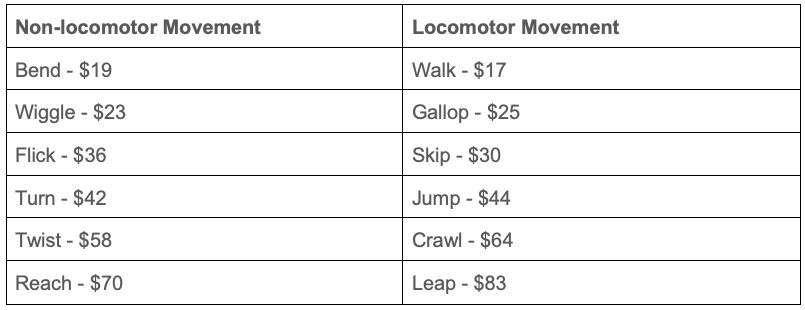
  • The following values represent the cost of one of each movement
  • Students should write out the complete equation(s) used to determine the total ticket price for someone to attend their performances.

Explore a table of non-locomotor and locomotor movements with prices—perfect for choreography planning or teaching multiplication and division through creative movement. Non-locomotor: Bend $19, Wiggle $23, Turn $42. Locomotor: Walk $17, Jump $44, Leap $83.

Ticket Share:

Using the total ticket price, have students calculate the following: A group of four friends is coming to see your dance. How much does each friend need to contribute to see the dance? How much will it cost them total?

Closing Reflection

Have students respond to the following prompt as an exit ticket: Share what you think your group was most successful at in this process. What was the most challenging part for you and/or your group and how did you overcome it?


Assessments

Formative

  • Teacher observation of students during warm-up to check for understanding of vocabulary
  • Individual group check-ins during group work time and class sharing of phrases looking for phrase creation and multiplication/division check
  • Exit Ticket

Summative

  • Written equations with products and sums
  • Student dance phrases that meet the requirements


Differentiation 

Acceleration: 

  • Change movement word values and/or the number of friends in the ticket share
  • Allow students to develop their own locomotor and non-locomotor movements

Remediation:

  • Change movement word values
  • Reduce the number of movements total that students must include in their dances


Credits

U.S. Department of Education- STEM + the Art of Integrated Learning

Ideas contributed by: Christopher Crabb

*This integrated lesson provides differentiated ideas and activities for educators that are aligned to a sampling of standards. Standards referenced at the time of publishing may differ based on each state’s adoption of new standards.

Revised and copyright:  June 2025 @ ArtsNOW


HABITATS & ANIMAL ADAPTATIONS: ANIMAL ADAPTATIONS DANCE 3

ANIMAL ADAPTATIONS DANCE

HABITATS & ANIMAL ADAPTATIONS: ANIMAL ADAPTATIONS DANCE

Learning Description

In this lesson, students will demonstrate their understanding of the ways that animals adapt to survive in their environments through choreography and dance performances. Students will evaluate each other’s performances and identify how the dancers/choreographers used levels and locomotor/non-locomotor movements to communicate animal adaptation.


Learning Targets

GRADE BAND: 3
CONTENT FOCUS: DANCE & SCIENCE
LESSON DOWNLOADS:

Download PDF of this Lesson

"I Can" Statements

“I Can…”

  • I can create movements to demonstrate animal adaptations.
  • I can create choreography using different levels and locomotor and non-locomotor movements.
  • I can use dance to communicate meaning.

Essential Questions

  • How do choreographers use movement to communicate meaning?
  • How do animals adapt to survive in their environments?
  • What environmental factors might affect an animal’s survival?


Georgia Standards

Curriculum Standards

S3L1. Obtain, evaluate, and communicate information about the similarities and differences between plants, animals, and habitats found within geographic regions (Blue Ridge Mountains, Piedmont, Coastal Plains, Valley and Ridge, and Appalachian Plateau) of Georgia.

a. Ask questions to differentiate between plants, animals, and habitats found within Georgia’s geographic regions.

b. Construct an explanation of how external features and adaptations (camouflage, hibernation, migration, mimicry) of animals allow them to survive in their habitat.

c. Use evidence to construct an explanation of why some organisms can thrive in one habitat and not in another.

Arts Standards

ESD3.CR.1 Demonstrate an understanding of the choreographic process.

a. Collaborate with others to create and perform movement phrases.

b. Create a sequence of three or more movements utilizing body, space, time, and energy

ESD3.CR2 Demonstrate an understanding of dance as a form of communication.

ESD3.PR.1 Identify and demonstrate movement elements, skills, technique, and terminology in dance.

a. Apply and expand dance terminology to describe and create movement (e.g. levels, pathways, directions, speed, rhythm, energy, qualities, shapes).

b. Combine and execute a wide range of locomotor movements with appropriate energy and coordination (e.g. walk, run, hop, jump, gallop, skip).


South Carolina Standards

Curriculum Standards

3-LS4-2. Use evidence to construct an explanation for how the variations in traits among individuals of the same species may provide advantages in surviving and producing offspring.

3-LS4-3. Construct an argument with evidence that in a particular habitat some organisms can thrive, struggle to survive, or fail to survive.

Arts Standards

Anchor Standard 1: I can use movement exploration to discover and create artistic ideas and works.

Anchor Standard 2: I can choreograph a dance.

Anchor Standard 3: I can perform movements using the dance elements


Key Vocabulary

Content Vocabulary

  • Adaptation - A change by which an organism becomes better suited to its environment.
  • Mimicry - An adaptation by which an organism copies the physical or vocal characteristics of another.
  • Camouflage - An adaptation by which an organism visually blends into its surroundings by virtue of its shapes, patterns, and coloring.
  • Habitat - The natural home or environment of an animal, plant, or other organism.

Arts Vocabulary

  • Non-locomotor - This refers to a movement that does not travel through space
  • Locomotor - This refers to a movement that travels through space
  • Space - An element of movement involving direction, level, size, focus, and pathway
  • Level - One of the aspects of movement (there are three basic levels in dance: high, middle, and low)
  • Choreography - The art of composing dances and planning and arranging the movements, steps, and patterns of dancers
  • Shape - This refers to an interesting and interrelated arrangement of body parts of one dance; the visual makeup or molding of the body parts of a single dancer; the overall visible appearance of a group of dancers


Materials


Instructional Design

Opening/Activating Strategy

  • Begin the lesson by playing the “mirror game”. Demonstrate various levels (high, medium, and low) and locomotor and non-locomotor movements (see vocabulary).
    • Students must copy the movements that the teacher makes without speaking.
  • After the game, ask students what they were doing. Explain that this demonstrates mimicry; show pictures to demonstrate mimicry in nature.
    • Discuss the levels that you used and share with students that levels are one of the ways that dancers show the element of space in dance.
    • Discuss how some movements stayed in one place and some movements required students to move from one place to another. Movements in dance in which the dancer does not move to a new location are called non-locomotor movements; movements in which the dancer moves from one location to another are called locomotor movements.

Work Session

  • Review or teach the following vocabulary words with students: Adaptations, mimicry, migration, camouflage, and hibernation.
  • Present the following task to students. Students must create a choreography that demonstrates mimicry, migration, camouflage, and hibernation.
    • Students will come up with a unique movement for each of their words.
    • Their dance must start with a beginning frozen shape, have a middle in which they demonstrate each vocabulary word, and finish in a frozen end shape.
    • Students must demonstrate use of levels and locomotor/non-locomotor movements in their choreography.

Students will have twenty minutes to develop their choreography and rehearse.

Closing Reflection

  • Students will present their choreographies to the audience. Discuss appropriate audience participation and etiquette prior to performances.
  • The audience will guess which movement represented which content vocabulary words based on their body movements throughout the choreography. Encourage students to use the terms “levels” and “locomotor/non-locomotor movements” as they describe the dances.
  • In their STEAM journals, students should explain their process and how they used dance concepts to demonstrate animal adaptations.


Assessments

Formative

  • Teacher observation of students’ ability to mirror teacher’s movements in activator
  • Responses to discussion of ways that animals adapt to their environments
  • Demonstration of understanding of levels and locomotor/non-locomotor movements
  • Collaboration with group members to create movements to represent the different ways that animals adapt to their environments

Summative

CHECKLIST for students and teacher:

  • Do I have a beginning, middle, and end to my choreography?
  • Do I have a movement for each vocabulary word (that describes it)?
  • Did I use different levels in my choreography?
  • Did I use locomotor and non-locomotor movements in my choreography?
  • Did everyone participate in the process?


Differentiation

Accelerated: 

  • Students will research an animal native to one of the habitats being studied. Students will discover how that animal adapts to its environment and then will choreograph a dance that demonstrates this animal’s adaptation(s).

Remedial:

  • Students will be given a list of the vocabulary words and some movements that may correlate to their definition.
  • Scaffold the lesson by choreographing one vocabulary work together as a class before groups work on their own.
  • Reduce the number of vocabulary words that students will create movements for.


Credits

U.S. Department of Education- STEM + the Art of Integrated Learning

Ideas contributed by: SAIL Grant Teacher Leaders

*This integrated lesson provides differentiated ideas and activities for educators that are aligned to a sampling of standards. Standards referenced at the time of publishing may differ based on each state’s adoption of new standards.

Revised and copyright:  June 2025 @ ArtsNOW


CREATIVE EXPRESSIONS IN MULTIPLICATION: MULTIPLY YOUR MOVES 3

MULTIPLY YOUR MOVES

CREATIVE EXPRESSIONS IN MULTIPLICATION: MULTIPLY YOUR MOVES

Learning Description

In this lesson, students engage in movement-based exercises to solve multiplication equations by incorporating non-locomotor movements using specific body parts. Students will use movements such as stretching, bending, twisting, and balancing to represent multiplication problems. For example, they might stretch both arms to represent the number two and twist their torso three times to illustrate 2 × 3. By combining these non-locomotor movements with body parts (e.g., arms, legs, or hands), students will create and solve multiplication problems in a dynamic and interactive way, reinforcing both mathematical concepts and physical coordination.


Learning Targets

GRADE BAND: 3
CONTENT FOCUS: DANCE & MATH
LESSON DOWNLOADS:

Download PDF of this Lesson

"I Can" Statements

“I Can…”

  • I can solve and express a multiplication equation using different body parts and non-locomotor movements.

Essential Questions

  • What connections can we make between mathematical operations like multiplication and the movements we create with our bodies?
  • What strategies can we use to break down a multiplication problem?


Georgia Standards

Curriculum Standards

3.PAR.3.6 Solve practical, relevant problems involving multiplication and division within 100 using part-whole strategies, visual representations, and/or concrete models.

Arts Standards

ESD3.CR.1.d Respond to a variety of stimuli through movement (e.g. literature, visual art, props).

ESD3.PR.1.c Execute a range of axial movements comprised of space, force, body shapes, and qualities (e.g. levels, sharp/smooth, curved/straight, heavy/light, swing/float planes).


ESD3.CN.3 Identify connections between dance and other areas of knowledge.


South Carolina Standards

Curriculum Standards

3.NSBT.3 Multiply one-digit whole numbers by multiples of 10 in the range 10 – 90, using knowledge of place value and properties of operations.

Arts Standards

Anchor Standard 1: I can use movement exploration to discover and create artistic ideas and works.

Anchor Standard 3: I can perform movements using the dance elements.

Anchor Standard 7: I can relate dance to other arts disciplines, content areas, and careers.


Key Vocabulary

Content Vocabulary

  • Multiplication - A mathematical operation used to calculate the total of one number added repeatedly a specific number of times
  • Equation - A mathematical sentence that has two equal sides separated by an equal sign
  • Factor - The numbers that are multiplied
  • Product - The answer to a multiplication problem
  • Multiplier - The number of groups
  • Multiplicand - The number of items in each group
  • Array - A way of organizing objects, numbers, or symbols in rows and columns to visually represent mathematical concepts, especially multiplication and division

Arts Vocabulary

  • Non-locomotor movement - A movement that does not travel through space (e.g. shaking, bending, stretching, twisting, turning & more)
  • Levels - One of the aspects of movement (there are three basic levels in dance: high, middle, and low)
  • Body shape - Refers to an interesting and interrelated arrangement of body parts of one dancer; the visual makeup or molding of the body parts of a singular dancer; the overall visible appearance of a group of dancers (they may be curved/angular, symmetrical/asymmetrical, positive/negative)
  • Repetition - When you do the same movement or pattern more than once
  • Movement exploration - Trying out different ways of moving your body to discover new things


Materials

  • Upbeat instrumental music
  • Speaker or other device with the ability to play music
  • Index cards with multiplication equations written on them


Instructional Design

Opening/Activating Strategy

Move It! Shape It!

  • Choose one word from each list below for students to interpret through movement (e.g., Shake your elbows at a high level).
  • When music plays, students move, in their personal space, to express vocabulary given.
    • Suggestion: Upbeat instrumental music is best.
  • When the music stops, students should freeze in a body shape.
  • Repeat as needed.

Vocabulary to utilize:

  • Body Parts: Head, shoulders, arm, elbow, hand, finger, hips, leg, knee, foot
  • Non-Locomotor Movement: Bend, wiggle, shake, flick, turn, twist, dab, reach, grow, melt
  • Levels: Low, middle, high

Work Session

  • Review multiplication, parts of a multiplication equation, and solving a multiplication equation.
  • As a class, explore how to express a multiplication equation in movement.
    • Factor 1:
      • Factor 1 is the number of body parts to be “moved”.
      • Identify the body parts to be used (can use the body parts list above in the activating strategy or have students identify other suitable body parts).
    • Factor 2:
      • Factor 2 identifies the number of times a non-locomotor movement is performed at each identified body part.
      • Identify a non-locomotor movement to bring each body part to action.
    • Product:
      • Students count the non-locomotor movements as they perform.
    • Example: 2 x 3 = ?
      • Two body parts: Head and elbow
      • Three times of a specific non-locomotor movement
        • Three shakes of head
        • Three shakes of elbow
      • Product: How many total shakes?
    • Group students as pairs or trios.
      • Give each group one or two multiplication equations.
      • Each group goes through the above process of solving their equation(s).
      • Students should write their equation(s) with the product included.

Closing Reflection

  • Invite groups to share their movement phrases with the class.
  • After sharing, the rest of the class will write the multiplication equation with the product.


Assessments

Formative

  • Teacher observation of students during “Move It! Shape It!” to check for understanding of vocabulary
  • Individual group check-ins during group work time and class sharing of phrases looking for body parts and non-locomotor movement

Summative

  • Written equations with product
  • Evidence that students understand the difference between locomotor and non-locomotor movements


Differentiation 

Accelerated: 

Group students according to the multiplication fact set they are ready to master.

Remedial:

Adjust multiplication equations to the fact set that they are currently mastering.


Credits

U.S. Department of Education- STEM + the Art of Integrated Learning

Ideas contributed by: Christopher Crabb

*This integrated lesson provides differentiated ideas and activities for educators that are aligned to a sampling of standards. Standards referenced at the time of publishing may differ based on each state’s adoption of new standards.

Revised and copyright:  June 2025 @ ArtsNOW


POLLUTION MATTERS: EXPLORING POLLUTION THROUGH DANCE 3-5

EXPLORING POLLUTION THROUGH DANCE

POLLUTION MATTERS: EXPLORING POLLUTION THROUGH DANCE

Learning Description

In this lesson, students will learn about air, water and land pollution around the world by responding to images and conducting research. Students will then express their understanding of pollution through movement using locomotor and non-locomotor movements and levels.


Learning Targets

GRADE BAND: 3,5
CONTENT FOCUS: VISUAL ARTS/DANCE & SCIENCE
LESSON DOWNLOADS:

Download PDF of this Lesson

"I Can" Statements

“I Can…”

  • I can identify types of pollution around the world.
  • I can analyze the effects that pollution has on human life.
  • I can express my feelings about pollution using movement.

Essential Questions

  • How does pollution affect people from different cultures in different ways?
  • What are the effects of pollution on people and the environment?


Georgia Standards

Curriculum Standards

Grade 3:

S3L2. Obtain, evaluate, and communicate information about the effects of pollution (air, land, and water) and humans on the environment.

a. Ask questions to collect information and create records of sources and effects of pollution on the plants and animals.

b. Explore, research, and communicate solutions, such as conservation of resources and recycling of materials, to protect plants and animals.

Arts Standards

Grade 3:

ESD3.CR.1 Demonstrate an understanding of the choreographic process.

ESD3.CR.2 Demonstrate an understanding of dance as a form of communication.


South Carolina Standards

Curriculum Standards

Grade 5:

5-ESS3-1. Evaluate potential solutions to problems that individual communities face in protecting the Earth’s resources and environment.

Arts Standards

Anchor Standard 1: I can use movement exploration to discover and create artistic ideas and works.

Anchor Standard 2: I can choreograph a dance.


Key Vocabulary

Content Vocabulary

  • Pollution - The introduction of harmful or toxic substances, known as pollutants, into the environment
  • Reduce, reuse, recycle - A sustainability concept aimed at minimizing waste and conserving resources
  • Garbage - Waste materials that are no longer useful or wanted and are typically discarded
  • Litter - Waste, trash, or discarded material that is improperly disposed of in public spaces instead of in designated trash or recycling bins
  • Smog - A type of air pollution that results from the interaction of sunlight with pollutants like ground-level ozone and particulate matter
  • Smoke - A collection of gasses, particles, and other chemicals released when a substance undergoes combustion (burning)
  • Water vapor - The gaseous form of water
  • Acid rain - Precipitation (rain, snow, sleet, or fog) that has a lower pH than normal due to the presence of harmful chemicals, primarily sulfur dioxide (SO₂) and nitrogen oxides (NOₓ) in the atmosphere
  • Oil spills - The release of liquid petroleum (crude oil or refined oil) into the environment, typically into bodies of water like oceans, rivers, or lakes
  • Runoff - The flow of water, usually from rainfall or melting snow, that travels over the ground and eventually enters rivers, lakes, streams, or oceans
  • Pesticides - Chemicals or substances used to prevent, control, or eliminate pests, such as insects, weeds, fungi, rodents, and other organisms that can harm crops, livestock, or human health
  • Fertilizers - Substances or materials added to soil or plants to provide essential nutrients that promote healthy plant growth
  • Emissions (ex: car, airplane) - The release of substances (often gasses, liquids, or particles) into the environment

Arts Vocabulary

  • Mood - Emotion or feeling
  • Locomotor movement - A movement that travels through space
  • Non-locomotor movement - A movement that does not travel through space
  • Levels - One of the aspects of movement (there are three basic levels in dance: high, middle, and low)


Materials


Instructional Design

Opening/Activating Strategy

  • Lead students in a mirroring movement warm-up to introduce the following vocabulary:
    • Locomotor
    • Non-locomotor
    • Levels (high, middle, low)
    • Pathways
  • Begin by telling students that they will mirror your movements so they must be watching closely. Have students establish a space where they can move without interfering with other students.
    • Start by doing simple non-locomotor movements (i.e., bending, twisting, shaking, etc.)
    • Now incorporate high, middle, and low levels by making non-locomotor movements at different levels.
    • Begin to incorporate locomotor movements, such as stepping together from side to side, gliding as if skating, walking, etc.
    • Incorporate levels high, middle, and low by making locomotor movements at different levels.
  • Debrief with students explaining the dance vocabulary.
  • Now, tell students that you will call out vocabulary and they will make a movement that expresses the vocabulary.
    • Example: Create a locomotor movement at a low level.
  • After practicing using the vocabulary, have students return to their seats.
  • Show students images of pollution around the world and discuss the images as a class.
    • Engage students in the Step Inside Artful Thinking Routine.
      • Choose a person, object or element in an image or work of art, and step inside that point of view. Consider:
        • What can the person/thing perceive and feel? What might the person/thing know about or believe?
        • What might the person/thing care about?
        • How would you feel if you were in the same situation or you were in that environment?
      • Take on the character of the thing you’ve chosen and improvise a monologue. Speaking in the first person, talk about who/what you are and what you are experiencing.
      • What do you think caused the pollution in the environment?
    • After several of the images, discuss the feelings that students have. Ask students to show that feeling using a movement.
    • Then ask students to explain their rationale for choosing each movement.

Work Session

Part 1

  • Introduce to students the concept of “Ego vs. Eco” (human advancement at the expense of nature versus caring for the ecosystem). Use this website resource to explore/research this concept: https://recyclingsutainabiliy4a.weebly.com/ego-vs-eco.html.
  • Students will create journal entries on Padlet/sticky notes (teacher's choice) to explain possible causes of and solutions for pollution viewed in the images from the slideshow.

Part 2

Part 3:

  • Place students in small groups of three or four students.
  • Students will review the research and make a list of six adjectives used to describe pollution.
  • Direct students to work together to choreograph a movement for each adjective.
  • Students should then connect them together to form a dance.
  • Students’ dances must:
    • Have at least six movements
    • Use both locomotor and non-locomotor movements
    • Use all three levels–high, middle, and low
  • If time permits, direct students to select music that they connect to. Otherwise, provide students with two options of music to use for their dance (instrumental recommended).
  • Students should rehearse their dances.

Closing Reflection

  • Have students name the different types of pollution they saw and describe the effects it has on our world.
    • Have students discuss where they saw locomotor/non-locomotor movements and levels.
  • Ask students:
    • How does it make you feel seeing pollution around the world?
    • Where have you seen pollution in your own environment?
    • What could you do to help the environment?
    • How can we further reduce the amount of waste that we have?
    • What is something new you learned about pollution while participating in this project?


Assessments

Formative

  • Teachers will observe students’:
    • Responses during the activating strategy: Step Inside
    • Journal entries
    • Research and identification of relevant vocabulary terms from research
    • Students’ collaboration on choreography

Summative

  • Students’ choreography:
    • Has at least six movements
    • Uses both locomotor and non-locomotor movements
    • Uses all three levels–high, middle, and low
    • Includes a movement for six different relevant adjectives to describe pollution
    • Students can name the different types of pollution they saw and describe the effects it has on our world.


Differentiation 

Accelerated: 

Remedial:

  • Provide sentence starters for students’ journal entry writing.
  • Allow for peer tutor and pairings.
  • Include visuals to support the content vocabulary.
  • Allow students to copy their articles into Microsoft Word Online and use the “Immersive Reader” feature to hear their articles read aloud. (Office365 Student Account>Word Document Online>View>Immersive Reader)


Credits

U.S. Department of Education- STEM + the Art of Integrated Learning

Ideas contributed by: Jill McNally, Alisa Moore, Julie Palmieri, Edited by Dr. Carla Cohen, Edited by Jessica Espinoza and Katy Betts

*This integrated lesson provides differentiated ideas and activities for educators that are aligned to a sampling of standards. Standards referenced at the time of publishing may differ based on each state’s adoption of new standards.

Revised and copyright:  June 2025 @ ArtsNOW