Be You! 1 (Music)

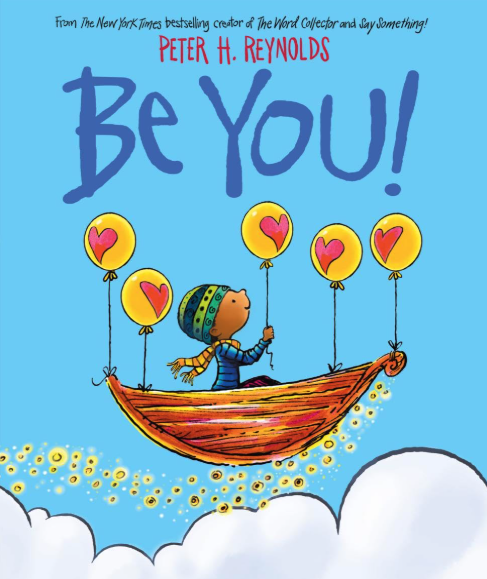
A banner with the book cover "Be You!" by Peter H. Reynolds on the left, and the text "Creativity Task Cards 1" in large, white, playful letters on colorful circles—perfect for inspiring theatre activities or connecting with The Big Umbrella.

Art Form: Music


Supplies Needed

-Be You! book

Vocabulary

Tempo - the speed of the beat

Rhythm - long and short sounds and silences

Steady beat - the consistent pulse or "heartbeat" of music

Form - the organization of a piece (how the music is put together)

Dynamics - loud and soft sounds; volume

Instructions

1.  Read the book, Be You!. Discuss the events in the book. Who are the characters? What is the setting? What is the main idea or central message of the book?

2.  What word is repeated? (“be”). Notice that every “be” is followed by a different word or words.

3.  Pat the steady beat at a moderate tempo. Practice saying each “be” phrase rhythmically in two beats—some words and syllables will be short!

4.  Read the book, inserting each “be” phrase spoken rhythmically. Since the other parts of the book can’t be read rhythmically, pat the beat only while you say the “be” phrases.

5.  Some parts of the book have a steady beat (the “be” phrases) while others don’t (the phrases that don’t start with “be”). The book is organized in parts that aren’t read rhythmically and parts that are—it had a specific form!

6.  What other words could make a “be” sentence (for example, “be generous” and “be strong”)? Write those words on a card and add these to the story— you choose where!

Extensions

Experiment with different punctuation at the end of the “be” phrases. How would the dynamics change if the “be” phrase ended with an exclamation mark (as happens on the second page)? Would it be loud or quiet?

For extra challenge, change the beat from pat-pat to pat-clap.
About

The REimagining and Accelerating Literacy through Arts Integration (REALAI) grant supports the literacy achievement of 3,200 students and 170 teachers, media specialists, and literacy coaches across six schools in Georgia and South Carolina.

In addition to professional learning for educators, this project contributes significantly to school library collections through the purchase of developmentally appropriate and culturally relevant books.

This grant also includes parent events to provide families with access to books and other content about how to support their child’s reading development.

Change Sings 4-5 (Music)

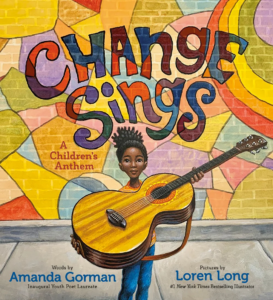
A vibrant banner featuring the "Change Sings" book cover with a guitar illustration. Inspired by "Maybe Something Beautiful," the text "Creativity Task Cards 4-5" dances across a dynamic background of orange, green, and yellow circles, celebrating visual arts.

Art Form: Music


Supplies Needed

Change Sings book


Vocabulary

Ostinato - short repeated pattern

Body percussion - creating sounds using your body (ex. patting your legs, clapping, stomping, mouth sounds, etc.)

Rhythm - pattern of short and long sounds in a musical
composition

Steady beat - a rhythmic pattern that holds a regular pulse

Theme - the message the author communicates through the text

Text structure - how the text is built, or organized

Anthem - an uplifting song identified with a group, body, or cause

Instructions

1. Read the book's full title, including “A Children’s Anthem.” Discuss what an anthem is with your child.

2. Discuss the purpose for reading the book - to find the theme. What message is the author trying to convey?

3. Read through the book once. Discuss the theme. Write a short, meaningful phrase that conveys the theme and can be used for your ostinato, such as “We are the change” (over 4 beats) or “We all want change. Won’t you sing along?” (over 8 beats).

4. Decide on a rhythm for your ostinato. Decide how often you want to perform the ostinato while rereading the text. Will you perform it after every page? Reread the text while performing your ostinato.

5. Make changes, if necessary, to your ostinato pattern. Choose body percussion to add to your performance.

6. Reread the text once more, performing your revised ostinato and body percussion.

Extensions

Record your performance and share it with other family or school members.


About

The REimagining and Accelerating Literacy through Arts Integration (REALAI) grant supports the literacy achievement of 3,200 students and 170 teachers, media specialists, and literacy coaches across six schools in Georgia and South Carolina.

In addition to professional learning for educators, this project contributes significantly to school library collections through the purchase of developmentally appropriate and culturally relevant books.

This grant also includes parent events to provide families with access to books and other content about how to support their child’s reading development.

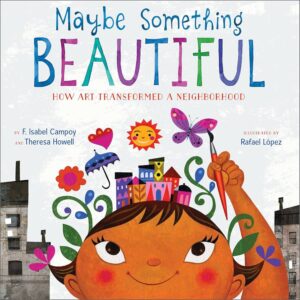
Maybe Something Beautiful 2-3 (Music)

Image of a banner with the text "Creativity Task Cards" in white on a pink background. The left side features a book titled "Maybe Something Beautiful" with an illustration of a child and colorful flowers, evoking the magic of theatre. A yellow and green background displays "2-3" to the right.

Art Form: Music


Supplies Needed

Maybe Something Beautiful book


Vocabulary

Steady Beat - an ongoing, steady, repetitive pulse

Rhythm - long and short sounds

Tempo - speed of the beat


Instructions

1. Read the book. Select a page in the book to reread. This time, read the page one word at a time with short pauses between each word (kind of robotically). Ask
your child how that sounded. Reread the page, but this time, read it rhythmically, finding a natural, sing-song flow. Ask your child how it sounded that time. Which way sounds better? Which way is more interesting? Which way is easier to understand? Explain that speaking words rhythmically can make them come alive and easier to remember!

2. Look at the page that includes the words “As the man drew pictures on the bricks,” (it’s soon after Mira paints on the wall). Tap a steady beat: pat your legs, then clap your hands. Fit the words of the first sentence over 4 steady beats.

3. Do the same for the next 2 sentences (“Soon Mr. Sax joined in”).

4. Read the first 3 sentences on the page rhythmically while you tap a steady beat.

5. Now try repeating some of these phrases at different tempos. Try it faster and slower.

6. Read the story adding your rhythmic speech in the right places.

About

The REimagining and Accelerating Literacy through Arts Integration (REALAI) grant supports the literacy achievement of 3,200 students and 170 teachers, media specialists, and literacy coaches across six schools in Georgia and South Carolina.

In addition to professional learning for educators, this project contributes significantly to school library collections through the purchase of developmentally appropriate and culturally relevant books.

This grant also includes parent events to provide families with access to books and other content about how to support their child’s reading development.
I Believe I Can K-1 (Music)

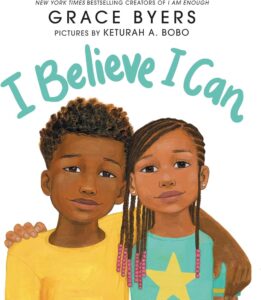
A bright banner features a book cover for "I Believe I Can" by Grace Byers, with an illustration of two children. To the right of the book cover, text reads "Creativity Task Cards K-1" on a teal background, with a yellow and green backdrop.

Art Form: Music


Supplies Needed

I Believe I Can book

Vocabulary

Dynamics - loudness or softness of sounds

Soundscape - using a variety of sounds to represent words and assist in telling a story

Tempo - the speed of the beat

Volume - how loud or quiet the sound is

Pitch - the highness or lowness of sound


Instructions

1. After you read the book, go back and find words that make you think of sounds.
Example: Ocean “Woosh, woosh”

2. Create a sound or sounds to represent the action or feeling on each page of the book.

  • Use your voice or any materials that you can find around you.
  • Are the sounds at a high or low pitch?
  • How loud would the sounds be based on the setting, characters, and action on the page?
  • What tempo would the sounds be?

3. Now re-read your story and add in your sounds! Try using different
volumes, tempos, and pitches. How can you change the dynamics of your
soundscape?

Extensions

Use recycled materials that are around the house to make musical instruments. Examples: paper plates, empty cans, paper towel rolls, dried beans, rice

Compare/contrast two sounds in the story and tell how they are alike or different. Examples: long and short, high and low, fast and slow


About

The REimagining and Accelerating Literacy through Arts Integration (REALAI) grant supports the literacy achievement of 3,200 students and 170 teachers, media specialists, and literacy coaches across six schools in Georgia and South Carolina.

In addition to professional learning for educators, this project contributes significantly to school library collections through the purchase of developmentally appropriate and culturally relevant books.

This grant also includes parent events to provide families with access to books and other content about how to support their child’s reading development.

Thank you, Omu! 5th (Music)

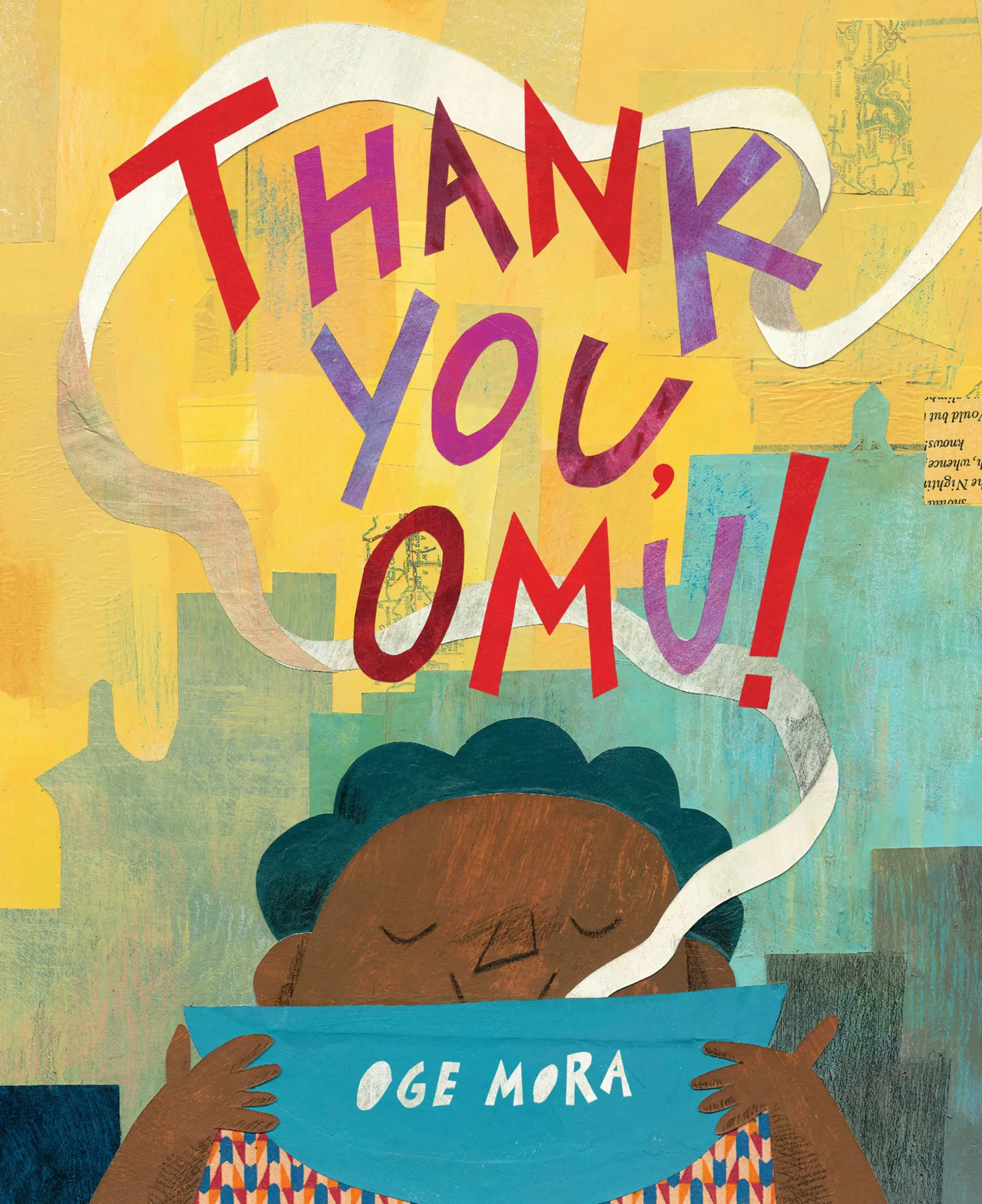
A colorful banner titled "Creativity Task Cards" in the center with a "Thank You, Omu!" book cover on the left. A large white number 5 inside a yellow circle is on the right, indicating the grade level—fifth grade.

Art Form: Music


Supplies Needed

Thank You, Omu! book

Optional: Various sound makers (pots, pans, box,
spoons, etc.)


Vocabulary

Dynamics - Loudness or softness of sounds

Rhythm - Short and long sounds

Steady beat - Consistent pulse; “heartbeat” of music

Tempo - Speed of the beat

Soundscape - Using sounds to represent actions, ideas, feelings, or objects in a story; telling a story through sound

Pitch - Highness or lowness of sound

Instructions

1. After reading the book, look for words or pictures that make you think of sounds (for example, stirring stew, knocking, smell wafting, eating stew, smelling stew,
school bus). Sometimes you’ll have to look hard to find things that would make sound (for example, a construction worker walking down the street).

2. Use your voice, body and/or materials around you to create each sound (for example, stamping a steady beat loudly to create the sound of walking).

3. Think about:

  • Will the sounds be high or low? (Pitch)
  • Will the sounds be loud or soft? (Dynamics)
  • Will the sounds be fast or slow? (Tempo)
  • Will the sounds be long or short? (Rhythm)
  • Will any sounds have a steady beat?

4. Read the story again and add your sounds. Experiment with different sounds. How does changing the tempo, dynamics, and pitch change your sounds?

Extensions

Find materials around you to use as instruments (paper plates, empty paper towel rolls, pencils, empty cans, rice, beans, etc.).

Read the story for someone new. Don’t tell them what pictures or words you are illustrating through sound and have them guess!

Compare and contrast two sounds in the story. How are they alike? How are they different?

About

The REimagining and Accelerating Literacy through Arts Integration (REALAI) grant supports the literacy achievement of 3,200 students and 170 teachers, media specialists, and literacy coaches across six schools in Georgia and South Carolina.

In addition to professional learning for educators, this project contributes significantly to school library collections through the purchase of developmentally appropriate and culturally relevant books.

This grant also includes parent events to provide families with access to books and other content about how to support their child’s reading development.