EXPLORING THEMES THROUGH PRINTMAKING 6-8

EXPLORING THEMES THROUGH PRINTMAKING

EXPLORING THEMES THROUGH PRINTMAKING

Learning Description

Students will work in groups to analyze a short story, identify one or more themes, and examine how they develop over the course of the text. Each student will design and carve a symbol that represents their group's chosen theme. The group will then collaboratively print their symbols on a single piece of paper, visually representing their analysis through art.


Learning Targets

GRADE BAND: 6-8
CONTENT FOCUS: VISUAL ARTS & ELA
LESSON DOWNLOADS:

Download PDF of this Lesson

"I Can" Statements

“I Can…”

  • I can determine and analyze the theme of a literary text.
  • I can provide an objective summary of a text.
  • I can design and carve a symbol that represents a theme in a story.
  • I can collaborate with my peers to create a unified visual representation of a literary theme.

Essential Questions

  • How do authors develop themes in literature?
  • How can multiple themes emerge in a single text?
  • How can symbols visually represent a theme?
  • How does collaboration enhance artistic and literary interpretation?


Georgia Standards

Curriculum Standards

Grade 6:

ELAGSE6RL2 Determine a theme and/or central idea of a text and how it is conveyed through particular details; provide a summary of the text distinct from personal opinions or judgments.

Grade 7:

ELAGSE7RL2 Determine a theme and/or central idea of a text and analyze its development over the course of the text; provide an objective summary of the text.

Grade 8:

ELAGSE8RL2 Determine a theme and/or central idea of a text and analyze its development over the course of the text, including its relationship to the characters, setting, and plot; provide an objective summary of the text.

Arts Standards

VA.CR.1 Visualize and generate ideas for creating works of art.

VA.CR.3 Engage in an array of processes, media, techniques, and/or technology through experimentation, practice, and persistence.

VA.PR.1 Plan, prepare, and present completed works of art.


South Carolina Standards

Curriculum Standards

ELA.AOR.2: Evaluate and critique the development of themes and central ideas within and across texts.

Grade 6:

ELA.6.AOR.2.1 Analyze how key details contribute to the development of a theme(s) over the course of a literary text.

Grade 7:

ELA.7.AOR.2.1 Compare two or more themes within a literary text(s) and how each is developed over the course of a text(s).

Grade 8:

ELA.8.AOR.2.1 Analyze how key details contribute to the development of two or more themes within and across literary texts.

Arts Standards

Anchor Standard 1: I can use the elements and principles of art to create artwork.

Anchor Standard 2: I can use different materials, techniques, and processes to make art.

Anchor Standard 7: I can relate visual arts ideas to other arts disciplines, content areas, and careers.


Key Vocabulary

Content Vocabulary

  • Theme – The central idea or underlying message in a text
  • Symbolism – The use of images or objects to represent deeper meanings

Arts Vocabulary

  • Symbol – A visual representation of an idea or theme
  • Printmaking – The art or technique of making prints, especially as practiced in engraving, etching, dry point, woodcut or serigraphy
  • Brayer – A tool used to roll ink evenly onto the printing plate
  • Composition – How an artist arranges the Elements of Art (line, shape, form, value, color, space, texture) to create an artwork
  • Collaboration – Working together to achieve a common goal


Materials

  • Selected short stories
  • Pencils
  • Copy paper
  • Styrofoam sheets
  • Ball point pen or dull pencils
  • Water based printing ink
  • Brayers
  • Large sheets of paper for group prints
  • Colored pencils or art sticks
  • Drying rack or space to lay prints


Instructional Design

Opening/Activating Strategy

Engage (Research & Discussion)

  • Divide students into small groups.
  • Assign each group a short story to read and analyze (e.g., "The Lottery" by Shirley Jackson, "Thank You, Ma'am" by Langston Hughes, "The Necklace" by Guy de Maupassant).
  • In their groups, students will discuss and identify one or more themes present in the story.
  • Groups will create an objective summary of the text, focusing on how the theme develops over time.

Work Session

Explore (Sketch & Plan):

  • Each student will sketch a symbol that represents the identified theme.
  • Students will collaborate with their groups to refine their individual symbols to ensure coherence in their final composition.


Create (Printmaking Process):

  • Follow the printmaking process below.
  • After students have created their symbols on styrofoam plates, they will print their individual symbols onto a shared sheet of paper, creating a collective representation of their theme.
  • Review these printmaking tips with students:
    • Prepping the styrofoam plate:
      • Use a dull pencil or ballpoint pen to carve designs—press firmly but avoid puncturing all the way through.
      • Encourage students to sketch lightly first before carving to avoid mistakes.
    • Carving techniques:
      • Keep lines simple and bold for clear prints; intricate details may not transfer well.
      • Reverse letters or numbers if including text, as prints will be a mirror image.
      • Vary line thickness for added depth—thicker lines hold more ink, while thinner lines create subtle details.
    • Inking the plate:
      • Roll out a thin, even layer of ink on a tray before applying to the printing plate with a brayer.
      • Make sure ink covers the entire design, but avoid excessive ink, which can cause smudging.
      • Test prints on scrap paper before the final collaborative print.
    • Printing process:
      • Place the inked plate face down on the final paper and press evenly with hands or a clean brayer.
      • Avoid shifting or sliding the plate while printing to prevent smudging.
      • Lift the plate carefully to reveal the design.
      • Encourage students to appreciate the imperfections as part of the artistic process!
    • Final Touches:
      • Allow prints to dry completely before handling.
      • Once dry, encourage students to add color and hand-drawn details.


Classroom Tips:

  • Encourage students to work carefully.
  • Make sure there is a piece of newsprint under each printmaking station.


Extension:

  • Virtual Gallery: Upload finished prints to Padlet or Google Sites for peer review.
  • Video Reflection: Students can record a short video explaining their theme and artistic choices using Flipgrid or Canva Video.


Closing Reflection

Reflect (Gallery walk and discussion):

  • Groups will present their collaborative prints, explaining their theme choice, how it was developed in the text, and how their symbols represent it.
  • Students will write an exit ticket explaining how their symbol represents the theme in paragraph form.
  • Facilitate a class discussion on the effectiveness of visual symbolism in interpreting literature.


Assessments

Formative

  • Group discussions and teacher observation during analysis and sketching phases

Summative

  • Final collaborative print with a written reflection on the theme’s development and symbolic representation
  • Group presentation assessing comprehension and understanding of thematic analysis


Differentiation

Accelerated: 

  • Encourage students to incorporate multiple symbols within their group’s composition to represent nuanced themes.
  • Have advanced students compare themes across different texts and integrate symbols accordingly.


Remedial:

  • Provide graphic organizers to help students track how the theme develops over the story.
  • Provide examples of symbols to help students visualize their ideas.


Additional Resources


Credits

Ideas contributed by: Shannon Green

*This integrated lesson provides differentiated ideas and activities for educators that are aligned to a sampling of standards. Standards referenced at the time of publishing may differ based on each state’s adoption of new standards.

Revised and copyright:  May 2025 @ ArtsNOW

 

EXPLORING INTERDEPENDENCE IN ECOSYSTEMS THROUGH PRINTMAKING 6-8

EXPLORING INTERDEPENDENCE IN ECOSYSTEMS THROUGH PRINTMAKING

PRINTMAKING ECOSYSTEMS: CARRYING CAPACITY AND BIODIVERSITY

Learning Description

Students will research ecosystem interactions and choose a biotic or abiotic factor to represent in a collaborative printmaking project. Each student will create a styrofoam print of a key component of an ecosystem (e.g., a producer, consumer, decomposer, or abiotic factor like water or sunlight). Then, students will combine their prints to create a large-scale class ecosystem print that visually represents interdependence and energy flow.


Learning Targets

GRADE BAND: 6-8
CONTENT FOCUS: VISUAL ARTS & SCIENCE
LESSON DOWNLOADS:

Download PDF of this Lesson

"I Can" Statements

“I Can…”

  • I can describe the interdependence between organisms and their environment.
  • I can develop a model showing the flow of energy in an ecosystem.
  • I can create a print that symbolizes an important ecosystem component.
  • I can collaborate with my peers to construct a visual representation of an ecosystem.

Essential Questions

  • How do organisms interact with one another and their environment?
  • How do abiotic factors influence ecosystems?
  • How does resource availability affect populations within an ecosystem?
  • How can we represent scientific relationships through visual symbols?


Georgia Standards

Curriculum Standards

Grade 7:

S7L4. Obtain, evaluate, and communicate information to examine the interdependence of organisms with one another and their environments.

a. Construct an explanation for the patterns of interactions observed in different ecosystems in terms of the relationships among and between organisms and abiotic components of the ecosystem.

b. Develop a model to describe the cycling of matter and the flow of energy among biotic and abiotic components of an ecosystem.

Arts Standards

VA7.CR.1 Visualize and generate ideas for creating works of art.

VA7.PR.1 Plan, prepare, and present completed works of art.


South Carolina Standards

Curriculum Standards

Grade 7:

7-LS2-2. Construct an explanation that predicts patterns of interactions among organisms across multiple ecosystems.

7-LS2-3. Develop a model to describe the cycling of matter and flow of energy among living and nonliving parts of an ecosystem.

Additional Science standards that can be taught using this Visual Arts strategy:


Grade 6:

6-LS1-3. Use arguments supported by evidence for how the body is a system of interacting subsystems composed of groups of cells.


Grade 8:

8-LS1-5. Construct a scientific explanation based on evidence for how environmental and genetic factors influence the growth of organisms.

Arts Standards

Anchor Standard 1: I can use the elements and principles of art to create artwork.

Anchor Standard 2: I can use different materials, techniques, and processes to make art.

Anchor Standard 7: I can relate visual arts ideas to other arts disciplines, content areas, and careers.


Key Vocabulary

Content Vocabulary

  • Interdependence – The way organisms rely on each other and their environment
  • Ecosystem – A community of interacting organisms and their physical environment
  • Biotic factors – Living components of an ecosystem (plants, animals, fungi, bacteria)
  • Abiotic factors – Nonliving components of an ecosystem (sunlight, water, soil)

Arts Vocabulary

  • Symbol – A visual representation of an idea or theme
  • Printmaking – The art or technique of making prints, especially as practiced in engraving, etching, dry point, woodcut or serigraphy
  • Styrofoam printing plate – A carved surface used to make repeated prints
  • Brayer – A small roller for inking type by hand, usually for making a proof
  • Composition – How an artist arranges the Elements of Art (line, shape, form, value, color, space, texture) to create an artwork
  • Collaboration – Working together to achieve a common goal


Materials

  • Pencils
  • Copy paper
  • Styrofoam sheets
  • Ball point pen or dull pencils
  • Water based printing ink
  • Brayers
  • Paper for printing (mixed media paper works well)
  • Colored pencils or art sticks
  • Drying rack or space to lay prints
  • Paper towels to wipe ink off of styrofoam plates
  • Trays for ink


Instructional Design

Opening/Activating Strategy

Engage (Research & Discussion)

  • Divide students into groups.
  • Students will research different ecosystems (rainforest, desert, ocean, tundra, etc.) and analyze how organisms interact with their environment.
  • Each group will choose an ecosystem and each student will choose a component to represent (e.g., a predator, a tree, a river).
  • Ask students to sketch a symbol that represents their chosen organism or abiotic factor.

Work Session

Explore (Planning & Design)

  • Discuss what a symbol is. Discuss how symbols are visual representations of an idea or theme.
  • Ask students to create detailed sketches of their component, ensuring their symbol visually represents its role in the ecosystem.
  • Ask students to discuss how their organisms interact (e.g., a rabbit and a fox, a tree providing oxygen).


Create (Printmaking Process):

  • Review these printmaking tips with students.
    • Prepping the styrofoam plate:
      • Use a dull pencil or ballpoint pen to carve designs—press firmly but avoid puncturing all the way through.
      • Encourage students to sketch lightly first before carving to avoid mistakes.
    • Carving techniques:
      • Keep lines simple and bold for clear prints; intricate details may not transfer well.
      • Reverse letters or numbers if including text, as prints will be a mirror image.
      • Vary line thickness for added depth—thicker lines hold more ink, while thinner lines create subtle details.
    • Inking the plate:
      • Roll out a thin, even layer of ink on a tray before applying to the printing plate with a brayer.
      • Roll the inked brayer over the styrofoam plate. Make sure ink covers the entire design, but avoid excessive ink, which can cause smudging.
      • Test prints on scrap paper before the final collaborative print.
    • Printing process:
      • Place the inked plate face down on the final paper and press evenly with hands or a clean brayer.
      • Avoid shifting or sliding the plate while printing to prevent smudging.
      • Lift the plate carefully to reveal the design.
      • Encourage students to appreciate the imperfections as part of the artistic process!


Final Touches:

  • Allow prints to dry completely before handling.
  • Once dry, encourage students to add color and hand-drawn details using colored pencils or art sticks.


Collaboration:

Instruct students to assemble their prints to represent an ecosystem, visually showing relationships like predator-prey, competition, and symbiosis.


Closing Reflection

  • Students will participate in a gallery walk, observing and discussing the ecosystem prints.
  • Groups will present their components and explain how they contribute to the ecosystem.
  • Students write a reflection on how their organism depends on others and how resource availability impacts populations.


Assessments

Formative

  • Observe students’ research on how their component interacts with others (option to have students complete a graphic organizer).
  • Peer discussions – Students explain their symbols before carving to ensure accurate representation.

Summative

  • Final print and presentation – Students will submit their individual prints and written reflections of their ecosystem’s energy flow.
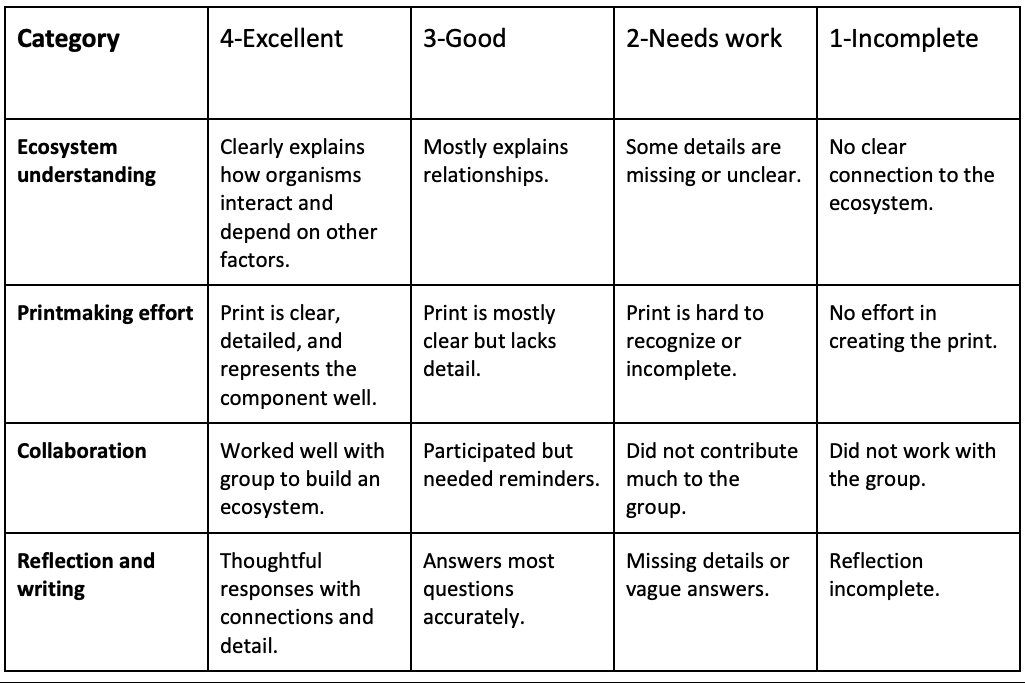
  • RUBRIC

A rubric table for grades 6-8 assessing Ecosystem understanding, Printmaking effort, Collaboration, and Reflection and writing—each rated from 4-Excellent to 1-Incomplete with specific criteria like interdependence in ecosystems.


Differentiation

Accelerated: 

  • Students research and depict more complex interactions (e.g., symbiosis, keystone species).
  • Reflection Essay – Students write an analysis of ecosystem relationships, including the impact of resource availability.
  • Students photograph their prints and use Google Slides or Canva to create a digital food web or ecosystem model.
  • Students can animate their food web interactions in Scratch to show energy flow.


Remedial:

  • Provide pre-drawn symbol templates for inspiration.
  • Use sentence starters for the reflection writing portion.


Additional Resources

Virtual Field Trip


Credits

Ideas contributed by: Shannon Green

*This integrated lesson provides differentiated ideas and activities for educators that are aligned to a sampling of standards. Standards referenced at the time of publishing may differ based on each state’s adoption of new standards.

Revised and copyright:  May 2025 @ ArtsNOW
 

ELECTRICITY IGNITES! MAY THE FORCE BE WITH YOU IMPROVISATIONS 6-8

MAY THE FORCE BE WITH YOU IMPROVISATIONS

ELECTRICITY IGNITES! MAY THE FORCE BE WITH YOU IMPROVISATIONS

Learning Description

Students will use improvisation to expand their knowledge of gravity, electricity, and magnetism. The room will buzz with movement as they put gravity and magnetic fields into their bodies while playing "Gravity Groove" and "Magnetic Field Milling". They will then explore the golden rule of improvisation, "Yes..and" by playing "You are a….Yes, I am". The lesson concludes with students creating improvised scenes with given Force of Nature Scenarios (Gravity, Magnetism, Electricity, Friction, Inertia). This challenging and hilarious lesson will catapult students' imaginations and get them out of their comfort zones.


Learning Targets

GRADE BAND: 6-8
CONTENT FOCUS: THEATRE & SCIENCE
LESSON DOWNLOADS:

Download PDF of this Lesson

"I Can" Statements

“I Can…”

  • I can use my body to explore different aspects of electricity.
  • I can use my imagination to learn about science.
  • I can create stories with characters and dialogue to bring electricity to life.
  • I can use improvisation to make stories about what I am learning in science.
  • I can build upon others' ideas.

Essential Questions

  • How can improvisation help me understand the forces of nature?
  • What is the difference between negating and accepting others' ideas?
  • How can I embody radical acceptance in my life and the world around me?


Georgia Standards

Curriculum Standards

Grade 8:

S8P5 Obtain, evaluate, and communicate information about gravity, electricity, and magnetism as major forces acting in nature.

Additional Science standards that can be taught using these theatre strategies:

Grade 6:

S6E4. Obtain, evaluate, and communicate information about how the sun, land, and water affect climate and weather.

a. Analyze and interpret data to compare and contrast the composition of Earth’s atmospheric layers (including the ozone layer) and greenhouse gases.

b. Plan and carry out an investigation to demonstrate how energy from the sun transfers heat to air, land and water at different rates.

Grade 7:

S7L2. Obtain, evaluate, and communicate information to describe how cell structures, cells, tissues, organs, and organ systems interact to maintain the basic needs of organisms.

a. Develop a model and construct an explanation of how cell structures (specifically the nucleus, cytoplasm, cell membrane, cell wall, chloroplasts, lysosome, and mitochondria) contribute to the function of the cell as a system in obtaining nutrients in order to grow, reproduce, make needed materials, and process waste.

Arts Standards

TA.PR.1 Act by communicating and sustaining roles in formal and informal environments.

a. Demonstrate effective verbal and non-verbal communication skills (e.g. rate, pitch, volume, inflection, posture, facial expression, physical movement).

c. Demonstrate a variety of types of theatre performances.


South Carolina Standards

Curriculum Standards

Grade 8:

8-PS2-1. Apply Newton’s third law to design a solution to a problem involving the motion of two colliding objects.

8-PS2-3. Analyze and interpret data to determine the factors that affect the strength of electric and magnetic forces.

8-PS2-4. Construct and present arguments using evidence to support the claim that gravitational interactions are attractive and depend on the masses of interacting objects and the distance between them.

8-PS2-5. Conduct an investigation and evaluate the experimental design to provide evidence that fields exist between objects exerting forces on each other even though the objects are not in contact.

Additional Science standards that can be taught using these theatre strategies:

Grade 6:

6-PS1-4. Develop and use a model that predicts and describes changes in particle motion, temperature, and state of a pure substance when thermal energy is added or removed.

6-PS3-4. Plan an investigation to determine the relationships among the energy transferred, the type of matter, the mass, and the change in the average kinetic energy of the particles as measured by the temperature of the sample.

Grade 7:

7-PS1-2. Analyze and interpret data on the properties of substances before and after the substances interact to determine if a chemical reaction has occurred.

7-PS3-5. Construct, use, and present arguments to support the claim that when the kinetic energy of an object changes, energy is transferred to or from the object.

Arts Standards

Anchor Standard 1: I can create scenes and write scripts using story elements and structure. 

Anchor Standard 3: I can act in improvised scenes and written scripts.


Key Vocabulary

Content Vocabulary

  • Attract - When two objects pull toward each other due to magnetic or electric forces; opposite charges or poles attract (e.g., a north pole and a south pole of a magnet)
  • Repel - When two objects push away from each other due to magnetic or electric forces; like charges or poles repelling (e.g., two north poles of a magnet)
  • Positive (+) - A type of electric charge or magnetic property. It repels other positive charges and attracts negative charges.
  • Negative (-) - A type of electric charge or magnetic property. It repels other negative charges and attracts positive charges.
  • North Pole (N) - One of the two ends of a magnet where the magnetic force is the strongest
  • South Pole (S) - The opposite end of a magnet where the magnetic force is the strongest
  • Gravity - The force that pulls all objects with mass towards each other, causing things to fall to the ground and keeping planets in orbit
  • Friction - A force that opposes motion when two surfaces come into contact
  • Inertia - The tendency of an object to resist a change in motion; an object at rest stays at rest, and an object in motion stays in motion unless acted on by an outside force (Newton's First Law of Motion)
  • Magnetism - The force that is created by the movement of tiny charged particles called electrons and causes some materials, like iron, to attract or repel each other
  • Magnetic field -  The invisible area around a magnet where the force of magnetism acts, attracting or repelling other magnets and magnetic materials like iron

Arts Vocabulary

  • Body - Actors use their body to become a character through body posture and movement. What your mind thinks, what your emotions feel, all of this is supposed to show up in your body.
  • Posture - How an actor holds their shoulders and chest to portray a character's motivations, emotions, and traits.
  • Imagination - Actors use their imagination to envision things that are not real. It is an essential tool in an actor’s ability to bring a character, scene, etc. to life.
  • Facial Expressions - Using your face to show emotion
  • Improvisation - A moment in a play that is not rehearsed or “scripted”, or acting without a script. For example: if an actor forgets a line, he/ she may improvise the line in the scene.
  • Rules of Improvisation -
  1. Say "Yes, and…"
    • Always accept what your scene partner says or does.
    • Build on it by adding your own ideas instead of shutting theirs down.
  2. Avoid asking too many questions.
    • Instead of just asking, add information to keep the scene moving.
  3. Make bold choices and commit.
    • Don't be afraid to fully commit to your character and actions.
    • Even if something feels silly, own it!
  4. Keep the scene moving forward.
    • Scenes shouldn't stall—always contribute to the action.
    • If things slow down, introduce a new action, emotion, or obstacle.
  5. Stay in the moment.
    • Listen to your scene partners and respond genuinely.
  6. Make your partner look good.
    • Improv is about teamwork, not competition.
    • Support each other and help the scene succeed instead of trying to be the funniest.
  7. There are no mistakes, only opportunities.
    • If something unexpected happens, go with it!
    • Mistakes can lead to hilarious or creative moments in a scene.
  8. Keep it appropriate.
  •  
  •  
  •  
  •  


Materials

  • Positive/Negative cards–index cards with one word on each: Positive (+), negative (-) (one card per student)
  • North/South cards–index cards with one word on each: North (N), South (S) (one card per student)
  • Rules of Improvisation
  • Force of Nature Scenarios for "May the Force Be With You" improvisations.
    • 1 - "Magnetic Mystery" (Magnetism, Electricity)
      • Scenario: A town is experiencing strange magnetic disturbances—cars, phones, and even metal trash cans are flying toward a mysterious magnetic field! A group of scientists must figure out what's causing it before everything metal disappears into the sky.
        • Forces in action:
          • Magnetism–students can act as metal objects being pulled toward an invisible force
          • Electricity–powering the magnet on/off to control the chaos
        • 2 - "Frenzy Friction" (Friction, Inertia)
          • Scenario: A group of skiers is competing in a downhill race, but as they reach the bottom, they realize the snow has melted into a super slippery ice patch! With almost no friction, they can't stop and must figure out how to slow down before crashing.
            • Forces in action:
              • Friction–acting out different surfaces: rough snow versus slick ice
              • Inertia–skiers keep moving unless something stops them
            • 3 - "Elevator Drop" (Electricity, Gravity)
              • Scenario: A group of people is in an elevator when the power goes out! Without electricity, the elevator stops moving. Then, the emergency backup kicks in, but gravity starts pulling it too fast. Can they figure out how to stop the elevator before it crashes?
                • Forces in action:
                  • Electricity–powers the elevator, but it fails
                  • Gravity–pulling it down when the power is lost
                  • Friction–brakes activating to slow it down
                • 4 - "Rollin’ Coaster" (Inertia, Friction, Gravity)
                  • Scenario: A brand-new roller coaster malfunctions, and instead of slowing down at the end, it keeps speeding up! The riders must find a way to stop the ride before they launch off the tracks.
                    • Forces in action:
                      • Gravity–pulling the coaster down steep drops
                      • Inertia–coaster keeps moving unless stopped
                      • Friction–brakes trying to slow it down


Instructional Design

Opening/Activating Strategy

EXTREME ZING! (Magnetism & Electricity)

  • Explore the words attract and repel and how they look on our bodies.
    • Repel jumps away.
    • Attract comes together.
  • Explore the words positive and negative and how they look with our bodies, faces, and voices.
    • Positive - Tall body, high level that goes from small to big, face goes small to big, voice with pitch and volume that grows
    • Negative - Small body, low level that goes from low to high, face from big to small, voice with pitch and volume that decrease
  • Discuss how attract and repel relate to positive and negative charges.
    • Opposites attract.
    • Likes repel.
  • Have students mill about the room.
  • Tell students:
    • When I say "1, 2, 3…Action" you will mill about the room as your positive or negative character.
    • When I say "1, 2, 3…ZING!" you will freeze opposite the person/character closest to you.
    • Physically react to your partner/other character:
      • If they are opposites (+ and -) or (North and South), they must move toward each other (slow-motion magnetization).
      • If they are like charges (+ and +) or (North and North), they must dramatically push apart like an invisible force is pushing them.
    • I will then say "1, 2, 3…Action” and you will mill about the room again until I call out "1, 2, 3.. ZING”.
  • Give each student a positive/negative card and a north/south card.
  • Keep playing for several rounds.
  • Then, add the third action: Neutral!
    • Students freeze, representing an uncharged object.


GRAVITY GROOVE

  • Discuss how gravity changes movement.
  • Ask students to move around the room normally.
  • Call out different gravity levels:
    • Zero gravity:
      • Students move in slow motion, floating like astronauts.
    • Moon gravity:
      • Students take big, slow steps, like walking on the Moon.
    • Extreme gravity:
      • Students act as if they are being pulled down with heavy weight.
    • Coaching note:
      • Encourage students to exaggerate their movements and facial expressions to tell a strong non-verbal story.


MAGNETIC FIELD MILLING

  • Discuss the meaning of a magnetic field.
  • Play music.
  • Explain the game. Say:
    • When I play the music, you will walk around the room like a magnetic particle floating in space.
    • When I stop the music, I will call out a scenario.
    • You need to use your whole body, facial expression, and imagination to embody the scenario without words.
  • Start the music. Asking questions as students mill about the space.
    • How would that feel in your body?
    • How would your legs react?
    • How would your arms react?
  • Stop the music and call out a scenario:
    • Strong magnet!
      • Students rush to the center of the room acting like a strong magnetic field pulling them in.
        • Coaching questions:
          • How would this change the pace of your movement?
          • How would the magnetic field pull you?
          • What part of your body would lead?
        • Weak magnet!
          • Students lazily move in all directions showing a weak attraction.
            • Coaching questions:
              • How would this change the pace of your movement?
              • How would your face react?
              • What part of your body would lead?
              • How would your posture change?
            • Magnet turned off!
              • Students collapse like the magnet lost power.
                • Coaching questions:
                  • How would you fall to the ground?
                  • Add a sound when you are turned off.

Work Session

IMPROVISATION

  • Introduce the Rules of Improvisation.
  • Watch the video: Minute Improv Yes And.
  • GAME: "YOU ARE A…..YES, AND I AM"
    • Have students get into partners around the room.
    • Partner #1 tells the other what character they are/have.
      • #1 says, “You are a ________.”
      • #1 claps three times while Partner #2 becomes the character.
    • Partner #2 immediately physicalizes and embodies the character said to them.
      • Then says, after the claps, “Yes, I am ….and….I _______”, adding in a detail and acting it out.
    • Partner #1 gives Partner #2 three character suggestions. Then, the partners switch.
    • Partner #2 gives Partner #1 three character suggestions.
    • Example:
      • #1 says, “You are a monkey” then claps three times.
      • #2 becomes a monkey with body, voice, and sounds.
      • #2 says, “YES, I am a monkey, AND I eat bananas!”.
      • Repeat this twice and then switch.


MAY THE FORCE BE WITH YOU

  • Say, “Now, let's practice and play with improvisation; let's make up scenes on our feet as we go along”.
  • Ask three student volunteers to come to the front of the room.
  • Read the scenario: "Lost in Space" (Gravity, Inertia).
    • A team of astronauts is on a spacewalk when their spaceship's gravity generator malfunctions! Suddenly, they are floating in zero gravity. A planet’s gravitational pull pulls them in as they struggle to move. Can they escape before they get sucked into the atmosphere?
    • Ask students which forces are at work. This scenario deals with gravity and inertia.
    • Ask students to explore ways that would look in their bodies in each scenario.
      • Gravity–weightlessness in space versus strong pull from a planet
      • Inertia–astronauts floating in motion until they push off something
    • Ask students to freeze in a pose as if they are floating in zero gravity.
    • Call "Action" and have students come to life.
    • Coaching notes as students improvise.
      • If a student negates something, ask them to repeat it with "Yes, and…"
      • Tell students:
        • Project your voice so that we can hear you.
        • Listen to your partner.
        • Build on what your partner is saying.
        • Bring in the focus of nature.
      • When students are finished, call "Lights out."
      • Have students bow.
      • Ask the students in the audience what they thought each actor did well.
      • Ask them what worked and didn't work about the dialogue.
      • Assign groups of students a Force of Nature Scenario (Gravity, Magnetism, Electricity, Friction, Inertia).
        • Give students ten minutes to rehearse.
        • Have students share scenes.
        • Keep coaching as scenes are being performed to help direct the scenes if needed


Closing Reflection

  • Say, “Improvisation is radical cooperation and acceptance. Why do you think people say that about improv?”.
    • Have students turn and talk to a neighbor about the following:
      • Was improvisation easy or hard for you, and why?
      • Think about how saying "Yes…and" might change some of your school, home, and work relationships.


Assessments

Formative

  • Walk around the room and listen to collaboration to assess students’ comprehension of the material.
  • Observe students' understanding of improvisation and comfort level throughout the lesson.

Summative

  • Assess students' content comprehension through the scenes that they create. Check to make sure they include the forces and create dialogue.


Differentiation

Accelerated: 

  • Accelerated students can revise and edit their scripts. Then, type them out and create blocking to perform in front of the class. Blocking is the physical arrangement of actors on a stage that facilitates the performance of a play.


Remedial:

  • The class can work as one team and develop a simple script for each scenario. Then, they can read them aloud in class.


Additional Resources

Minute Improv Video: Yes And


Credits

Ideas contributed by: Susie Spear Purcell

*This integrated lesson provides differentiated ideas and activities for educators that are aligned to a sampling of standards. Standards referenced at the time of publishing may differ based on each state’s adoption of new standards.

Revised and copyright:  May 2025 @ ArtsNOW


THE ART OF CHANGE– A CHEMICAL AND PHYSICAL ADVENTURE: EXPLORING PHYSICAL AND CHEMICAL CHANGES THROUGH INDIGO DYEING 5,7

EXPLORING PHYSICAL AND CHEMICAL CHANGES THROUGH INDIGO DYEING

THE ART OF CHANGE–A CHEMICAL AND PHYSICAL ADVENTURE:EXPLORING PHYSICAL AND CHEMICAL CHANGES THROUGH INDIGO DYEING

Learning Description

Students will explore both physical and chemical changes by using the visual arts process of indigo dyeing to help students apply their understanding of chemical and physical changes as they go through the various steps of dyeing fabric.


Learning Targets

GRADE BAND: 5,7
CONTENT FOCUS: VISUAL ARTS & SCIENCE
LESSON DOWNLOADS:

Download PDF of this Lesson

"I Can" Statements

“I Can…”

  • I can use art materials to engage in the artistic process of indigo dyeing./li>
  • I can differentiate between which steps in the visual arts process were physical changes and which were chemical changes.
  • I can justify my artistic choices using my knowledge of both physical and chemical changes.

Essential Questions

  • How can visual arts be used to demonstrate understanding of what constitutes a physical change versus a chemical change?
  • How can the artistic process of indigo dyeing be used to model and classify both physical and chemical changes?


Georgia Standards

Curriculum Standards

Grade 5:

S5P1. Obtain, evaluate, and communicate information to explain the differences between a physical change and a chemical change.
a.Plan and carry out investigations of physical changes by manipulating, separating, and mixing dry and liquid materials.
b.Construct an argument based on observations to support a claim that the physical changes in the state of water are due to temperature changes, which cause small particles that cannot be seen to move differently.
c. Plan and carry out an investigation to determine if a chemical change occurred based on observable evidence (color, gas, temperature change, odor, new substance produced).

Arts Standards

Grade 5:

VA5.CR.1 Engage in the creative process to generate and visualize ideas by using subject matter and symbols to communicate meaning.
VA5.CR.2 Create works of art based on selected themes.
VA5.CR.3 Understand and apply media, techniques, processes, and concepts of two-dimensional art.
VA5.CN.2 Integrate information from other disciplines to enhance the understanding and production of works of art.


South Carolina Standards

Curriculum Standards

Grade 7:

7-PS1-2. Analyze and interpret data on the properties of substances before and after the substances interact to determine if a chemical reaction has occurred.

Arts Standards

Anchor Standard 1: I can use the elements and principles of art to create artwork.
Anchor Standard 2: I can use different materials, techniques, and processes to make art. 
Anchor Standard 7: I can relate visual arts ideas to other arts disciplines, content areas, and careers.


Key Vocabulary

Content Vocabulary

  • State of matter - The distinct forms that different phases of matter take on: solid, liquid, gas and plasma
  • Physical change - A change from one state of matter to another without a change in chemical composition
  • Chemical change - A change that produces one or more new substances and may release energy
  • Substance - A type of matter that has a unique set of properties
  • Material - Relating to, derived from, or consisting of matter
  • Heat - The movement of thermal energy from one place to another
  • Reversible change - A change that can be undone; often called a physical or temporary change
  • Irreversible change - A process that is not reversible
  • Mixtures - A combination of two or more substances that can be separated by physical means
  • Compound - A substance made up of two or more elements that are chemically combined. For example, carbon dioxide is a compound that is chemically combined
  • Oxidize - To undergo a chemical reaction in which a substance combines with oxygen, resulting in a change in its chemical composition

Arts Vocabulary

  • Indigo dye - An organic compound with a distinctive blue color; historically, indigo was a natural dye extracted from plants, and this process was important economically because blue dyes were once rare
  • Indican - The compound that yields indigo blue, is a glycoside: a sugar (in this case a form of glucose) bound to another molecule, indoxyl; when the glycosidic bond is broken, the indoxyl is freed; then the indoxyl compound is oxidized, it becomes blue: indigo blue
  • Shibori - A Japanese manual resist dyeing technique, which produces patterns on fabric
  • Resist - A technique where a substance or material is applied to a surface to prevent certain areas from absorbing paint, dye, or ink; it creates patterns, designs, or textures by "resisting" the medium in specific areas


Materials


Instructional Design

Opening/Activating Strategy

  • Review physical and chemical changes.
  • Introduce students to the art of Shibori with images.
    • Have students observe the images using a visual thinking strategy, such as the artful thinking routine of 10x2 or the artful thinking routine of Colors/Shapes/Lines.
      • 10x2 Artful Thinking Routine:
        • Look at the image quietly for at least 30 seconds. Let your eyes wander.
        • List 10 words or phrases about any aspect of the picture.
        • Repeat Steps 1 and 2: Look at the image again and try to add 10 more words or phrases to your list.
      • Colors/Shapes/Lines Artful Thinking Routine:
        • Look at the artwork or object for a moment.
          • What colors do you see?
          • What shapes do you see?
          • What lines do you see?

Tell students that Shibori is a technique that results in both physical and chemical changes.

Work Session

Teacher note: This activity can be done in small groups or as a whole class.

Hand out the physical and chemical changes checklist. Students may complete this individually or in pairs/groups. Students will complete the checklist during the process.

  • Pass out the Indigo Dying Chart to students. Spend a few minutes going over the document.
  • Follow these steps for preparing the indigo:
    • Fill a bucket with four gallons of water.
    • Add the thiox and soda ash to the water while stirring.
    • Add the reduced indigo.
    • Stir in a clockwise motion until indigo is dissolved, reverse the direction and place the lid on the bucket.
    • Let indigo sit for twenty minutes.
  • While the indigo is sitting, demonstrate or show students a video of shibori folding techniques. Students should fold their cloth and bind to create a resist.
  • Remove the lid from the indigo vat and remove the frothy bloom. The bloom is the result of oxygen leaving the vat. Now the vat is ready for dyeing.
  • Put on rubber gloves.
  • Dip the fabric bundle into clean water and wring out.
  • Hold your bundle under the surface of the indigo vat, massaging the dye into the fabric for one minute.
  • Remove the bundle; notice the physical characteristics of the bundle.
  • It should be a yellow color that changes from green to blue as it oxidizes.
    • Ask students to make observations about what is happening to the color and why they think it’s changing.
    • Discuss what it means for something to “oxidize”.
  • The bundle may be dipped multiple times to obtain a deep blue color.
  • Allow the bundle to sit for ten minutes.
  • Rinse the bundle under water.
  • Unbind your bundle and admire your design.
  • Hang to dry.

Closing Reflection

  • Have students reflect on the following questions either in small groups or in a written format:
    • How did engaging in the arts support and build upon your understanding of chemical and physical changes?
    • How did this STEAM activity help you understand chemical and physical changes in the world around you?
    • If you were to go through this artistic process again, what would you do differently? Why?


Assessments

Formative

  • Observations of students in the artistic process
  • Question and answer

Summative

Indigo Dying Chart


DIFFERENTIATION

Acceleration: 

Ask students to predict their shibori pattern based on their folding technique. Compare the predictions and final product.

Remediation:

  • Chunk the lesson by periodically stopping to review the Indigo Dying Chart with students and discuss the physical and chemical changes that are taking place.
  • Allow students to work with a small group or in partners on the Indigo Dying Chart.

ADDITIONAL RESOURCES

Shibori: https://www.seamwork.com/issues/2015/08/shibori-dyeing


CREDITS

U.S. Department of Education- STEM + the Art of Integrated Learning

*This integrated lesson provides differentiated ideas and activities for educators that are aligned to a sampling of standards. Standards referenced at the time of publishing may differ based on each state’s adoption of new standards.

Revised and copyright:  June 2025 @ ArtsNOW


THE ART OF CHANGE– A CHEMICAL AND PHYSICAL ADVENTURE: DRAMATIZING PHYSICAL AND CHEMICAL CHANGES THROUGH MOVEMENT 5,7

DRAMATIZING PHYSICAL AND CHEMICAL CHANGES THROUGH MOVEMENT

THE ART OF CHANGE–A CHEMICAL AND PHYSICAL ADVENTURE:DRAMATIZING PHYSICAL AND CHEMICAL CHANGES THROUGH MOVEMENT

Learning Description

Students will use their bodies and movement to personify and dramatize physical or chemical changes. They will create a two-part moving picture and dialogue to support their dramatization.


Learning Targets

GRADE BAND: 5,7
CONTENT FOCUS: THEATRE & SCIENCE
LESSON DOWNLOADS:

Download PDF of this Lesson

"I Can" Statements

“I Can…”

  • I can use my body and movement to dramatize the changes of an object involved in chemical or physical change.
  • I can create a two-part tableau and incorporate dialogue that helps communicate the story and my understanding of chemical and physical changes.
  • I can justify my artistic choices using my knowledge of both physical and chemical changes.

Essential Questions

  • How can theatre strategies be used to demonstrate understanding of what constitutes a physical change versus a chemical change?
  • How can moving through two tableaux be used to dramatize materials as they undergo physical or chemical changes?


Georgia Standards

Curriculum Standards

Grade 5:

S5P1. Obtain, evaluate, and communicate information to explain the differences between a physical change and a chemical change.
a.Plan and carry out investigations of physical changes by manipulating, separating, and mixing dry and liquid materials.
b.Construct an argument based on observations to support a claim that the physical changes in the state of water are due to temperature changes, which cause small particles that cannot be seen to move differently.
c. Plan and carry out an investigation to determine if a chemical change occurred based on observable evidence (color, gas, temperature change, odor, new substance produced).

Arts Standards

Grade 5:

TA5.PR.1 Act by communicating and sustaining roles in formal and informal environments.


South Carolina Standards

Curriculum Standards

Grade 7:

7-PS1-2. Analyze and interpret data on the properties of substances before and after the substances interact to determine if a chemical reaction has occurred.

Arts Standards

Anchor Standard 3: I can act in improvised scenes and written scripts.


Key Vocabulary

Content Vocabulary

  • State of matter - The distinct forms that different phases of matter take on: solid, liquid, gas and plasma
  • Physical change - A change from one state of matter to another without a change in chemical composition
  • Chemical change - A change that produces one or more new substances and may release energy
  • Substance - A type of matter that has a unique set of properties
  • Material - Relating to, derived from, or consisting of matter
  • Heat - The movement of thermal energy from one place to another
  • Reversible change - A change that can be undone; often called a physical or temporary change
  • Irreversible change - A process that is not reversible
  • Mixtures - A combination of two or more substances that can be separated by physical means
  • Compound - A substance made up of two or more elements that are chemically combined. For example, carbon dioxide is a compound that is chemically combined

Arts Vocabulary

  • Tableau - A frozen picture representing a scene or moment in a story that occurs during a theatrical performance. When creating a tableau in theatre, the following principles should be applied:
    • Create body levels (low, mid, high);
    • Use facial expressions to communicate thoughts and feelings;
    • Show relationships between the various characters in the setting; and
    • Make sure the audience can all see your face.
  • Dialogue - A conversation between two or more persons
  • Scenario - The outline of action in a play
  • Thought-tracking - A theatre technique in which individuals participating in tableau, or members of the class observing a tableau, are invited to speak the thoughts or feelings of a portrayed character aloud


Materials


Instructional Design

Opening/Activating Strategy

  • Introduce the art form of tableau with a warm-up: Silent Tableau.
  • Students will form small groups. Groups will be asked to form various shapes within their groups silently. (Ex: circle, crescent moon, diamond)
  • Go over the Principles of Tableau (Anchor Charts - Tableau and Physical versus Chemical Changes (slide 1).
  • Groups will then be asked to form various scenarios within their groups silently. Dialogue will be added into the silent scenes through thought-tracking. Groups will practice forming two-part tableaux of a particular scenario.

Examples: Students are on a picnic and it begins to rain; students are playing with a ball in the living room until someone hits a lamp and it breaks; a group of friends wait to yell “surprise” for a surprise birthday party.

Work Session

  • Review the concept of physical versus chemical changes.
  • Divide class into small groups and assign a particular chemical or physical change on an index card. (Suggested prompts for dramatizing physical and chemical changes).
  • Groups will discuss their change and determine together whether it is physical or chemical.
  • Then they will form a two-part dramatization of the scenario undergoing the change. The two tableaux will dramatize how the change occurred and the cause and effect of the change.
  • Direct students to use the Tableau Preparation Template to help with the next step.
  • In each scenario, students will create dialogue that helps support the type of change that occurred.
  • After the groups have had time to rehearse, groups share their tableaux in an informal class performance. The goal is for the audience to be able to determine the materials that changed and whether it was a physical or chemical change based on the performance.

Classroom Tips:

  • Use cueing methods when directing tableaux in your classroom: “3-2-1- Freeze” and “Actor’s Neutral”.
  • Make your expectations for the tableau science task explicit and go over these before the group work begins. Post them in the room so that students can refer back to them if they need to during their group working time.

Closing Reflection

  • Have students respond to the following reflection questions in small groups or through a written reflection:
    • How did engaging in the arts support and build upon your understanding of chemical and physical changes?
    • How did this tableau help you understand chemical and physical changes in the world around you?
    • If you were to go through this artistic process again, what would you do differently? Why?


Assessments

Formative

Summative


Differentiation

Acceleration: 

  • During the student performances of the tableau, digital pictures or video can be taken for integration on a final group presentation of a Thinglink. The class will work in groups to create a Thinglink example of their physical or chemical change. They may link their digital pictures or videos to a place in the artwork. Other content to include on the Thinglink should be the definition of the physical or chemical change, other examples of the physical or chemical change, why the change is important, and a definition of a tableau.

Remediation:

  • Use modeling and guided practice by going through the process of creating a tableau to show a physical or chemical change. Ask the class to help you decide how to show the before and after of the change.
  • Provide students with images of physical and chemical changes. Ask students to show those images with their bodies.


Credits

U.S. Department of Education- STEM + the Art of Integrated Learning

*This integrated lesson provides differentiated ideas and activities for educators that are aligned to a sampling of standards. Standards referenced at the time of publishing may differ based on each state’s adoption of new standards.

Revised and copyright:  June 2025 @ ArtsNOW