
PRINTMAKING ECOSYSTEMS: CARRYING CAPACITY AND BIODIVERSITY
Learning Description
Students will research ecosystem interactions and choose a biotic or abiotic factor to represent in a collaborative printmaking project. Each student will create a styrofoam print of a key component of an ecosystem (e.g., a producer, consumer, decomposer, or abiotic factor like water or sunlight). Then, students will combine their prints to create a large-scale class ecosystem print that visually represents interdependence and energy flow.
Learning Targets
"I Can" Statements
“I Can…”
- I can describe the interdependence between organisms and their environment.
- I can develop a model showing the flow of energy in an ecosystem.
- I can create a print that symbolizes an important ecosystem component.
- I can collaborate with my peers to construct a visual representation of an ecosystem.
Essential Questions
- How do organisms interact with one another and their environment?
- How do abiotic factors influence ecosystems?
- How does resource availability affect populations within an ecosystem?
- How can we represent scientific relationships through visual symbols?
Georgia Standards
Curriculum Standards
Grade 7:
S7L4. Obtain, evaluate, and communicate information to examine the interdependence of organisms with one another and their environments.
a. Construct an explanation for the patterns of interactions observed in different ecosystems in terms of the relationships among and between organisms and abiotic components of the ecosystem.
b. Develop a model to describe the cycling of matter and the flow of energy among biotic and abiotic components of an ecosystem.
Arts Standards
VA7.CR.1 Visualize and generate ideas for creating works of art.
VA7.PR.1 Plan, prepare, and present completed works of art.
South Carolina Standards
Curriculum Standards
Grade 7:
7-LS2-2. Construct an explanation that predicts patterns of interactions among organisms across multiple ecosystems.
7-LS2-3. Develop a model to describe the cycling of matter and flow of energy among living and nonliving parts of an ecosystem.
Additional Science standards that can be taught using this Visual Arts strategy:
Grade 6:
6-LS1-3. Use arguments supported by evidence for how the body is a system of interacting subsystems composed of groups of cells.
Grade 8:
8-LS1-5. Construct a scientific explanation based on evidence for how environmental and genetic factors influence the growth of organisms.
Arts Standards
Anchor Standard 1: I can use the elements and principles of art to create artwork.
Anchor Standard 2: I can use different materials, techniques, and processes to make art.
Anchor Standard 7: I can relate visual arts ideas to other arts disciplines, content areas, and careers.
Key Vocabulary
Content Vocabulary
- Interdependence – The way organisms rely on each other and their environment
- Ecosystem – A community of interacting organisms and their physical environment
- Biotic factors – Living components of an ecosystem (plants, animals, fungi, bacteria)
- Abiotic factors – Nonliving components of an ecosystem (sunlight, water, soil)
Arts Vocabulary
- Symbol – A visual representation of an idea or theme
- Printmaking – The art or technique of making prints, especially as practiced in engraving, etching, dry point, woodcut or serigraphy
- Styrofoam printing plate – A carved surface used to make repeated prints
- Brayer – A small roller for inking type by hand, usually for making a proof
- Composition – How an artist arranges the Elements of Art (line, shape, form, value, color, space, texture) to create an artwork
- Collaboration – Working together to achieve a common goal
Materials
- Pencils
- Copy paper
- Styrofoam sheets
- Ball point pen or dull pencils
- Water based printing ink
- Brayers
- Paper for printing (mixed media paper works well)
- Colored pencils or art sticks
- Drying rack or space to lay prints
- Paper towels to wipe ink off of styrofoam plates
- Trays for ink
Instructional Design
Opening/Activating Strategy
Engage (Research & Discussion)
- Divide students into groups.
- Students will research different ecosystems (rainforest, desert, ocean, tundra, etc.) and analyze how organisms interact with their environment.
- Each group will choose an ecosystem and each student will choose a component to represent (e.g., a predator, a tree, a river).
- Ask students to sketch a symbol that represents their chosen organism or abiotic factor.
Work Session
Explore (Planning & Design)
- Discuss what a symbol is. Discuss how symbols are visual representations of an idea or theme.
- Ask students to create detailed sketches of their component, ensuring their symbol visually represents its role in the ecosystem.
- Ask students to discuss how their organisms interact (e.g., a rabbit and a fox, a tree providing oxygen).
Create (Printmaking Process):
- Review these printmaking tips with students.
- Prepping the styrofoam plate:
- Use a dull pencil or ballpoint pen to carve designs—press firmly but avoid puncturing all the way through.
- Encourage students to sketch lightly first before carving to avoid mistakes.
- Carving techniques:
- Keep lines simple and bold for clear prints; intricate details may not transfer well.
- Reverse letters or numbers if including text, as prints will be a mirror image.
- Vary line thickness for added depth—thicker lines hold more ink, while thinner lines create subtle details.
- Inking the plate:
- Roll out a thin, even layer of ink on a tray before applying to the printing plate with a brayer.
- Roll the inked brayer over the styrofoam plate. Make sure ink covers the entire design, but avoid excessive ink, which can cause smudging.
- Test prints on scrap paper before the final collaborative print.
- Printing process:
- Place the inked plate face down on the final paper and press evenly with hands or a clean brayer.
- Avoid shifting or sliding the plate while printing to prevent smudging.
- Lift the plate carefully to reveal the design.
- Encourage students to appreciate the imperfections as part of the artistic process!
- Prepping the styrofoam plate:
Final Touches:
- Allow prints to dry completely before handling.
- Once dry, encourage students to add color and hand-drawn details using colored pencils or art sticks.
Collaboration:
Instruct students to assemble their prints to represent an ecosystem, visually showing relationships like predator-prey, competition, and symbiosis.
Closing Reflection
- Students will participate in a gallery walk, observing and discussing the ecosystem prints.
- Groups will present their components and explain how they contribute to the ecosystem.
- Students write a reflection on how their organism depends on others and how resource availability impacts populations.
Assessments
Formative
- Observe students’ research on how their component interacts with others (option to have students complete a graphic organizer).
- Peer discussions – Students explain their symbols before carving to ensure accurate representation.
Summative
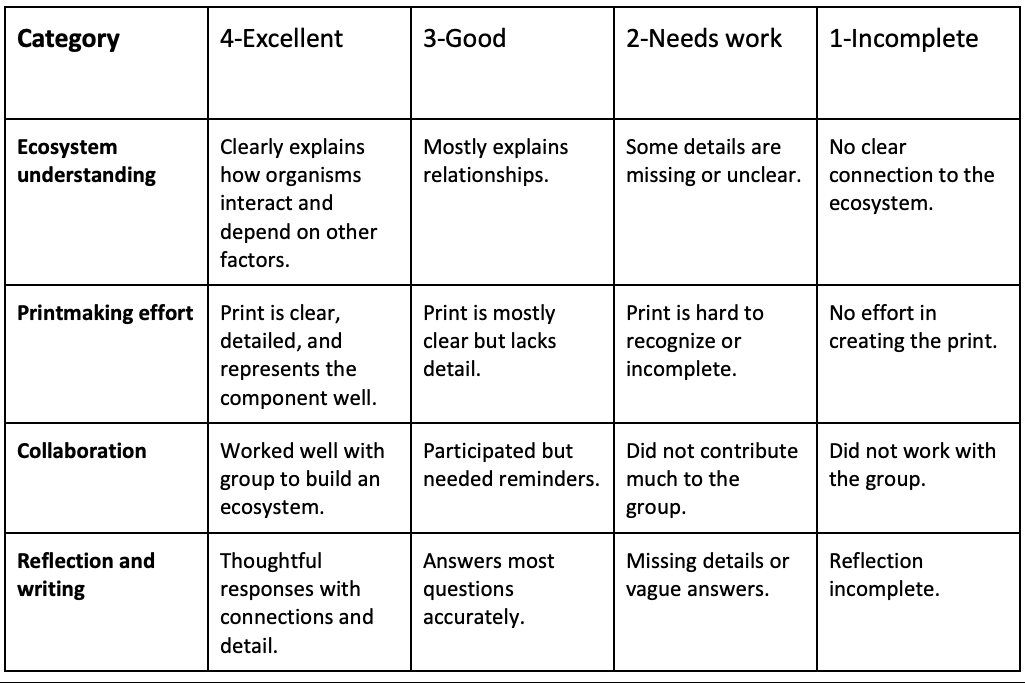
- Final print and presentation – Students will submit their individual prints and written reflections of their ecosystem’s energy flow.
- RUBRIC
Differentiation
|
Accelerated:
Remedial:
|
Additional Resources
Virtual Field Trip
Credits
Ideas contributed by: Shannon Green
*This integrated lesson provides differentiated ideas and activities for educators that are aligned to a sampling of standards. Standards referenced at the time of publishing may differ based on each state’s adoption of new standards.
Revised and copyright: May 2025 @ ArtsNOW