MINDFUL MANDALAS 5

MINDFUL MANDALAS

MINDFUL MANDALAS

Learning Description

Students will create mindful mandalas that use radial balance, pattern, and variety to calm the mind.


Learning Targets

GRADE BAND: 5
CONTENT FOCUS: VISUAL ARTS & HEALTH
LESSON DOWNLOADS:

Download PDF of this Lesson

"I Can" Statements

“I Can…”

  • I can use and identify radial balance.
  • I can use color, pattern, and variety to create harmony.
  • I can use positive self-talk to change my mindset.

Essential Questions

  • What is radial balance?
  • How can we use color, pattern, and variety to create harmony?
  • How can positive self-talk change your mindset?


Georgia Standards

Curriculum Standards

HE5.1 Students will comprehend concepts related to health promotion and disease prevention to enhance health.

HE5.1.c Describe and apply the basic health concept of mental and emotional well-being.

HE5.7 Students will demonstrate the ability to practice health-enhancing behaviors and avoid or reduce health risks.

HE5.7.a Practice responsible personal health choices.

Arts Standards

VA5.CR.1 Engage in the creative process to generate and visualize ideas by using subject matter and symbols to communicate meaning.

VA5.PR.1 Plan and participate in appropriate exhibition(s) of works of art to develop identity of self as artist.

VA5.CR.5 Demonstrate an understanding of the safe and appropriate use of materials, tools, and equipment for a variety of artistic processes.

VA5.RE.1 Use a variety of approaches for art criticism and to critique personal works of art and the artwork of others to enhance visual literacy.

VA5.CN.3 Develop life skills through the study and production of art (e.g. collaboration, creativity, critical thinking, communication).


South Carolina Standards

Curriculum Standards

Standard 1: “Students will comprehend concepts related to health promotion and disease prevention to enhance health” (NHES, 2007).

M-5.1.1 Describe coping strategies to promote mental health.

Standard 6: “Students will demonstrate the ability to use goal-setting skills to enhance health” (NHES, 2007).

M-5.6.1 Develop a plan to reduce and manage stress.

Arts Standards

Anchor Standard 1: I can use the elements and principles of art to create artwork.

Benchmark VA.CR I can combine several elements of art to express ideas.

Indicator VA.CR NM.1.2 I can combine several elements of art to construct 2D or 3D artwork.

Anchor Standard 2: I can use different materials, techniques, and processes to make art.

Benchmark VA.CR NM.2 I can use some materials, techniques, and tools to create artwork.

Indicator VA.CR NM.2.1 I can use two-dimensional art materials to explore ways to make art.

Anchor Standard 4: I can organize work for presentation and documentation to reflect specific content, ideas, skills, and or media.

Benchmark VA.P NL.4 I can show and describe the idea of my artwork.

Indicator VA.P NL.4.2 I can describe my artwork.


Key Vocabulary

Content Vocabulary

  • Mindfulness - The practice of paying full, non-judgmental attention to the present moment—your thoughts, feelings, bodily sensations, and surroundings

Arts Vocabulary

  • Mandala - A geometric design—often circular—that organizes patterns, symbols, and shapes around a central point, usually in a symmetrical or radial arrangement
  • Radial balance - A type of visual balance in which elements are arranged around a central point and radiate outward in a circular or spiral pattern
  • Variety - The differences in a work, achieved by using different shapes, textures, colors and values
  • Pattern - Repetition of specific visual elements such as a unit of shape or form
  • Unity - This is seen in a painting or drawing when all the parts equal a whole. Similar to harmony, which is achieved in a body of work by using similar elements throughout the work, such as color harmony.

Materials

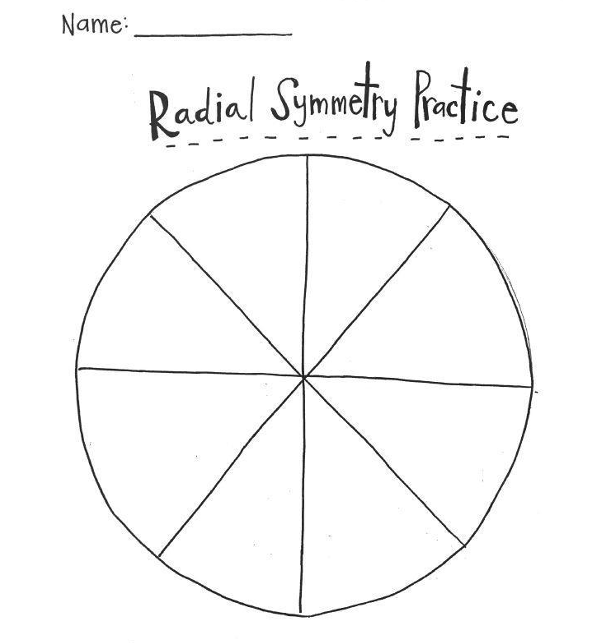
A worksheet titled “Radial Symmetry Practice” with a blank name line and a large circle divided into eight equal sections—perfect for mindful mandalas or mandala coloring activities.


Instructional Design

Opening/Activating Strategy

  • Show the introductory video: Video of sand mandala
  • Ask students: “What is a mandala? Have you seen one before?”.
  • Lead a class discussion:
    • Mandalas are circular designs found in many cultures (Tibetan, Hindu, Native American, etc.).
    • They often represent unity, balance, and mindfulness.
  • Show students examples of mandalas. Ask students what is similar and different about them. Students should see that all mandalas have radial balance, pattern and repetition, and a color scheme.
    • Discuss how these things contribute to the unity of the mandala.
    • Tell students that they will create their own mandalas using symmetry, pattern, and repetition.

Work Session

  • Begin by demonstrating to students how to create a mandala.
    • Demonstrate how to trace a circle (use a paper plate or compass).
    • Fold it in half three times to create eight sections (like a pizza).
    • Draw guidelines through the folds with a ruler.
    • On a whiteboard or projector, demonstrate how to repeat simple patterns (shapes, lines, symbols) around the circle.
    • Emphasize radial balance—what’s on one side should mirror around the circle. All patterns should radiate out from the center.
  • Have students practice/plan for their mandala using a planning guide.

A worksheet titled “Radial Symmetry Practice” with a blank name line and a large circle divided into eight equal sections—perfect for mindful mandalas or mandala coloring activities.

  • Students should draw at least four repeating shapes/patterns in each section.
    • Encourage students to use variety in shapes and lines, remember to show radial balance, and draw lightly for clean pencil sketches.
  • Before moving to the final product, students must:
    • Turn in their practice sheet.
    • Receive teacher approval for:
      • Radial balance
      • Creativity
      • Pattern and repetition
      • Variety
      • Completion of design
    • Students should follow the steps to create their final mandala.
      • Trace a large circle on the final paper.
      • Fold in half three times to get eight symmetrical sections.
      • Use a ruler to trace the fold lines lightly.
      • Begin drawing the approved practice design.
      • Once the full design is complete, trace carefully with black Sharpie.
      • Select a color scheme.
        • Add color using markers or colored pencils.
          • Encourage thoughtful color choices.
          • Remind students about color balance and repetition for unity.


Closing Reflection

  • Have students reflect by creating a brief reflection/artist statement. Students can include the following:
    • How did creating your mandala make you feel? Did you practice mindfulness?
    • What was challenging or calming about the process?


Assessments

Formative

  • Observe students’ discussion responses and whether students can identify and create radial balance, patterns, variety, and color schemes.
  • Conference with students during the art-making process.

Summative


Differentiation

Accelerated: 

  • Incorporate math concepts such as fractions, radius, circumference, and area.
  • Have students use colored pencils to create changes in value in the mandala creating the illusion of three-dimensions.


Remedial:

  • Provide students with a Mandala that is already cut out with dividing lines in place.
  • Provide images and design choices for them to choose from.


Additional Resources

  • Examples of various lines and shapes that work for mandala designs


Credits

U.S. Department of Education- STEM + the Art of Integrated Learning

Ideas contributed by: SAIL Grant Teacher Leaders–Chad Itnyre, Kristen Alvarez, Leah Patel, Lucerito Gonzalez, Tamu Clayton, Sandra Cash, Erin Smullen

*This integrated lesson provides differentiated ideas and activities for educators that are aligned to a sampling of standards. Standards referenced at the time of publishing may differ based on each state’s adoption of new standards.

Revised and copyright:  August 2025 @ ArtsNOW


TAG YOUR LIFE WITH POSITIVITY 4

TAG YOUR LIFE WITH POSITIVITY

TAG YOUR LIFE WITH POSITIVITY

Learning Description

In this lesson, students will explore how street art can be a powerful tool for communication and self-expression. Students will brainstorm uplifting words and phrases that can inspire others. Each student will select a positive affirmation—such as “You Matter”—and design it in a graffiti style.


Learning Targets

GRADE BAND: 4
CONTENT FOCUS: VISUAL ARTS & HEALTH
LESSON DOWNLOADS:

Download PDF of this Lesson

"I Can" Statements

“I Can…”

  • I can explain the difference between a tag, throw, and piece.
  • I can use line, shape, form, and symbols as a means of communication.
  • I can use positive self-talk to change my mindset.

Essential Questions

  • What are different types of graffiti?
  • How can I communicate meaning using line, shape, form, and symbols?
  • How can positive self-talk change your mindset?


Georgia Standards

Curriculum Standards

HE5.1 Students will comprehend concepts related to health promotion and disease prevention to enhance health.

HE5.1.c Describe and apply the basic health concept of mental and emotional well-being.

HE5.4 Students will demonstrate the ability to use interpersonal communication skills to enhance health and avoid or reduce health risks.

HE5.4.a Apply effective verbal and nonverbal communication skills to enhance health.

Arts Standards

VA5.CR.1 Engage in the creative process to generate and visualize ideas by using subject matter and symbols to communicate meaning.

VA5.PR.1 Plan and participate in appropriate exhibition(s) of works of art to develop identity of self as artist.

VA5.CR.5 Demonstrate an understanding of the safe and appropriate use of materials, tools, and equipment for a variety of artistic processes.

VA5.RE.1 Use a variety of approaches for art criticism and to critique personal works of art and the artwork of others to enhance visual literacy.

VA5.CN.3 Develop life skills through the study and production of art (e.g. collaboration, creativity, critical thinking, communication).


South Carolina Standards

Curriculum Standards

Standard 1: “Students will comprehend concepts related to health promotion and disease prevention to enhance health” (NHES, 2007).

M-5.1.1 Describe coping strategies to promote mental health.

Standard 7: “Students will demonstrate the ability to practice health-enhancing behaviors and avoid or reduce health risks” (NHES, 2007).

M-5.7.2 Demonstrate positive self-management skills.

Arts Standards

Anchor Standard 1: I can use the elements and principles of art to create artwork.

Benchmark VA.CR I can combine several elements of art to express ideas.

Indicator VA.CR NM.1.2 I can combine several elements of art to construct 2D or 3D artwork.

Anchor Standard 2: I can use different materials, techniques, and processes to make art.

Benchmark VA.CR NM.2 I can use some materials, techniques, and tools to create artwork.

Indicator VA.CR NM.2.1 I can use two-dimensional art materials to explore ways to make art.

Anchor Standard 4: I can organize work for presentation and documentation to reflect specific content, ideas, skills, and or media.

Benchmark VA.P NL.4 I can show and describe the idea of my artwork.

Indicator VA.P NL.4.2 I can describe my artwork.


Key Vocabulary

Content Vocabulary

  • Positive mindset - A way of thinking that focuses on seeing the good in situations
  • Self-talk - The inner voice or thoughts you have about yourself and your experience

Arts Vocabulary

  • Line - A continuous mark made on some surface by a moving point. It may be two dimensional, like a pencil mark on a paper or it may be three dimensional (wire) or implied (the edge of a shape or form) often it is an outline, contour or silhouette.
  • Shape - A flat, enclosed line that is always two-dimensional and can be either geometric or organic
  • Color - An element of art with three properties: 1) Hue: the name of the color, e.g. red, yellow, etc.; 2) Intensity: the purity and strength of the color (brightness or dullness); 3) Value: the lightness or darkness of the color (shades and tints)
  • Tag - A word design using the qualities of line; a tag cannot be colored in
  • Throw - A letter or word that can be filled in with color or design; the letters in a “throw” have shape
  • Piece - A “piece” letter or word now has the illusion of form; various forms of perspective create perceptions of height, length, and width

Materials

A cartoon shows two versions of the same person facing each other. Positive self-talk phrases, highlighting positivity, are in green bubbles; negative ones in orange. A prompt asks for more examples to help tag your life with uplifting thoughts.

  • Artwork examples:

A vibrant collage of colorful graffiti and text art featuring uplifting messages like


Instructional Design

Opening/Activating Strategy

Work Session

  • Engage the students in a conversation about having a positive mindset and what that means. Talk about how individuals who have a positive mindset pay attention to the good, rather than bad in people, situations, events.
  • Discuss different ways students can use positive self-talk to change their mindset. Show the image below.

A cartoon shows two versions of the same person facing each other. Positive self-talk phrases, highlighting positivity, are in green bubbles; negative ones in orange. A prompt asks for more examples to help tag your life with uplifting thoughts.

  • Ask students to brainstorm with a partner a time that they used or could have used a positive mindset to see the best in a situation. Ask them how this influenced the situation.
  • Explain the project to students. Show them some examples:

A vibrant collage of colorful graffiti and text art featuring uplifting messages like

  • Create a list of positive words and phrases with the students to use as a reference for their project (i.e., “dream big”, “persevere”, “you got this”, etc.).
  • Have the students choose a positive word or phrase for their project.
  • Introduce students to different types/styles/fonts of graffiti.
    • Discuss and show the differences between a tag, throw, and piece.
  • Practice/demo with students so that they get more comfortable drawing different styles.
  • Have students practice their word or phrase using tag, throw, or piece style graffiti.
  • When they have decided how they want to create their project and have practiced, pass out project paper and have them draw their designs. Remind students to fill the space on their paper.
  • Pass out black sharpies and have them outline their work.
  • Have the students use tempera paints to add color and interest to their work. Remind students to be sure to paint the background.
  • Display the finished pieces throughout the school to help spread positivity.


Closing Reflection

  • Provide students the opportunity to share their positive tag artwork and explain their artistic choices.


Assessments

Formative

  • Observe whether students:
    • Are able to identify how graffiti artists use lines, shapes, and colors in their work.
    • Can use lines, shapes, and colors to express themselves during the planning process.
    • Choose words and phrases to create a positive affirmation.

Summative


Differentiation

Accelerated: 

  • Provide students with a choice of materials, including paint, markers, oil pastels.
  • Have students add details like texture and pattern to the letters and/or background of their artwork.


Remedial:

  • Provide students with examples of positive affirmations to choose from.
  • Model how to create different styles of graffiti.


Additional Resources

  • Color chart showing common color uses for feelings and emotions
  • Line chart that shows common uses for color and emotions
  • Various alphabets of graffiti for students to view


Credits

U.S. Department of Education- STEM + the Art of Integrated Learning

Ideas contributed by: SAIL Grant Teacher Leaders–Chad Itnyre, Kristen Alvarez, Leah Patel, Lucerito Gonzalez, Tamu Clayton, Sandra Cash, Erin Smullen, Katy Betts

*This integrated lesson provides differentiated ideas and activities for educators that are aligned to a sampling of standards. Standards referenced at the time of publishing may differ based on each state’s adoption of new standards.

Revised and copyright:  August 2025 @ ArtsNOW


CALLIGRAM IDENTITY PORTRAIT 4

CALLIGRAM IDENTITY PORTRAIT

CALLIGRAM IDENTITY PORTRAIT

Learning Description

Students will explore self-portraits as a way to show who they are using colors, lines, and meaningful words or phrases. They will create a background that represents their personality, and use words and phrases that represent themselves to create the contour lines of their portrait.


Learning Targets

GRADE BAND: 4
CONTENT FOCUS: VISUAL ARTS & HEALTH
LESSON DOWNLOADS:

Download PDF of this Lesson

"I Can" Statements

“I Can…”

  • I can use words to express and describe myself.
  • I can use color and line to express feelings and emotions.
  • I can create a self-portrait that expresses my identity.

Essential Questions

  • How can we use words to express our identity?
  • How can we use color and line to express our feelings and emotions?
  • What is identity?


Georgia Standards

Curriculum Standards

HE5.1 Students will comprehend concepts related to health promotion and disease prevention to enhance health.

HE5.1.c Describe and apply the basic health concept of mental and emotional well-being.

HE5.4 Students will demonstrate the ability to use interpersonal communication skills to enhance health and avoid or reduce health risks.

HE5.4.a Apply effective verbal and nonverbal communication skills to enhance health.

Arts Standards

VA5.CR.1 Engage in the creative process to generate and visualize ideas by using subject matter and symbols to communicate meaning.

VA5.PR.1 Plan and participate in appropriate exhibition(s) of works of art to develop identity of self as artist.

VA5.CR.5 Demonstrate an understanding of the safe and appropriate use of materials, tools, and equipment for a variety of artistic processes.

VA5.RE.1 Use a variety of approaches for art criticism and to critique personal works of art and the artwork of others to enhance visual literacy.

VA5.CN.3 Develop life skills through the study and production of art (e.g. collaboration, creativity, critical thinking, communication).


South Carolina Standards

Curriculum Standards

Standard 1: “Students will comprehend concepts related to health promotion and disease prevention to enhance health” (NHES, 2007).

M-5.1.1 Describe coping strategies to promote mental health.

Standard 7: “Students will demonstrate the ability to practice health-enhancing behaviors and avoid or reduce health risks” (NHES, 2007).

M-5.7.2 Demonstrate positive self-management skills.

Arts Standards

Anchor Standard 1: I can use the elements and principles of art to create artwork.

Benchmark VA.CR I can combine several elements of art to express ideas.

Indicator VA.CR NM.1.2 I can combine several elements of art to construct 2D or 3D artwork.

Anchor Standard 2: I can use different materials, techniques, and processes to make art.

Benchmark VA.CR NM.2 I can use some materials, techniques, and tools to create artwork.

Indicator VA.CR NM.2.1 I can use two-dimensional art materials to explore ways to make art.

Anchor Standard 4: I can organize work for presentation and documentation to reflect specific content, ideas, skills, and or media.

Benchmark VA.P NL.4 I can show and describe the idea of my artwork.

Indicator VA.P NL.4.2 I can describe my artwork.


Key Vocabulary

Content Vocabulary

  • Self-awareness - The ability to understand one’s own emotions, thoughts, and values and how they influence behavior across contexts
  • Identity - The understanding of who someone is, encompassing the characteristics, beliefs, qualities, and experiences that define them as an individual or as part of a group
  • Feelings - The emotional responses we have to experiences, thoughts, or situations
  • Thoughts - The ideas, opinions, and mental images that form in our minds

Arts Vocabulary

  • Self-portrait - An artwork in which an artist creates a visual representation of themselves
  • Calligram - A type of visual poetry where the text is arranged to form a shape or image that reflects the content or theme of the words
  • Line - A continuous mark made on some surface by a moving point. It may be two dimensional, like a pencil mark on a paper or it may be three dimensional (wire) or implied (the edge of a shape or form) often it is an outline, contour or silhouette.
  • Contour line - A line that defines the edges and surface ridges of an object in drawing
  • Shape - A flat, enclosed line that is always two-dimensional and can be either geometric or organic
  • Pattern - Repetition of specific visual elements such as a unit of shape or form
  • Color - An element of art with three properties: 1) Hue: the name of the color, e.g. red, yellow, etc.; 2) Intensity: the purity and strength of the color (brightness or dullness); 3) Value: the lightness or darkness of the color (shades and tints)

Materials


Instructional Design

Opening/Activating Strategy

  • Look at examples of portraits engaging students in the See/Think/Wonder Artful Thinking Routine (example portraits: “The Frame” by Frida Kahlo, “Portrait of Pablo Picasso” by Juan Gris, and “Mystic Head: Ravenwings IV by Alexej Von Jawlensky).
    • Ask students:
      • What do you see?
      • What do you think about what you see?
      • What do you wonder about what you see?
    • Ask students to identify lines, shapes, and colors that they see in the portraits and why they think the artists may have chosen them.
    • Discuss the different ways that artists choose to represent themselves and others.

Work Session

  • As a class, brainstorm words, phrases, and sentences that represent personal identity–What makes you, YOU?
    • This can be done in small groups or with a partner.
    • Students should write them down in their sketchbooks.
  • As a class, discuss common uses for color to express feelings and emotions.
    • Look at examples of artworks with strong use of color, such as Picasso’s Blue Period. Discuss the different feelings that the artwork evokes.
  • Have students select colors for their artwork. They can experiment with how the colors look together using colored pencils in their sketchbooks. Students should be able to connect the colors that they chose to the feelings they want to evoke in their artwork.
  • Discuss how different types of lines can express feelings and emotions.
    • Have students draw lines and shapes in their sketchbooks to represent the different words and phrases.
    • Students should then plan a pattern or design for the background of their portrait.
  • Students will create a contour drawing of themselves focusing on using simple lines.
    • Discuss contour line with students. Show students examples of artwork that uses contour lines.
    • Print pictures of students on 8.5x11 paper. Using tracing paper, students should trace the major lines using dull pencils or ebony pencils. Be sure that students are drawing dark, thick lines.
    • Have students flip the tracing paper over onto their watercolor paper. Using a pencil, have them trace over their lines. The image should lightly transfer onto the watercolor paper.
  • Students will then write the words or phrases from the brainstorming session directly over the lines drawn using fine line Sharpies. Once all words are written, students will go back and erase all pencil marks.
  • Tell students that they will now create a background for their self-portraits using the colors, patterns, and designs that they planned in their sketchbooks. Their artistic choices should reflect the emotions and ideas that they want to convey.
    • Students should draw first with pencil and then add color with colored pencil or watercolor.

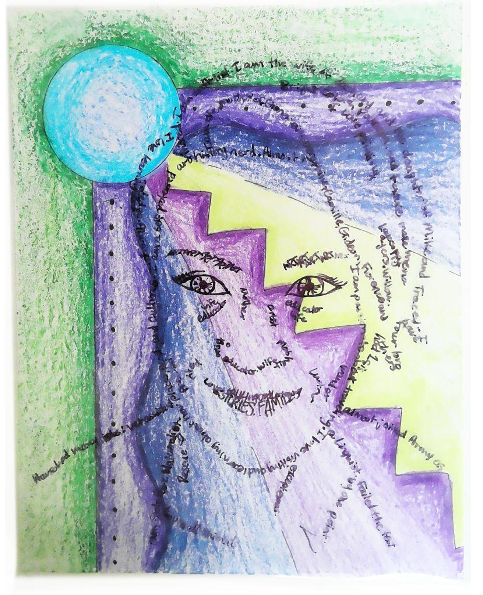
A colorful abstract identity portrait of a face with geometric shapes in green, purple, and yellow tones. A blue circle is in the top left corner. Handwritten calligram text curves around the face and background, blending with the artwork.


Closing Reflection

  • Students will complete an Identity Artist Statement.
    • What techniques were used to make the art piece?
    • What does the artwork represent as far as your personal identity?
    • What would you want to tell others about your art?
    • Provide students the opportunity to share their self-portrait and describe the words or phrases they chose.


Assessments

Formative

  • Observe whether students are:
    • Able to identify how other artists use color, line, and shape to represent themselves in self-portraiture.
    • Using lines, shapes, patterns, and colors to express themselves during the planning process.
    • Using words and phrases to express themselves during the planning process.

Summative


Differentiation

Accelerated: 

  • Provide students with a choice of materials, including paint, markers, oil pastels.
  • Have students draw their self-portraits from observation rather than using tracing paper.


Remedial:

  • Provide specific questions for students to respond to in the What Makes You, YOU? brainstorming session.
  • Provide sentence starters for the artist statement or have students simply respond to the questions rather than writing in paragraph form.
  • Allow students to orally respond to artist statement questions rather than writing their answers.


Additional Resources

  • Color chart showing common color uses for feelings and emotions
  • Line chart that shows common uses for emotions or characteristics


Credits

U.S. Department of Education- STEM + the Art of Integrated Learning

Ideas contributed by: SAIL Grant Teacher Leaders–Chad Itnyre, Kristen Alvarez, Leah Patel, Lucerito Gonzalez, Tamu Clayton, Sandra Cash, Erin Smullen, Katy Betts

*This integrated lesson provides differentiated ideas and activities for educators that are aligned to a sampling of standards. Standards referenced at the time of publishing may differ based on each state’s adoption of new standards.

Revised and copyright:  August 2025 @ ArtsNOW
 

BE YOUR OWN SUPERHERO 4

BE YOUR OWN SUPERHERO

BE YOUR OWN SUPERHERO

Learning Description

In this lesson, students will first think about a personal fear, worry, or challenge. After identifying this, they will design their own unique superhero—one that has the strength and confidence to overcome that fear, worry, or challenge. The goal of the lesson is to help students look within themselves and discover the amazing “superpowers” that everyone already has.


Learning Targets

GRADE BAND: 4
CONTENT FOCUS: VISUAL ARTS & HEALTH
LESSON DOWNLOADS:

Download PDF of this Lesson

"I Can" Statements

“I Can…”

  • I can create a self-portrait that represents myself as a superhero.
  • I can use the Elements of Art to create a unique character and background.
  • I can create a superhero that can help me overcome a fear, worry, or challenge.

Essential Questions

  • How can I create a superhero that can help me overcome a fear, worry, or challenge?
  • How can the Elements of Art help me create a unique character and background?


Georgia Standards

Curriculum Standards

HE4.1 Students will comprehend concepts related to health promotion and disease prevention to enhance health.

HE4.1.c Describe basic health concepts of mental and emotional well-being.

Arts Standards

VA4.CR.1 Engage in the creative process to generate and visualize ideas by using subject matter and symbols to communicate meaning.

VA4.CR.3 Understand and apply media, techniques, processes, and concepts of two-dimensional art.

VA4.PR.1 Plan and participate in appropriate exhibition(s) of works of art to develop identity of self as artist.

VA4.CR.5 Demonstrate an understanding of the safe and appropriate use of materials, tools, and equipment for a variety of artistic processes.

VA4.RE.1 Use a variety of approaches for art criticism and to critique personal works of art and the artwork of others to enhance visual literacy.


South Carolina Standards

Curriculum Standards

Standard 2: “Students will analyze the influence of family, peers, culture, media, technology, and other factors on health behaviors” (NHES, 2007).

I-4.2.1 Analyze ways that protective factors promote health and safety (e.g., positive outlook, healthy self-concept, good relationships with parents).

Standard 6: “Students will demonstrate the ability to use goal-setting skills to enhance health” (NHES, 2007).

M-4.6.1 Develop a plan to reduce and manage stress.

Arts Standards

Anchor Standard 1: I can use the elements and principles of art to create artwork.

Benchmark VA.CR I can combine several elements of art to express ideas.

Indicator VA.CR NM.1.2 I can combine several elements of art to construct 2D or 3D artwork.

Anchor Standard 2: I can use different materials, techniques, and processes to make art.

Benchmark VA.CR NM.2 I can use some materials, techniques, and tools to create artwork.

Indicator VA.CR NM.2.1 I can use two-dimensional art materials to explore ways to make art.

Anchor Standard 4: I can organize work for presentation and documentation to reflect specific content, ideas, skills, and or media.

Benchmark VA.P NL.4 I can show and describe the idea of my artwork.

Indicator VA.P NL.4.2 I can describe my artwork.


Key Vocabulary

Content Vocabulary

  • Challenge - Something that tests your ability, strength, or determination
  • Strength - Something someone is good at or a positive quality someone possesses that helps them in life

Arts Vocabulary

  • Space - The distance or area between, around, above or within things. Positive space refers to the subject or areas of interest in an artwork, while negative space is the area around the subject of an artwork. It can be a description for both two and three-dimensional portrayals.
  • Foreground - The area of the artwork that appears closest and is largest
  • Middle ground - The area of the artwork that appears in the middle of the picture plane between the background and middle ground
  • Background - The area of the artwork that appears furthest away and is smallest
  • Color - An element of art with three properties: 1) Hue: the name of the color, e.g. red, yellow, etc.; 2) Intensity: the purity and strength of the color (brightness or dullness); 3) Value: the lightness or darkness of the color (shades and tints)

Materials

  • 12x18 paper
  • Pencils
  • Sharpies
  • Markers
  • Collage papers
  • Glue
  • Scissors
  • Images of people, buildings, shape tracers, examples of superhero designs


Instructional Design

Opening/Activating Strategy

  • Brainstorm examples of fears or challenges and how someone might overcome those fears or challenges.
    • Discuss how creating art helps in processing thoughts and feelings. It can help someone visualize something that they want to be reality.
  • Provide examples of a superhero that could be created to overcome a challenge and the environment they might be placed in.
    • For example, if it is a fear of heights, the superhero might be able to fly. The art might showcase the superhero flying above a city or landscape.
    • Tell students that the superhero inside comes out when we feel intimidated or afraid and helps to remind us that we can overcome challenges.

Work Session

  • Have students brainstorm things that they might want to overcome–fears, worries, challenges, etc.
  • After they have decided on one, provide time for them to brainstorm what their superhero might look like and what their superpower might be.
    • Discuss how color can represent characteristics; for example, soft colors might represent kindness and bright colors might represent boldness.
    • Have students brainstorm ideas for their superhero and choose one final design.
  • Next, discuss how to portray space using a background, middle ground, and foreground.
  • Students will need to decide on and create a background environment for their specific superhero.
    • Students can draw the background, trace with a Sharpie, and color with markers. Students can also use collage papers to create shapes for the background.
    • Remind students that the environment should connect to the challenge the superhero is overcoming.
  • Once the background is complete students will then begin the process of drawing their unique superhero character with pencil then tracing with a sharpie.
    • Be sure students understand that the superhero is a self-portrait of them as the superhero.
    • The students will then add color with markers and cut out to glue down the character onto their background.
    • Speech bubbles can be added to aid in the concept the students are trying to convey.


Closing Reflection

  • Engage the students in a gallery walk. Students will walk around the classroom and view the artworks. Students will see if they can identify clearly what challenge each superhero is overcoming.
  • Facilitate a discussion about how we each have strengths inside us that can help us overcome our challenges.


Assessments

Formative

  • The teacher will assess whether:
    • Students are using color and space to create their artwork.
    • Students clearly created a superhero that represents the idea or topic.
    • Students have used craftsmanship in their artwork.

Summative


Differentiation

Accelerated: 

  • Students can turn their idea into a comic strip or create multiple scenes.


Remedial:

  • Students can use drawing aids like images and shape tracers as well as smaller sized paper.


Credits

U.S. Department of Education- STEM + the Art of Integrated Learning

Ideas contributed by: SAIL Grant Teacher Leaders–Chad Itnyre, Kristen Alvarez, Leah Patel, Lucerito Gonzalez, Tamu Clayton, Sandra Cash, Erin Smullen

*This integrated lesson provides differentiated ideas and activities for educators that are aligned to a sampling of standards. Standards referenced at the time of publishing may differ based on each state’s adoption of new standards.

Revised and copyright:  August 2025 @ ArtsNOW


MY FAVORITE STUFFED ANIMAL STILL LIFE 4

MY FAVORITE STUFFED ANIMAL STILL LIFE

MY FAVORITE STUFFED ANIMAL STILL LIFE

Learning Description

Students will learn about the art of still life while connecting it to a favorite stuffed animal. Students will learn how we connect with objects that make us feel happy and safe.


Learning Targets

GRADE BAND: 4
CONTENT FOCUS: VISUAL ARTS & HEALTH
LESSON DOWNLOADS:

Download PDF of this Lesson

"I Can" Statements

“I Can…”

  • I can use my observation skills to create a still life based on a stuffed animal.

Essential Questions

  • How can I use the Elements of Art to draw a still life?


Georgia Standards

Curriculum Standards

HE4.1 Students will comprehend concepts related to health promotion and disease prevention to enhance health.

HE4.1.c Describe basic health concepts of mental and emotional well-being.

Arts Standards

VA4.CR.1 Engage in the creative process to generate and visualize ideas by using subject matter and symbols to communicate meaning.

VA4.PR.1 Plan and participate in appropriate exhibition(s) of works of art to develop identity of self as artist.

VA4.CR.5 Demonstrate an understanding of the safe and appropriate use of materials, tools, and equipment for a variety of artistic processes.

VA4.RE.1 Use a variety of approaches for art criticism and to critique personal


South Carolina Standards

Curriculum Standards

Standard 6: “Students will demonstrate the ability to use goal-setting skills to enhance health” (NHES, 2007).

M-4.6.1 Develop a plan to reduce and manage stress.

Arts Standards

Anchor Standard 1: I can use the elements and principles of art to create artwork.

Benchmark VA.CR I can combine several elements of art to express ideas.

Indicator VA.CR NM.1.2 I can combine several elements of art to construct 2D or 3D artwork.

Anchor Standard 2: I can use different materials, techniques, and processes to make art.

Benchmark VA.CR NM.2 I can use some materials, techniques, and tools to create artwork.

Indicator VA.CR NM.2.1 I can use two-dimensional art materials to explore ways to make art.

Anchor Standard 4: I can organize work for presentation and documentation to reflect specific content, ideas, skills, and or media.

Benchmark VA.P NL.4 I can show and describe the idea of my artwork.

Indicator VA.P NL.4.2 I can describe my artwork.


Key Vocabulary

Content Vocabulary

  • Security - The feeling of safety, stability, and confidence

Arts Vocabulary

  • Still life - A type of artwork—most often a painting, drawing, or photograph—that depicts inanimate objects arranged in a composition
  • Line - A continuous mark made on some surface by a moving point. It may be two dimensional, like a pencil mark on a paper or it may be three dimensional (wire) or implied (the edge of a shape or form) often it is an outline, contour or silhouette.
  • Shape - A flat, enclosed line that is always two-dimensional and can be either geometric or organic
  • Form - An object that is three-dimensional and encloses volume (cubes, spheres, and cylinders are examples of various forms)
  • Texture - The surface quality, or "feel" of an object, such as roughness, smoothness, or softness. Actual texture can be felt while simulated textures are implied by the way the artist renders areas of the picture.
  • Color - An element of art with three properties: 1) Hue: the name of the color, e.g. red, yellow, etc.; 2) Intensity: the purity and strength of the color (brightness or dullness); 3) Value: the lightness or darkness of the color (shades and tints)
  • Value - This describes the lightness or darkness of a color. Value is needed to express volume.
  • Space - The distance or area between, around, above or within things. Positive space refers to the subject or areas of interest in an artwork, while negative space is the area around the subject of an artwork. It can be a description for both two and three-dimensional portrayals.

Materials


Instructional Design

Opening/Activating Strategy

Work Session

  • Lead a discussion around how objects can carry meaning and make us feel secure and safe. Ask students if they have or had a favorite stuffed animal that gave them a sense of security.
  • Students will need to bring to school either a favorite stuffed animal or a picture of one.
  • Demonstrate how to use simple lines and shapes to begin building the artwork before adding the fine details and colors.
  • Students will practice drawing sketches of their stuffed animal before beginning the final drawing.
  • Students will start with a pencil and the trace over with a sharpie. However, they will have a choice in how they add color. Students must include a background created from memory or imagination.


Closing Reflection

Have students think about their stuffed animal and how it makes them feel. Students will write a few sentences about why it is special to them. They can also describe their favorite memory with it, or what feelings they wanted to show in their artwork.


Assessments

Formative

  • The teacher will observe whether students:
    • Are using the elements of arts in a way that aids in the creation of their artwork.
    • Are using appropriate lines and shapes that correctly represent the size and shape of their stuffed animal.

Summative


Differentiation

Accelerated: 

  • Students can turn the artwork into a short story or comic in which the stuffed animal is the main character.


Remedial:

  • These students may use shape tracers as guides to begin creating their shapes for the more detailed version.


Credits

U.S. Department of Education- STEM + the Art of Integrated Learning

Ideas contributed by: SAIL Grant Teacher Leaders–Chad Itnyre, Kristen Alvarez, Leah Patel, Lucerito Gonzalez, Tamu Clayton, Sandra Cash, Erin Smullen

*This integrated lesson provides differentiated ideas and activities for educators that are aligned to a sampling of standards. Standards referenced at the time of publishing may differ based on each state’s adoption of new standards.

Revised and copyright:  August 2025 @ ArtsNOW