
A MATTER OF ISOLATION 6-8

A MATTER OF ISOLATION

A MATTER OF ISOLATION

Learning Description

Students will create a game in which players use movement to show how changes in thermal energy change the behavior of particles.


Learning Targets

GRADE BAND: 6-8
CONTENT FOCUS: DANCE, SCIENCE & STEAM
LESSON DOWNLOADS:

Download PDF of this Lesson

"I Can" Statements

“I Can…”

  • I can demonstrate the effect of thermal change on particles through choreography.
  • I can relate the elements of dance to states of matter.
  • I can use the elements of dance to vary movements to communicate multiple ideas in one choreography.

Essential Questions

  • How does dance movement demonstrate states of matter and change in thermal energy?


Georgia Standards

Curriculum Standards

Grade 8:

S8P1.b Develop and use models to describe the movement of particles in solids, liquids, gases, and plasma states when thermal energy is added or removed.

Arts Standards

Grade 8:

MSD.CR.1 Demonstrate an understanding of the choreographic process.

MSD.RE.1 Demonstrate critical and creative thinking in dance.

MSD.CN.3 Demonstrate an understanding of a dance as it relates to other areas of knowledge.


South Carolina Standards

Curriculum Standards

Grade 6:

6-PS1-4. Develop and use a model that predicts and describes changes in particle motion, temperature, and state of a pure substance when thermal energy is added or removed

Arts Standards

Anchor Standard 1: I can use movement exploration to discover and create artistic ideas and works.

Anchor Standard 2: I can choreograph a dance.

Anchor Standard 3: I can perform movements using the dance elements.

Anchor Standard 5: I can describe, analyze, and evaluate a dance.

Anchor Standard 7: I can relate dance to other arts disciplines, content areas, and careers.


Key Vocabulary

Content Vocabulary

  • Particle – A small object which can be described by several physical or chemical properties; matter is made up of particles
  • Thermal Energy – The motion of particles within a substance that is responsible for its temperature

Arts Vocabulary

  • Isolation – Movement created by moving one part of their body while keeping the rest of the body still or controlled
  • Axial – Movement that occurs in place, without traveling to a new location
  • Locomotor – A movement that travels through space
  • Choreographic process - The steps taken to create movement sequences for dancers, which include testing, revising, and editing work
  • Choreography - The art of designing and arranging sequences of movements, steps, and gestures to create a dance piece
  • Engineering Design Process -
    • Ask – What is the problem? What do we need to do?
    • Imagine – What are some possible solutions?
    • Plan – Which idea will we try? How will we build it?
    • Create – Build the solution.
    • Test & Improve – Does it work? How can we make it better?


Materials

  • Blank index cards, blank paper
  • A variety of music selections
  • Music source and speakers
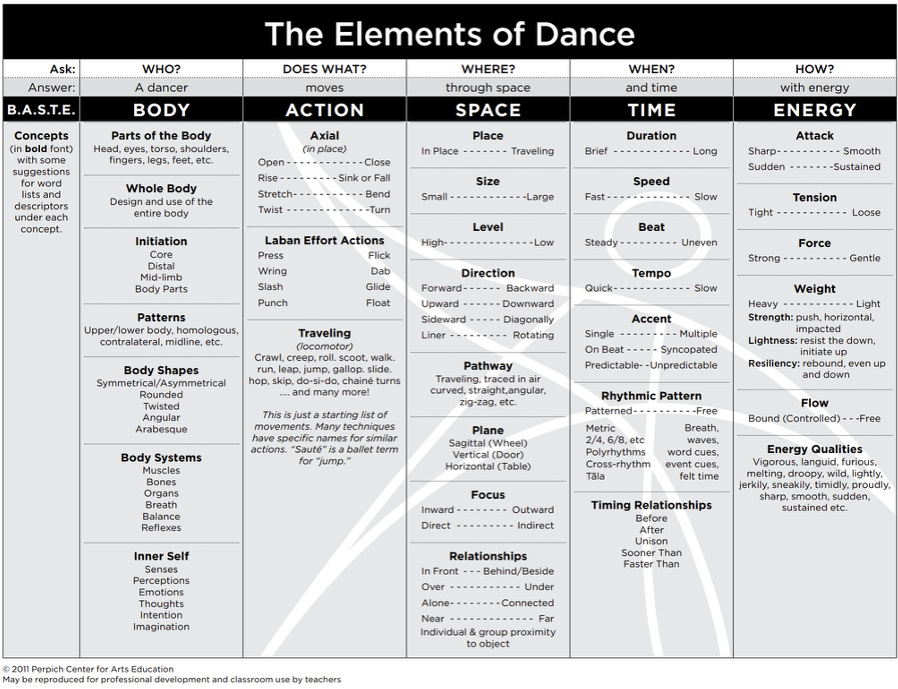
  • Word bank of dance vocabulary:


Instructional Design

Opening/Activating Strategy

  • Students improvise movements in a hand dance. Using only their hands and fingers, students work in pairs, with one being the leader and the other the follower. Students sit facing one another so that when they extend their arms in front of them their hands do NOT touch.
  • The leader extends one arm and faces the palm of the hand to the other student. The follower extends one arm and faces the palm of one hand to the leader to create a mirror image of the other student’s hand. The leader moves the one hand and fingers in slow steady motions while the follower imitates the movement. The teacher plays music and students move in silence, without talking or making any noise, until the music stops.
  • The teacher pauses the music. Partners change roles and repeat the process.
  • Partners should mentally note which movements are successful or when they find a movement that they would like to remember for use later in the lesson.

Work Session

PART 1

  • Divide students into small groups of three members. Each group will create a game in which players earn points when they use their hands and fingers to show how particles move in reaction to increasing or decreasing thermal energy.
  • For the game, participants should be organized into teams. Team members isolate their hands and fingers to create dance movements that represent states of matter to successfully earn points.
  • Students list a few of their favorite games and think about the strategy/rules of those games.
  • Give each group a few sheets of paper and index cards to use as game materials.

PART 2

  • Students list the information that they need to know in order to create the game. In other words, they list questions and answers about scientific concepts, dance concepts, and game rules.
  • Students gather the details that they need to plan the game.

PART 3

  • Students brainstorm different ways in which players could move their fingers and hands to play the game. They write down dance terms from a word bank derived from the Energy or Time columns of the Elements of Dance to describe the movements.
  • Students correlate the dance vocabulary with descriptions of how particles move when matter is a solid, liquid, or gas.

PART 4

  • Students imagine how teams could interact in a game so that players earn points by showing the movement of particles when thermal energy is applied, removed, increased, or decreased. Students should consider the different ways that players could describe the presence/absence/increase/decrease of thermal energy, including using words such as warmer or cooler, or absolute measures of temperature, i.e., 32 degrees F or 212 degrees F.
  • Students write down the rules of the game.

PART 5

Students test their games by playing them. They note where improvements need to be made and revise their rules. 


Closing Reflection

  • Ask students to explain how moving their bodies in this lesson helps them to understand and describe the properties of thermal energy and how it impacts matter.
  • Ask students to describe how the process of asking questions up front helped them create the game.
  • Ask students to describe how brainstorming movements first helped them imagine the play strategy (writing the rules).
  • Ask students how they revised their games after the testing phase.


Assessments

Formative

Visually observe the students during the process of creativity.

  • Teacher observes students discussing and writing questions during PART 2.
  • Teacher observes students using vocabulary of the elements of dance and vocabulary of states of matter and thermal energy together, as they brainstorm ways that teams will move to earn points and as they imagine the rules of the games.

Summative

A MATTER OF ISOLATION CHECKLIST

  • Movements are limited to hands and fingers.
  • Game options contain variation of time and energy elements.
  • The game rules effectively use dance to communicate changes in thermal energy so that observers can identify distinct states of matter.


Differentiation

Accelerated: 

  • Rather than limiting movements to hands and fingers, students explore whole-body axial and locomotor movements to exaggerate molecular activity and/or thermal energy change.


Remedial:

  • Complete PART 2 as a whole class.
  • Stop the activity at the end of PART 2. Assess the use of the first step of the engineering design process, which is to define the problem.


Additional Resources

Classroom Tip:  Use the opening activity as an opportunity for students to identify movements that they will use later in the lesson.
 

Credits

Ideas contributed by: Julie Galle Baggenstoss

*This integrated lesson provides differentiated ideas and activities for educators that are aligned to a sampling of standards. Standards referenced at the time of publishing may differ based on each state’s adoption of new standards.

Revised and copyright:  January 2026 @ ArtsNOW


TRIGONOMETRY ON STAGE 9-12

TRIGONOMETRY ON STAGE

TRIGONOMETRY ON STAGE

Learning Description

In this lesson, students deepen their understanding of trigonometric vocabulary and problem-solving by personifying key terms as characters and creating a scene that demonstrates their relationships in a right triangle.


Learning Targets

GRADE BAND: 9-12
CONTENT FOCUS: THEATRE & ALGEBRA/GEOMETRY
LESSON DOWNLOADS:

Download PDF of this Lesson

"I Can" Statements

“I Can…”

  • I can explain the meanings of sine, cosine, tangent, opposite, adjacent, and hypotenuse.
  • I can use trigonometric ratios and the Pythagorean Theorem to solve problems with right triangles.
  • I can work with my group to create a scene where the vocabulary terms solve a problem together.
  • I can use my voice and body to create and embody characters out of trigonometric terms.
  • I can reflect on how this creative process helped me understand and demonstrate understanding of trigonometry.

Essential Questions

  • How can understanding trigonometric terms as characters help us solve real-world problems involving right triangles?


Georgia Standards

Curriculum Standards

Geometry:

G.GSR.6.3 Use trigonometric ratios and the Pythagorean Theorem to solve for sides and angles of right triangles in applied problems.

Arts Standards

TAHSFT.PR.1 

Act by communicating and sustaining roles in formal and informal environments.

TAHSFT.PR.1.a 

Observe and demonstrate aspects of verbal and non-verbal techniques in common human activity for performance (e.g. voice, breathing, posture, facial expression, physical movement).

TAHSFT.CN.1 

Explore how theatre connects to life experiences, careers, and other content. 


South Carolina Standards

Curriculum Standards

Algebra 2 with Probability:

A2P.MGSR.1. Explore and analyze sine and cosine functions using the unit circle, right triangle definitions, and models of periodic phenomena.

Geometry with Statistics:

GS.MGSR.6. Discover and apply relationships in similar right triangles.

Arts Standards

Anchor Standard 1:  I can create scenes and write scripts using story elements and structure.

Anchor Standard 3: I can act in improvised scenes and written scripts.

Anchor Standard 8: I can relate theatre to other content areas, arts disciplines, and careers.


Key Vocabulary

Content Vocabulary

  • Sine — Ratio of the length of the opposite side to the hypotenuse in a right triangle
  • Cosine — Ratio of the length of the adjacent side to the hypotenuse in a right triangle
  • Tangent — Ratio of the length of the opposite side to the adjacent side in a right triangle
  • Opposite — The side opposite the given angle in a right triangle
  • Adjacent — The side next to (adjacent to) the given angle in a right triangle
  • Hypotenuse — The longest side of a right triangle, opposite the right angle

Arts Vocabulary

  • Actor/Actress — A person who portrays a character in a theatrical performance
  • Improvisation — A moment in a play that is not rehearsed or “scripted”, or acting without a script. For example: if an actor forgets a line, he/ she may improvise the line in the scene. Improvisation is also a style of theatre that lends itself to comedy that is created “in the moment”.
  • Embodiment — The representation or expression of something in a tangible form while bridging the gap between the character’s thoughts and your physical self
  • Voice - Actors use their voice to be heard by the audience clearly. Actors must also apply vocal choices such as pitch, tempo, and volume to the character they are dramatizing. 
  • Gesture - An expressive movement of the body or limbs
  • Body - Actors use their body to become a character through body posture and movement. What your mind thinks, what your emotions feel, all of this is supposed to show up in your body.


Materials


Instructional Design

Opening/Activating Strategy

Day One

  • Introduce the essential question and objectives.
  • Mini-lesson: Review right triangle vocabulary (sine, cosine, tangent, opposite, adjacent, hypotenuse) with definitions and examples.
  • Do a quick guided practice identifying sides and calculating basic ratios.

Work Session

  • Assign students to small groups (3–6 students).
  • Assign each group one or more of the vocabulary words to personify.
  • Explain to the students that they will be acting as their characters to solve a right-triangle problem and create a scene showing the solution.
  • Optional: Show the “Embodying the Role” video to help students understand how to get into character.
  • Groups will decide:
    • What personality traits fit their word?
    • What does their word “do” in a right triangle?
    • How can their word interact with the others?
  • Groups will create short descriptions of each character and practice acting out their word (voice, gesture, movement).
  • Teacher will assign a right-triangle problem to each group.
  • Groups will work together to solve the problem mathematically.
  • Once solved, groups write a short scene where their vocabulary characters interact to explain and solve the problem together. Students can use the Trigonometry Character Scene Worksheet to help plan their scene.
  • Groups will rehearse their scene and practice staying in character.
  • Teacher will circulate and offer prompts to help students as needed such as:
    • What would Sine say to Opposite and Hypotenuse?
    • How does Tangent feel about Adjacent?
    • Who works together to find the missing angle?
    • What happens when the triangle comes to life?


Closing Reflection

  • Each group will introduce their character(s) to the class (name, personality, and what role they play in a triangle).
  • Each group will then perform their scene for the class.
  • After all performances, discuss the following:
    • How did acting out the words help you understand them?
    • Which terms do you feel most confident about now?


Assessments

Formative

  • Observations during group work and mini-lesson questioning.
  • Completion of character profiles and problem-solution.

Summative

  • Group scene performance (see rubric)


Differentiation

Accelerated: 

  • Add more challenging problems or ask students to incorporate additional terms (like angle of elevation/depression).


Remedial:

  • Provide sentence starters or sample lines for scenes and support with additional examples of right triangles.


Credits

Ideas contributed by: Courtney Rubio, Susie Spear Purcell, Gretchen Hollingsworth

*This integrated lesson provides differentiated ideas and activities for educators that are aligned to a sampling of standards. Standards referenced at the time of publishing may differ based on each state’s adoption of new standards.

Revised and copyright:  January 2026 @ ArtsNOW


STRINGING IT TOGETHER: EXPLORING ANGLES THROUGH ABSTRACT SCULPTURE 9-12

EXPLORING ANGLES THROUGH ABSTRACT SCULPTURE

STRINGING IT TOGETHER: EXPLORING ANGLES THROUGH ABSTRACT SCULPTURE

Learning Description

In this engaging one-day lesson, students integrate mathematics and visual art by creating abstract string sculptures that demonstrate angles of elevation and depression. Using yarn or string, students design sculptures throughout the classroom (or outdoors), anchoring string to surfaces to form right triangles of varying sizes. Students then identify where the angles of elevation and depression appear in their sculpture, measure side lengths, and use trigonometric ratios and inverse trigonometric functions to find the angle measurements. Through the process, they learn what abstract art is and how it can express ideas using shapes, space, and movement.


Learning Targets

GRADE BAND: 9-12
CONTENT FOCUS: VISUAL ARTS & ALGEBRA/GEOMETRY
LESSON DOWNLOADS:

Download PDF of this Lesson

"I Can" Statements

“I Can…”

  • I can create an abstract sculpture that includes right triangles and angles of elevation and depression.
  • I can measure and solve for angles using trigonometric ratios and inverse trig functions.
  • I can explain how my sculpture is an example of abstract art.

Essential Questions

  • How can we use abstract art and trigonometry to understand angles of elevation and depression in real spaces?


Georgia Standards

Curriculum Standards

Geometry:

G.GSR.6.3 Use trigonometric ratios and the Pythagorean Theorem to solve for sides and angles of right triangles in applied problems.

Arts Standards

VAHSSC.CR.1.a

Generate sculptural ideas through the sequential process of ideation, innovation, development, and actualization.

VAHSSC.CR.1.b

Investigate choice of themes, materials, and methods as they relate to personal, contemporary, and traditional sculptural artists/works.


South Carolina Standards

Curriculum Standards

Geometry with Statistics:

GS.MGSR.6. Discover and apply relationships in similar right triangles.

Algebra 2 with Probability:

A2P.MGSR.1. Explore and analyze sine and cosine functions using the unit circle, right triangle definitions, and models of periodic phenomena.

Arts Standards

Anchor Standard 1: I can use the elements and principles of art to create artwork.

Anchor Standard 2: I can use different materials, techniques,  and processes to make art. 

Anchor Standard 7: I can relate visual arts ideas to other arts disciplines, content areas, and careers.


Key Vocabulary

Content Vocabulary

  • Angle of Elevation — The angle between the horizontal and a line of sight looking upward
  • Angle of Depression — The angle between the horizontal and a line of sight looking downward
  • Right Triangle — A triangle with one 90° angle
  • Inverse Trigonometry — Using sin⁻¹, cos⁻¹, or tan⁻¹ to find an angle when sides are known

Arts Vocabulary

  • Line — A continuous mark made on some surface by a moving point. It may be two dimensional, like a pencil mark on a paper or it may be three dimensional (wire) or implied (the edge of a shape or form) often it is an outline, contour or silhouette.
  • Shape — A flat, enclosed line that is always two-dimensional and can be either geometric or organic
  • Space — The distance or area between, around, above or within things. Positive space refers to the subject or areas of interest in an artwork, while negative space is the area around the subject of an artwork. It can be a description for both two and three-dimensional portrayals.
  • Sculpture — A three-dimensional work of art that can be made from a variety of materials, such as wood, clay, metal, or stone
  • Abstract Art — Art that does not attempt to represent external reality directly, but uses shapes, colors, forms, and textures to achieve its effect
  • Installation Art — Art created to transform the perception of a space, often immersive and site-specific


Materials


Instructional Design

Opening/Activating Strategy

  • Introduce the essential question and explain the day’s objectives.
  • Show students examples of abstract art (printed or projected) and discuss:
    • What do you notice?
    • How does it use space, shape, and line?
    • How could we create our own abstract art installations by making angles of elevation and depression using string?
  • Optional: Offer students the reference sheet.
  • Review trigonometric ratios and how to find angles of elevation and depression.

Work Session

  • Explain to students that they will be working in small groups to create abstract string sculpture in the classroom or an outdoor space.
  • Students are encouraged to use multiple surfaces and create several visible right triangles.
    • Be sure that students understand they can use any of the space in the classroom from floor to ceiling (or other parameters set by the teacher).
  • Once sculptures are completed, groups will identify angles of elevation and depression within their sculpture.
  • Using yardsticks, they will measure the side lengths of their triangles and record their data.
  • Students will then calculate the angle measurements using inverse trigonometric functions and record their findings on their worksheet. Students will use String Sculpture Measurement and Calculation Worksheet.
  • As the teacher circulates, they can support students by prompting:
    • Where is your angle of elevation? Where is your angle of depression?
    • How can you use different levels (high, middle, low) to make your sculpture more interesting?
    • How does your sculpture transform the space around you?


Closing Reflection

  • Groups will briefly present their sculptures to the class, pointing out their angles and how they calculated them.
  • Reflect as a class:
    • How did creating the sculpture help you understand and demonstrate your understanding of elevation and depression?
    • How did it feel to use art to express a math concept?

Students will write an artist’s statement to explain the meaning behind their sculpture, its angles, and how they calculated them. They should connect how their sculpture represents abstract art and geometric principles.


Assessments

Formative

  • Observations of student discussions and work during sculpture creation and calculations.

Summative

  • Completed sculpture, measurements, and angle calculations.
  • Artist’s statement


Differentiation

Accelerated: 

  • Students create more complex sculptures with multiple triangles and calculate additional unknowns.


Remedial:

  • Teacher supports groups by helping identify right triangles and provides sample calculations.


Additional Resources


Credits

Ideas contributed by: Courtney Rubio, Shannon Green, Gretchen Hollingsworth

*This integrated lesson provides differentiated ideas and activities for educators that are aligned to a sampling of standards. Standards referenced at the time of publishing may differ based on each state’s adoption of new standards.

Revised and copyright:  January 2026 @ ArtsNOW


STORIES ON THE WALL: BRINGING HALE WOODRUFF’S MURALS TO LIFE 9-12

BRINGING HALE WOODRUFF’S MURALS TO LIFE

STORIES ON THE WALL: BRINGING HALE WOODRUFF’S MURALS TO LIFE

Learning Description

In this multidisciplinary lesson, students analyze two of Hale Woodruff’s murals at Talladega College (The Trial of the Amistad Captives and Building of Savery Library) as visual texts, focusing on their positive messages of racial collaboration and justice. Students first observe the murals using the See/Think/Wonder visual literacy strategy, then receive a brief background about the murals’ context. In small groups, they research how purpose, audience, and circumstances shaped the meaning of their assigned mural. Each group then creates a tableau — a frozen scene — to represent what their mural depicts. Finally, students write an artist’s statement analyzing how purpose, audience, and circumstances influence the mural’s meaning and how their tableau expresses this. They support their explanation with evidence from research and specific references to the murals.


Learning Targets

GRADE BAND: 9-12
CONTENT FOCUS: THEATRE & ELA
LESSON DOWNLOADS:

Download PDF of this Lesson

"I Can" Statements

“I Can…”

  • I can analyze how purpose, audience, perspective, and historical circumstances shape a text.
  • I can explain the positive messages in Woodruff’s murals and how they reflect his perspective and historical context.
  • I can work with my group to create a tableau that communicates my interpretation of the mural.
  • I can write an artist’s statement that explains my analysis and creative choices, using evidence and appropriate tone.

Essential Questions

  • How do purpose, audience, and circumstances shape the meaning of a text, and how can we express that meaning through performance and writing?


Georgia Standards

Curriculum Standards

9.T.C.1 Analyze the impact of purpose and audience on a wide variety of texts.

9.T.C.2 Evaluate how authors’ and/or speakers’ perspectives influence texts and how circumstances shape their creation.

9.T.T.2.d Apply expository techniques to develop a cohesive text, organized in a way that clarifies the relationship between ideas, includes multiple and varied types of information, and uses the appropriate tone to address a target audience and specific purpose.

Arts Standards

TAHSFT.PR.1 Act by communicating and sustaining roles in formal and informal environments.

TAHSFT.PR.1.a Observe and demonstrate aspects of verbal and non-verbal techniques in common human activity for performance (e.g. voice, breathing, posture, facial expression, physical movement).

TAHSFT.CN.1 Explore how theatre connects to life experiences, careers, and other content.


South Carolina Standards

Curriculum Standards

ELA.E1.AOR.1.1 Analyze how perspective, context, and/or key elements deepen meaning or enhance style.

ELA.E1.R.1.1 Conduct short and more sustained research to answer a question(s) or solve a problem(s) by: a. generating and answering a research question(s) about a topic; and b. using a variety of print and multimedia sources to refine the scope of inquiry as relevant to the topic, purpose, and audience.

Arts Standards

Anchor Standard 1: I can create scenes and write scripts using story elements and structure.

Anchor Standard 3: I can act in improvised scenes and written scripts

Anchor Standard 4: I can direct and organize work for a performance to reflect specific content, ideas, skills, and media.

Anchor Standard 8: I can relate theatre to other content areas, arts disciplines, and careers.


Key Vocabulary

Content Vocabulary

  • Purpose — The reason the artist created the work (to inspire, to educate, to commemorate)
  • Audience — The intended viewers of the artwork and their expectations
  • Perspective — The artist’s personal, cultural, and historical viewpoint
  • Circumstance — The historical and cultural events and conditions that shaped the creation of the text
  • Expository writing — Writing that explains and informs clearly and logically about a topic

Arts Vocabulary

  • Tableau — A frozen picture representing a scene or moment in a story that occurs during a theatrical performance. When creating a tableau in theatre, the following principles should be applied:
    1.    Create body levels (low, mid, high);2. Use facial expressions to communicate thoughts and feelings;3. Show relationships between the various characters in the setting; and4. Make sure the audience can all see your face.


Materials


Instructional Design

Opening/Activating Strategy

  • Engage students in the See/Think/Wonder Artful Thinking Routine. Teacher projects one mural at a time and asks students to write or discuss:
    • What do you see?
    • What do you think is happening?
    • What do you wonder about this scene?
    • ***NOTE: Each question in this routine should be asked and discussed/answered before moving on to the next question.
  • After each question, teacher facilitates a brief whole-class discussion to share ideas.
  • Teacher provides brief background information on the murals, highlighting:
    • One mural depicts people of different races working together to build Savery Library, emphasizing unity and education.
    • Another mural shows the Amistad captives returning to Africa after being freed by the U.S. Supreme Court, marking a historic affirmation of freedom.
    • Both murals reflect Woodruff’s positive vision of racial cooperation and justice.

Work Session

  • Students divide into small groups and are assigned to one mural.
  • Groups use the Research Guide to investigate:
    • What is the mural’s purpose?
    • Who is the intended audience?
    • How did the historical and cultural circumstances influence its meaning?
    • What evidence from the mural and historical facts supports these ideas?
  • Using what they learned, each group creates a tableau that depicts what the mural represents and reflects its positive message.
    • Emphasize use of levels, space, facial expressions, and symbolism to communicate clearly.
  • As teacher circulates during the work session, they can prompt students using questions such as:
    • What clues in the mural tell you about its message?
    • How does the mural reflect the time it was painted?
    • What should the audience feel or understand when they see your tableau?


Closing Reflection

  • Groups perform their tableaux for the class.
  • Each student writes an artist’s statement explaining:
    • How purpose, audience, and circumstances influenced the mural’s meaning.
    • How their tableau expresses that meaning.
    • Evidence from their research and specific details from the mural to support their explanation.

***Artist statements should be organized clearly, using appropriate tone and varied information.

Final reflection (oral or written): What did you learn about how art can communicate powerful messages about history and society?


Assessments

Formative

  • Participation in See/Think/Wonder and group discussion.
  • Teacher observation of research and tableau creation.

Summative

  • Completed artist’s statement evaluated for the following (see rubric on page 3 of research guide):
    • Analysis of purpose, audience, and circumstances.
    • Explanation of tableau choices.
    • Use of evidence and specific references.
    • Clarity, organization, and tone.


Differentiation

Accelerated: 

  • Groups can add symbolic props or a brief soundscape to enhance the tableau.
  • Groups can research one of the other murals to compare/contrast.


Remedial:

  • Provide scaffolded sentence starters, a model artist’s statement, or additional examples of analysis.


Additional Resources

High Museum of Art: Rising Up: Hale Woodruff’s Murals at Talladega College


Credits

Ideas contributed by: Catherine DeCocco, Susie Spear Purcell, Gretchen Hollingsworth

*This integrated lesson provides differentiated ideas and activities for educators that are aligned to a sampling of standards. Standards referenced at the time of publishing may differ based on each state’s adoption of new standards.

Revised and copyright:  January 2026 @ ArtsNOW


STAGE TO SAVE: INSPIRING CHANGE FOR ENDANGERED SPECIES 9-12

INSPIRING CHANGE FOR ENDANGERED SPECIES

STAGE TO SAVE: INSPIRING CHANGE FOR ENDANGERED SPECIES

Learning Description

In this multi-day lesson, students use digital storytelling and theatrical techniques to create a persuasive PSA that raises awareness about an endangered species. Students begin by researching their species’ status, threats, and ecological importance, then they will craft a conservation message designed to inspire action and encourage donations. Using their voice, diction, projection, and creative choices in music and imagery, students will plan, script, and produce a short video PSA. They will incorporate theatre elements like mood, scene design, and cues alongside digital editing tools to engage the audience emotionally and intellectually. Through this project, students deepen their understanding of conservation issues while developing communication, performance, and media production skills to advocate for change.


Learning Targets

GRADE BAND: 9-12
CONTENT FOCUS: THEATRE & SCIENCE
LESSON DOWNLOADS:

Download PDF of this Lesson

"I Can" Statements

“I Can…”

  • I can research and explain the conservation status, threats, and importance of an endangered species.
  • I can design a persuasive conservation message that inspires others to act.
  • I can use my voice, music, and imagery to create mood and communicate a clear message.
  • I can plan, script, and produce a digital PSA using theatrical techniques and media tools.
  • I can reflect on how digital storytelling can raise awareness and inspire change.

Essential Questions

  • How can we use theatrical techniques to inspire others to protect endangered species?


Georgia Standards

Curriculum Standards

Environmental Science:

SEV2. Obtain, evaluate, and communicate information to construct explanations of stability and change in Earth’s ecosystems.

d. Construct an argument to support a claim about the value of biodiversity in ecosystem resilience including keystone, invasive, native, endemic, indicator, and endangered species.

SEV4. Obtain, evaluate, and communicate information to analyze human impact on natural resources.

a. Construct and revise a claim based on evidence on the effects of human activities on natural resources.

Arts Standards

TAHSFT.CR.2.c Construct and critique elements of dramatic structure, character, and dialogue.

TAHSFT.RE.2 Critique various aspects of theatre and other media using appropriate supporting evidence.

TAHSFT.CN.1 Explore how theatre connects to life experiences, careers, and other content.


South Carolina Standards

Curriculum Standards

Biology:

B-LS2-1. Use mathematical and/or computational representations to support explanations of biotic and abiotic factors that affect carrying capacity of ecosystems at different scales.

B-LS2-6. Evaluate claims, evidence, and reasoning that the complex interactions in ecosystems maintain relatively consistent numbers and types of organisms in stable conditions but changing conditions may result in a new ecosystem.

B-LS2-7. Design, evaluate, and refine a solution for reducing the impacts of human activities on biodiversity and ecosystem health.

B-LS2-8. Evaluate evidence for the role of group behavior on individual and species’ chances to survive and reproduce.

Earth & Space Science:

E-ESS3-4. Evaluate or refine a technological solution that reduces impacts of human activities on natural systems.

Arts Standards

Anchor Standard 1:  I can create scenes and write scripts using story elements and structure.

Anchor Standard 2: I can design and use technical elements for improvised scenes and written scripts. 

Anchor Standard 3: I can act in improvised scenes and written scripts.

Anchor Standard 5:  I can interpret and evaluate live or recorded dramatic performances as an active audience member.

Anchor Standard 8: I can relate theatre to other content areas, arts disciplines, and careers.


Key Vocabulary

Content Vocabulary

  • Endangered species — A species at risk of extinction because its population is so small or declining rapidly
  • Vulnerable — A species that is likely to become endangered if threats to its survival continue
  • Critically endangered — A species facing an extremely high risk of extinction in the immediate future
  • Near threatened — A species that does not yet qualify as endangered or vulnerable but may soon if threats increase
  • Habitat — The natural home or environment where a plant or animal lives and grows
  • Conservation — The careful use and protection of natural resources to prevent overuse, destruction, or extinction
  • Biodiversity — The variety of living organisms — plants, animals, fungi, and microorganisms — in an ecosystem or on Earth as a whole
  • Ecosystem — A community of living organisms interacting with each other and their physical environment
  • Habitat restoration — The process of repairing damaged ecosystems so they can support healthy populations of plants and animals again
  • Human impact — The effects humans have on the environment, including pollution, deforestation, habitat destruction, and climate change
  • Conservation program — An organized effort to protect and manage wildlife, habitats, and natural resources for the future

Arts Vocabulary

  • Voice — Actors use their voice to be heard by the audience clearly. Actors must also apply vocal choices such as pitch, tempo, and volume to the character they are dramatizing. 
  • Audience — The group of spectators, listeners and viewers collectively, in attendance at a theater 
  • Director — A director oversees the entire process of staging a production
  • Lighting/visual design — choosing visuals and effects to convey mood and meaning
  • Cue — A signal or prompt that indicates when a specific action or line should take place
  • Diction — Using a “crisp & clear” actor voice that can be understood by everyone watching and listening
  • Monologue — A long speech by a single character 
  • Projection — Using a “big” actor voice so that you can be heard in the very back row of a space (classroom, auditorium, theater)
  • Scene — A single situation or unit of dialogue in a play (in this lesson, a PSA)
  • Mood — The emotional tone created through voice, music, and visuals


Materials

  • Student access to the Internet
  • Digital devices with video editing tools (WeVideo, iMovie, Canva, Adobe Express, etc.).
  • Sample endangered species PSAs.
  • Student packet for each student, which includes a research planning worksheet, storyboard template, and rubric.
  • Images, music, and sound effects (royalty-free resources recommended)
  • Video of tips for creating an effective video PSA


Instructional Design

Opening/Activating Strategy

  • Discuss what a public service announcement is and watch examples. Discuss what techniques the PSA used to make the audience understand and care about the issue.
    • Ask students: How were voice, music, and imagery used effectively? How could they be improved?
    • Introduce the driving question, objectives, and vocabulary.

Work Session

  • Teacher gives students approximately 10 minutes to research endangered species and add examples to a list on the board. Teacher approves species added to the list as potential research choices.
  • Students choose an endangered species to research for their PSA.
  • As students research their chosen endangered species, they should complete the Research Planning Sheet in the student packet (see materials) using guiding questions.
  • Students use Research Sheet Part 2 in the student packet (see materials) to help them write their conservation message for their PSA and brainstorm how to encourage realistic fundraising for their cause.
  • Review PSA structure: Beginning (problem), Middle (evidence and emotional hook), End (solution and call-to-action).
    • Teacher may want to show the following video of tips for creating an effective video PSA (voiceover PSA begins at the 2:19 mark).
      • Discuss how the actor doing the voiceover uses diction and projection to communicate the message.
    • Students should use their research and intended message/solution to help them create their Storyboard Template located in the student packet (see materials).
    • Students should provide detail on the scenes, visuals, narration/dialogue, cues, and music/sound.
    • Review examples of PSAs as a class. Discuss how a PSA uses voice, mood, and visuals to connect with the audience.
    • Teacher guides students on choosing visuals, music, and sounds to help them create the appropriate mood/tone for their PSA.
    • Students should use the Internet to select and edit imagery, music, and video clips.
    • As students gather their elements for their PSA, they should begin assembling their digital PSA.
    • Before students record their voice-overs for their PSAs, discuss key theatre/media concepts: voice, diction, projection, mood. Teacher may want to go back to an example PSA to provide examples of each.
    • Students practice speaking clearly and expressively (diction and projection) as they rehearse their voiceovers. Teacher circulates and provides feedback.


Closing Reflection

  • Set expectations for being a respectful audience.
  • Discuss how to give constructive feedback.
  • Students take turns sharing their PSAs with the class (via projector or shared folder).
  • Classmates provide compliments and suggestions on feedback forms, sticky notes, or verbally.
  • Students complete the reflection in the student packet.


Assessments

Formative

  • Research notes and planning sheets
  • Storyboard drafts and rehearsals

Summative

  • Final PSA video (see rubric in student packet)
  • Written or recorded reflection


Differentiation

Accelerated: 

  • Create a PSA targeting a specific audience (e.g., children, lawmakers), or add subtitles, graphics, or a more elaborate script.


Remedial:

  • Provide sentence starters, audio recording help, and royalty-free media resources.


Additional Resources

Sample PSAs:


Credits

Ideas contributed by: Kearsten Jones, Susie Spear Purcell, Gretchen Hollingsworth

*This integrated lesson provides differentiated ideas and activities for educators that are aligned to a sampling of standards. Standards referenced at the time of publishing may differ based on each state’s adoption of new standards.

Revised and copyright:  January 2026 @ ArtsNOW