
MOVEMENT BY CHANCE: EXPLORING DANCE AND DATA PATTERNS 9-12

EXPLORING DANCE AND DATA PATTERNS

MOVEMENT BY CHANCE: EXPLORING DANCE AND DATA

Learning Description

Students will explore the concept of chance dance, inspired by Merce Cunningham, while simultaneously developing data interpretation skills. Students will begin by learning about Cunningham’s innovative approach, where movements are determined randomly using dice, coins, or digital tools. Working in small groups, they will create short dance sequences by assigning movements to numbers and rolling dice to determine the movements in their choreography. After performing their sequences, students will record data on movement frequency, patterns, and transitions. They will then analyze this data discussing trends and drawing conclusions about how probability influences artistic composition. This lesson merges creative expression with mathematical thinking, encouraging students to see patterns in both dance and data.


Learning Targets

GRADE BAND: 9-12
CONTENT FOCUS: DANCE & MATH
LESSON DOWNLOADS:

Download PDF of this Lesson

"I Can" Statements

“I Can…”

  • I can create a chance dance sequence using randomization.
  • I can analyze movement patterns by collecting and interpreting data.
  • I can use probability to determine the likelihood of using different movements in choreography.

Essential Questions

  • How can we use data interpretation to analyze and understand patterns created through chance dance?


Georgia Standards

Curriculum Standards

Statistical Reasoning:

SR.DSR.2 Formulate statistical investigative questions of interest to students that can be answered with data

SR.DSR.3 Collect data by designing and implementing a plan to address the formulated statistical investigative question.

SR.DSR.4 Analyze data by selecting and using appropriate graphical and numerical methods

SR.DSR.5 Interpret the results of the analysis, making connections to the formulated statistical investigative question.

Arts Standards

DHSD1.CR.1 Demonstrate an understanding of creative/choreographic principles, processes, and structures.

DHSD1.CR.2 Demonstrate an understanding of dance as a form of communication.

DHSD1.RE.1 Demonstrate critical and creative thinking in all aspects of dance.

DHSD1.CN.3 Demonstrate an understanding of dance as it relates to other areas of knowledge.


South Carolina Standards

Curriculum Standards

Statistics and Probability:

SPMJ.2* Distinguish between experimental and theoretical probabilities. Collect data on a chance event and use the relative frequency to estimate the theoretical probability of that event. Determine whether a given probability model is consistent with experimental results.

SPID.1* Select and create an appropriate display, including dot plots, histograms, and box plots, for data that includes only real numbers.

SPMD.1 Develop the probability distribution for a random variable defined for a sample space in which a theoretical probability can be calculated and graph the distribution.

Arts Standards

Anchor Standard 1: I can use movement exploration to discover and create artistic ideas and works.

Anchor Standard 2: I can choreograph a dance.

Anchor Standard 3: I can perform movements using the dance elements.

Anchor Standard 5: I can describe, analyze, and evaluate a dance.


Key Vocabulary

Content Vocabulary

  • Data - Facts and statistics collected together for reference or analysis
  • Analyze - Examine methodically and in detail the constitution or structure of something, especially information, typically for purposes of explanation and interpretation
  • Interpret - Explain the meaning of information, words, or actions
  • Charts - A sheet of information in the form of a table, graph, or diagram
  • Graphs - A diagram showing the relation between variable quantities, typically of two variables, each measured along one of a pair of axes at right angles
  • Fraction - A numerical quantity that is not a whole number
  • Probability - The extent to which an event is likely to occur, measured by the ratio of the favorable cases to the whole number of cases possible.

Arts Vocabulary

  • Merce Cunningham - American modern dancer and choreographer who developed new forms of abstract dance movement
  • Chance Dance - Chance dance is a choreography technique that uses chance to determine the order of a sequence of movements. It can also refer to a movement activity where participants create a dance using a random method like rolling dice.
  • Choreography - The art of designing and arranging sequences of movements, steps, and gestures to create a dance piece
  • Choreographer - The person who designs or creates a dance piece
  • Form - How a dance/choreography is structured (put together)


Materials


Instructional Design

Opening/Activating Strategy

  • Create a short dance with students using a movement list to select from. Example movement list:
    • Jump
    • Hop
    • Clap
    • Turn
    • Slide
    • Change levels
    • Change directions
  • Explain to the students that a piece of choreography is a collection of data.
  • Using the data/choreography, create a chart/graph to represent all the steps in the dance.
  • Explore various types of charts/graphs that can be used to display the data/choreography.
  • Ask students how they think probability could be used to choreograph a dance.

Work Session

  • Watch the video The Six Sides of Merce Cunningham. Discuss who Merce Cunningham is and how he used the concept of chance to create dances.
  • Discuss how this concept applies to dancers and choreographers.
  • Break class into groups.
  • Give each group a set of movement cards (each group's cards should be the same) and one die.
  • After assigning a set number of movements that must be included in the dance, have students assign a numerical value (one to six) to each movement.
    • Have students determine the probability that they will use each of the movements in their choreography.
    • Have students roll their dice to determine what each movement in their choreography will be.
  • Students will then create choreography for the data they have.
  • Each group will share their choreography with the whole class.


Closing Reflection

  • Facilitate a discussion around the following questions:
    • How was each group's dance different even though each group had the same data to start with?
    • How did probability impact the outcome?


Assessments

Formative

  • The teacher will assess student learning throughout the lesson by observing students’ ability to use various movements in dance and their ability to use chance to create a unique piece of choreography.

Summative

  • Create a list of questions to ask about the students' choreography/data. Examples:
    • What is the probability that your dance has:
      • One turn
      • Two jumps
      • One slide and one clap
      • Compare all groups’ choreography–Example: What is the probability that all groups had a jump first?


Differentiation

Accelerated: 

  • Students will compare statistical data and probability of all the groups.


Remedial:

  • Limit the data set.
  • Limit the complexity of mathematical questions about the data.


Additional Resources


Credits

Ideas contributed by: Melissa Dittmar-Joy

*This integrated lesson provides differentiated ideas and activities for educators that are aligned to a sampling of standards. Standards referenced at the time of publishing may differ based on each state’s adoption of new standards.

Revised and copyright:  May 2025 @ ArtsNOW
 

MOVEMENT BY CHANCE: EXPLORING DANCE AND DATA PATTERNS 6-8

EXPLORING DANCE AND DATA PATTERNS

MOVEMENT BY CHANCE: EXPLORING DANCE AND DATA

Learning Description

Students will explore the concept of chance dance, inspired by Merce Cunningham, while simultaneously developing data interpretation skills. Students will begin by learning about Cunningham’s innovative approach, where movements are determined randomly using dice, coins, or digital tools. Working in small groups, they will create short dance sequences by assigning movements to numbers and rolling dice to determine the movements in their choreography. After performing their sequences, students will record data on movement frequency, patterns, and transitions. They will then analyze this data using charts or graphs, discussing trends and drawing conclusions about how randomness influences artistic composition. This lesson merges creative expression with mathematical thinking, encouraging students to see patterns in both dance and data.


Learning Targets

GRADE BAND: 6-8
CONTENT FOCUS: DANCE & MATH
LESSON DOWNLOADS:

Download PDF of this Lesson

"I Can" Statements

“I Can…”

  • I can create a chance dance sequence using randomization.
  • I can analyze movement patterns by collecting and interpreting data.

Essential Questions

  • How can we use data interpretation to analyze and understand patterns created through chance dance?


Georgia Standards

Curriculum Standards

Grade 6:

6.NR.2.2 Summarize categorical and quantitative (numerical) data sets in relation to the context: display the distributions of quantitative (numerical) data in plots on a number line, including dot plots, histograms, and box plots and display the distribution of categorical data using bar graphs.

6.NR.2.3 Interpret numerical data to answer a statistical investigative question created. Describe the distribution of a quantitative (numerical) variable collected, including its center, variability, and overall shape.

6.NR.2.4 Design simple experiments and collect data. Use data gathered from realistic scenarios and simulations to determine quantitative measures of center (median and/or mean) and variability (interquartile range and range). Use these quantities to draw conclusions about the data, compare different numerical data sets, and make predictions.


Grade 7:

7.PR.6 Using mathematical reasoning, investigate chance processes and develop, evaluate, and use probability models to find probabilities of simple events presented in authentic situations.

7.PAR.4 Recognize proportional relationships in relevant, mathematical problems; represent, solve, and explain these relationships with tables, graphs, and equations.


Grade 8:

8.PAR.3 Create and interpret expressions within relevant situations. Create, interpret, and solve linear equations and linear inequalities in one variable to model and explain real phenomena.

Arts Standards

MSD.CR.1 Demonstrate an understanding of the choreographic process.

MSD.CR.2 Demonstrate an understanding of dance as a form of communication.

MSD.RE.1 Demonstrate critical and creative thinking in dance.

MSD.CN.3 Demonstrate an understanding of dance as it relates to other areas of knowledge.


South Carolina Standards

Curriculum Standards

Grade 6: 6.DS.4 Select and create an appropriate display for numerical data, including dot plots, histograms, and box plots.

Grade 7:

7.DSP.5 Investigate the concept of probability of chance events.

a. Determine probabilities of simple events.

b.Understand that probability measures likelihood of a chance event occurring.

c. Understand that the probability of a chance event is a number between 0 and 1.

d. Understand that a probability closer to 1 indicates a likely chance event.

e. Understand that a probability close to 1 2 indicates that a chance event is neither likely nor unlikely.

f. Understand that a probability closer to 0 indicates an unlikely chance event.


Grade 8:

8.DSP.2 Draw an approximate line of best fit on a scatter plot that appears to have a linear association and informally assess the fit of the line to the data points.

Arts Standards

Anchor Standard 1: I can use movement exploration to discover and create artistic ideas and works.

Anchor Standard 2: I can choreograph a dance.

Anchor Standard 3: I can perform movements using the dance elements.

Anchor Standard 5: I can describe, analyze, and evaluate a dance.


Key Vocabulary

Content Vocabulary

  • Data - Facts and statistics collected together for reference or analysis
  • Analyze - Examine methodically and in detail the constitution or structure of something, especially information, typically for purposes of explanation and interpretation
  • Interpret - Explain the meaning of information, words, or actions
  • Charts - A sheet of information in the form of a table, graph, or diagram
  • Graphs - A diagram showing the relationship between variable quantities, typically of two variables, each measured along one of a pair of axes at right angles
  • Fraction - A numerical quantity that is not a whole number

Arts Vocabulary

  • Merce Cunningham - American modern dancer and choreographer who developed new forms of abstract dance movement
  • Chance Dance - Chance dance is a choreography technique that uses chance to determine the order of a sequence of movements. It can also refer to a movement activity where participants create a dance using a random method like rolling dice.
  • Choreography - The art of designing and arranging sequences of movements, steps, and gestures to create a dance piece
  • Choreographer - The person who designs or creates a dance piece
  • Form - How a dance/choreography is structured (put together)
  • Level - One of the aspects of movement (there are three basic levels in dance: high, middle, and low)


Materials


Instructional Design

Opening/Activating Strategy

  • Create a short dance with students using a movement list to select from.
    • Example movement list:
      • Jump
      • Hop
      • Clap
      • Turn
      • Slide
      • Change levels
      • Change directions
    • Explain to the students that a piece of choreography is a collection of data.
    • Using the data/choreography, create a chart/graph to represent all the steps in the dance.
    • Explore various types of charts/graphs that can be used to display the data/choreography.

Work Session

  • Watch the video, The Six Sides of Merce Cunningham. Discuss who Merce Cunningham is and how he used the concept of chance to create dances.
  • Discuss how this applies to dancers and choreographers.
  • Break class into groups.
  • Give each group a set of movement cards (each group's cards should be the same) and one die.
  • Choose one of the two methods:
    • 1) Tell the students to randomly select a card then roll the die to indicate the number of times that movement will be done.
      • Students should continue until they have used all the cards.
    • 2) Give students a set number of movements that they must include in their choreography. Have students assign a numerical value (one to six) to each movement. Have students roll their dice to determine what each movement in their choreography will be.
  • Have the students create a graph/chart (ex. histograms, dot plot, box plot) to represent all the data in their choreography.
  • Students will then create choreography for the data they have.
  • Each group will share their choreography with the whole class.


Closing Reflection

  • Facilitate a discussion around the following questions:
    • How was each group's dance different even though each group had the same data to start with?
    • How did chance impact the outcome?


Assessments

Formative

  • The teacher will assess student learning throughout the lesson by observing students’ ability to use various movements in dance and their ability to use chance to create a unique piece of choreography.

Summative

  • The teacher will assess student learning using the data charts students create about their choreography
  • Create a list of questions to ask about the students choreography/data–Examples:
    • How many total movements were in your dance?
    • What was the mean/median/mode of your data?
    • Compare all data charts.
      • What is the probability that all dances would contain a jump?
      • What is the mean/median/mode of all dances?


Differentiation

Accelerated: 

  • Have the students collect the data from all groups' choreography and create various types of charts/graphs representing all the data or comparing the data of different groups.


Remedial:

  • Limit the data set.
  • Give the students a chart/graph that is already created and have them create choreography from the data.


Credits

Ideas contributed by: Melissa Dittmar-Joy

*This integrated lesson provides differentiated ideas and activities for educators that are aligned to a sampling of standards. Standards referenced at the time of publishing may differ based on each state’s adoption of new standards.

Revised and copyright:  May 2025 @ ArtsNOW


EXPLORING THEMES THROUGH PRINTMAKING 9-12

EXPLORING THEMES THROUGH PRINTMAKING

EXPLORING THEMES THROUGH PRINTMAKING

Learning Description

Students will analyze a text to determine a universal theme and track its development over the course of the text. They will then design and carve a symbolic representation of the theme onto a styrofoam plate for printmaking. Each student will contribute their individual print to a class-wide gallery display that visually represents diverse perspectives on universal themes.This high school printmaking lesson encourages critical literary analysis while allowing students to express their understanding through symbolic artwork. It fosters collaboration, creativity, and deeper engagement with universal themes in literature.


Learning Targets

GRADE BAND: 6-8
CONTENT FOCUS: VISUAL ARTS & ELA
LESSON DOWNLOADS:

Download PDF of this Lesson

"I Can" Statements

“I Can…”

  • I can determine and analyze a universal theme in a literary text.
  • I can explain how key details contribute to a theme’s development.
  • I can create a symbolic representation of a theme through printmaking.
  • I can critique and compare my artistic interpretation with my peers'.

Essential Questions

  • How do authors develop universal themes in literature?
  • How can symbols visually communicate abstract literary themes?
  • How does artistic interpretation deepen our understanding of literature?
  • What connections can we draw between literary themes and contemporary issues?


Georgia Standards

Curriculum Standards

9th Grade Literature and Composition:

ELAGSE9-10RL2 Determine a theme and/or central idea of text and analyze in detail its development over the course of the text, including how it emerges and is shaped and refined by specific details; provide an objective summary of the text.


10th Grade Literature and Composition:

ELAGSE9-10RL2 Determine a theme and/or central idea of text and closely analyze its development over the course of the text, including how it emerges and is shaped and refined by specific details; provide an objective summary of the text.

Arts Standards

VAHSVA.CR.1.a Generate and conceptualize artistic ideas and work.

VAHSVA.CR.1.b Consider multiple options, weighing consequences, and assessing results.

VAHSVA.CR.3 Engage in an array of processes, media, techniques, and technology through experimentation, practice, and persistence.

South Carolina Standards

Curriculum Standards

ELA.AOR.2: Evaluate and critique the development of themes and central ideas within and across texts.

English I:

ELA.E1.AOR.2.1 Determine a universal theme(s) and explain how key details contribute to its development over the course of a literary text.

English II:

ELA.E2.AOR.2.1 Analyze the development of universal themes across literary texts from different time periods, places, and/or cultures.

English III:

ELA.E3.AOR.2.1 Evaluate the development of universal themes across literary texts from different time periods, places, and/or cultures.

English IV:

ELA.E4.AOR.2.1 Evaluate and critique the development of universal themes across literary texts from different time periods, places, and/or cultures.

Arts Standards

Anchor Standard 1: I can use the elements and principles of art to create artwork.

Anchor Standard 2: I can use different materials, techniques, and processes to make art.

Anchor Standard 5: I can interpret and evaluate the meaning of an artwork.

Anchor Standard 7: I can relate visual arts ideas to other arts disciplines, content areas, and careers.


Key Vocabulary

Content Vocabulary

  • Theme – The central idea or underlying message in a text
  • Symbolism – The use of images or objects to represent deeper meanings

Arts Vocabulary

  • Printmaking – The art or technique of making prints, especially as practiced in engraving, etching, dry point, woodcut or serigraphy
  • Relief print – A printmaking technique in which a design is carved into a material and inked for printing
  • Brayer – A tool used to roll ink evenly onto the printing plate
  • Composition – How an artist arranges the Elements of Art (line, shape, form, value, color, space, texture) to create an artwork
  • Contrast – The arrangement of opposite elements in a composition (light vs. dark, rough vs. smooth, etc.); similar to variety, which refers to the differences in a work, achieved by using different shapes, textures, colors and values


Materials

  • Literary text (short stories, poems, novel excerpts)
  • Sketchbooks/pencils
  • Styrofoam sheets
  • Dull pencils or ball point pens
  • Brayers
  • Water based printing ink
  • Printing paper (white, colored, textured)
  • Colored pencils or art sticks
  • Drying racks or designated drying space


Instructional Design

Opening/Activating Strategy

Engage (Text Selection & Theme Analysis)

  • Students will read and analyze a short story, poem, or novel excerpt (e.g., Of Mice and Men, The Great Gatsby, Fahrenheit 451, Othello).
  • As they read, students will annotate how key details develop the theme over time.
  • In groups, they will identify a universal theme (e.g., power and corruption, isolation, identity, loss of innocence, resilience, fate versus free will) and discuss its relevance.

Work Session

Explore (Symbol Development & Sketching):

  • Students will brainstorm symbols that represent their theme (e.g., a broken clock for time’s passage, a tree with missing branches for loss, etc.).
  • Each student will sketch at least two possible symbols, refining their designs through peer feedback.
  • The class will discuss how symbols communicate deeper meaning in both literature and art.


Create (Printmaking Process):

  • Follow the printmaking process below.
  • Prepping the Styrofoam Plate:
    • Use a dull pencil or ballpoint pen to carve designs—press firmly but avoid puncturing all the way through.
    • Encourage students to sketch lightly first before carving to avoid mistakes.
  • Carving Techniques:
    • Keep lines simple and bold for clear prints; intricate details may not transfer well.
    • Reverse letters or numbers if including text, as prints will be a mirror image.
    • Vary line thickness for added depth—thicker lines hold more ink, while thinner lines create subtle details.
  • Inking the Plate:
    • Roll out a thin, even layer of ink on a tray before applying to the plate with a brayer.
    • Make sure ink covers the entire design, but avoid excessive ink, which can cause smudging.
    • Test prints on scrap paper before the final collaborative print.
  • Printing Process:
    • Place the inked plate face down on the final paper and press evenly with hands or a clean brayer.
    • Avoid shifting or sliding the plate while printing to prevent smudging.
    • Lift the plate carefully to reveal the design.
    • Encourage students to appreciate the imperfections as part of the artistic process!
  • Creative Enhancements:
    • Try different colors – Experiment with layering multiple prints in different colors.
    • Overlap prints – Print the same design multiple times on one page to create patterns.
    • Use mixed media – Combine printmaking with drawing, collage, or watercolor backgrounds for unique effects.


Classroom Tips:

  • Encourage students to work carefully.
  • Make sure there is a piece of newsprint under each printmaking station.


Extension:

  • Virtual Gallery: Upload finished prints to Padlet or Google Sites for peer review.
  • Video Reflection: Students can record a short video explaining their theme and artistic choices using Flipgrid or Canva Video.


Closing Reflection

Reflect (Gallery walk and discussion):

  • Students will display their final prints in a class gallery.
  • They write a reflection explaining their theme, symbol choice, and how it connects to the text in paragraph form.
  • Students will participate in a peer critique, providing constructive feedback on how effectively their peers' work communicates meaning.


Assessments

Formative

  • Class Discussions: Check for theme identification and text analysis through guided questions.
  • Sketch and peer review: Monitor symbol development before carving begins.

Summative

  • Final print and reflection: Students submit their printmaking piece with a written analysis of their symbol, theme, and artistic choices.
  • Gallery walk participation: Students will evaluate and compare different artistic interpretations of universal themes.


Differentiation

Accelerated: 

  • Encourage students to layer multiple prints to represent contrasting themes within one text.
  • Compare themes across two different texts and create a dual print composition.
  • Research how historical artists have used printmaking to explore social themes (eg: José Guadalupe Posada).


Remedial:

  • Provide graphic organizers to help break down theme development step by step.
  • Offer symbol examples and guided sketching activities.
  • Allow students to work in pairs to carve a shared printing plate.


Additional Resources


Credits

Ideas contributed by: Shannon Green

*This integrated lesson provides differentiated ideas and activities for educators that are aligned to a sampling of standards. Standards referenced at the time of publishing may differ based on each state’s adoption of new standards.

Revised and copyright:  May 2025 @ ArtsNOW


EXPLORING THEMES THROUGH PRINTMAKING 6-8

EXPLORING THEMES THROUGH PRINTMAKING

EXPLORING THEMES THROUGH PRINTMAKING

Learning Description

Students will work in groups to analyze a short story, identify one or more themes, and examine how they develop over the course of the text. Each student will design and carve a symbol that represents their group's chosen theme. The group will then collaboratively print their symbols on a single piece of paper, visually representing their analysis through art.


Learning Targets

GRADE BAND: 6-8
CONTENT FOCUS: VISUAL ARTS & ELA
LESSON DOWNLOADS:

Download PDF of this Lesson

"I Can" Statements

“I Can…”

  • I can determine and analyze the theme of a literary text.
  • I can provide an objective summary of a text.
  • I can design and carve a symbol that represents a theme in a story.
  • I can collaborate with my peers to create a unified visual representation of a literary theme.

Essential Questions

  • How do authors develop themes in literature?
  • How can multiple themes emerge in a single text?
  • How can symbols visually represent a theme?
  • How does collaboration enhance artistic and literary interpretation?


Georgia Standards

Curriculum Standards

Grade 6:

ELAGSE6RL2 Determine a theme and/or central idea of a text and how it is conveyed through particular details; provide a summary of the text distinct from personal opinions or judgments.

Grade 7:

ELAGSE7RL2 Determine a theme and/or central idea of a text and analyze its development over the course of the text; provide an objective summary of the text.

Grade 8:

ELAGSE8RL2 Determine a theme and/or central idea of a text and analyze its development over the course of the text, including its relationship to the characters, setting, and plot; provide an objective summary of the text.

Arts Standards

VA.CR.1 Visualize and generate ideas for creating works of art.

VA.CR.3 Engage in an array of processes, media, techniques, and/or technology through experimentation, practice, and persistence.

VA.PR.1 Plan, prepare, and present completed works of art.


South Carolina Standards

Curriculum Standards

ELA.AOR.2: Evaluate and critique the development of themes and central ideas within and across texts.

Grade 6:

ELA.6.AOR.2.1 Analyze how key details contribute to the development of a theme(s) over the course of a literary text.

Grade 7:

ELA.7.AOR.2.1 Compare two or more themes within a literary text(s) and how each is developed over the course of a text(s).

Grade 8:

ELA.8.AOR.2.1 Analyze how key details contribute to the development of two or more themes within and across literary texts.

Arts Standards

Anchor Standard 1: I can use the elements and principles of art to create artwork.

Anchor Standard 2: I can use different materials, techniques, and processes to make art.

Anchor Standard 7: I can relate visual arts ideas to other arts disciplines, content areas, and careers.


Key Vocabulary

Content Vocabulary

  • Theme – The central idea or underlying message in a text
  • Symbolism – The use of images or objects to represent deeper meanings

Arts Vocabulary

  • Symbol – A visual representation of an idea or theme
  • Printmaking – The art or technique of making prints, especially as practiced in engraving, etching, dry point, woodcut or serigraphy
  • Brayer – A tool used to roll ink evenly onto the printing plate
  • Composition – How an artist arranges the Elements of Art (line, shape, form, value, color, space, texture) to create an artwork
  • Collaboration – Working together to achieve a common goal


Materials

  • Selected short stories
  • Pencils
  • Copy paper
  • Styrofoam sheets
  • Ball point pen or dull pencils
  • Water based printing ink
  • Brayers
  • Large sheets of paper for group prints
  • Colored pencils or art sticks
  • Drying rack or space to lay prints


Instructional Design

Opening/Activating Strategy

Engage (Research & Discussion)

  • Divide students into small groups.
  • Assign each group a short story to read and analyze (e.g., "The Lottery" by Shirley Jackson, "Thank You, Ma'am" by Langston Hughes, "The Necklace" by Guy de Maupassant).
  • In their groups, students will discuss and identify one or more themes present in the story.
  • Groups will create an objective summary of the text, focusing on how the theme develops over time.

Work Session

Explore (Sketch & Plan):

  • Each student will sketch a symbol that represents the identified theme.
  • Students will collaborate with their groups to refine their individual symbols to ensure coherence in their final composition.


Create (Printmaking Process):

  • Follow the printmaking process below.
  • After students have created their symbols on styrofoam plates, they will print their individual symbols onto a shared sheet of paper, creating a collective representation of their theme.
  • Review these printmaking tips with students:
    • Prepping the styrofoam plate:
      • Use a dull pencil or ballpoint pen to carve designs—press firmly but avoid puncturing all the way through.
      • Encourage students to sketch lightly first before carving to avoid mistakes.
    • Carving techniques:
      • Keep lines simple and bold for clear prints; intricate details may not transfer well.
      • Reverse letters or numbers if including text, as prints will be a mirror image.
      • Vary line thickness for added depth—thicker lines hold more ink, while thinner lines create subtle details.
    • Inking the plate:
      • Roll out a thin, even layer of ink on a tray before applying to the printing plate with a brayer.
      • Make sure ink covers the entire design, but avoid excessive ink, which can cause smudging.
      • Test prints on scrap paper before the final collaborative print.
    • Printing process:
      • Place the inked plate face down on the final paper and press evenly with hands or a clean brayer.
      • Avoid shifting or sliding the plate while printing to prevent smudging.
      • Lift the plate carefully to reveal the design.
      • Encourage students to appreciate the imperfections as part of the artistic process!
    • Final Touches:
      • Allow prints to dry completely before handling.
      • Once dry, encourage students to add color and hand-drawn details.


Classroom Tips:

  • Encourage students to work carefully.
  • Make sure there is a piece of newsprint under each printmaking station.


Extension:

  • Virtual Gallery: Upload finished prints to Padlet or Google Sites for peer review.
  • Video Reflection: Students can record a short video explaining their theme and artistic choices using Flipgrid or Canva Video.


Closing Reflection

Reflect (Gallery walk and discussion):

  • Groups will present their collaborative prints, explaining their theme choice, how it was developed in the text, and how their symbols represent it.
  • Students will write an exit ticket explaining how their symbol represents the theme in paragraph form.
  • Facilitate a class discussion on the effectiveness of visual symbolism in interpreting literature.


Assessments

Formative

  • Group discussions and teacher observation during analysis and sketching phases

Summative

  • Final collaborative print with a written reflection on the theme’s development and symbolic representation
  • Group presentation assessing comprehension and understanding of thematic analysis


Differentiation

Accelerated: 

  • Encourage students to incorporate multiple symbols within their group’s composition to represent nuanced themes.
  • Have advanced students compare themes across different texts and integrate symbols accordingly.


Remedial:

  • Provide graphic organizers to help students track how the theme develops over the story.
  • Provide examples of symbols to help students visualize their ideas.


Additional Resources


Credits

Ideas contributed by: Shannon Green

*This integrated lesson provides differentiated ideas and activities for educators that are aligned to a sampling of standards. Standards referenced at the time of publishing may differ based on each state’s adoption of new standards.

Revised and copyright:  May 2025 @ ArtsNOW


EXPLORING INTERDEPENDENCE IN ECOSYSTEMS THROUGH PRINTMAKING 6-8

EXPLORING INTERDEPENDENCE IN ECOSYSTEMS THROUGH PRINTMAKING

PRINTMAKING ECOSYSTEMS: CARRYING CAPACITY AND BIODIVERSITY

Learning Description

Students will research ecosystem interactions and choose a biotic or abiotic factor to represent in a collaborative printmaking project. Each student will create a styrofoam print of a key component of an ecosystem (e.g., a producer, consumer, decomposer, or abiotic factor like water or sunlight). Then, students will combine their prints to create a large-scale class ecosystem print that visually represents interdependence and energy flow.


Learning Targets

GRADE BAND: 6-8
CONTENT FOCUS: VISUAL ARTS & SCIENCE
LESSON DOWNLOADS:

Download PDF of this Lesson

"I Can" Statements

“I Can…”

  • I can describe the interdependence between organisms and their environment.
  • I can develop a model showing the flow of energy in an ecosystem.
  • I can create a print that symbolizes an important ecosystem component.
  • I can collaborate with my peers to construct a visual representation of an ecosystem.

Essential Questions

  • How do organisms interact with one another and their environment?
  • How do abiotic factors influence ecosystems?
  • How does resource availability affect populations within an ecosystem?
  • How can we represent scientific relationships through visual symbols?


Georgia Standards

Curriculum Standards

Grade 7:

S7L4. Obtain, evaluate, and communicate information to examine the interdependence of organisms with one another and their environments.

a. Construct an explanation for the patterns of interactions observed in different ecosystems in terms of the relationships among and between organisms and abiotic components of the ecosystem.

b. Develop a model to describe the cycling of matter and the flow of energy among biotic and abiotic components of an ecosystem.

Arts Standards

VA7.CR.1 Visualize and generate ideas for creating works of art.

VA7.PR.1 Plan, prepare, and present completed works of art.


South Carolina Standards

Curriculum Standards

Grade 7:

7-LS2-2. Construct an explanation that predicts patterns of interactions among organisms across multiple ecosystems.

7-LS2-3. Develop a model to describe the cycling of matter and flow of energy among living and nonliving parts of an ecosystem.

Additional Science standards that can be taught using this Visual Arts strategy:


Grade 6:

6-LS1-3. Use arguments supported by evidence for how the body is a system of interacting subsystems composed of groups of cells.


Grade 8:

8-LS1-5. Construct a scientific explanation based on evidence for how environmental and genetic factors influence the growth of organisms.

Arts Standards

Anchor Standard 1: I can use the elements and principles of art to create artwork.

Anchor Standard 2: I can use different materials, techniques, and processes to make art.

Anchor Standard 7: I can relate visual arts ideas to other arts disciplines, content areas, and careers.


Key Vocabulary

Content Vocabulary

  • Interdependence – The way organisms rely on each other and their environment
  • Ecosystem – A community of interacting organisms and their physical environment
  • Biotic factors – Living components of an ecosystem (plants, animals, fungi, bacteria)
  • Abiotic factors – Nonliving components of an ecosystem (sunlight, water, soil)

Arts Vocabulary

  • Symbol – A visual representation of an idea or theme
  • Printmaking – The art or technique of making prints, especially as practiced in engraving, etching, dry point, woodcut or serigraphy
  • Styrofoam printing plate – A carved surface used to make repeated prints
  • Brayer – A small roller for inking type by hand, usually for making a proof
  • Composition – How an artist arranges the Elements of Art (line, shape, form, value, color, space, texture) to create an artwork
  • Collaboration – Working together to achieve a common goal


Materials

  • Pencils
  • Copy paper
  • Styrofoam sheets
  • Ball point pen or dull pencils
  • Water based printing ink
  • Brayers
  • Paper for printing (mixed media paper works well)
  • Colored pencils or art sticks
  • Drying rack or space to lay prints
  • Paper towels to wipe ink off of styrofoam plates
  • Trays for ink


Instructional Design

Opening/Activating Strategy

Engage (Research & Discussion)

  • Divide students into groups.
  • Students will research different ecosystems (rainforest, desert, ocean, tundra, etc.) and analyze how organisms interact with their environment.
  • Each group will choose an ecosystem and each student will choose a component to represent (e.g., a predator, a tree, a river).
  • Ask students to sketch a symbol that represents their chosen organism or abiotic factor.

Work Session

Explore (Planning & Design)

  • Discuss what a symbol is. Discuss how symbols are visual representations of an idea or theme.
  • Ask students to create detailed sketches of their component, ensuring their symbol visually represents its role in the ecosystem.
  • Ask students to discuss how their organisms interact (e.g., a rabbit and a fox, a tree providing oxygen).


Create (Printmaking Process):

  • Review these printmaking tips with students.
    • Prepping the styrofoam plate:
      • Use a dull pencil or ballpoint pen to carve designs—press firmly but avoid puncturing all the way through.
      • Encourage students to sketch lightly first before carving to avoid mistakes.
    • Carving techniques:
      • Keep lines simple and bold for clear prints; intricate details may not transfer well.
      • Reverse letters or numbers if including text, as prints will be a mirror image.
      • Vary line thickness for added depth—thicker lines hold more ink, while thinner lines create subtle details.
    • Inking the plate:
      • Roll out a thin, even layer of ink on a tray before applying to the printing plate with a brayer.
      • Roll the inked brayer over the styrofoam plate. Make sure ink covers the entire design, but avoid excessive ink, which can cause smudging.
      • Test prints on scrap paper before the final collaborative print.
    • Printing process:
      • Place the inked plate face down on the final paper and press evenly with hands or a clean brayer.
      • Avoid shifting or sliding the plate while printing to prevent smudging.
      • Lift the plate carefully to reveal the design.
      • Encourage students to appreciate the imperfections as part of the artistic process!


Final Touches:

  • Allow prints to dry completely before handling.
  • Once dry, encourage students to add color and hand-drawn details using colored pencils or art sticks.


Collaboration:

Instruct students to assemble their prints to represent an ecosystem, visually showing relationships like predator-prey, competition, and symbiosis.


Closing Reflection

  • Students will participate in a gallery walk, observing and discussing the ecosystem prints.
  • Groups will present their components and explain how they contribute to the ecosystem.
  • Students write a reflection on how their organism depends on others and how resource availability impacts populations.


Assessments

Formative

  • Observe students’ research on how their component interacts with others (option to have students complete a graphic organizer).
  • Peer discussions – Students explain their symbols before carving to ensure accurate representation.

Summative

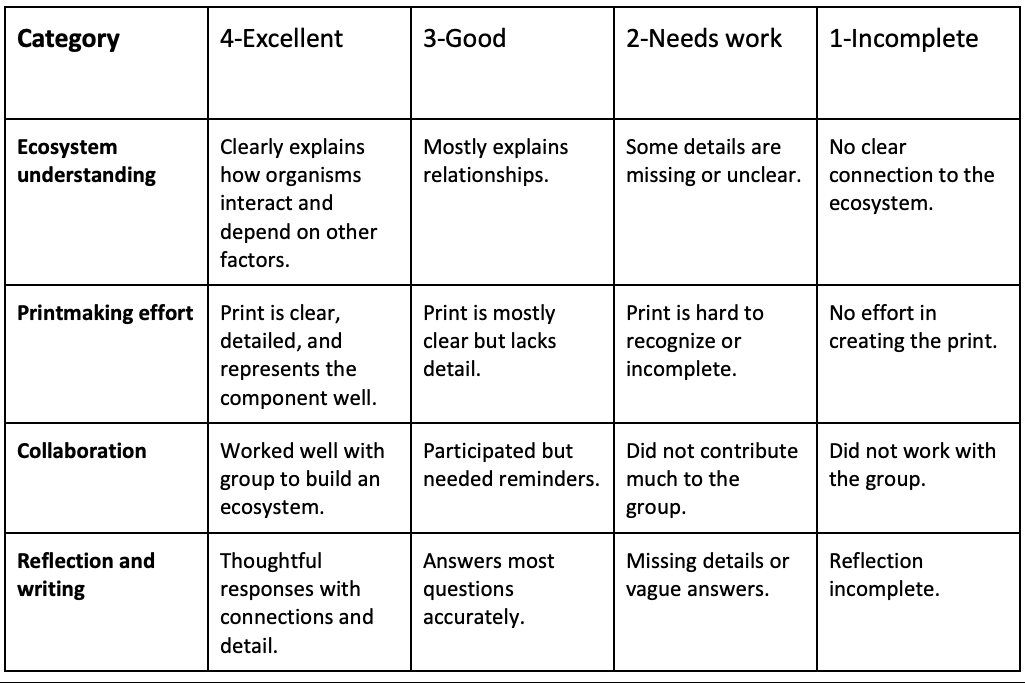
  • Final print and presentation – Students will submit their individual prints and written reflections of their ecosystem’s energy flow.
  • RUBRIC

A rubric table for grades 6-8 assessing Ecosystem understanding, Printmaking effort, Collaboration, and Reflection and writing—each rated from 4-Excellent to 1-Incomplete with specific criteria like interdependence in ecosystems.


Differentiation

Accelerated: 

  • Students research and depict more complex interactions (e.g., symbiosis, keystone species).
  • Reflection Essay – Students write an analysis of ecosystem relationships, including the impact of resource availability.
  • Students photograph their prints and use Google Slides or Canva to create a digital food web or ecosystem model.
  • Students can animate their food web interactions in Scratch to show energy flow.


Remedial:

  • Provide pre-drawn symbol templates for inspiration.
  • Use sentence starters for the reflection writing portion.


Additional Resources

Virtual Field Trip


Credits

Ideas contributed by: Shannon Green

*This integrated lesson provides differentiated ideas and activities for educators that are aligned to a sampling of standards. Standards referenced at the time of publishing may differ based on each state’s adoption of new standards.

Revised and copyright:  May 2025 @ ArtsNOW