
Why Student Engagement Matters for Learning & What’s Working in Classrooms Today
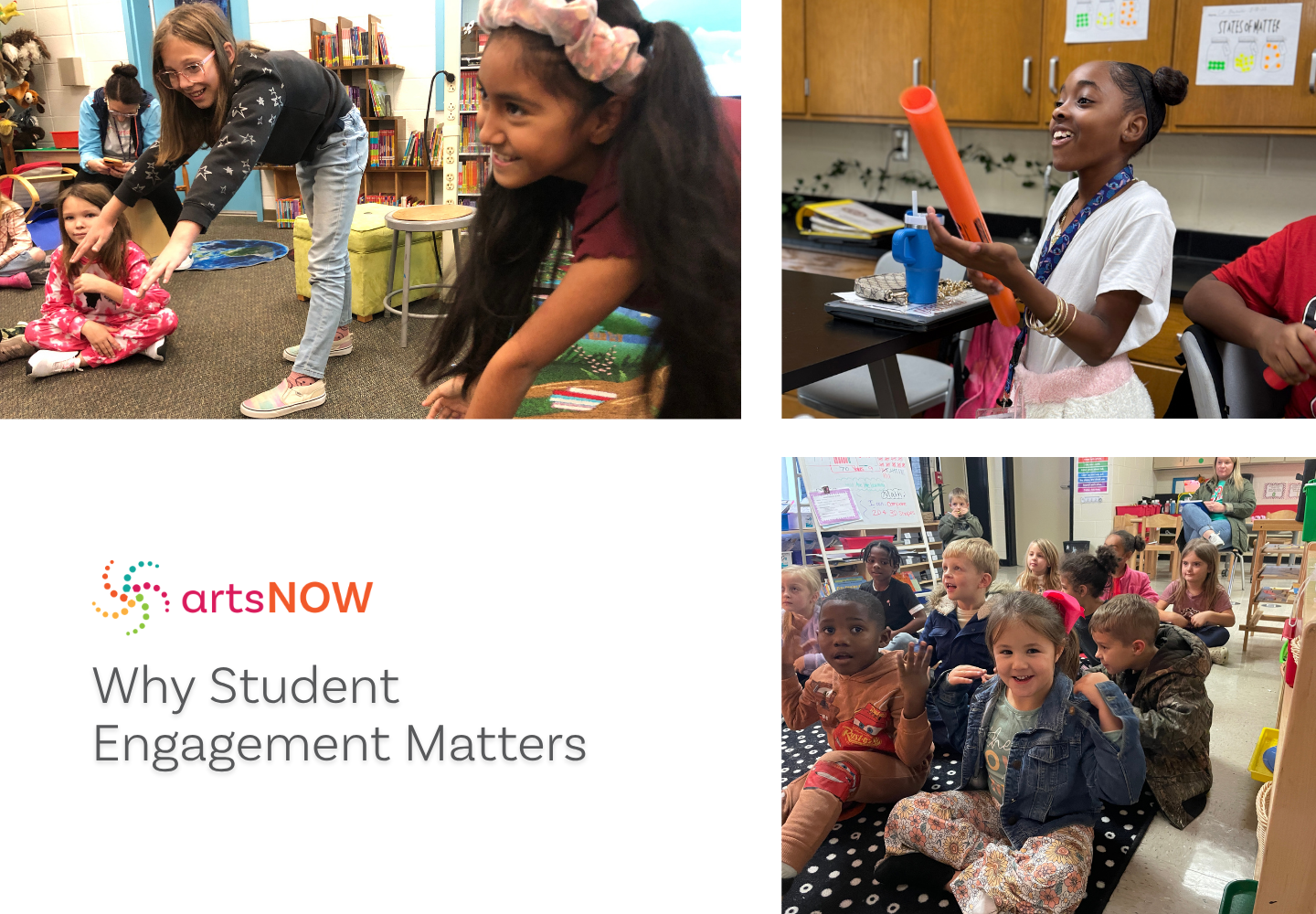
Student engagement has become one of the defining challenges in education today, and one of the clearest indicators of whether meaningful learning is actually happening.
Across the country, educators are grappling with a decline in student engagement in the classroom. According to EdWeek, 83% of students state there are not enough opportunities in the classroom for them to be curious. When engagement declines, academic achievement and long-term student success often decline alongside it.
At ArtsNOW, we work directly with schools navigating this challenge and know that when classrooms become creative and collaborative, student engagement rises—and outcomes follow.
What Is Student Engagement?
Student engagement is the degree to which students are emotionally connected, cognitively invested, and behaviorally involved in learning.
- Cognitive engagement: students think deeply and pursue understanding, not just task completion.
- Behavioral engagement: students actively participate, collaborate, and persist in learning.
- Emotional engagement: students feel connected to their learning, peers, and teachers.
When all three are present, classrooms shift from passive instruction to active learning environments with students genuinely invested in their work.
Why Student Engagement Matters
Engagement is a critical driver of learning. Students who are engaged are more likely to retain information, think critically, participate confidently, and persist through challenges.
Low engagement is closely tied to many of the challenges schools are currently facing:
- Chronic absenteeism
- Declining literacy rates
- Behavioral challenges
- Teacher burnout
- Lower academic achievement
Approximately 28% of U.S. students were chronically absent during the 2022–23 school year, with disengagement widely recognized as a major contributing factor.
In Georgia and South Carolina, large percentages of third graders are not reading proficiently—a critical benchmark because third grade marks the transition from “learning to read” to “reading to learn.” Students who fall behind at this stage face significantly greater risks of future academic struggles and dropout.
Teachers are feeling the impact as well. Between 40-50% of new teachers leave the profession within their first five years, often citing burnout, challenging classroom environments, and lack of support.
The causes of student disengagement are complex, but several themes consistently emerge across schools nationwide. According to educators, some of the biggest contributors include:
- Limited opportunities for creativity and active participation
- Heavy reliance on lecture-based instruction
- Weak connections between classroom content and students’ real lives
- Gaps in belonging and social-emotional connection
- Increased distractions from screen use
- Lingering impacts of disrupted learning environments
Students are far more likely to invest in learning when they can actively experience it, connect it to the world around them, and see themselves reflected in the process.
What’s Working in Classrooms Today
One of the most effective strategies emerging in schools today is arts integration.
Arts integration combines academic instruction with visual arts, music, theatre, and dance to create hands-on, inquiry-driven learning experiences. Rather than treating the arts as separate from academics, arts integration uses creativity as a pathway into rigorous learning.
This approach is highly effective at increasing student engagement. A 2025 ArtsNOW Partner School Study conducted by the University of South Carolina’s Research, Evaluation, and Measurement (REM) Center found that 95% of educators reported higher student engagement in classrooms supported by ArtsNOW.
Engagement and Academic Achievement Go Hand in Hand
Schools partnering with ArtsNOW have reported measurable academic gains, including:
- Powder Springs Elementary posted a 15% increase in third-grade ELA performance, nearly double the gains seen in a matched comparison school.
- At Angel Oak Elementary, the percentage of students reading at grade level climbed from 60% to 74% over five years.
- In Cobb County, 97% of English Learners in ArtsNOW partner schools improved language proficiency in a single year, significantly outperforming similar schools at 74%.
- At J.C. Lynch Elementary, third-grade ELA scores surged 36% in a single year, outpacing the state average by 15 percentage points.
- Forest Hills and Cottageville Elementary advanced from “Below Average” to “Average” on their state report cards, while teacher confidence jumped 24%.
These outcomes reinforce that students learn more deeply when they are engaged meaningfully in the learning process.
These results deliver a clear message that achievement, especially in literacy, rises when schools integrate the arts with intention and fidelity.
The Path Forward
In ArtsNOW partner schools, students are:
- Building robots to demonstrate energy transfer in science
- Using tableau theatre techniques to model math concepts and equations
- Creating human soundscapes to explore migration and environmental change in social studies
- Choreographing movement to represent scientific and mathematical concepts
- Using visual arts to deepen literary analysis and comprehension
Improving student engagement is not about making learning easier. It is about making learning more meaningful.
At ArtsNOW, we know engaged students become stronger learners, confident communicators, and creative problem-solvers. When classrooms come alive, learning outcomes can change. If you're ready to explore how arts-integrated learning can strengthen student engagement at your school, we’d love to connect.
And if you believe in building more engaging, effective classrooms through proven solutions, consider supporting this work with a donation to ArtsNOW.