Money Time K-2

Description

Using rhythmical experiences in music, the students will explore numbers and their relationships. Every aspect of music can be described mathematically. An understanding of patterns, the ability to develop operations, reveal functions, and being able to move toward higher levels of abstractions, can be strengthened through parallel music study. Dividing beats and meters: patterns; and starting the same patterns at different times to create canons: developing operations will be explored in this lesson.

SHARE
FACEBOOK

Monumental Sculpture 6-8

MONUMENTAL SCULPTURE

MONUMENTAL SCULPTURE

Learning Description

Discover the endless possibilities of paper sculpture! Let your imagination soar as you dive into this collaborative art-making process, creating large-scale, non-objective sculptures. Students will participate in the design process and analyze their sculptures through the lens of geometric concepts.


Learning Targets

GRADE BAND: 6-8
CONTENT FOCUS: VISUAL ARTS & MATH
LESSON DOWNLOADS:

Download PDF of this Lesson

"I Can" Statements

“I Can…”

  • I can work collaboratively to create a geometric sculpture in the round that demonstrates geometric concepts.

  • I can use the design process to design, create, and refine a sculpture in the round.

  • I can describe my sculpture in mathematical terms.

Essential Questions

  • How can art-making become a team building process?

  • How are mathematical concepts used in art?


Georgia Standards

Curriculum Standards

Grade 6:

6.MP: Display perseverance and patience in problem-solving. Demonstrate skills and strategies needed to succeed in mathematics, including critical thinking, reasoning, and effective collaboration and expression. Seek help and apply feedback. Set and monitor goals.


6.GSR.5.1 Explore area as a measurable attribute of triangles, quadrilaterals, and other polygons conceptually by composing or decomposing into rectangles, triangles, and other shapes. Find the area of these geometric figures to solve problems.


Grade 7:

7.MP: Display perseverance and patience in problem-solving. Demonstrate skills and strategies needed to succeed in mathematics, including critical thinking, reasoning, and effective collaboration and expression. Seek help and apply feedback. Set and monitor goals.


Grade 8:

8.MP: Display perseverance and patience in problem-solving. Demonstrate skills and strategies needed to succeed in mathematics, including critical thinking, reasoning, and effective collaboration and expression. Seek help and apply feedback. Set and monitor goals.


8.GSR.8.1 Explain a proof of the Pythagorean Theorem and its converse using visual models.


8.GSR.8.3 Apply the Pythagorean Theorem to find the distance between two points in a coordinate system in practical, mathematical problems.

Arts Standards

Grade 6: 

VA6.CR.1 Visualize and generate ideas for creating works of art. 


VA6.CR.2 Choose from a range of materials and/or methods of traditional and contemporary artistic practices to plan and create works of art.


Grade 7: 

VA7.CR.1 Visualize and generate ideas for creating works of art. 


VA7.CR.2 Choose from a range of materials and/or methods of traditional and contemporary artistic practices to plan and create works of art.


Grade 8: 

VA8.CR.1 Visualize and generate ideas for creating works of art. 


VA8.CR.2 Choose from a range of materials and/or methods of traditional and contemporary artistic practices to plan and create works of art.


South Carolina Standards

Curriculum Standards

Grade 6:

6.GM.1 Find the area of right triangles, other triangles, special quadrilaterals, and polygons by composing into rectangles or decomposing into triangles and other shapes; apply these techniques in the context of solving real-world and mathematical problems.


6.GM.4 Unfold three-dimensional figures into two-dimensional rectangles and triangles (nets) to find the surface area and to solve real-world and mathematical problems.


Grade 7:

7.GM.6 Apply the concepts of two- and three-dimensional figures to real-world and mathematical situations. a. Understand that the concept of area is applied to two-dimensional figures such as triangles, quadrilaterals, and polygons.


Grade 8:

8.GM.6 Use models to demonstrate a proof of the Pythagorean Theorem and its converse.


8.GM.7 Apply the Pythagorean Theorem to model and solve real-world and mathematical problems in two and three dimensions involving right triangles.

Arts Standards

Anchor Standard 1: I can use the elements and principles of art to create artwork.


Anchor Standard 2: I can use different materials, techniques, and processes to make art.


Anchor Standard 5: I can interpret and evaluate the meaning of an artwork.

Anchor Standard 7: I can relate visual arts ideas to other arts disciplines, content areas, and careers.


Key Vocabulary

Content Vocabulary

  • Area - The measure of the amount of space inside the boundary of a two-dimensional shape

  • Perimeter - The total distance around the boundary of a two-dimensional shape
  • Acute angle - An angle measuring less than 90 degrees
  • Right angle - A 90 degree angle
  • Obtuse angle - An angle measuring greater than 90 degrees
  • Isosceles triangle - A type of triangle that has at least two sides of equal length
  • Equilateral triangle - A type of triangle in which all three sides are of equal length
  • Scalene triangle - A type of triangle in which all three sides have different lengths
  • Right triangle -  A triangle that has a right angle
  • Parallel lines - Lines that will never touch
  • Perpendicular lines - Lines that intersect forming a 90 degree angle
  • Pythagorean Theorem -
  • Design process - A systematic, iterative method used by engineers to solve problems
  • Balance - Possessing equilibrium or equal distribution of weight
  • Counter balance - A weight balancing another weight

Arts Vocabulary

  • Construction - A type of sculpture in which materials are physically joined together to make a whole

  • Sculpture in the round - A three-dimensional structure that is meant to be viewed from all sides
  • Line - The path of a moving point
  • Shape - A two-dimensional enclosed line; in art, shape can be geometric or organic/freeform


Materials

  • Newspaper or newsprint sheets 24” x 36” (computer paper or lined paper can be substituted)
  • Masking tape 
  • Pencils and sketch paper
  • Yardstick or measuring tape to measure dimensions of finished sculpture


Instructional Design

Opening/Activating Strategy

Classroom Tips: Have ample space in the room so groups can move far enough apart during the creating process to enable maximum space for the construction process.


  • Show students an image of “Mutual Support” by George Hart. Do not tell students the name of the sculpture.
  • Ask students to work collaboratively to make at least ten objective observations about the sculpture (i.e. color, line, angles, overall shape, etc.).
    • Have students share observations as a whole class.
  • Next, ask students to guess how Hart constructed the sculpture. Have students share ideas as a class. Students should justify their answers by referring to specific things that they can see in the sculpture.
  • Show students the title of the sculpture, “Mutual Support”. Ask students how the design of the sculpture demonstrates the name.
  • Tell students that this is an example of sculpture in the round.
    • Tell students that sculpture is always three-dimensional and that sculpture in the round means that the viewer can walk all the way around the sculpture to view it from all sides.


Work Session

  • Tell students that in this lesson, they will be creating sculptures in the round inspired by the work of George Hart.
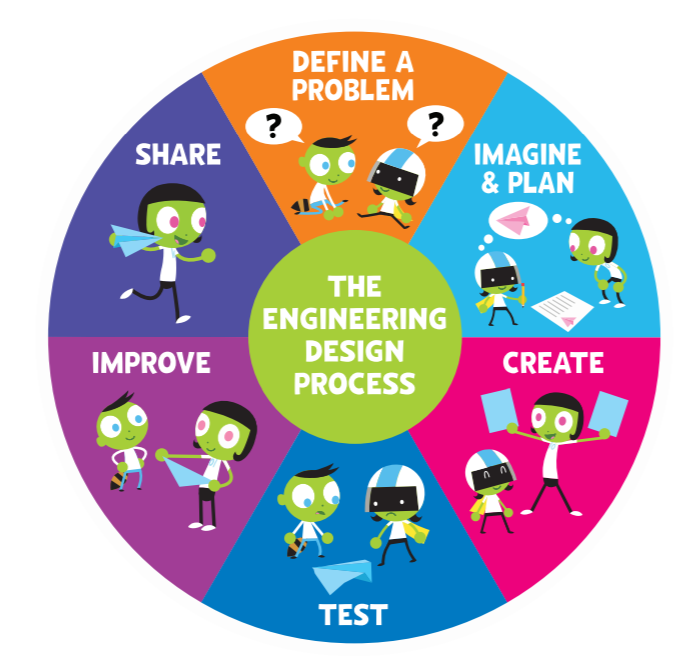
  • Introduce the design process to students. 
  • Next, divide students into groups of 2-4.  
  • Begin by demonstrating how to create building sticks by rolling sheets of newsprint from corner to corner using a pencil as a guide. The sticks are fastened at the end with a small piece of masking tape.
    • Each team will need 20 sticks total.


  • Ask students to experiment with the types of geometric shapes they can create with the sticks. Tell students that in their actual sculptures, they can bend the sticks to make smaller shapes.
  • Next, have students make a basic drawn design for their sculpture (Grade 8 students should focus on incorporating right triangles in order to utilize the Pythagorean Theorem).
    • Tell students that they will need to start with a triangular or square base.
    • Remind students that a sculpture is always three-dimensional, so their final sculpture should not be flat.
    • Tell students that their sculptures must meet the following guidelines:
      • Sculptures must be made up of geometric shapes. 
      • Constructions must be three-dimensional.
      • All materials must be fully incorporated into the group constructions.
      • Constructions must be able to stand on their own and be transported easily.
  • Students will work intuitively attaching sticks with masking tape until their construction is completed. 
  • Encourage students to be mindful of strong construction, balance, and counter balance. 
  • Once sculptures are complete, students will:
    • Calculate the area of right triangles, other triangles, special quadrilaterals, and polygons by composing into rectangles or decomposing into triangles and other shapes.
    • Grade 8 students will use right triangles in their sculptures to demonstrate a proof of the Pythagorean Theorem in their design and sculptures.


Closing Reflection

  • Students will reflect on the design process. Students should look at their original sketches and observe how their final product changed through the creation process.
    • Students should reflect on the following questions. This can be written or done orally through conversation.
      • How did the design change?
      • Why did the design change?
      • What design choices did you make to ensure that your sculpture could stand on its own?
      • If you were to design and create this artwork again, what would you do differently?
  • Students will present their sculptures to their peers, as a whole group or several small groups can present to each other, and discuss how their design changed from the original design to the final sculpture.


Assessments

Formative

Teachers will assess students’ understanding of the content throughout the lesson by observing students’ participation in the activator, collaboration during the design process and sculpture creation, and conferencing with students throughout the creative process.


Summative

CHECKLIST

  • Students can work collaboratively to create a geometric sculpture in the round that demonstrates geometric concepts.
  • Students can use the design process to design, create, and refine a sculpture in the round.
  • Students can describe their sculpture in mathematical terms.


DIFFERENTIATION 

Acceleration: Have students write step by step detailed instructions to tell another person how to recreate their sculpture using mathematical concepts. If time permits, two groups can swap instructions and attempt to build each other’s sculptures. Then, the groups should reflect on the results and evaluate the clarity of their written instructions.

Remediation: 

  • Show students an example of a completed sculpture so that students can visualize the end result. Analyze how the sculpture was created so that students can see the steps needed to create their sculpture.
  • Provide an alternative to creating paper sticks, such as straws.


 ADDITIONAL RESOURCES


*This integrated lesson provides differentiated ideas and activities for educators that are aligned to a sampling of standards. Standards referenced at the time of publishing may differ based on each state’s adoption of new standards.

Ideas contributed by: Darby Jones. Updated by: Katy Betts.

Revised and copyright: August 2024 @ ArtsNOW

 

Moving With Fractions 4-5

MOVING WITH FRACTIONS

MOVING WITH FRACTIONS

Learning Description

In this lesson, students will use movement phrases to model common fractions with like denominators and convert fractions into decimals. Students will compare the fraction of locomotor and non-locomotor movements in a movement phrase. Students will then create their own movement phrase and use fractions to describe their performance. Students will recognize that fractions are used in many aspects of our world including the arts.


Learning Targets

GRADE BAND: 4-5
CONTENT FOCUS: DANCE & MATH
LESSON DOWNLOADS:

Download PDF of this Lesson

"I Can" Statements

“I Can…”

  • I can accurately represent fractions of movement in a movement phrase that I choreograph.
  • I can accurately describe a movement phrase using fractions.
  • I can compare fractions.
  • I can identify and use locomotor and non-locomotor movements and levels in choreography.

Essential Questions

  • How can choreography be expressed in terms of fractions?
  • What is a fraction?
  • How can a fraction be converted to a decimal?


Georgia Standards

Curriculum Standards

Grade 4: 

4.NR.4: Solve real-life problems involving addition, subtraction, equivalence, and comparison of fractions with denominators of 2, 3, 4, 5, 6, 8, 10, 12, and 100 using part-whole strategies and visual models.


4.NR.5: Solve real-life problems involving addition, equivalence, comparison of fractions with denominators of 10 and 100, and comparison of decimal numbers as tenths and hundredths using part-whole strategies and visual models.


Grade 5: 

5.NR.3: Describe fractions and perform operations with fractions to solve relevant, mathematical problems using part-whole strategies and visual models.

Arts Standards

Grade 4: 

ESD4.CR.1 Demonstrate an understanding of the choreographic process.


ESD4.CR.2 Demonstrate an understanding of dance as a form of communication.


ESD4.PR.1 Identify and demonstrate movement elements, skills, and terminology in dance


ESD4.RE.1 Demonstrate critical and creative thinking in dance.


Grade 5:

ESD5.CR.1 Demonstrate an understanding of the choreographic process.


ESD5.CR.2 Demonstrate an understanding of dance as a form of communication.


ESD5.PR.1 Identify and demonstrate movement elements, skills, and terminology in dance


ESD5.RE.1 Demonstrate critical and creative thinking in dance.


South Carolina Standards

Curriculum Standards

Grade 4:

4.NSF.2 Compare two given fractions (i.e., denominators 2, 3, 4, 5, 6, 8, 10, 12, 25, 100) by creating common denominators or numerators, or by comparing to a benchmark fraction such as 1/2 and represent the comparison using the symbols >, =, or <.


4.NSF.3 Develop an understanding of addition and subtraction of fractions (i.e., denominators 2, 3, 4, 5, 6, 8, 10, 12, 25, 100) based on unit fractions.

  1. Compose and decompose a fraction in more than one way, recording each composition and decomposition as an addition or subtraction equation; b. Add and subtract mixed numbers with like denominators; c. Solve real-world problems involving addition and subtraction of fractions referring to the same whole and having like denominators.


Grade 5: 

5.NSF.3 Understand the relationship between fractions and division of whole numbers by interpreting a fraction as the numerator divided by the denominator

Arts Standards

Anchor Standard 1: I can use movement exploration to discover and create artistic ideas and works.

Anchor Standard 2: I can choreograph a dance.

Anchor Standard 3: I can perform movements using the dance elements.

Anchor Standard 7: I can relate dance to other arts disciplines, content areas, and careers.


Key Vocabulary

Content Vocabulary

  • Fraction - A numerical quantity that represents a part of a whole number
  • Numerator - Represents the number of parts out of the whole that are being considered
  • Denominator - Represents the total parts of something

Arts Vocabulary

  • Movement phrase - A series of movements linked together to make a distinctive pattern
  • Non-locomotor - This refers to a movement that does not travel through space
  • Locomotor - This refers to a movement that travels through space
  • Steady beat - An unchanging, continuous pulse
  • Space - An element of movement involving direction, level, size, focus, and pathway
  • Level - One of the aspects of the movement element space; in dance, there are three basic levels: high, middle, and low
  • Choreography - The art of composing dances and planning and arranging the movements, steps, and patterns of dancers
  • Choreographer - A person who creates dances
  • Shape - This refers to an interesting and interrelated arrangement of body parts of one dance; the visual makeup or molding of the body parts of a single dancer; the overall visible appearance of a group of dancers


Materials

  • Sound source and music with a steady beat


Instructional Design

Opening/Activating Strategy

  • Begin the lesson by engaging students in movement that introduces students to the Elements of Dance: Body, action, space, time and energy.
    • Have students arrange themselves in the classroom with enough personal space to move freely without touching a neighbor.
    • Turn on instrumental music with a steady beat.
    • First, have students bring awareness to their bodies by leading them through gentle stretches starting from the head and moving to the toes (e.g., head circles, shoulder shrugs, toe touches, etc.).
    • Next, bring students’ awareness to the rhythm of the music by having them march in place to the beat with high knees, swinging their arms side to side.
    • Now, direct students to explore energy variations with different movement qualities such as sharp movements–quick, precise actions like punches or snaps, and smooth movements–slow, flowing actions like waves or circles with arms.
    • Finally, bring students’ attention to levels (high, middle, low) and directions (forward, backward, sideways) with movements such as stretching up high and moving on tiptoes, moving low to the ground and crawling forwards and backwards, and bouncing in place at a medium level.
    • Have students return to their seats.


Work Session

  • Display a rectangle divided into tenths.
  • The tenths should be shaded in three different colors, such as red, white, and blue.
    • The red tenths equal non-locomotor movement.
    • The blue tenths equal locomotor movement.
    • The white tenths equal holds in the movement phrase.
  • Show examples of simple locomotor and non-locomotor movements and have students perform the examples. Ask the students for suggestions of other locomotor and non-locomotor movements and use their suggested movements to perform the movement phrase in the pattern displayed in the rectangle.
  • Discuss the fraction of non-locomotor movements and locomotor movements represented in the rectangle.
    • Ask students to add the number of non-locomotor movements and locomotor movements to get the total number of movements during the phrase.
    • Students should represent locomotor movements as a fraction and non-locomotor movements as a fraction.
    • Students should then compare the fractions of locomotor and non-locomotor movements using greater than, less than, and equal to signs.
    • Have students convert the fractions to decimals and add the two decimals.
  • Divide students into groups. Students will work with their group to create and perform a simple movement phrase.
    • Before sending groups to work, play music for students to choreograph their dances to; help students find the steady. Then, turn music down and allow students to begin their choreography.
    • Tell students that movement phrases will include 10 steps and must show locomotor and non-locomotor movements and various levels.
    • Students will write the fractions and decimals that describe their movement phrase and compare their fractions using greater than, equal to, or less than signs.


Closing Reflection

  • The students will perform their movement phrases for their classmates. Discuss appropriate audience participation and etiquette prior to performances.
  • Turn up the volume of the music and help students find the steady beat again by tapping their toe on the floor.
  • Invite the first group up to perform their dance.
    • After each performance, the audience should analyze the dance in terms of locomotor or non-locomotor movements and determine the fraction of locomotor and non-locomotor movements in the phrase. They will also describe the shapes and levels evident in the movement phrase.


Assessments

Formative

Teachers will assess students’ understanding of the content throughout the lesson by observing students’ participation in the activator, ability to identify and compare fractions, ability to work collaboratively to choreograph a movement phrase that demonstrates locomotor and non-locomotor movements and levels, and ability to describe choreography in terms of fractions.


Summative

CHECKLIST

  • Students can accurately represent the fractions of movement in the movement phrase they choreograph.
  • Students can accurately describe the movement phrases they see using fractions.
  • Students can accurately compare fractions.
  • Students can convert fractions to decimals.
  • Students can identify and use locomotor and non-locomotor movements and levels in choreography.


DIFFERENTIATION 

Acceleration: Challenge students to analyze other elements of their choreography such as levels, directions, and pathways in terms of fractions.

Remediation: Reduce the number of movements students are required to include in their choreography.


*This integrated lesson provides differentiated ideas and activities for educators that are aligned to a sampling of standards. Standards referenced at the time of publishing may differ based on each state’s adoption of new standards.

Ideas contributed by: Whitney Jones. Updated by Katy Betts.

Revised and copyright:  June 2024 @ ArtsNOW


Music and Acoustics 4-5

MUSIC AND ACOUSTICS

MUSIC AND ACOUSTICS

Learning Description

Students will work together creatively to compose a rhythmic piece using cups, demonstrating their ability to identify and understand the relationship between force, size and sound. Throughout the lesson, students will apply musical skills such as improvisation, composition, listening, and playing.


Learning Targets

GRADE BAND: 4-5
CONTENT FOCUS: MUSIC & SCIENCE
LESSON DOWNLOADS:

Download PDF of this Lesson

"I Can" Statements

“I Can…”

  • I can identify high, medium, and low sounds and loud, medium, and soft sounds aurally.
  • I can describe the impact of size and force on sound.
  • I can create and perform an 8-beat rhythmic pattern.
  • I can identify the pitch and dynamics of peers’ compositions verbally and through notation.

Essential Questions

  • How can music listening and composing support learning in other curricular areas?
  • What is the relationship between size and sound and force and sound?


Georgia Standards

Curriculum Standards

Grade 4:

S4P2. Obtain, evaluate, and communicate information about how sound is produced and changed and how sound and/or light can be used to communicate.


  1. Plan and carry out an investigation utilizing everyday objects to produce sound and predict the effects of changing the strength or speed of vibrations.

Arts Standards

Grade 4:

ESGM4.CR.1 Improvise melodies, variations, and accompaniments.


ESGM4.CR.2 Compose and arrange music within specified guidelines.


ESGM4.PR.2 Perform a varied repertoire of music on instruments, alone and with others.


ESGM4.RE.1 Listen to, analyze, and describe music.


ESGM4.CN.1 Connect music to the other fine arts and disciplines outside the arts.


South Carolina Standards

Curriculum Standards

Grade 4: 

4-PS4-3. Generate and compare multiple solutions that use patterns to transmit information.

Arts Standards

Anchor Standard 1: I can arrange and compose music.

Anchor Standard 2: I can improvise music.

Anchor Standard 4: I can play instruments alone and with others.

Anchor Standard 6: I can analyze music.

Anchor Standard 9: I can relate music to other arts disciplines, other subjects, and career paths.


Key Vocabulary

Content Vocabulary

  • Sound wave - A vibration that travels through a medium (such as air, water, or solid materials) as a result of oscillating particles
  • Pattern - A repeated arrangement of elements or events, often following a specific order or sequence
  • Transmit - To send or pass something

Arts Vocabulary

  • Acoustics - The branch of physics that deals with sound and sound waves
  • Body percussion - Sounds produced by striking or scraping parts of the body; typically includes snapping, clapping, patting, and stamping
  • Dynamics - Volume of sound (loudness, quietness)
  • Texture - The thickness or thinness of sound
  • Pitch - The highness or lowness of sound


Materials

  • Audio recording of drum composition (examples can be found on iTunes, Spotify, YouTube, etc.)
  • Sound source (computer and speakers)
  • Drums of three different sizes (improvise with other objects, such as buckets or pots, that can be used in place of a drum if you do not have drums available)
  • Plastic cups of three different sizes
  • 8-beat visual (numbers 1-8 spaced evenly)
  • Pencils
  • “Pitch detective” charts for each student
  • “Pitch detective” visual on board


Instructional Design

Opening/Activating Strategy

Classroom Tips: Arrange student groups throughout the room so that they can move far enough apart during the creating process to enable careful listening and minimize distraction from other groups. Perform compositions out of sight of “audience,” so students rely on listening rather than sight to identify sounds heard. 


  • Play a recording of drums as students enter the room.
  • Have students listen and then discuss with a partner what they heard.
  • Introduce musical terms (e.g., instrument names, dynamics, pitch, texture, etc.) as students make observations.


Work Session

  • Take out three different sized drums (or buckets turned over). Demonstrate different pitches (high, medium, low) of various size drums (using the same relative force when you hit each drum).
  • Ask students if they can determine the relationship between sound and drum size.
  • Now change the force used on one drum–soft, medium, and hard. Ask students to determine the relationship between force and sound.
  • Now, transfer these acoustical principles to various size plastic cups.
  • Play a listening game with students. Out of students’ sight, perform 4- or 8-beat rhythmic patterns (or beats) on different drums and/or cups.
  • Challenge students to identify what was heard (e.g., three sounds on a small drum and one sound on a medium drum).
  • Have students echo the pattern, using body percussion (e.g., clap for high drum, pat for medium drum, stamp for large drum).
  • Perform an 8-beat rhythmic pattern using low, medium, and/or high sounds, and have students identify what they heard (high, medium, and low).
    • Keep the patterns simple by using quarter notes (one sound for each beat) and eighth notes (two sounds on each beat only).
    • Using an 8-beat visual (see below) may be helpful to guide student responses.

1    2    3    4    5    6    7    8

  • Vary the performance by changing the dynamics (loud, medium and soft). Have students identify the dynamics and how changing the dynamics changed the composition.
  • Divide students into groups of four to six students, with each student having a cup. Have students create an 8-beat pattern using cups.
    • Remind them to include everyone in the composing and performing process.
    • Have students try changing the dynamics of their performances as they rehearse.
  • Distribute pencils and “pitch detective” charts. While each group performs (out of the sight of their classmates), the other students will be “pitch detectives” and notate what they hear on their charts.
    • For example, using a blank 8x3 table (such as appears below), students could write an “X” in the appropriate boxes based on what they hear. The boxes below would demonstrate four high sounds, two medium sounds, and two low sounds.
  • Have groups perform again; this time students will use a key to indicate the dynamics of the sound–loud, medium or soft. For example, students could circle the X’s for loud, draw a triangle around the X’s for medium, and underline the X’s for soft.


Closing Reflection

  • Compare and contrast student compositions, discussing the differences in pitches, dynamics and rhythms.
  • Finally, have students complete a written reflection on the relationships between force and sound and size and sound.


Assessments

Formative

Teachers will assess students’ understanding of the content throughout the lesson by observing students’ participation in the activator; ability to use musical vocabulary to describe music; ability to identify high, medium, and low sounds and loud, medium, and soft sounds; and collaboration with group members to create an 8-beat pattern using cups.


Summative

CHECKLIST

  • Students can identify high, medium, and low sounds and loud, medium, and soft sounds aurally.
  • Students can describe the impact of size and force on sound.
  • Students can create and perform an 8-beat rhythmic pattern.
  • Students can identify pitch and dynamics of peers’ compositions verbally and through notation.


DIFFERENTIATION 

Acceleration: 

  • Provide students with a variety of materials (including but not limited to cardboard boxes, plastic hangers, foil, rubber bands in different sizes, etc). Ask students to build (or design) new instruments that play different pitches. Allow students to research and explore how instruments are made. Having different students research different instruments will allow for discussion on how they make different sounds.
  • Combine two student compositions into a 16-beat phrase.
  • Combine two student compositions simultaneously, producing a thicker texture.
  • Alter dynamics and/or tempo of student compositions.
  • Have students write compositions for others to perform using various notational systems.
    • Write 1-2 Xs in each cell of a 3x8 table.
    • Use other symbols (triangle, square, circle) to represent high, medium, and low sounds.
  • Have students write sequential steps for generating new compositions.

Remediation:

  • When performing rhythmic patterns, have students perform a four beat pattern.
  • Group students into pairs as they complete their “pitch detective” charts.
  • Make the “pitch detective” charts 4x3.

ESOL Modifications and Adaptations:

  • Ensure that students have a clear understanding of the concepts of steady beat and pitch, along with the music vocabulary words texture, dynamics, acoustics, and body percussion prior to teaching this lesson.


*This integrated lesson provides differentiated ideas and activities for educators that are aligned to a sampling of standards. Standards referenced at the time of publishing may differ based on each state’s adoption of new standards.

Ideas contributed by: Maribeth Yoder-White. Modifications, Extensions, and Adaptations Contributed by: Candy Bennett, Patty Bickell, Vilma Thomas, and Lori Young. Updated by: Katy Betts.

Revised and copyright: September 2024 @ ArtsNOW


Music Time K-2

Description

Using music as an impetus for creating original poetry and music, students will develop skills and understandings in language arts and music. Creative thinking, vocabulary development, and structural understanding are necessary to create poetry and music in a prescribed form. Musical skills addressed include improvising, composing, listening, and speaking.

SHARE
FACEBOOK