Exploring Adjectives Through Art and Creative Writing

EXPLORING ADJECTIVES THROUGH ART AND CREATIVE WRITING

EXPLORING ADJECTIVES THROUGH ART AND CREATIVE WRITING

Learning Description

Describing artwork can be a great way to help students use more adjectives!  Adjectives support students in using descriptive language to create interesting and unique stories. In this lesson students will have the opportunity to do both!


Learning Targets

GRADE BAND: K-1
CONTENT FOCUS: VISUAL ARTS & ELA
LESSON DOWNLOADS:

Download PDF of this Lesson

"I Can" Statements

“I Can…”

  • I can use adjectives to describe a piece of art.
  • I can use art as an inspiration to write a creative story.

Essential Questions

  • How can adjectives help me describe a piece of art? 
  • How can art stimulate my imagination and help me write a creative story?


Georgia Standards

Curriculum Standards

Kindergarten:

ELAKR6 The student gains meaning from orally presented text.  

ELAKW1 The student begins to understand the principles of writing. 

ELAKW2 The student begins to write in a variety of genres, including narrative, informational, persuasive, and response to literature.  

ELAKLSV1 The student uses oral and visual skills to communicate.  

Grade 1:

ELA1R6 The student uses a variety of strategies to understand and gain meaning from grade-level text. 

  1. Recognizes and uses graphic features        

and graphic organizers to understand text. 

ELA1W2 The student writes in a variety of genres, including narrative, informational, persuasive and response to literature.

ELA1LSV1 The student uses oral and visual strategies to communicate. 

Grade 2: 

ELA2R4 The student uses a variety of strategies to gain meaning from grade-level text. 

ELA2W2 The student writes in a variety of genres, including narrative, informational, persuasive, and response to literature.  

ELA2LSV1 The student uses oral and visual strategies to communicate. 

Arts Standards

Kindergarten:

VAK.CR.1 Engage in the creative process to generate and visualize ideas by using subject matter and symbols to communicate meaning.

VAK.CR.2 Create works of art based on selected themes. a. Create works of art emphasizing one or more elements of art and/or principles of design. 

VAK.CR.3 Understand and apply media, techniques, and processes of two-dimensional art. e. Develop manual dexterity to develop fine motor skills. 

VAK.MC.3: Selects and uses subject matter, symbols, and/or ideas to communicate meaning. 

VAK.PR.1 Participate in appropriate exhibition(s) of works of art to develop identity of self as artist. 

Grade 1:

VA1.CR.1 Engage in the creative process to generate and visualize ideas by using subject matter and symbols to communicate meaning.

VA1.CR.2 Create works of art based on selected themes. a. Create works of art emphasizing one or more elements of art and/or principles of design. 

  1. Create works of art that attempt to fill the space in an art composition.

VA1.CR.3 Understand and apply media, techniques, and processes of two-dimensional art. 

  1. Explore spatial relationships.

VA1MC.3: Selects and uses subject matter, symbols, and ideas to communicate meaning. 

VA1.PR.1 Participate in appropriate exhibition(s) of works of art to develop identity of self as artist.


South Carolina Standards

Curriculum Standards

Kindergarten:

K.W.MCC.3.1 3.1 Use a combination of drawing, dictating, and writing to narrate a single event or several loosely linked events, to tell about the events in the order in which they occurred, and to provide a reaction to what happened.

K.W.L.4.5 With guidance and support, use adjectives.

K.W.MC.1.4 Participate in conversations with varied partners about focused grade level topics and texts in small and large groups.

Grade 1:

1.W.MCC.3.1  Explore multiple texts to write narratives that recount two or more sequenced events, include details, use temporal words to signal event order, and provide a sense of closure. 

1.W.L.4.5 Use adjectives and adverbs.

1.W.MC.1.4 Participate in shared conversations with varied partners about focused grade level topics and texts in small and large groups

Arts Standards

Anchor Standard 1: I can use the elements and principles of art to create artwork.

Anchor Standard 2: I can use different materials, techniques, and processes to make art.

Anchor Standard 3: I can improve and complete artistic work using elements and principles.

Anchor Standard 4: I can organize work for presentation and documentation to reflect specific content, ideas, skills, and or media


Key Vocabulary

Content Vocabulary

Narrative - A story or sequence of events and experiences. 

Adjective - Words that describe or modify another person or thing in the sentence. 

Illustration - A picture or diagram that helps make something clear or attractive. 

Arts Vocabulary

Line - A mark made by a pointed tool such as a brush, pen, or stick; a moving point

Color - One of the seven elements of art; it is created by light. There are three properties of color: Hue (name), value (shades and tints), and intensity (brightness)

Shape - A flat, enclosed area that has two dimensions, length and width

Texture - Describes the feel of an actual surface


Materials

  • Picture of artwork 
  • Pencil 
  • Paper 
  • Colored pencils/crayons/markers


Instructional Design

Opening/Activating Strategy

Project an image. In pairs, have students identify 10 things that they see in the image. Have students switch pairs and identify 10 more things that they see. Repeat one final time.  Reflect with the students on how the task became more difficult with each round.  Point out some examples in rounds 2 and 3 in which students began to include more detail, describing the attributes of what they saw (using adjectives).


Work Session

Process 

  • Start the lesson by reviewing adjectives. Using the image from the activator, name a few adjectives that can be seen in the image. Focus adjectives around the elements of art - color, types of lines and shapes, and texture.
  • Show students a work of art or illustration from a story. The illustration should be vivid and colorful if possible (not abstract). This will help the students identify many adjectives to use in describing the image. 
  • Older students will write their adjective on a sticky note. The teacher will ask students to take turns sharing their adjectives that describe the artwork. Students will place the sticky note on the board next to the image of the artwork. They will share where they see the adjective in the artwork when it’s their turn to put their sticky note on the board. For younger students, have them take turns coming up to the board and pointing out where they see the adjective that they used to describe the artwork. The teacher can write these words on the board. 
  • Next, have the students close their eyes and imagine what is happening in the picture. Ask the students the following questions to guide their imagination. 
    • Who are the people or objects in the artwork? 
    • What are the characters doing in the image? 
    • Where are the characters going? 
    • When did this happen? 
    • Have the students focus on Who, What, When, and Why as they will have to use their creativity and imagination to write a creative story using the artwork as a starting point. 
  • Explain that students will be writing a story based on the artwork. Students will fill out a graphic organizer to plan their story. Set a minimum number of adjectives that students should include in their story to make the story more interesting and capture the readers’ interest. 
  • Students will then generate drawings of their own to illustrate their stories.

Closing Reflection

Have students engage in small group story time. Students will share their stories and illustrations with each other. Students should use adjectives to describe each other’s stories and illustrations.


Assessments

Formative

  • Check for understanding through student discussion of artwork using adjectives and explaining where students see them. 
  • Creative story planning graphic organizer


Summative

Students will demonstrate mastery of learning concepts through their illustrations and creative stories based on original artwork.


Acceleration: 

Gifted Modifications and Extensions:  Follow steps 1-3 of the original lesson and then finish the lesson with these modifications: Give students a series of adjectives and have them create their own piece of artwork. When done creating their artwork, have the students close their eyes and imagine what is happening in the picture. They will then write an imaginative writing piece answering the questions who, what, when and where in their writing.  

Remediation: 

Follow steps 1 and 2. Next, using a graphic organizer, work as a group to name adjectives that describe the picture. Invite students to use the adjectives as they write or dictate sentences about the picture. 

*This integrated lesson provides differentiated ideas and activities for educators that are aligned to a sampling of standards. Standards referenced at the time of publishing may differ based on each state’s adoption of new standards.

Ideas contributed by: Greg Sena. Modifications, Extensions, and Adaptations Contributed by:  Peggy Barnes, Candy Bennett, Lindsey Elrod, Jennifer Plummer, and Vilma Thomas.  Reviewed by Debbie Frost. Updated by Susie Spear Purcell and Katy Betts

Revised and copyright:  August 2022 @ ArtsNOW
Exploring Habitats Through Music Composition 2-3

EXPLORING HABITATS THROUGH MUSIC COMPOSITION

EXPLORING HABITATS THROUGH MUSIC COMPOSITION

Learning Description

Through composition of original speech pieces, students will develop skills and understandings in science, language arts, and music. Teamwork and creativity are necessary to create a chant that demonstrates understanding of plant and animal life in various habitats. Musical skills addressed in this lesson include improvising, composing, listening, speaking, and moving.


Learning Targets

GRADE BAND: 2-3
CONTENT FOCUS: MUSIC & SCIENCE
LESSON DOWNLOADS:

Download PDF of this Lesson

"I Can" Statements

“I Can…”

  • I can create and accurately perform an original speech composition in rondo form about my assigned habitat.
  • I can create and accurately perform a body percussion ostinato to accompany my speech composition.
  • I can aurally and visually identify rondo form in musical compositions.

Essential Questions

  • How can music composition help us understand and remember habitats?


Georgia Standards

Curriculum Standards

Grade 3:

S3L1. Obtain, evaluate, and communicate information about the similarities and differences between plants, animals, and habitats found within geographic regions (Blue Ridge Mountains, Piedmont, Coastal Plains, Valley and Ridge, and Appalachian Plateau) of Georgia.


  1. Construct an explanation of how external features and adaptations (camouflage, hibernation, migration, mimicry) of animals allow them to survive in their habitat.
  2. Use evidence to construct an explanation of why some organisms can thrive in one habitat and not in another.

Arts Standards

Grade 2:

ESGM2.CR.1 Improvise melodies, variations, and accompaniments.

ESGM2.CR.2 Compose and arrange music within specified guidelines.

ESGM2.PR.2 Perform a varied repertoire of music on instruments, alone and with others.

ESGM2.RE.1 Listen to, analyze, and describe music.

ESGM2.RE.2 Evaluate music and music performances.

ESGM2.CN.1 Connect music to the other fine arts and disciplines outside the arts.


Grade 3:

ESGM3.CR.1 Improvise melodies, variations, and accompaniments.

ESGM3.CR.2 Compose and arrange music within specified guidelines.

ESGM3.PR.2 Perform a varied repertoire of music on instruments, alone and with others.

ESGM3.RE.1 Listen to, analyze, and describe music.

ESGM3.RE.2 Evaluate music and music performances.

ESGM3.CN.1 Connect music to the other fine arts and disciplines outside the arts.


South Carolina Standards

Curriculum Standards

Grade 3:

3-LS3-1. Analyze and interpret data to provide evidence that plants and animals have inherited traits that vary within a group of similar organisms.

3-LS4-3. Construct an argument with evidence that in a particular habitat some organisms can thrive, struggle to survive, or fail to survive.

Arts Standards

Anchor Standard 1: I can arrange and compose music.

Anchor Standard 2: I can improvise music.

Anchor Standard 4: I can play instruments alone and with others.

Anchor Standard 6: I can analyze music.

Anchor Standard 7: I can evaluate music.

Anchor Standard 9: I can relate music to other arts disciplines, other subjects, and career paths.


Key Vocabulary

Content Vocabulary

  • Habitat - The natural environment of an organism; place that is natural for the life and growth of an organism
  • Organism - A living thing, like an animal, plant, fungus, bacterium, or protist
  • Adaptation - How organisms change or adjust to new conditions
  • Environment - All external conditions, influences, and factors that affect and interact with living organisms

Arts Vocabulary

  • Rondo - A form of composition in which the first section recurs throughout the piece, alternating with different sections (e.g., A-B-A-B-A or A-B-A-C-A, etc.); this form is found especially in compositions of the Baroque and Classical eras
  • Ostinato - A repeated pattern (plural: ostinati)
  • Body percussion - Sounds produced by striking or scraping parts of the body; typically includes snapping, clapping, patting, and stomping
  • Phrase - Musical sentence or unit, commonly a passage of four or eight measures; a dependent division of music, much like a single line of poetry in that it does not have a sense of completion in itself; usually two or more phrases balance each other
  • Texture - The thickness or thinness of sound


Materials

  • Habitat cards (individual cards with one habitat on each)
  • Cutouts of shapes (or shapes can be written on the board)
  • Visual of A section text (to be displayed after chant is learned)
  • Sound source (computer and speakers)
  • Recording of musical composition in rondo form (this could be a song that is structured verse-chorus-verse-chorus)
  • Large paper and markers


Instructional Design

Opening/Activating Strategy

Classroom Tips: Arrange groups so that students can move away from each other during the creating process to enable careful listening and minimize distraction from other groups.


  • Play a musical composition in rondo form, challenging students to listen for repeated sections. (NOTE: Music with text may facilitate students’ discernment of repetition and contrast.)
  • Identify form heard in composition as rondo form.
  • Demonstrate different body percussion techniques, such as snapping, clapping, patting, and stomping. Have students follow your movements.
  • Challenge students to establish a simple two, four, or eight beat body percussion ostinato.


Work Session

  • Explain that students will now become composers of their own speech piece to illustrate rondo form.
  • While students perform the body percussion ostinato that they created, teach the following chant by rote (teacher speaks, students echo).


Habitats define life and growth within a place
Where animals and plants naturally live in their space.
Each is connected by the environment in which they live; 
Contributing uniquely, they all have something to give.

  • To facilitate student success in learning the chant aurally, begin by speaking the entire chant, then speak the first phrase (first eight beats) and have students echo.
  • Continue speaking each phrase and having students echo. Then combine two phrases (16 beats) and have students echo.
  • Once students are comfortable with 8- and 16-beat phrases, speak the entire chant.
  • This becomes the A section of the class composition.
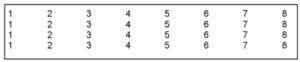
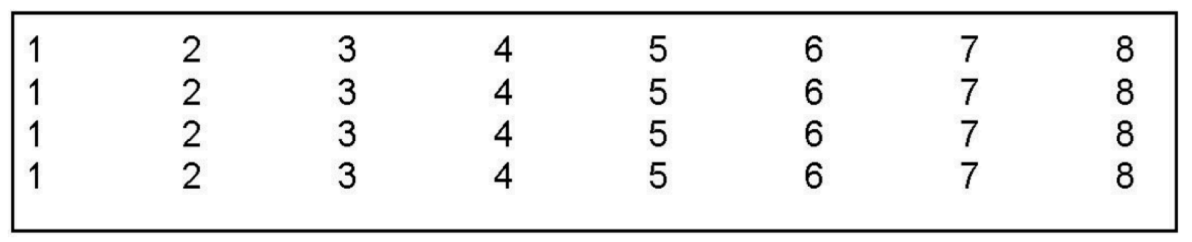
  • Analyze the structure of the chant (32 beats long with the last word on beat 31).
  • A visual such as follows may be helpful in guiding students’ analysis.
A rectangular grid with four identical rows, each containing the numbers 1 through 8 in order, separated by spaces. Reminiscent of music composition, the grid is outlined with a black border.


  • To help students understand the chant’s length and structure, point to each number while speaking the chant.
  • Analyze the rhyme scheme of the chant, marking on the visual of the chant to facilitate understanding.
  • Divide students into small groups and give each group a habitat card (such as mountains, marsh/swamp, coast, etc.).
  • Working in small groups, have students create a chant about their habitat.
  • Their chant must be the same length and use the same rhyme scheme as the A section.
  • Once students are satisfied with their composition, have them write it down (text only) on large paper.
  • Encourage students to write their composition in four lines to facilitate understanding of the four phrases.


Closing Reflection

  • Combine group compositions with the original chant to create a rondo form.
  • The original chant is the A section while student creations become the alternating sections.
  • Use shapes drawn on board or cut from construction paper (or cogni-tiles) and letters to illustrate each section in rondo form.
  • Allow time for students to comment on the compositional efforts of others, perhaps noticing distinctive rhythms and/or word choice.
  • Discuss the characteristics of each of the habitats performed.


Assessments

Formative

Teachers will assess students’ understanding of the content throughout the lesson by observing students’ participation in the activator, ability to repeat and learn the A section of the habitat chant, analysis of rhyme scheme, and collaboration with their groups to create their own habitat chant.


Summative

CHECKLIST

  • Students can create and accurately perform an original speech composition using the prescribed form and content (assigned habitat).
  • Students can create and accurately perform a body percussion ostinato to accompany the speech composition.
  • Students aurally and visually identify rondo form in musical compositions.


DIFFERENTIATION 

Acceleration: 

  • Have students record their creations and evaluate their work.
  • Challenge students to create simple melodies to accompany their text.
  • Have students transfer their spoken text to body percussion (e.g., clap the rhythm of the words rather than speaking the words). Experiment with and discuss various textures. For example, have half the students maintain the ostinato while the other group performs their chant on body percussion; then have only the chant performed on body percussion. Discuss what happens to the texture of the sound as other parts are added or deleted.
  • After students have transferred their spoken text to body percussion, have two (or more) groups superimpose (perform simultaneously) their chants. Discuss the texture changes this compositional device creates.
  • To connect to dance, have students create movement compositions demonstrating plants and/or animals found in their habitats. Then have other students guess the habitat demonstrated through movement.
  • To connect to theater, have students create dialogues between plants and/or animals found in various habitats. Dialogues should not include the name of the habitat so that after performing their dialogues, other students can guess the habitat being discussed.

Remediation: 

  • Scaffold the lesson by working collaboratively as a class to create a chant about a habitat. Then release students to create their own.
  • Reduce the number of lines students are required to create in their chant.
  • Provide sentence starters to help students structure their chants.


*This integrated lesson provides differentiated ideas and activities for educators that are aligned to a sampling of standards. Standards referenced at the time of publishing may differ based on each state’s adoption of new standards.

Ideas contributed by: Maribeth Yoder-White. 

Revised and copyright:  September 2024 @ ArtsNOW


Exploring Habitats Through Music Composition 3-5

Description

Through composition of original speech pieces, students will develop skills and understandings in science, language arts, and music. Teamwork and creativity are necessary to create a chant that demonstrates understanding of plant and animal life in various habitats. Musical skills addressed include improvising, composing, listening, speaking, and moving.

SHARE
FACEBOOK

Exploring Plane Figures Through Music Composition 2-3

EXPLORING PLANE FIGURES THROUGH MUSIC COMPOSITION

EXPLORING PLANE FIGURES THROUGH MUSIC COMPOSITION

Learning Description

In this lesson, students will compose speeches to demonstrate their understanding of plane figures and perform them using body percussion in rondo form as whole-class composition.


Learning Targets

GRADE BAND: 2-3
CONTENT FOCUS: MUSIC & MATH
LESSON DOWNLOADS:

Download PDF of this Lesson

"I Can" Statements

“I Can…”

  • I can create and accurately perform an original speech composition about a plane figure and perform it in rondo form.
  • I can create and accurately perform a body percussion ostinato.

Essential Questions

  • How can music composition help us understand mathematical concepts?
  • What is rondo form in music?


Georgia Standards

Curriculum Standards

Grade 2:

Math

2.GSR.7: Draw and partition shapes and other objects with specific attributes and conduct observations of everyday items and structures to identify how shapes exist in the world.

2.GSR.7.1 Describe, compare and sort 2-D shapes including polygons, triangles, quadrilaterals, pentagons, hexagons, and 3-D shapes including rectangular prisms and cones, given a set of attributes.


ELA

ELAGSE2W2 Write informative/explanatory texts in which they introduce a topic, use facts and definitions to develop points, and provide a concluding statement or section.


Grade 3:

Math

3.GSR.6: Identify the attributes of polygons, including parallel segments, perpendicular segments, right angles, and symmetry.

3.GSR.6.1 Identify perpendicular line segments, parallel line segments, and right angles, identify these in polygons, and solve problems involving parallel line segments, perpendicular line segments, and right angles.


ELA

ELAGSE3W2 Write informative/explanatory texts to examine a topic and convey ideas and information clearly. 

  1. Introduce a topic and group related information together; include illustrations when useful to aiding comprehension. 
  2. Develop the topic with facts, definitions, and details. 
  3. Use linking words and phrases (e.g., also, another, and, more, but) to connect ideas within categories of information. 
  4. Provide a concluding statement or section.

Arts Standards

Grade 2:

ESGM2.PR.1b. Echo simple singing and speech patterns.

ESGM2.PR.2b. Perform steady beat and simple rhythmic patterns with appropriate technique using body percussion and classroom instruments.

ESGM2.RE.1 Listen to, analyze, and describe music.


Grade 3:

ESGM3.PR.1b. Echo simple singing and speech patterns and perform call and response songs.

ESGM3.PR.2b. Perform steady beat and simple rhythmic patterns with appropriate technique using body percussion and classroom instruments.

ESGM3.RE.1 Listen to, analyze, and describe music.


South Carolina Standards

Curriculum Standards

Grade 2:

Math

2.G.1 Identify triangles, quadrilaterals, hexagons, and cubes. Recognize and draw shapes having specified attributes, such as a given number of angles or a given number of equal faces.


ELA

WRITING - Meaning, Context, and Craft

Standard 2: Write informative/explanatory texts to examine and convey complex ideas and information clearly and accurately through the effective selection, organization, and analysis of content.

2.1 Explore print and multimedia sources to write informative/explanatory texts that introduce a topic, use facts and definitions to develop points, and provide a concluding statement or section.


Grade 3:

Math

3.G.1 Understand that shapes in different categories (e.g., rhombus, rectangle, square, and other 4-sided shapes) may share attributes (e.g., 4-sided figures) and the shared attributes can define a larger category (e.g., quadrilateral). Recognize rhombuses, rectangles, and squares as examples of quadrilaterals, and draw examples of quadrilaterals that do not belong to any of these subcategories.


ELA

WRITING - Meaning, Context, and Craft

Standard 2: Write informative/explanatory texts to examine and convey complex ideas and information clearly and accurately through the effective selection, organization, and analysis of content.

2.1 Write informative/explanatory texts that: 

  1. introduce a topic clearly; 
  2. use relevant information from multiple print and multimedia sources; 
  3. provide a general observation and focus; 
  4. group related information logically; 
  5. develop the topic with facts, definitions, concrete details, quotations, or other information and examples related to the topic; k. use precise language and domain-specific vocabulary to inform or explain the topic

Arts Standards

Anchor Standard 1: I can arrange and compose music.

Anchor Standard 3: I can sing alone and with others.

Anchor Standard 6: I can analyze music.


Key Vocabulary

Content Vocabulary

  • Plane figure - A flat, closed figure that is in a plane; may be composed of straight lines, curved lines, or both 
  • Vertices - A vertex (plural: vertices) is a point where two or more lines, edges, or rays meet
  • Polygon - A geometric shape that has more than two sides


Arts Vocabulary

  • Rondo - A form of composition in which the first section recurs throughout the piece, alternating with different sections (e.g., A-B-A-C-A, etc.); found especially in compositions of the Baroque and Classical eras
  • Ostinato - A repeated pattern (plural: ostinati)
  • Body Percussion - Sounds produced by striking or scraping parts of the body; typically includes snapping, clapping, patting, and stamping
  • Phrase - Musical sentence or unit, commonly a  passage of four or eight measures; a dependent division of music, much like a single line of poetry in that it does not have a sense of completion in itself


Materials

  • Plane figure cards (individual cards with one figure on each) 
  • Large paper and markers 
  • Visual of four 8-beat phrases
  • Visual of text for section A of the rondo to be displayed after chant is learned
  • Sound source (iPod, iPhone, computer, speakers, etc.) 
  • Recording of musical composition in rondo form (or create your own using found sounds or body percussion)


Instructional Design

Opening/Activating Strategy

  • Perform two sounds, some of which are the same (e.g., clap-clap) and some of which are different (e.g., tap-clap). 
  • Have students identify what they hear as the same or different. 
    • Explain that students will be focusing on hearing parts that are the same and parts that are different.
  • Play a musical composition in rondo form, challenging students to listen for repeated sections. 
    • To help students hear the same and different sections, you may want to have them keep the beat one place for the A sections, a different place for the B section, and a different place for the C section (e.g., A = pat legs, B = clap, C = tap shoulders).
  • Identify the form heard in composition as rondo form. Use letters to help students understand the same and different sections (e.g., A B A C A). Explain that students will now become composers of their own piece to illustrate rondo form.


Work Session

  • Have students establish a simple 2- or 4-beat body percussion ostinato (e.g., pat-clap or pat-clap-clap-clap). 
  • While students perform the body percussion ostinato, teach the following chant by rote (teacher speaks, students echo). You may also want to have a visual displayed to aid reading. 


Plane figures are around us everyday. 

Just count the sides and angles to see what’s on display. 

Vertices and angle size, they’re important too, 

So let’s gather ‘round and see what you can do! 


  • To facilitate student success in learning the chant aurally, begin by speaking the entire chant, then speak the first phrase (first 8 beats) and have students echo. 
  • Continue speaking each phrase and having students echo. 
  • Then combine two phrases (16 beats) and have students echo. 
  • Once students are comfortable with 8- and 16-beat phrases, speak the entire chant. 
    • This becomes the A section of the class composition. 

*Teacher note: If maintaining the body percussion ostinato while saying the chant is too difficult, have one group perform the ostinato while the other group speaks.

  • Analyze the structure of the chant (32 beats long with the last word on the last beat 7). A visual such as follows may be helpful in guiding students’ analysis. 

  • To help students understand the chant’s length and structure, point to each number while speaking the chant. 
  • Analyze the rhyme scheme of the chant, marking on the visual of the chant to          facilitate understanding. 
    • Teachers may want to use one color marker for “everyday” and “display” and a different color marker for “too” and “do.”
  • Divide students into small groups. Give each group a card with a plane figure on it. 
    • Have students create a chant about their plane figure (rectangle, triangle, square, trapezoid, quadrilateral, hexagon, etc.). 
      • Their chant should be the same length and use the same rhyme scheme as the A section (e.g., 4 phrases of 8 beats each; rhyming words at the end of phrases 1 and 2; different rhyming words at the end of phrases 3 and 4).
      • Have ample space in the room so student groups can move far enough apart during the creating process to enable careful listening and minimize distraction from other groups. 
      • Have students write their chants (text only) on large paper. Writing their composition in 4 lines may facilitate understanding of the 4 phrases. 
    • Combine compositions with the original chant to create a rondo form. The original chant is the A section while the student creations become the alternating sections.


Closing Reflection

  • Have students find a “rondo” pattern in the classroom (e.g., poster - wall - poster - window - poster = A B A C A). 
  • Have students describe rondo form in their own words. 
  • Challenge students to find other examples of rondo form in music.


Assessments

Formative

Teachers will assess students’ learning by observing students’ engagement and participation while the class identifies the same and different sections of music, performs a body percussion ostinato to accompany speech, identifies the rhyme scheme of a chant, and creates sentences and say them over 8 beats.


Summative

CHECKLIST

  • Students can create and accurately perform an original speech composition about a plane figure using the prescribed form. 
  • Students can create and accurately perform a body percussion ostinato to accompany the speech composition.


Differentiation

Acceleration: 

  • Have students record their creations. 
  • Have students create additional sections about different plane figures.
  • Challenge students to create and notate simple melodies for their text. 
  • Have students listen to music in rondo form to discern the different sections. 
  • Have students transfer their spoken text to body percussion (e.g., clap the rhythm of the words rather than speaking the words).
  • Experiment with and discuss various textures in music. For example, have half the students maintain the ostinato while the other group performs their chant on body percussion; then have only the chant performed on body percussion. Discuss what happens to the texture as other parts are added or deleted.
  • To connect to dance, have students create movement compositions to share while they say their chant.

Remediation: 

    • Rather than creating a rondo, have students work together to create one section about a plane figure. The form then becomes A B A (with the A section being the chant initially presented and the B section being the newly created chant).
    • If writing a 32-beat chant is too challenging, use the first half of the chant as the A section, thereby making the chant 16 beats long. Alternating sections then will be 16 beats long (rather than 32 beats).  
    • If keeping the body percussion ostinato on two levels (pat-clap) is challenging, have students keep the beat on one level (e.g., pat legs).

ADDITIONAL RESOURCES

  • Websites such as rhymezone.com may be helpful in finding rhyming words.
  • Short pieces in rondo form include “Fossils” by Camille Saint-Saens (ABACA), “La Raspa” (ABACADA), “Für Elise” by Ludwig van Beethoven (ABACA), “Rondo alla Turca” by Wolfgang Amadeus Mozart, and “The Entertainer” by Scott Joplin (Introduction ABACA).
  • YouTube includes recordings of music that also show the rondo form.
  • Rondo Form video 


*This integrated lesson provides differentiated ideas and activities for educators that are aligned to a sampling of standards. Standards referenced at the time of publishing may differ based on each state’s adoption of new standards.

Ideas contributed by and updated by: Maribeth Yoder-White 

Revised and copyright:  June 2024 @ ArtsNOW

Famous African Americans and Visual Art 2-3

FAMOUS AFRICAN AMERICANS AND VISUAL ART

FAMOUS AFRICAN AMERICANS AND VISUAL ART

Learning Description

Explore the artist Jacob Lawrence and learn about his bold artistic style while studying the life of the famous American, Dr. Martin Luther King, Jr.*. Document history by creating a series of paintings to illustrate the struggles and triumphs of Dr. King just as Jacob Lawrence documented the important events in African American history.

*This lesson can also be adapted to teach about the life of other important African American figures.


Learning Targets

GRADE BAND: 2-3
CONTENT FOCUS: Visual Arts, Social Studies & ELA
LESSON DOWNLOADS:

Download PDF of this Lesson

"I Can" Statements

“I Can…”

  • I can identify important events in Dr. Martin Luther King, Jr.’s life.
  • I can visually represent important events in Dr. Martin Luther King, Jr.’s life using the style of Jacob Lawrence. 
  • I can describe the style of Jacob Lawrence’s artwork.

Essential Questions

  • How can you use Jacob Lawrence’s style of painting to document the lives of historical figures?
  • Who is Dr. Martin Luther King, Jr. and what are important events in his life?


Georgia Standards

Curriculum Standards

Grade 2:

Social Studies

SS2H1 Describe the lives and contributions of historical figures in Georgia history. 

  1. Martin Luther King, Jr. (civil rights)


ELA

ELAGSE2W2 Write informative/explanatory texts in which they introduce a topic, use facts and definitions to develop points, and provide a concluding statement or section.

Arts Standards

Grade 2:

VA2MC.3: Selects and uses subject matter, symbols, and/or ideas to communicate meaning.  

VA2CU.2: Views and discusses selected artworks.  

VA2PR.2: Understands and applies media, techniques, and processes of two-dimensional works of art (e.g., drawing, painting, printmaking, mixed media) using tools and materials in a safe and appropriate manner to develop skills.  

VA2C.1: Applies information from other disciplines to enhance the understanding and production of artworks. 


South Carolina Standards

Curriculum Standards

Grade 2:

Social Studies

Standard 1: Utilize the college and career skills of a historian to study the continuity and changes over time in the United States.

2.H.1 Identify and compare significant historical events, moments, and symbols in U.S. history.


ELA

WRITING - Fundamentals of Writing

Standard 2: Write informative/explanatory texts to examine and convey complex ideas and information clearly and accurately through the effective selection, organization, and analysis of content.

2.1 Explore print and multimedia sources to write informative/explanatory texts that introduce a topic, use facts and definitions to develop points, and provide a concluding statement or section.

Arts Standards

Anchor Standard 1: I can use the elements and principles of art to create artwork.

Anchor Standard 2: I can use different materials, techniques, and processes to make art.


Key Vocabulary

Content Vocabulary

  • Narrative - A story or sequence of events and experiences
  • Dr. Martin Luther King, Jr. - A prominent American civil rights leader, clergyman, and social activist who played a key role in the American civil rights movement

Arts Vocabulary

  • Line - One of the seven Elements of Art; a mark made by a pointed tool such as a brush, pen or stick; a moving point


  • Shape - One of the seven Elements of Art; it is a flat, enclosed area that has two dimensions, length and width; artists use both geometric and organic shapes
  • Color - One of the seven Elements of Art; it is created by light; there are three properties of color: Hue (name), Value (shades and tints), and Intensity (brightness)
  • Primary Colors - A hue from which all other colors can be mixed: red, yellow, and blue


  • Secondary Colors - A hue mixed from two primary colors, such as orange, green, and purple
  • Neutral Colors - Black, white, gray, brown


Materials


Instructional Design

Opening/Activating Strategy

  • Display one of Jacob Lawrence’s paintings on the board. 
  • Without giving students any information about the artwork, ask students to write a short description of what they think is going on in the painting. 
    • Students should explain what they see in the image that helped them come to this conclusion.
    • Allow students time to share with a partner.
    • Ask a few students to share their ideas with the class.
  • Tell students the name of the artist, name of the painting, and a description of what is going on. 
    • Ask students how their interpretations are similar or different to the actual description of the painting.


Work Session

  • Tell students that they will be painting in the style of Jacob Lawrence in this lesson.
    • Lawrence is among the best-known twentieth century African American painters. 
    • Lawrence concentrated on depicting the history and struggles of African Americans.  
    • Lawrence used tempera paints. 
    • Direct students’ attention toward Lawrence’s use of vivid color, expressive style, flat shapes, use of entire space, and the series format to convey a story. 
    • Optional: 
      • Ask students to take turns coming up to the board and outlining the major shapes in different paintings.
      • Provide printed copies of one of the paintings; have students outline the major shapes in the painting.
    • Ask students how the description and the painting are connected just as an illustration in a book is connected to the text on the page.
  • Tell students they are going to become artists like Jacob Lawrence. As a class, they will create a series of paintings that depict the life of Dr, Martin Luther King, Jr. 
    • Use a graphic organizer to sequence the important events in his life. 
    • Next, instruct the students to do a simple sketch or illustration of each event.
    • Instruct the students to use pencil to make a sketch of their assigned event before painting. 
    • Remind students to:
      • Introduce their topic (the event) at the beginning of the paragraph 
      • Use facts and definitions that they learned from the lesson to inform the reader about the event
      • Describe how they showed those facts in their painting
      • Include a conclusion sentence
    • Read a biography of Dr. Martin Luther King, Jr., and discuss the life of Dr. King with the class. 
    • Arrange students into groups of two to three students. Assign each group an event in Dr. King’s life. 
    • Students will create a painting of the event in the style of Jacob Lawrence (remind students of Lawrence’s use of vivid color, line and geometric shape). 
    • After students finish painting, they will write a description of their painting on an index card describing what part of Dr. King’s life is pictured. 
  • Have students arrange the paintings in chronological order.
  • Display the paintings as a series that illustrates the life of Dr. King.   

Classroom Tips: Cover students’ work area with butcher paper. Have students share paint and water supply on their work area. Fill 2 buckets with water--empty one by filling student water cups 1/3 full, then use it to dump dirty water in; the second bucket will be your fresh water supply as needed. 


Closing Reflection

  • Allow students time to engage in a gallery walk to view all of the artworks. 
  • Facilitate a class discussion around how each group portrayed the event in the style of Jacob Lawrence.


Assessments

Formative

Teachers will assess students’ understanding by observing students’ discussion of the style of Jacob Lawrence’s work and students’ identification and visual depiction of important events in Dr. King’s life.


Summative

CHECKLIST

  • Students can identify important events in Dr. Martin Luther King, Jr.’s life.
  • Students can visually represent important events in Dr. Martin Luther King, Jr.’s life through painting using the style of Jacob Lawrence.
  • Students can accurately describe and write about an event in Dr. Martin Luther King, Jr.’s life using relevant details through a well-organized paragraph.


Differentiation

Acceleration:

After reading the biography, students will research other events in the life of Dr. Martin Luther King, Jr. using internet or library resources. Students will pick one event in his life to depict through a picture in the style of Jacob Lawrence. Once each student has created a picture, the student will write a paragraph describing the picture and the event. They will work together to create a chronological/numeric timeline to represent the events in the life of Dr. King.

Remediation:

ESOL Modifications and Adaptations: To prepare the ESOL students for the painting assignment, the ESOL teacher will read to students Story Painter: Life of Jacob Lawrence by John Duggleby and show how a series of paintings can tell a story. The ESOL teacher should also utilize photographs and images to help student comprehension when reading the biography of Dr. King (such as Happy Birthday, Martin Luther King).

Special Education Modifications and Adaptations: Read an age appropriate book about Dr. Martin Luther King Jr. (such as Happy Birthday, Martin Luther King). The teacher will provide cards with pictures and text that describe the life of Dr. King based on the book of choice. Students will work as a group to sequence the cards in story order. Provide geometric shaped templates and straight edges for students to use as they draw pictures in the style of  Jacob Lawrence. Students will accompany drawings with one or two sentences that they write or dictate.

ADDITIONAL RESOURCES

  • “Martin Luther King Jr.’s Life in Pictures.” CNN, www.cnn.com/interactive/2018/04/us/martin-luther-king-jr-cnnphotos/. Accessed 26 June 2023.


*This integrated lesson provides differentiated ideas and activities for educators that are aligned to a sampling of standards. Standards referenced at the time of publishing may differ based on each state’s adoption of new standards.

Ideas contributed by: Whitney Jones. Modifications, Extensions, and Adaptations Contributed by:  Peggy Barnes, Candy Bennett, Lindsey Elrod, Jennifer Plummer, and Vilma Thomas.  Reviewed by Michael Miller. Updated by Whitney Jones Snuggs and Katy Betts.

Revised and copyright:  June 2024 @ ArtsNOW