
CLAY MANDALAS 3

CLAY MANDALAS

CLAY MANDALAS

Learning Description

Students will create a mandala using clay. They will focus on coil building, creating simple forms, radial symmetry, and wax resist techniques.


Learning Targets

GRADE BAND: 3
CONTENT FOCUS: VISUAL ARTS, Math & HEALTH
LESSON DOWNLOADS:

Download PDF of this Lesson

"I Can" Statements

“I Can…”

  • I can differentiate between three different types of balance (symmetrical, asymmetrical, and radial).
  • I can explain what a mandala is and create one using clay handbuilding techniques.
  • I can use clay handbuilding techniques to turn a two-dimensional design of a mandala into a three-dimensional mandala made out of clay.

Essential Questions

  • What is balance and what are the different types?
  • What is radial symmetry and how is it used in art?
  • What is a mandala?
  • How can I use clay handbuilding techniques to turn a two-dimensional design of a mandala into a three-dimensional mandala made out of clay?


Georgia Standards

Curriculum Standards

Math

3.NR.4 Represent fractions with denominators of 2, 3, 4, 6 and 8 in multiple ways within a framework using visual models.

3.GSR.6.3 Identify lines of symmetry in polygons.

Health

HE3.1 Students will comprehend concepts related to health promotion and disease prevention to enhance health.

HE3.1.c Prevent and manage emotional stress and anxiety in healthy ways.

Arts Standards

VA3.CR.1 Engage in the creative process to generate and visualize ideas by using subject matter and symbols to communicate meaning.

VA3.PR.1 Plan and participate in appropriate exhibition(s) of works of art to develop identity as an artist.

VA3.CR.5 Demonstrate an understanding of the safe and appropriate use of materials, tools, and equipment for a variety of artistic processes.

VA3.RE.1 Use a variety of approaches for art criticism and to critique personal works of art and the artwork of others to enhance visual literacy.

VA3.CN.3 Develop life skills through the study and production of art (e.g. collaboration, creativity, critical thinking, communication).


South Carolina Standards

Curriculum Standards

Math

3.NR.2.1 Identify unit fractions as the quantity formed by one part when a whole is partitioned into 2, 3, 4, 6, or 8 equal-sized parts. Express each part as a unit fraction of the whole.

Health

Standard 1: “Students will comprehend concepts related to health promotion and disease prevention to enhance health” (NHES, 2007).

M-3.1.1 Identify examples of mental, emotional, social, and physical health.

M-3.1.3 Identify healthy ways to communicate (e.g., verbal, nonverbal, written).

Arts Standards

Anchor Standard 1: I can use the elements and principles of art to create artwork.

Benchmark VA.CR I can combine several elements of art to express ideas.

Indicator VA.CR NM.1.2 I can combine several elements of art to construct 2D or 3D artwork.

Anchor Standard 2: I can use different materials, techniques, and processes to make art.

Benchmark VA.CR NM.2 I can use some materials, techniques, and tools to create artwork.

Indicator VA.CR NM.2.2 I can use three-dimensional art materials and techniques to make art.

Anchor Standard 4: I can organize work for presentation and documentation to reflect specific content, ideas, skills, and or media.

Benchmark VA.P NL.4 I can show and describe the idea of my artwork.

Indicator VA.P NL.4.2 I can describe my artwork.


Key Vocabulary

Content Vocabulary

  • Radius - The distance between the center of a circle and the edge of the circle
  • Fractions - Equal parts of a whole
  • 2D shapes - Shapes that are flat
  • 3D shapes - Shapes that have height, width, and depth
  • Mindfulness - The practice of intentionally paying attention to the present moment with openness

Arts Vocabulary

  • Shape - A flat, enclosed line that is always two-dimensional and can be either geometric or organic
  • Form - An object that is three-dimensional and encloses volume (cubes, spheres, and cylinders are examples of various forms)
  • Hand building techniques for clay
    • Coil - A rope of clay
    • Pinch - A hand-building method where the artist shapes the clay by pinching it between their fingers and thumb to form the desired shape
    • Slab - A sheet of clay
    • Score - Scratch marks used to connect two pieces of clay
  • Wax resist - A technique used in ceramics where a waxy substance is applied to areas of a clay surface to repel glaze
  • Balance - This is a sense of stability in the body of work. Balance can be created by repeating the same shapes and by creating a feeling of equal visual weight.
  • Symmetry - One side of an object, shape, or composition mirrors the other.
  • Radial symmetry - A type of symmetry where elements are arranged evenly around a central point
  • Mandala - A circular design made up of repeating patterns, shapes, and symbols that are usually arranged with radial symmetry around a central point
  • Pattern - Repetition of specific visual elements such as a unit of shape or form

Materials


Instructional Design

Opening/Activating Strategy

  • Students will explore the concept of balance and how artists use balance in their work.
  • They will examine all three types of balance (symmetrical, asymmetrical, and radial).
  • They will use this knowledge to compare and contrast works of art by various artists.

Work Session

    • After students’ clay mandalas have been fired in the kiln, they will use oil pastels to add color to their mandalas making sure to continue the pattern with color. Review examples of mandalas as needed.
    • Students will then use a black ink wash to paint over the entire front of the mandala creating a wax resist effect.
      • After students’ clay mandalas have been fired in the kiln, they will use oil pastels to add color to their mandalas making sure to continue the pattern with color. Review examples of mandalas as needed.
      • Students will then use a black ink wash to paint over the entire front of the mandala creating a wax resist effect.
        • After students’ clay mandalas have been fired in the kiln, they will use oil pastels to add color to their mandalas making sure to continue the pattern with color. Review examples of mandalas as needed.
        • Students will then use a black ink wash to paint over the entire front of the mandala creating a wax resist effect.
        • Students will then run their projects under the sink to take away any extra ink to reveal their colorful designs.Students will then run their projects under the sink to take away any extra ink to reveal their colorful designs.Students will then run their projects under the sink to take away any extra ink to reveal their colorful designs.Day 1: INTRODUCTION AND PLANNING
          • Students will do a close study of radial designs and discuss the importance of a circle's radius. Students will observe how they will use this information in their design.
          • Next, have students look at examples of mandalas. Ask students what they see that is similar and what is different.
            • Students should notice repeated patterns and colors and how they are organized.
            • Discuss how the art of mandalas helps with the practice of mindfulness.
          • Students will then get a piece of paper and trace around a circle stencil on the front and back of the paper.
            • On one side of the paper, they will divide the circle into fourths.
              • They will begin using lines and simple shapes to fill one fourth of the circle with a design using shape and line. Students will repeat that design in each section creating a mandala.
              • Encourage students to create simple designs as they will be translating the drawing into a clay sculpture.
            • They will repeat this process on the back but will divide their circle into eighths.


          Days 2-3: CREATING WITH CLAY

          • Students will choose one of the mandalas they made on day one to recreate using clay.
          • Students will use hand building techniques, such as coils, slabs, and pinching to create lines and simple shapes to create their mandalas.
          • Once they have created their design with clay, they will score the back and smear wet clay on the back to attach all the pieces.
          • Students will turn their project over to reveal their final design.

          Days 4-5: WAX RESIST TECHNIQUE AND VARNISH

          • After students’ clay mandalas have been fired in the kiln, they will use oil pastels to add color to their mandalas making sure to continue the pattern with color. Review examples of mandalas as needed.
          • Students will then use a black ink wash to paint over the entire front of the mandala creating a wax resist effect.
          • Students will then run their projects under the sink to take away any extra ink to reveal their colorful designs.
          • Once they are dry students will add a clear varnish on top to protect the finish


Closing Reflection

  • Close the lesson with a gallery walk having students observe each other’s work. Students can provide “a glow and a grow” for three different mandalas.
  • Ask students to reflect on how creating their mandalas helped them with the practice of mindfulness.


Assessments

Formative

  • The teacher will observe students’:
    • Responses to class discussion to determine their understanding of the different types of balance, particularly radial balance.
    • Planning process and initial mandala designs.

Summative


Differentiation

Accelerated: 

  • Students should use a larger denominator for the mandalas; provide students with various fractions to create in their mandalas.
    • Examples: ½ of the mandala should use a warm color scheme; ⅓ of the mandala should have organic shapes and ⅔ should have geometric shapes, etc.

Remedial:

  • Brainstorm as a class various patterns that students could use for their mandala designs.
  • Provide guided practice to create patterns for mandalas.


Additional Resources


Credits

U.S. Department of Education- STEM + the Art of Integrated Learning

Ideas contributed by: SAIL Grant Teacher Leaders–Chad Itnyre, Kristen Alvarez, Leah Patel, Lucerito Gonzalez, Tamu Clayton, Sandra Cash, Erin Smullen

*This integrated lesson provides differentiated ideas and activities for educators that are aligned to a sampling of standards. Standards referenced at the time of publishing may differ based on each state’s adoption of new standards.

Revised and copyright:  August 2025 @ ArtsNOW
 

HAND ZENTANGLES 3

HAND ZENTANGLES

HAND ZENTANGLES

Learning Description

Students will use meditation and concentration techniques to create a zentangle hand using a variety of lines and patterns. Students will connect this modern art with that of Mehndi Hands.


Learning Targets

GRADE BAND: 3
CONTENT FOCUS: VISUAL ARTS & HEALTH
LESSON DOWNLOADS:

Download PDF of this Lesson

"I Can" Statements

“I Can…”

  • I can create a zentangle hand.
  • I can relax and focus solely on creating a work of art using a variety of lines/patterns.
  • I can connect zentangles with Mehndi designs.

Essential Questions

  • What is a zentangle?
  • How does creating a zentangle help to expand creativity and promote mindfulness?
  • What is a Mehndi hand?


Georgia Standards

Curriculum Standards

HE3.1 Students will comprehend concepts related to health promotion and disease prevention to enhance health.

HE3.1.c Prevent and manage emotional stress and anxiety in healthy ways.

Arts Standards

VA3.CR.1 Engage in the creative process to generate and visualize ideas by using subject matter and symbols to communicate meaning.

VA3.PR.1 Plan and participate in appropriate exhibition(s) of works of art to develop identity of self as artist.

VA3.CR.5 Demonstrate an understanding of the safe and appropriate use of materials, tools, and equipment for a variety of artistic processes.

VA3.RE.1 Use a variety of approaches for art criticism and to critique personal works of art and the artwork of others to enhance visual literacy.

VA3.CN.3 Develop life skills through the study and production of art (e.g. collaboration, creativity, critical thinking, communication).


South Carolina Standards

Curriculum Standards

Standard 1: “Students will comprehend concepts related to health promotion and disease prevention to enhance health” (NHES, 2007).

M-3.1.1 Identify examples of mental, emotional, social, and physical health.

M-3.1.3 Identify healthy ways to communicate (e.g., verbal, nonverbal, written).

Arts Standards

Anchor Standard 1: I can use the elements and principles of art to create artwork.

Benchmark VA.CR I can combine several elements of art to express ideas.

Indicator VA.CR NM.1.2 I can combine several elements of art to construct 2D or 3D artwork.

Anchor Standard 2: I can use different materials, techniques, and processes to make art.

Benchmark VA.CR NM.2 I can use some materials, techniques, and tools to create artwork.

Indicator VA.CR NM.2.1 I can use two-dimensional art materials to explore ways to make art.

Anchor Standard 4: I can organize work for presentation and documentation to reflect specific content, ideas, skills, and or media.

Benchmark VA.P NL.4 I can show and describe the idea of my artwork.

Indicator VA.P NL.4.2 I can describe my artwork.


Key Vocabulary

Content Vocabulary

  • Mindfulness - The ability to be present and fully engaged with whatever is happening in the moment

Arts Vocabulary

  • Line - A continuous mark made on some surface by a moving point. It may be two dimensional, like a pencil mark on a paper or it may be three dimensional (wire) or implied (the edge of a shape or form) often it is an outline, contour or silhouette.
  • Variety - The differences in a work, achieved by using different shapes, textures, colors and values
  • Pattern - Repetition of specific visual elements such as a unit of shape or form
  • Contrast - The arrangement of opposite elements in a composition (light vs. dark, rough vs. smooth, etc.) Similar to variety, which refers to the differences in a work, achieved by using different shapes, textures, colors and values.
  • Zentangle - A doodle-like drawing made up of repeating patterns intended to help with focus and relaxation
  • Mehndi/Henna - A traditional form of body art made by applying henna paste in decorative patterns, usually on the hands and feet

Materials


Instructional Design

Opening/Activating Strategy

  • Begin by showing students examples of Zentangles. Working with a partner, ask students to identify the types of lines and shapes they see.
  • Explain that the art of Zentangle centers around focus and mindfulness.
  • Discuss the patterns and variety evident within Zentangles.
  • Next, look at the art of Mehndi hands. Have students discuss the similarities and differences between Zentangles and Mehndi hands.

Work Session

  • Have students divide a blank sheet of paper into eight equal sections. Model how to create a type of Zentangle pattern. Have students fill each section of their paper with a different Zentangle pattern. This will help them plan for their artwork.
    • Students can research designs, as well as create their own.
  • Pass out the final draft paper. Have students trace their hands, an image that begins with a personal attachment.
  • Explain that within their hand outline, they should add a variety of Zentangle patterns. Determine the minimum number of patterns that students should include.
    • Have students brainstorm different ways to divide their hand into sections.
    • As students begin adding Zentangles to their hand, continue to discuss types of lines, contrast, and how to create complex designs.
    • Encourage the students to fill the space; allow for necessary breaks in the space but make sure they do not leave unintentional gaps.


Closing Reflection

  • Have students reflect on the process. Ask them to reflect on what they might have been thinking while they were working and why they chose certain Zentangle patterns. Ask them to think about why they chose to put certain designs in particular places.
    • Allow time for students to share their reflections with a partner.
  • Have students share their art through a gallery walk or through a pair share.
  • Have students complete a 3-2-1 reflection: list three things they learned from the lesson, two things they want to know more about, and one question they have about the lesson.


Assessments

Formative

  • Observe students’ responses to discussion about Zentangles and Mehndi designs.
  • Observe and provide feedback to students during the planning and artmaking process.
  • 3-2-1: list three things they learned from the lesson, two things they want to know more about, and one question they have about the lesson

Summative


Differentiation

Accelerated: 

Have students draw the outline of their hands from observation rather than tracing them.

Remedial:

Model how to create several different Zentangle patterns for students.


Additional Resources


Credits

U.S. Department of Education- STEM + the Art of Integrated Learning

Ideas contributed by: SAIL Grant Teacher Leaders–Chad Itnyre, Kristen Alvarez, Leah Patel, Lucerito Gonzalez, Tamu Clayton, Sandra Cash, Erin Smullen

*This integrated lesson provides differentiated ideas and activities for educators that are aligned to a sampling of standards. Standards referenced at the time of publishing may differ based on each state’s adoption of new standards.

Revised and copyright:  August 2025 @ ArtsNOW


WHAT GROUNDS YOU? 3

WHAT GROUNDS YOU?

WHAT GROUNDS YOU?

Learning Description

In this lesson, students will reflect on what helps them feel strong and supported, such as people, places, or values that are important to them. Using trees as the subject matter, they will create artwork representing what grounds them.


Learning Targets

GRADE BAND: 3
CONTENT FOCUS: VISUAL ARTS & HEALTH
LESSON DOWNLOADS:

Download PDF of this Lesson

"I Can" Statements

“I Can…”

  • I can use the Elements of Art to represent ideas.
  • I can represent what grounds me in life visually.

Essential Questions

  • How can I use the Elements of Art to represent ideas?
  • How can I visually represent what grounds me in life?


Georgia Standards

Curriculum Standards

HE3.1 Students will comprehend concepts related to health promotion and disease prevention to enhance health.

HE3.1.c Prevent and manage emotional stress and anxiety in healthy ways.

HE3.2 Students will analyze the influence of family, peers, culture, media, technology, and other factors on health behaviors.

HE3.2.a Discuss how family and cultural factors influence personal health and well-being.

Arts Standards

VA3.CR.5 Demonstrate an understanding of the safe and appropriate use of materials, tools, and equipment for a variety of artistic processes.

VA3.CN.3 Develop life skills through the study and production of art (e.g, collaboration, creativity, critical thinking, communication).


South Carolina Standards

Curriculum Standards

Standard 1: “Students will comprehend concepts related to health promotion and disease prevention to enhance health” (NHES, 2007).

M-3.1.1 Identify examples of mental, emotional, social, and physical health.

M-3.1.3 Identify healthy ways to communicate (e.g., verbal, nonverbal, written).

Standard 2: “Students will analyze the influence of family, peers, culture, media, technology, and other factors on health behaviors” (NHES, 2007).

M-3.2.1 Identify sources that both positively and negatively influence an individual’s mental, emotional, and social health behaviors.

Arts Standards

Anchor Standard 1: I can use the elements and principles of art to create artwork.

Benchmark VA.CR I can combine several elements of art to express ideas.

Indicator VA.CR NM.1.2 I can combine several elements of art to construct 2D or 3D artwork.

Anchor Standard 2: I can use different materials, techniques, and processes to make art.

Benchmark VA.CR NM.2 I can use some materials, techniques, and tools to create artwork.

Indicator VA.CR NM.2.1 I can use two-dimensional art materials and techniques to make art.

Anchor Standard 4: I can organize work for presentation and documentation to reflect specific content, ideas, skills, and or media.

Benchmark VA.P NL.4 I can show and describe the idea of my artwork.

Indicator VA.P NL.4.2 I can describe my artwork


Key Vocabulary

Content Vocabulary

  • Support system - Family, friends, etc. who listen, empathize, and offer encouragement

Arts Vocabulary

  • Line - A continuous mark made on some surface by a moving point. It may be two dimensional, like a pencil mark on a paper or it may be three dimensional (wire) or implied (the edge of a shape or form) often it is an outline, contour or silhouette.
  • Color - An element of art with three properties: 1) Hue: the name of the color, e.g. red, yellow, etc.; 2) Intensity: the purity and strength of the color (brightness or dullness); 3) Value: the lightness or darkness of the color (shades and tints)
  • Texture - The surface quality, or "feel" of an object, such as roughness, smoothness, or softness. Actual texture can be felt while simulated textures are implied by the way the artist renders areas of the picture.

Materials


Instructional Design

Opening/Activating Strategy

  • Show students images of the following artworks: Swamp Maple by Alex Katz, Graft by Roxy Paine, and White Beeches in the Fall by Christian Rohlfs.
    • Ask students to discuss how they are similar and different.
  • Review the Elements of Art and discuss how artists use them as a tool of communication.
    • Discuss what the different trees in the artworks might represent and why. Include observations about the lines, colors, and textures that the artists used.
  • Show students additional photos of different types of trees. Ask students to think about what kind of tree would represent who they are and why.
  • Allow time for students to share with a neighbor.

Work Session

  • Next, discuss the role of roots in a tree. Students may discuss that it’s how trees get water, it’s what keeps them from falling over, etc.
  • Ask students to reflect on what “grounds” them? Family members, friends, sports, music, etc. Have them write down four or five things that ground them.
  • Tell students that they will create a tree that represents themselves and the things that ground them.
  • Provide time for students to sketch ideas in their sketchbooks. Remind students to use the Elements of Art, such as line, texture, and color, to communicate their ideas.
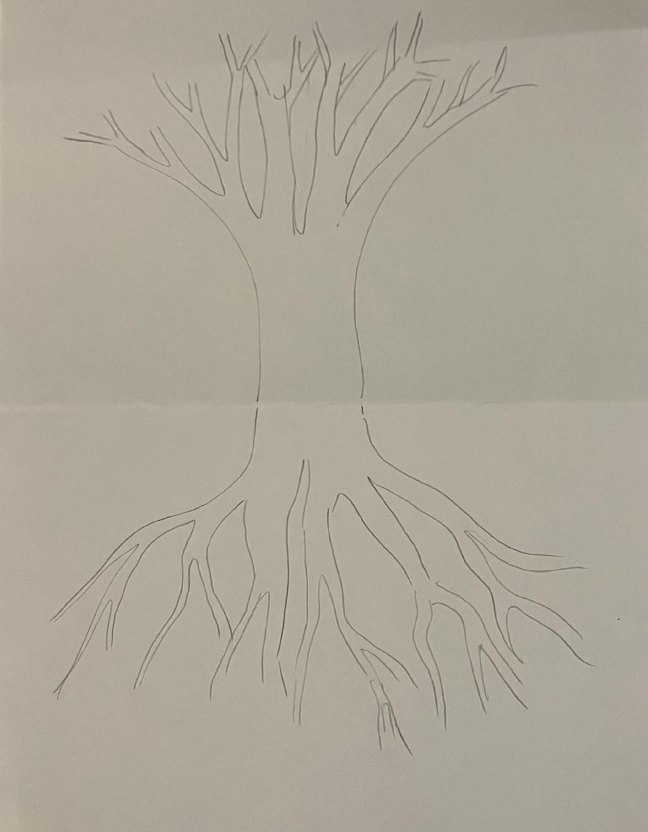
  • When students are ready for their final draft, they will begin by orienting the paper portrait style and folding it in half. On the top half, students will draw the tree in pencil; on the bottom half, students will draw the roots. The folded line represents the ground.

A simple pencil drawing of a tree with bare branches at the top and exposed roots at the bottom, sketched on a plain piece of paper, evokes mindfulness and grounding.

  • Students will then go over their lines in permanent marker.
  • Have students then write the things along the roots that they identified that ground them.
  • Finally, have students add color using watercolors, colored pencils, markers, or a combination.

A watercolor painting of a tree with green leaves, brown trunk, and large roots. The background fades from yellow to orange to gray, evoking mindfulness.

Closing Reflection

  • Arrange the artwork around the room. Engage students in a gallery walk.
  • Encourage students to observe what type of trees their classmates chose to represent themselves and what they wrote that grounds them.
  • Provide time for students to share if they feel comfortable.


Assessments

Formative

  • Observe students’ responses to the opening.
  • Observe students’ brainstorming, planning, and artmaking processes.

Summative


Differentiation

Accelerated: 

Have students do more in depth research about different types of trees and what environments they live in. Students will select a tree to represent them based on their research. They will include an oral or written explanation of why they chose that specific type of tree.

Remedial:

Allow students to trace printouts of trees, guide students through step-by-step instruction on how to draw a tree, or allow students to collage their trees.


Credits

U.S. Department of Education- STEM + the Art of Integrated Learning

Ideas contributed by: Katy Betts

*This integrated lesson provides differentiated ideas and activities for educators that are aligned to a sampling of standards. Standards referenced at the time of publishing may differ based on each state’s adoption of new standards.

Revised and copyright:  August 2025 @ ArtsNOW
 

CAPTURING EMOTIONS: IDIOMATIC ILLUSTRATION 3

CAPTURING EMOTIONS: IDIOMATIC ILLUSTRATION

CAPTURING EMOTIONS: IDIOMATIC ILLUSTRATION

Learning Description

Students will explore the rich world of idiomatic expressions. Through creative illustration, students will not only deepen their understanding of idioms but also gain insights into their own emotions and the emotions of others.


Learning Targets

GRADE BAND: 3
CONTENT FOCUS: VISUAL ARTS, ELA & HEALTH
LESSON DOWNLOADS:

Download PDF of this Lesson

"I Can" Statements

“I Can…”

  • I can create a visually compelling illustration of an idiomatic expression that effectively conveys its emotional significance, demonstrating empathy and understanding of the emotions expressed in both the expression and my artwork.

Essential Questions

  • In what ways do idiomatic illustrations encourage creativity and critical thinking?
  • How can the artistic process of illustrating idiomatic expressions enhance our self-awareness?


Georgia Standards

Curriculum Standards

ELA

3.T.SS.2.a Identify and describe the use of figurative language, such as similes, metaphors, and idioms in a wide variety of texts.

Health

HE3.1 Students will comprehend concepts related to health promotion and disease prevention to enhance health.

HE3.1.e Identify behaviors that show respect for themselves and others.

Arts Standards

VA3.CR.1 Engage in the creative process to generate and visualize ideas by using subject matter and symbols to communicate meaning.

VA3.CR.2 Create works of art based on selected themes.

VA3.CR.3 Understand and apply media, techniques, processes, and concepts of two-dimensional art.

VA3.CN.2 Integrate information from other disciplines to enhance the understanding and production of works of art.


South Carolina Standards

Curriculum Standards

ELA

ELA.3.AOR.1.2 Identify and explain the purpose of forms of figurative language to include metaphor, hyperbole, and idioms.

Health

Standard 1: “Students will comprehend concepts related to health promotion and disease prevention to enhance health” (NHES, 2007).

M-3.1.1 Identify examples of mental, emotional, social, and physical health.

Arts Standards

Anchor Standard 1: I can use the elements and principles of art to create artwork.

Benchmark VA.CR I can combine several elements of art to express ideas.

Indicator VA.CR NM.1.2 I can combine several elements of art to construct 2D or 3D artwork.

Anchor Standard 2: I can use different materials, techniques, and processes to make art.

Benchmark VA.CR NM.2 I can use some materials, techniques, and tools to create artwork.

Indicator VA.CR NM.2.1 I can use two-dimensional art materials to explore ways to make art.

Anchor Standard 4: I can organize work for presentation and documentation to reflect specific content, ideas, skills, and or media.

Benchmark VA.P NL.4 I can show and describe the idea of my artwork.

Indicator VA.P NL.4.2 I can describe my artwork.


Key Vocabulary

Content Vocabulary

  • Idiomatic phrase - A group of words that, when used together, have a meaning different from the literal meaning of the individual words

Arts Vocabulary

  • Space - The distance or area between, around, above or within things. Positive space refers to the subject or areas of interest in an artwork, while negative space is the area around the subject of an artwork. It can be a description for both two and three-dimensional portrayals.
  • Color - An element of art with three properties: 1) Hue: the name of the color, e.g. red, yellow, etc.; 2) Intensity: the purity and strength of the color (brightness or dullness); 3) Value: the lightness or darkness of the color (shades and tints)

Materials

  • 18x24 drawing paper
  • Pencil and eraser
  • Black sharpie marker
  • Crayons, markers, colored pencils
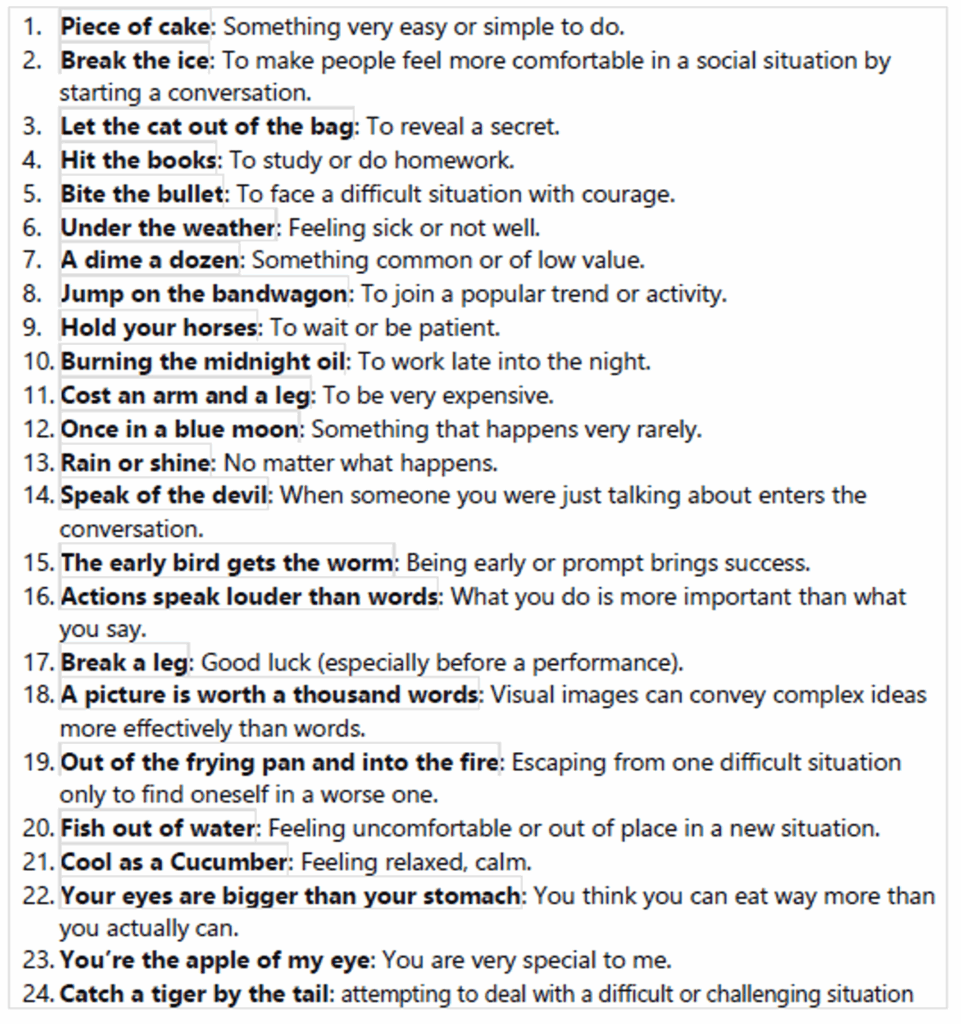
  • A list of idioms:

A list of 24 English idioms with their meanings, featuring idiomatic illustration and examples that reveal the emotions behind phrases like


Instructional Design

Opening/Activating Strategy

  • Begin with a discussion on idiomatic expressions, showing several examples, and explaining that these phrases often have meanings beyond their literal interpretation.
  • Students will brainstorm and share idioms they've heard before, exploring their literal and figurative meanings. This activity fosters communication skills and encourages students to consider language in a nuanced way.

Work Session

  • Students will select an idiomatic expression from a curated list or think of their own.
    • They will reflect on the emotional connotations of the chosen idiom, considering how it relates to personal experiences or feelings. This step promotes self-awareness as students connect the idioms to their own emotions and experiences.
      • Example: A student might choose “fish out of water” reflecting on a time when they felt out of place in an unfamiliar situation.
    • With their chosen idioms in mind, students will then begin the artistic process of illustration.
    • They will use various art materials such as pencils, crayons, markers, or colored pencils to create visual representations of their idioms.
      • Discuss how color can be used to represent emotions and meaning.
      • Discuss how students should use the whole space on their paper to create their artwork. Discuss how choice of placement and size can communicate meaning (i.e. elements in the center and elements that are larger usually communicate more importance).
      • Encourage students to think creatively and metaphorically, using imagery to convey the essence of the idioms and the emotions they evoke.
    • As students work on their artwork, facilitate discussions on emotions and empathy.
      • Students will be encouraged to consider the emotions expressed in their chosen idioms and how they might resonate with others. This promotes relationship skills as students engage in perspective-taking and empathy-building exercises.

Closing Reflection

  • Once the artwork is complete, students will have the opportunity to share their artwork with the class.
  • They will explain their chosen idioms, discuss the emotions they aimed to convey, and reflect on the significance of their artistic choices, such as color and use of space.
  • Sharing promotes social awareness and encourages students to appreciate the diverse perspectives and experiences of their peers.


Assessments

Formative

Teachers will assess students by observing students' discussion responses and checking in with students during the art-making process.

Summative


Differentiation

Acceleration: 

Have students reflect on the experience that inspired their artwork; have students create a written explanation about how their artwork demonstrates their experience.

Remediation:

  • Chunk the artmaking process for students.
  • Allow students to work with a partner to create their artwork.
  • Provide a list of idioms for students to choose from.


Credits

U.S. Department of Education- STEM + the Art of Integrated Learning

Ideas contributed by: SAIL Grant Teacher Leaders–Chad Itnyre, Kristen Alvarez, Leah Patel, Lucerito Gonzalez, Tamu Clayton, Sandra Cash, Erin Smullen

*This integrated lesson provides differentiated ideas and activities for educators that are aligned to a sampling of standards. Standards referenced at the time of publishing may differ based on each state’s adoption of new standards.

Revised and copyright:  August 2025 @ ArtsNOW


EMOTION ABSTRACT ART: PAINTING FEELINGS 3

EMOTION ABSTRACT ART: PAINTING FEELINGS

EMOTION ABSTRACT ART: PAINTING FEELINGS

Learning Description

Students will create abstract artworks that convey different emotions using color, shape, and texture, fostering self-expression and emotional awareness.


Learning Targets

GRADE BAND: 3
CONTENT FOCUS: VISUAL ARTS & HEALTH
LESSON DOWNLOADS:

Download PDF of this Lesson

"I Can" Statements

“I Can…”

  • I can create an abstract artwork that effectively conveys different emotions using color, shape, and texture, demonstrating my understanding of the relationship between art and emotions.

Essential Questions

  • How do artists use their own emotions and experiences as inspiration for creating abstract art, and how does this influence the viewer's emotional response?
  • How can color, shape, and texture be used to convey emotions in abstract art?
  • What role does personal experience play in interpreting and expressing emotions through art?


Georgia Standards

Curriculum Standards

HE3.1 Students will comprehend concepts related to health promotion and disease prevention to enhance health.

HE3.1.c Prevent and manage emotional stress and anxiety in healthy ways.

Arts Standards

VA3.CR.1 Engage in the creative process to generate and visualize ideas by using subject matter and symbols to communicate meaning.

VA3.CR.2 Create works of art based on selected themes.

VA3.CR.3 Understand and apply media, techniques, processes, and concepts of two-dimensional art.

VA3.CN.2 Integrate information from other disciplines to enhance the understanding and production of works of art.


South Carolina Standards

Curriculum Standards

Standard 1: “Students will comprehend concepts related to health promotion and disease prevention to enhance health” (NHES, 2007).

M-3.1.1 Identify examples of mental, emotional, social, and physical health.

M-3.1.3 Identify healthy ways to communicate (e.g., verbal, nonverbal, written).

Arts Standards

Anchor Standard 1: I can use the elements and principles of art to create artwork.

Benchmark VA.CR I can combine several elements of art to express ideas.

Indicator VA.CR NM.1.2 I can combine several elements of art to construct 2D or 3D artwork.

Anchor Standard 2: I can use different materials, techniques, and processes to make art.

Benchmark VA.CR NM.2 I can use some materials, techniques, and tools to create artwork.

Indicator VA.CR NM.2.1 I can use two-dimensional art materials to explore ways to make art

Anchor Standard 4: I can organize work for presentation and documentation to reflect specific content, ideas, skills, and or media.

Benchmark VA.P NL.4 I can show and describe the idea of my artwork.

Indicator VA.P NL.4.2 I can describe my artwork.


Key Vocabulary

Content Vocabulary

  • Emotions - How a person feels inside

Arts Vocabulary

  • Color association - The idea that color is associated with concepts
  • Color symbolism - The idea that colors can represent concepts
  • Overlapping - A technique where one object is placed in front of another, so it partially covers the object behind it
  • Layering - The technique of building up multiple layers of materials or elements to create depth, texture, and complexity in a piece
  • Variety - The differences in a work, achieved by using different shapes, textures, colors and values
  • Shape - A flat, enclosed line that is always two-dimensional and can be either geometric or organic
  • Composition - How an artist arranges the Elements of Art (line, shape, form, value, color, space, texture) to create an artwork

Materials


Instructional Design

Opening/Activating Strategy

  • Begin by discussing the importance of expressing emotions through art.
  • Show examples of abstract artworks that convey emotions through color, shape, and texture.
  • Explain that students will be creating their own abstract paintings to express different feelings.
  • Lead a guided discussion about emotions, asking students to identify and describe different feelings they experience.
    • Use prompts such as "What does happiness feel like?" or "How does anger look?".
    • Encourage students to share personal experiences or examples of times when they felt each emotion.

Work Session

  • Color exploration:
    • Introduce the concept of color symbolism by discussing how different colors can evoke different emotions.
    • Show examples of color associations (e.g., red for anger, blue for sadness, yellow for happiness) and discuss why certain colors might be linked to specific feelings.
    • Have students write various emotions on a blank sheet of paper. Allow students to experiment with mixing colors on their palettes or paint trays to represent these emotions.
    • Have students then create custom color palettes for their artworks based on the emotions they want to express.
  • Planning:
    • Have students look at additional examples of abstract artwork–particularly those that have a variety of shapes and textures (examples by Vasily Kandinsky).
      • Ask students to look at the shapes the artists used. Have students identify how the artist used layering, overlapping, and variety.
    • Have students sketch a plan for their compositions.
  • Artistic expression:
    • Distribute canvases or heavyweight paper to students.
    • Students should then sketch their plan lightly on their paper/canvas..
    • Encourage students to experiment with brushstrokes, layering, and texture to express the intensity and complexity of emotions.
    • Remind students to consider how color choice and composition can enhance the emotional impact of their artworks.

Closing Reflection

  • Sharing and reflection:
    • After completing their paintings, invite students to share their artworks with the class.
    • Ask students to describe the emotions they aimed to convey in their paintings and explain how they used color, shape, and texture to represent those feelings.
    • Facilitate a reflection discussion on the experience asking questions such as, "How did it feel to express emotions through abstract art?" and "What did you learn about yourself and others?".
  • Closure:
    • Summarize the key concepts learned during the lesson, emphasizing the power of art to convey emotions and foster self-expression.
    • Encourage students to continue exploring and expressing their emotions through art as a way to enhance emotional awareness and creativity.


Assessments

Formative

Teachers will assess students by observing students' discussion responses, observing their paint palette explorations and artwork plans, and checking in with students throughout the artmaking process.

Summative


Differentiation

Acceleration: 

  • Display the students' abstract artworks in a classroom gallery and encourage them to write short descriptions or titles for their pieces.
  • Explore the work of abstract artists who have depicted emotions in their artwork, such as Wassily Kandinsky or Joan Miró, and discuss how their use of color and form conveys feelings and experiences.
  • Collaborate with the school counselor to integrate discussions about emotional regulation and coping strategies into the art lesson.

Remediation:

  • Chunk the artmaking process for students.
  • Allow students to work with a partner to create their artwork.
  • Generate a class list of colors and feelings that are associated with those colors.
  • Provide shapes for students to trace.


Credits

U.S. Department of Education- STEM + the Art of Integrated Learning

Ideas contributed by: SAIL Grant Teacher Leaders–Chad Itnyre, Kristen Alvarez, Leah Patel, Lucerito Gonzalez, Tamu Clayton, Sandra Cash, Erin Smullen

*This integrated lesson provides differentiated ideas and activities for educators that are aligned to a sampling of standards. Standards referenced at the time of publishing may differ based on each state’s adoption of new standards.

Revised and copyright:  August 2025 @ ArtsNOW