
GEOMETRY: CHARACTERIZATION & GEOMETRY 4

CHARACTERIZATION & GEOMETRY

GEOMETRY: CHARACTERIZATION & GEOMETRY

Learning Description

In this lesson, students will use their voices and bodies to create the characters of an artist and museum curator. Students will collaborate with each other to write and perform a script where one student playing the role of artist will pitch their geometric Stabile sculpture (from lesson two in this unit) to the other student playing the museum curator. Students will demonstrate understanding of geometric concepts through their scripts.


Learning Targets

GRADE BAND: 4
CONTENT FOCUS: THEATRE & MATH
LESSON DOWNLOADS:

Download PDF of this Lesson

"I Can" Statements

“I Can…”

  • I can use my voice and body to create a character.
  • I can explain my artwork using mathematical concepts.

Essential Questions

  • How do actors use their voices and bodies to create characters?
  • What are the different types of polygons and what are their defining characteristics?
  • What are the different types of angles and what are their defining characteristics?


Georgia Standards

Curriculum Standards

4.GSR.7.1 Recognize angles as geometric shapes formed when two rays share a common endpoint. Draw right, acute, and obtuse angles based on the relationship of the angle measure to 90 degrees
4.GSR.8.1 Explore, investigate, and draw points, lines, line segments, rays, angles (right, acute, obtuse), perpendicular lines, parallel lines, and lines of symmetry. Identify these in two-dimensional figures.
4.GSR.8.2 Classify, compare, and contrast polygons based on lines of symmetry, the presence or absence of parallel or perpendicular line segments, or the presence or absence of angles of a specified size and based on side lengths.

Arts Standards

TA4.CR.1 Organize, design, and refine theatrical work.
TA4.CR.2 Develop scripts through theatrical techniques.
TA4.PR.1 Act by communicating and sustaining roles in formal and informal environments.


South Carolina Standards

Curriculum Standards

4.G.1 Draw points, lines, line segments, rays, angles (i.e., right, acute, obtuse), and parallel and perpendicular lines. Identify these in two-dimensional figures.
4.G.2 Classify quadrilaterals based on the presence or absence of parallel or perpendicular lines.
4.G.3 Recognize right triangles as a category, and identify right triangles.
4.G.4 Recognize a line of symmetry for a two-dimensional figure as a line across the figure such that the figure can be folded along the line into matching parts. Identify line symmetric figures and draw lines of symmetry.

Arts Standards

Anchor Standard 1: I can create scenes and write scripts using story elements and structure.
Anchor Standard 3: I can act in improvised scenes and written scripts


Key Vocabulary

Content Vocabulary

  • Right angle - An angle whose measure is exactly 90°
  • Acute angle - An angle whose measure is between 0° and 90°
  • Obtuse angle - An angle whose measure is between 91° and 180°
  • Equilateral triangle - A three-sided figure with sides of equal length
  • Isosceles triangle - A three-sided figure with two sides of equal length
  • Scalene triangle - A three-sided figure with no sides equal in length
  • Parallelogram - A quadrilateral with both pairs of opposite sides parallel
  • Pentagon - A five-sided polygon
  • Rectangle - A parallelogram with four right angle
  • Rhombus - A parallelogram with four sides of equal length
  • Square - A plane figure with four equal straight sides and four equal angles
  • Trapezoid - A quadrilateral with at least one pair of parallel sides

Arts Vocabulary

  • Body – An actor’s tool, which we shape and change to portray the way a character looks, walks, or moves
  • Posture – Body position; how a character sits or stands
  • Pose - A deliberate and often stationary position or posture that an actor assumes on stage
  • Voice - An actor’s tool, which we shape and change to portray the way a character speaks or sounds
  • Pitch – How high or low a voice is
  • Volume – How loud or quiet a voice is
  • Improvisation - A creation that is spoken or written without prior preparation
  • Scene – The dialogue and action between characters in one place for one continuous period of time
  • Script - The written text that provides the blueprint for a performance including dialogue between the characters
  • Dialogue - A conversation between two or more persons
  • Art curator - A professional responsible for managing, organizing, and overseeing collections of artwork a museum, gallery, or other institutions
  • Exhibit - A public display of artwork, typically held in galleries, museums, or other cultural venues


Materials

  • Paper and writing utensils (or student devices)


Instructional Design

Opening/Activating Strategy

  • Start with a general physical warm-up to get the students' bodies ready. Use exercises such as:
    • Stretching: Stretch all major muscle groups.
    • Shaking out limbs: Shake out arms, legs, and the whole body.
    • Energy Passes: Stand in a circle and pass a clap or a simple motion around to build group focus and energy.
  • Breathing and voice exercises: Have students stand in a circle and practice breathing from the diaphragm to project their voices. Have them say a simple sentence like, “I have an amazing idea!” and project it to the back of the room.
  • Body language practice: Have students walk around the room, alternating between different emotional states (confident, shy, excited, nervous). Then, discuss how body language changes depending on their state.

Work Session

  • Explain to students that just like actors perform in character, business professionals also perform when pitching ideas. They must engage, persuade, and leave a lasting impression on their audience
    • Briefly discuss:
      • The importance of body language: Gestures, posture, and eye contact to convey confidence and clarity
      • Voice projection and tone: Varying the voice to emphasize key points and using projection to ensure clarity
      • Character in business: Presenting as a confident, knowledgeable expert in the subject matter
    • Have students partner with the student with whom they made their Stabile sculptures.
    • Tell students that one partner will imagine that they want their Stabile sculpture to be displayed in a new art exhibit in a famous art museum. The focus of the exhibit is how artists use math to create artwork. The other partner will be the museum’s curator.
      • Students must write and present a short pitch to try to convince the museum curator to feature their artwork in the exhibit. Because the focus of the exhibit is how artists use math to create their artwork, students must be able to explain what mathematical concepts are used in their artwork. Students should work together on the script regardless of which role they play.
      • The museum curator must ask relevant questions of the artist about how math is used in the design of their artwork.
      • Students will write a script and will practice performing it using their voices and bodies to embody each character.
      • As students develop each of their characters, as them to consider:
        • How does your character stand? Sit? Walk?
        • What is their speaking style: Authoritative, friendly, enthusiastic?
        • What are their facial expressions and gestures while speaking?
        • Remind students to write the script as their characters, which means that they should use first person and dialogue.

Closing Reflection

  • Students will perform their scenes for the class. Discuss appropriate audience participation and etiquette prior to performances.
  • After each performance, have the audience discuss how the actors used their voices and bodies to demonstrate their characters.


Assessments

Formative

  • Teachers will assess understanding throughout the lesson by:
    • Observing whether students can use their voices and bodies to act out a character
    • Explain their artwork using mathematical concepts
    • Collaborate with their group to write a script

Summative

CHECKLIST:

  • Students can use their voices and bodies to create a character.
  • Students can explain their artwork using mathematical concepts.


Differentiation

Accelerated: 

  • After students have performed their scenes, have them create characters using their voices and bodies for the actual polygons represented in their artwork.
  • Have students create props and incorporate them in their performances.

Remedial:

Scaffold the lesson by providing a graphic organizer and/or sentence starters to help students write their scenes.


Credits

U.S. Department of Education- STEM + the Art of Integrated Learning

Ideas contributed by: Katy Betts

*This integrated lesson provides differentiated ideas and activities for educators that are aligned to a sampling of standards. Standards referenced at the time of publishing may differ based on each state’s adoption of new standards.

Revised and copyright:  June 2025 @ ArtsNOW
 

FRACTION FUSION–WHERE ART AND NUMBERS COLLIDE: BE THE FRACTION 4

BE THE FRACTION

FRACTION FUSION–WHERE ART AND NUMBERS COLLIDE: BE THE FRACTION

Learning Description

Students will bring fractions to life by becoming characters, such as ¼, setting off to find others who will complete their "fraction family" and help them add up to one whole. Through this role-play, students will work together to form complete “wholes” by joining with the right fractional parts.


Learning Targets

GRADE BAND: 4
CONTENT FOCUS: THEATRE & MATH
LESSON DOWNLOADS:

Download PDF of this Lesson

"I Can" Statements

“I Can…”

  • I can determine the best way to add and subtract fractions based on their denominators.
  • I can imagine being a fraction and interacting with other fractions to convey math concepts.

Essential Questions

  • How do we add and subtract fractions with like denominators?
  • How do we work with partners to actively embody and express math concepts?


Georgia Standards

Curriculum Standards

4.NR.4.6 Add and subtract fractions and mixed numbers with like denominators using a variety of tools.

Arts Standards

TA4.PR.1  Act by communicating and sustaining roles in formal and informal environments.


South Carolina Standards

Curriculum Standards

4.NSF.3 Develop an understanding of addition and subtraction of fractions (i.e., denominators 2, 3, 4, 5, 6, 8, 10, 12, 25, 100) based on unit fractions.
a. Compose and decompose a fraction in more than one way, recording each composition and decomposition as an addition or subtraction equation; b. Add and subtract mixed numbers with like denominators; c. Solve real-world problems involving addition and subtraction of fractions referring to the same whole and having like denominators.

Arts Standards

Anchor Standard 3: I can act in improvised scenes and written scripts.


Key Vocabulary

Content Vocabulary

  • Fraction - A number that represents a part of a whole
  • Numerator - The number above the line that indicates how many parts of a whole are being counted
  • Denominator - The number below the line that indicates the total number of equal parts in the whole
  • Addition - Combining two or more numbers to find a total or sum
  • Equation - A mathematical sentence that has two equal sides separated by an equal sign
  • Equivalent – Have equal value
  • Like denominator – A denominator that is found in two or more fractions
  • Unlike denominators – Denominators in two or more fractions that are different from each other

Arts Vocabulary

  • Recite – To speak or read a text out loud in a formal or performative manner
  • Role – A part played by an actor in a play, scene or drama activity
  • Unison – All together at once


Materials

  • Name tags with fractions written on them
  • Individual dry erase boards or note paper and utensils, if needed


Instructional Design

Opening/Activating Strategy

  • Explain that fractions are parts of a whole. Today, they’ll “become” fractions and work together to add up to one whole.
  • Tell the students that each of them will take on the role of a fraction and work with classmates to add up to a whole. Explain that fractions with the same denominator can be added by adding the numerators together.
  • Fraction warm-up game: Play a game where students must “freeze” in shapes that represent different fractions. For instance, a “1/2” could be a shape taking up half the space, while a “1/4” might be a quarter circle. This encourages them to visualize fraction sizes.

Work Session

Like Denominators Chant

  • Discuss/review how to add and subtract fractions. Introduce the following chant (as a projection, handout, or both):

With like denominators, we just add our numerators

And keep the original shared denominator.

With like denominators, we subtract the lesser numerator

From the greater, and keep the same denominator.

  • Work with students to find the best rhythm for the language of the chant. Establish a beat and recite the chant in unison.
  • Possibly, assign lines to individuals or pairs to recite rhythmically.

Role-Play

  • Hand out a fraction card to each student and ask them to wear it on their shirt or hold it visibly.
  • Explain that each student is part of a fraction family but each family has been separated. They must work to find the rest of their fraction family so that when added together, they total one whole.
    • For example, a student with ¼ will need to find others in the “fourths family” with fractions like ¾ or two students with ¼ and 2/4.
  • Have students practice introducing themselves using dialogue. “Hi, I’m ¼”. Students should articulate clearly and project their voices.
  • Allow students time to experiment by joining up with different classmates, testing if their fractions add up to a whole. Encourage them to double-check their math each time they form a new group.
    • Instruct students to stay in character and introduce themselves as the fraction every time they encounter a new student. Students can use dialogue, such as, "I am ¼. Are you the piece I need to make a whole?"
    • Once a group thinks they’ve completed their fraction family, they should write down their fractions in an addition sentence (e.g., ¼ + ¼ + 2/4 = 4/4 or 1).

Closing Reflection

  • Ask each group to share how they reached their solution and explain their thought process. If they made mistakes, ask them to talk about those too and how they adjusted.
    • Ask students: “What was the most challenging part of finding your whole?”.
  • Talk about different ways to make one whole with fractions (e.g., two students with ½, four students with ¼). Write these examples on the board and let students observe the patterns.

Conclude the lesson with the chant:
            With like denominators, we just add our numerators
            And keep the original shared denominator.

            With like denominators, we subtract the lesser numerator
            From the greater, and keep the same denominator.

Assessments

Formative

  • Assess students based on their ability to collaborate, add fractions correctly, and explain their thought process.
  • Observe whether students use their voices to speak the couplets clearly and readily assume the roles of fractions.

Summative

  • Students can accurately write out the equations that reflect their process.
  • Students can create complete fraction families that when added together, equal one whole.


Differentiation

Accelerated: 

  • Challenge students to try making fractions that add up to numbers other than 1, like ½ or ¾.
  • Challenge students to create an illustration of their fraction group adding up to one whole, like a pie chart or bar graph representation.
  • Have students add fractions with unlike denominators.

Remedial:

  • Direct several pairs in front of the class to model the process clearly.
  • Limit the number of denominators so that the focus is on addition.
  • Have students draw a fraction image on their name tag to help with visualization.


Credits

U.S. Department of Education- STEM + the Art of Integrated Learning

Ideas contributed by: Barry Stewart Mann and Katy Betts

*This integrated lesson provides differentiated ideas and activities for educators that are aligned to a sampling of standards. Standards referenced at the time of publishing may differ based on each state’s adoption of new standards.

Revised and copyright:  June 2025 @ ArtsNOW


VOLUME OF RIGHT RECTANGULAR PRISMS CEREAL SHOWDOWN 5

CEREAL SHOWDOWN

VOLUME OF RIGHT RECTANGULAR PRISMS: CEREAL SHOWDOWN

Learning Description

Students will demonstrate an understanding of volume by writing and performing scripts where siblings argue about which cereal box to purchase based on volume.


Learning Targets

GRADE BAND: 5
CONTENT FOCUS: THEATRE & MATH
LESSON DOWNLOADS:

Download PDF of this Lesson

"I Can" Statements

“I Can…”

  • I can use theater techniques to explore volume.
  • I can write and perform a script to help communicate volume.

Essential Questions

  • How can we use theater techniques to explore volume?
  • How can writing and performing a script help us communicate volume?


Georgia Standards

Curriculum Standards

5.GSR.8: Examine properties of polygons and rectangular prisms, classify polygons by their properties, and discover volume of right rectangular prisms.

Arts Standards

Grade 5:

TA5.PR.1 Act by communicating and sustaining roles in formal and informal environments.
TA5.CR.2 Develop scripts through theatrical techniques.


South Carolina Standards

Curriculum Standards

5.MDA.3 Understand the concept of volume measurement.
a. Recognize volume as an attribute of right rectangular prisms;
b. Relate volume measurement to the operations of multiplication and addition by packing right rectangular prisms and then counting the layers of standard unit cubes;
c. Determine the volume of right rectangular prisms using the formula derived from packing right rectangular prisms and counting the layers of standard unit cubes.

Arts Standards

Anchor Standard 1: I can create scenes and write scripts using story elements and structure.
Anchor Standard 3: I can act in improvised scenes and written scripts.


Key Vocabulary

Content Vocabulary

  • Volume - The amount of space occupied by a three-dimensional object or shape
  • Height - The perpendicular distance from the base of a shape or object to its topmost point
  • Length - The distance from one end of an object to the other along its longest side
  • Width - The measurement of the shorter side of an object or shape when compared to its length; it is usually the horizontal dimension
  • Three-dimensional figure - A figure that has length, width, and height

Arts Vocabulary

  • Script - The written version of a play, movie, or other acted performance
  • Dialogue - A conversation between two or more persons
  • Scene - a single situation or unit of dialogue in a play
  • Character - An actor or actress in a specified role
  • Voice - Actors use their voice to be heard by the audience clearly. Actors must also apply vocal choices such as pitch, tempo, and volume to the character they are dramatizing.
  • Gesture - An expressive movement of the body or limbs
  • Facial expression - Using your face to show emotion
  • Props - Items that actors use in a performance to depict real-life objects; props can also be used to help students brainstorm for their writing or character study
  • Voice - Actors use their voice to be heard by the audience clearly. Actors must also apply vocal choices such as pitch, tempo, and volume to the character they are dramatizing.


Materials

  • Various empty cereal boxes of different sizes (ask students to bring these in prior to the lesson)
  • Measuring tools (ruler, tape measure, etc.)
  • Paper and pencils for script writing
  • Performance space


Instructional Design

Opening/Activating Strategy

Tell students that you will say several different emotion words. When they hear the word they should create a facial expression for that word. After a few examples, have students add in gestures and sounds with the facial expressions.


Work Session

  • Tell students that they will work in pairs or small groups to write a short script where siblings argue about which cereal box to purchase based on volume.
  • Briefly review the concept of volume with the class, emphasizing how it relates to the amount of space inside a 3D object.
  • Each group will choose two cereal boxes to compare by measuring their dimensions and calculating their volume.
  • Discuss what a script is with students. Make sure that students understand that scripts have dialogue that is written in first person. It is not like a story written in third person.
  • Ask students to consider what type of voice their character would have and how their voice might change if they’re trying to convince someone of something. Ask students to consider what gestures and facial expressions their character might use to communicate their point of view.
  • Allow students time to work on their scripts. Encourage them to incorporate mathematical reasoning into their arguments. For example, they might discuss which box holds more cereal or which is a better value for the price.
  • Have students peer-review each other's scripts, focusing on how well they incorporate mathematical reasoning and theatre elements. Students should provide feedback based on the clarity of their arguments and the effectiveness of their use of volume concepts.
  • After writing their scripts, give students time to rehearse their performances. They should use the actual cereal boxes as props.
  • Have each group perform their script for the class. After each performance, facilitate a brief discussion about the volume comparison made in the script. Ask the audience to weigh in on which cereal box they think would be the best choice based on the arguments presented.


Closing Reflection

  • Ask students to reflect on the activity.
    • Did writing and performing the script help them understand the concept of volume better?
    • How did they incorporate math into their arguments?
    • How did incorporating theatre elements, like gestures, voice, and facial expressions add to their performances?


Assessments

Formative

  • Observe students’ ability to use facial expressions, voice, and gestures to communicate emotions.
  • Conference with students as they calculate volume and write their scripts to check for understanding.
  • After each performance, facilitate a class discussion where students can reflect on the mathematical concepts presented in the scripts.


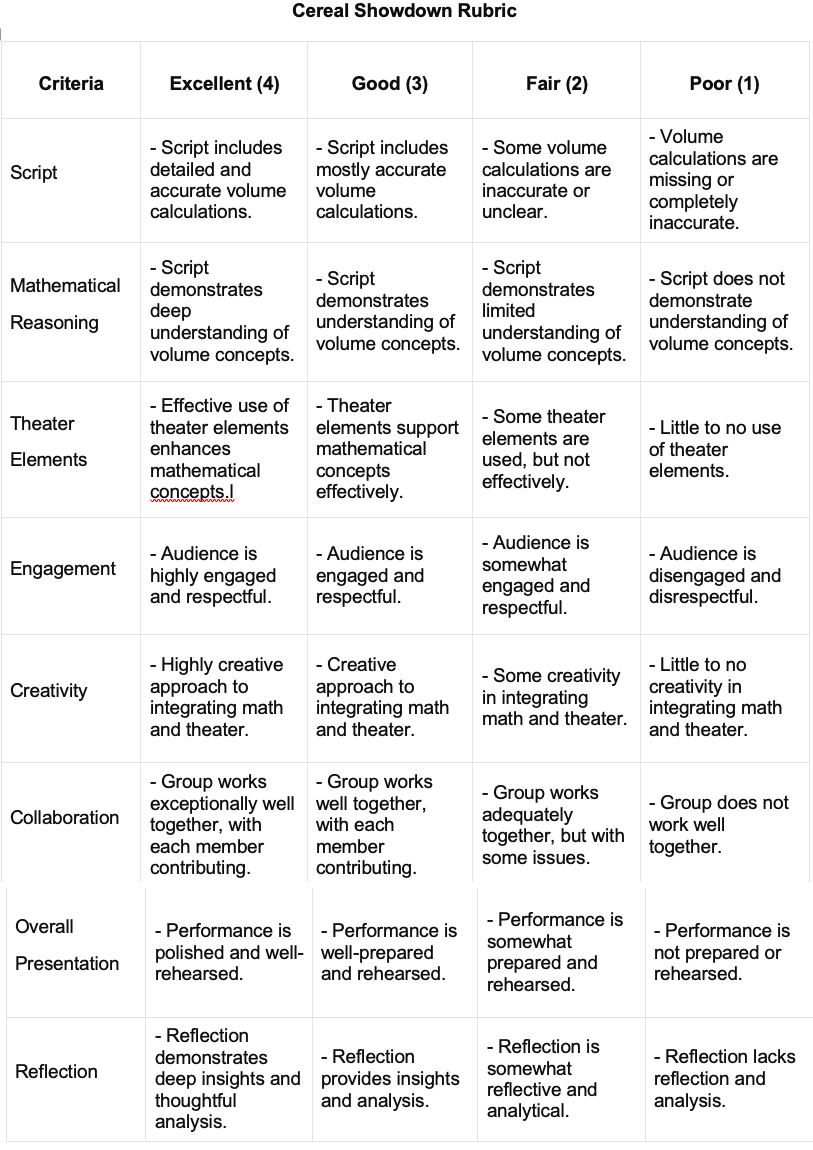
Summative

A rubric titled

Differentiation

Accelerated: 

  • Students can create a visual aid, such as a chart or graph, comparing the volumes of various cereal boxes.
  • Students can write a reflection on how they could use volume calculations in real-life situations.

Remedial:

  • Provide students with a pre-written script or sentence stems for writing a script so that students can focus on finding the volume. Students will still perform the pre-written script and should use their voices, facial expressions, and gestures as tools for communication.


Credits

U.S. Department of Education- STEM + the Art of Integrated Learning

Ideas contributed by: SAIL Grant Teacher Leaders

*This integrated lesson provides differentiated ideas and activities for educators that are aligned to a sampling of standards. Standards referenced at the time of publishing may differ based on each state’s adoption of new standards.

Revised and copyright:  June 2025 @ ArtsNOW


EARTH’S CHANGING SURFACE DRAMA CHARACTERIZATION–MASS LAND MOVEMENT 5-6

DRAMA CHARACTERIZATION–MASS LAND MOVEMENT

DRAMA CHARACTERIZATION–MASS LAND MOVEMENT

Learning Description

Students will use a written script to demonstrate the impact upon various surfaces (i.e. rock, soil, etc.) caused by destructive and constructive forces through dramatic characterization.


Learning Targets

GRADE BAND: 5,6
CONTENT FOCUS: THEATRE & SCIENCE
LESSON DOWNLOADS:

Download PDF of this Lesson

"I Can" Statements

“I Can…”

  • I can demonstrate destructive forces caused by glaciers, rivers, and streams using body movement and role play.
  • I can demonstrate the geological processes of landslides, rock falls, and other mass movement through movement and role play.
  • I can use my body and movement to communicate the effects of destructive forces on our Earth.

Essential Questions

  • Which destructive forces create mass land movement?
  • What impact does mass land movement have on Earth’s surface?
  • How can I use my body and movement to communicate the effects of destructive forces on our Earth?


Georgia Standards

Curriculum Standards

Grade 5:

S5E1. Obtain, evaluate, and communicate information to identify surface features on the Earth caused by constructive and/or destructive processes.
a. Construct an argument supported by scientific evidence to identify surface features (examples could include deltas, sand dunes, mountains, volcanoes) as being caused by constructive and/or destructive processes (examples could include deposition, weathering, erosion, and impact of organisms).
b. Develop simple interactive models to collect data that illustrate how changes in surface features are/were caused by constructive and/or destructive processes.

Arts Standards

Grade 5:

TA5.PR.1 Act by communicating and sustaining roles in formal and informal environments.
b. Use body and movement to communicate thoughts, ideas, and emotions of a character. c. Collaborate and perform with an ensemble to present theater to an audience.


South Carolina Standards

Curriculum Standards

Grade 6:

6-ESS2-2. Construct an explanation based on evidence for how geoscience processes have changed Earth’s surface at varying time and spatial scales.

Arts Standards

Anchor Standard 3: I can act in improvised scenes and written scripts.


Key Vocabulary

Content Vocabulary

  • Constructive force - A natural process that builds up the Earth's surface, creating new landforms and adding to existing ones
  • Destructive force - A natural process that breaks down or wears away the Earth's surface, destroying or altering landforms
  • Weathering - The breakdown of rocks into smaller fragments without changing their chemical composition; it can be caused by wind, rain, hail, snow, water
  • Erosion - The natural process by which soil, rock, or other surface materials are worn away and transported from one location to another by agents such as water, wind, ice, or gravity
  • Deposition - The geological process by which sediments, soil, and rocks that are transported by wind, water, ice, or gravity are dropped or settled in a new location

Arts Vocabulary

  • Body - Actors use their body to become a character through body posture and movement. What your mind thinks, what your emotions feel, all of this is supposed to show up in your body.
  • Voice - Actors use their voice to be heard by the audience clearly. Actors must also apply vocal choices such as pitch, tempo, and volume to the character they are dramatizing.
  • Audience - The group of spectators, listeners and viewers collectively, in attendance at a theater.
  • Collaborate - To work together with others to achieve a common goal or complete a task
  • Role play - The practice of actors assuming and portraying a character's behaviors, emotions, and responses in a given situation, typically based on a script or improvisation
  • Character - An actor or actress in a specified role


Materials


Instructional Design

Opening/Activating Strategy

Teacher Note: In order to be successful in this unit students should be able to define constructive and destructive forces prior to beginning this lesson. Students should understand that landforms can change quickly or slowly over time. Students should be able to identify surface features caused by constructive and destructive forces.

  • Review science vocabulary words.
  • Think-pair-share ideas of how wind and water causes specific land mass movement.

Present visuals of different landforms. Ask students to discuss with a partner which destructive force would best move the landform to a different location.


Work Session

  • Tell students that they will be demonstrating landform movement caused by wind or water through role play. Tell students that role play is when actors portray a character's behaviors, emotions, and responses in a given situation, typically based on a script or improvisation.
  • Go over the rubric with students.
  • Divide students into partner groups.
  • Students will brainstorm how they can demonstrate landform movement caused by wind or water through role play.
    • Students will personify each type of force by creating a unique voice for the character (force), determining how the character would move using their bodies, and what facial expression(s) the character would have.
  • Students will be given pictures of landforms. Students will select from the given pictures and determine which force(s) are at work.
  • Students will write a script that explains how they, as the force(s), will move the landform using wind or water.
  • Students will use the dramatic script as a guide, and then create two additional examples of how the landforms in their selected pictures could be moved. Remind students that they should write in first person.
  • Provide time for the students to practice their scripts.
  • Students will share their role play with class to be guided and scored by the rubric for lesson.


Closing Reflection

  • Students will reflect by discussing or writing about how the characters they created and the script that they wrote demonstrated their forces.


Assessments

Formative

  • Question and answer review of constructive and destructive forces
  • Students’ creation of constructive and destructive force characters
  • Students’ collaboration with partners to create their scripts


Summative

  • Student script and performance rubric


Differentiation

Accelerated: 

  • Students can summarize their understanding by utilizing technology to create a Powerpoint or Google slide presentation showing various causes of selected mass land movement.
  • Students will display their drama presentation to other grade levels, to enhance visual learning and literacy for students who may have limited understanding on the topic.
  • Students can create props and costumes for their performances.

Remedial:

  • Students will read simple sentences explaining how a constructive or destructive force  creates weathering, erosion and/or deposition to other grade levels to enhance visual and literacy instruction for students in Grades 1 and 2.


Credits 

U.S. Department of Education- STEM + the Art of Integrated Learning

Ideas contributed by: SAIL Grant Teacher Leaders

*This integrated lesson provides differentiated ideas and activities for educators that are aligned to a sampling of standards. Standards referenced at the time of publishing may differ based on each state’s adoption of new standards.

Revised and copyright:  June 2025 @ ArtsNOW


PLACE VALUE: DYNAMIC NUMBERS 3

DYNAMIC NUMBERS

PLACE VALUE: DYNAMIC NUMBERS

Learning Description

Students will be able to read and write multi-digit whole numbers up to 10,000 using theatre techniques to model base-ten numerals and expanded form. Students will use vocal elements (e.g. pitch) to communicate a digit’s value in numbers.


Learning Targets

GRADE BAND: 3
CONTENT FOCUS: THEATRE & MATH
LESSON DOWNLOADS:

Download PDF of this Lesson

"I Can" Statements

“I Can…”

  • I can use my voice and body to represent place value.
  • I can explain what place value is.
  • I can tell the value of digits in different place value positions.
  • I can express numbers in standard form, expanded form, and word form.
  • I can represent place value in multiple ways (concrete and abstract).

Essential Questions

  • How do actors use their voices and bodies as tools of communication?
  • What is place value?
  • What is standard and word form?
  • How can I represent place value in expanded form?
  • How can I represent place value using theatre techniques?


Georgia Standards

Curriculum Standards

3.NR.1 Use place value understanding to represent, read, write, and compare numerical values up to 10,000 and round whole numbers up to 1,000.How can we compare numbers?
3.NR.1.1 Read and write multi-digit whole numbers up to 10,000 to the thousands using base-ten numerals and expanded form.
3.NR.1.2 Use place value reasoning to compare multi-digit numbers up to 10,000, using >, =, and < symbols to record the results of comparisons.

Arts Standards

TA3.PR.1 Act by communicating and sustaining roles in formal and informal environments.
a.Use vocal elements (e.g. inflection, pitch, volume, articulation) to communicate a character’s thoughts, emotions, and actions.
c. Collaborate and perform with an ensemble to present theatre to an audience.
TA3.RE.1 Engage actively and appropriately as an audience member.
a. Participate as an audience.
b. Demonstrate appropriate theatre etiquette.


South Carolina Standards

Curriculum Standards

3.NSBT.5 Compare and order numbers through 999,999 and represent the comparison using the symbols >, =, or <.

Arts Standards

Anchor Standard 3: I can act in improvised scenes and written scripts.
Anchor Standard 5: I can interpret and evaluate live or recorded dramatic performances as an active audience member.


Key Vocabulary

Content Vocabulary

  • Place value - The value of each digit in a number based on its position
  • Ten-thousands - The fifth position represents the number of ten-thousands
  • Thousands - The fourth position represents the number of thousands
  • Hundreds - The third position represents the number of hundreds
  • Tens - The second position represents the number of tens
  • Ones - The rightmost position (1st place) represents the number of ones
  • Expanded form - A way of writing numbers to show the value of each digit according to its place value; it breaks down a number by expressing it as the sum of each digit multiplied by its place value
  • Standard form - The way of writing numbers using digits, without breaking them down by place value or expanding them
  • Numerical - Using digits to represent quantities, values, or amounts
  • Digits - Symbols used to represent numbers in a numeral system

Arts Vocabulary

  • Pitch - The highness or lowness of an actor’s voice
  • Voice – An actor’s tool, which we shape and change to portray the way a character speaks or sounds
  • Body – An actor’s tool, which we shape and change to portray the way a character looks, walks, or moves
  • Ensemble - All the parts of a thing taken together, so that each part is considered
  • Audience - The group of people who watch and experience the performance
  • Levels - One of the aspects of movement (there are three basic levels: high, middle, and low)


Materials

  • Pre-made "commas" (paper cut-outs) for students to hold
  • Note cards (one per student)
  • Pencils
  • Single digit numbers (one per student)
  • What is Characterization video
  •  


Instructional Design

Opening/Activating Strategy

  • Introduce the "Count Up" game to students.
  • Instruct students to close their eyes and call out numbers by counting on. Start with 1-2-3. Then move on to counting by tens and hundreds.
    • Example:
      • Student one says, “One”.
      • Student two says, “Two”.
    • If two students say the same number, the activity must start over.
    • Now tell students that they will play again. This time they will change the pitch of their voice to represent the value of the number.
      • The higher the voice level, the larger the number.
      • The lower the voice level, the smaller the place value.

Work Session

  • Students will be put into groups of five students.
  • Each student in the group will be given a digit. Each group should create a five digit number.
  • Give each group a note card and pencil. Once students determine their number, they should write their number in expanded form.
    • Example: If students received the digits, 2, 5, 3, 9 and 7, they might create the number 25,397.
      • Students should write this number in standard form, placing the comma in the correct spot.
    • Each student will then write the expanded form of their digit on their individual notecard.
      • Example:
        • Card 1: 20,0000
        • Card 2: 5,000
        • Card 3: 300
        • Card 4: 90
        • Card 5: 7
      • The students will model the values of each digit using different voice levels (pitch), body levels, and placement.
        • Example:
          • Pitch: The higher the voice level, the larger the place value; the lower the voice level, the smaller the place value
          • Body level: The taller the student stands (high level), the larger the place value; the lower the student stands/crouches, the smaller the place value
          • Placement: Students should order themselves according to where their place value is located
        • When students perform their number, the number should be read in word form: “Twenty-five thousand three hundred ninety-seven”.
      • Tell students that they will repeat the process again; this time they should rearrange the digits in their number so that no digit is in the same place value.
      • Example: 25,397 becomes 79,352.

Closing Reflection

  • Each group will share their performances of each number. The class will then help them determine which number performed is greater by recording each number on scratch paper and writing a “<” or “>” symbol in between the two numbers.
  • Students will reflect on their process and how they used their voices and bodies to represent place value in their STEAM journals.


Assessments

Formative

  • Teachers will assess student learning by observing whether students can:
    • Use their voices and bodies to represent the place value of each digit in a five digit number
    • Write numbers in standard and expanded form
    • Say numbers in word form
    • Compare two numbers using place value reasoning

Summative

  • Rubric:

A rubric table with five categories and four performance levels, detailing criteria for Group Collaboration, Create a Number, Theater Vocabulary, Understanding of Concept, and Group Participation.


Differentiation

Accelerated: 

Who am I?  Students will be given unknown numbers in name badges.  The badge will be pinned to their back. Students will ask yes/no questions regarding the digits and places for their "unknown" number. They will characterize and demonstrate understanding of multi-digit numbers represented in name badge (ie- 57,329). 

Remedial:

 Students can be given badges with single digits and grouped into smaller groups (less digits) to demonstrate understanding of place value of numbers less than 1,000.


Credits

U.S. Department of Education- STEM + the Art of Integrated Learning

Ideas contributed by: SAIL Grant Teacher Leaders, Barry Stewart Mann

*This integrated lesson provides differentiated ideas and activities for educators that are aligned to a sampling of standards. Standards referenced at the time of publishing may differ based on each state’s adoption of new standards.

Revised and copyright:  June 2025 @ ArtsNOW