
DANCING UP A STORM 6-8

DANCING UP A STORM

DANCING UP A STORM

Learning Description

Students will plan a choreography that demonstrates how high and low-pressure systems, as well as warm and cool air, interact in the atmosphere.


Learning Targets

GRADE BAND: 6-8
CONTENT FOCUS: DANCE, SCIENCE & STEAM
LESSON DOWNLOADS:

Download PDF of this Lesson

"I Can" Statements

“I Can…”

  • I can demonstrate how high pressure and low pressure systems interact in the atmosphere.
  • I can imagine and test ways in which movement communicates ideas about the interaction of high and low pressure, as well as warm and cool air
  • I can use the elements of dance to vary movements that will communicate multiple ideas in one choreography.

Essential Questions

  • How does dance movement demonstrate the cause and effect of weather events?


Georgia Standards

Curriculum Standards

Grade 6:

S6E4.d Construct an explanation of the relationship between air pressure, weather fronts, and air masses and meteorological events such as tornados and thunderstorms.

Arts Standards

Grade 6:

MSD.CR.1 Demonstrate an understanding of the choreographic process.

MSD.CR.2 Demonstrate an understanding of dance as a form of communication.

MSD.RE.1 Demonstrate critical and creative thinking in dance.

MSD.CN.3 Demonstrate an understanding of a dance as it relates to other areas of knowledge.

Grades 9-12:

DHSDC.CR.2 Demonstrate an understanding of dance as a form of communication.

DHSDC.PR.1 Identify and demonstrate movement elements, skills, and terminology in dance.

DHSDC.RE.1 Demonstrate critical and creative thinking in all aspects of dance.

DHSDC.CN.3 Demonstrate an understanding of dance as it relates to other areas of knowledge.


South Carolina Standards

Curriculum Standards

Grade 6:

6-ESS2-5. Analyze and interpret data to provide evidence for how the motions and complex interactions of air masses result in changes in weather conditions.

Arts Standards

Anchor Standard 1: I can use movement exploration to discover and create artistic ideas and works.

Anchor Standard 2: I can choreograph a dance.

Anchor Standard 3: I can perform movements using the dance elements.

Anchor Standard 4: I can perform movement skills and techniques

Anchor Standard 5: I can describe, analyze, and evaluate a dance.

Anchor Standard 7: I can relate dance to other arts disciplines, content areas, and careers.


Key Vocabulary

Content Vocabulary

  • Anticyclone - A mass of air with high pressure and light winds that blow in a clockwise direction in the Northern Hemisphere
  • Depression - A mass of air with low pressure, condensing water vapor, and possibly precipitation, with winds that blow in a counterclockwise direction in the Northern Hemisphere
  • High pressure - A mass of air with relatively higher atmospheric pressure, descending air molecules, relatively lower cloud formation, and lighter winds that blow away from the center of the system
  • Low pressure - A mass of air with relatively lower atmospheric pressure, rising air molecules, relatively greater cloud formation and precipitation and strong winds

Arts Vocabulary

  • Choreography - The art of designing and arranging sequences of movements, steps, and gestures to create a dance piece
  • Clockwise - A movement pathway that proceeds in the same direction that hands of a clock move
  • Counterclockwise - A movement pathway that proceeds opposite of the direction that the hands of a clock move
  • High Level - In regards to dance, movements that are made in the space that is at a greater distance from the ground, such as a jump or stretching the arms above the shoulders
  • Low Level - In regards to dance, movements that take up space that is closer to the ground, such as a squat, crouch, or stretching the arms downward so that the hands touch the knees or toes while standing up
  • Steady - In regards to dance, movements that take place at a consistent and unchanged interval
  • Sudden - In regards to dance, movements that occur quickly and without warning, and may elicit a reaction of surprise by the observer


Materials

  • A variety of music selections
  • Music source and speakers
  • Projection or printed cards showing dance terms in PART 1
  • Cards printed with weather conditions; one card per small group


Instructional Design

Opening/Activating Strategy

  • Show students one card at a time from a projection or a stack of cards printed with dance vocabulary words: high level, low level, sudden, steady, clockwise, counterclockwise (note that the terms fast/slow in PART 1 are not included in this list for an activating strategy).
  • Ask students to execute the movement while you play music for 5-10 seconds. When the music stops, students will freeze.
  • Change cards when the music stops and repeat this activity several times so that students become introduced to the different movements.
  • All students should move at the same time to create a low-stakes activity. Variation in movement is encouraged so that students produce individualized movements rather than copying peers. This is a time for students to experiment with movement and individuality.

Work Session

PART 1

  • Divide the class into small groups. Give each group a set of three cards that list conditions expected during a three-day period in the atmosphere over a given fictitious city. Each card should include conditions that do not completely describe the weather, such as:
    • CARD EXAMPLE 1 (discusses pressure systems)
      • Day 1: Winds 5 MPH, sunny skies; temperatures are 80-90 degrees.
      • Day 2: Low pressure passes over the city at 12 p.m. and 12:30 p.m.
      • Day 3: Winds return to 5 MPH with sunny skies; temperatures are 50-60 degrees.
    • CARD EXAMPLE 2 (discusses weather conditions)
      • Day 1: Light rain all day and night. Temperatures are 60-70 degrees.
      • Day 2: Light rain all day. Rain ends at sunset. Temperatures are 60-70 degrees.
      • Day 3: Sunny skies all day. Temperatures are 65-75 degrees.
    • Students consider the problem: Create a dance that reflects the weather forecast for the next three days by showing how high and low-pressure systems, as well as warm and cool air, will interact in the atmosphere.
      • Use the following dance elements:
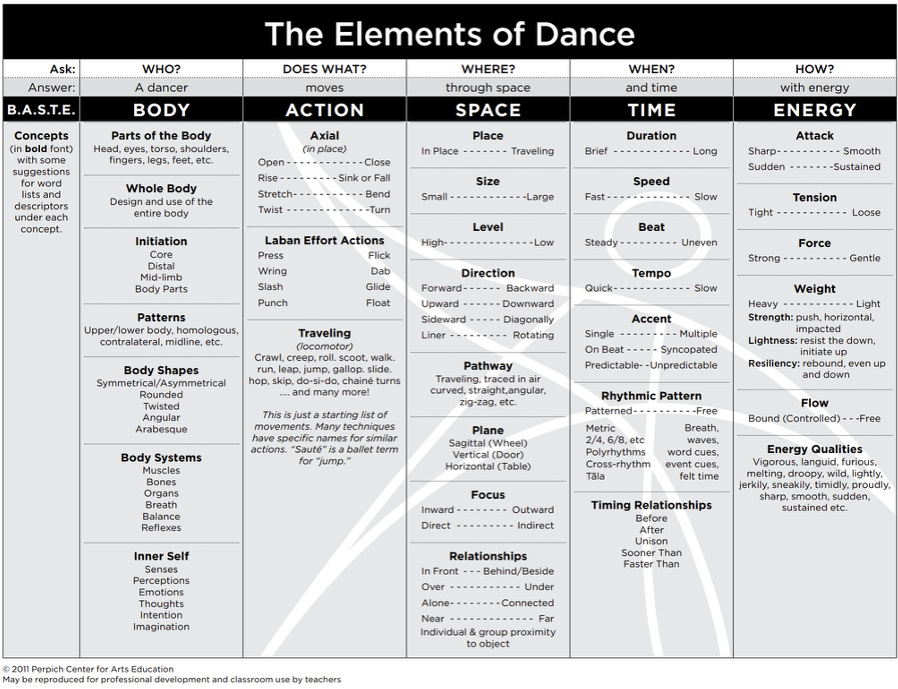
        • Speed: Fast/Slow
        • Level: High/Low
        • Energy: Sudden/Steady
        • Rotation: Clockwise/Counterclockwise
      • Students list the questions that they need to answer before brainstorming dance movements.

PART 2

  • Create three movements to show the changing conditions. Each movement should show the weather for one day, making sure to focus on the cause and effect relationship/interaction between the high- and low-pressure systems that will create the predicted weather conditions. Students need to prioritize their questions listed in PART 1 in order to focus on the cause and effect relationship of atmospheric systems. Students identify the dance elements that they will use in their movements.

PART 3

  • Students will order their dance movements to communicate the forecast based on the conditions printed on their cards.

PART 4

Students will write down their forecast. They will review the forecast to make sure that it represents the assigned conditions on their cards. Students will correct any inaccuracies, focusing on the high-and-low-pressure systems.


Closing Reflection

  • Ask students to describe the interaction of high and low pressure in various situations (i.e., a slow-moving high-pressure system versus a fast-moving system), using vocabulary of the Elements of Dance (dance vocabulary words on cards or their own words).
  • Ask students to explain how moving their bodies or observing dances in this lesson helps them to understand and describe the differences between high-and-low-pressure systems and how those systems interact in the atmosphere to create weather that we experience on the surface of the planet.


Assessments

Formative

Visually observe students formulating questions and exploring movement while discussing atmospheric concepts.

  • Teacher observes students correlating temperature, precipitation, and winds with anticyclones and depressions.
  • Teacher observes students using vocabulary of the Elements of Dance and vocabulary of atmospheric pressure, together, as they create and sequence movement.
  • Teacher observes students arranging movements so they demonstrate atmospheric systems that create weather conditions.

Summative

MATTER IN MOTION CHECKLIST

  • Students first list questions, and then prioritize the questions.
  • Movement qualities focus on cause and effect/interaction between atmospheric conditions, rather than the weather observed at the surface of the planet.
  • Movements are imagined first and then ordered.
  • The choreography effectively uses dance to communicate properties of atmospheric systems that contribute to weather conditions.


Differentiation

Accelerated: 

  • Ask students to consider the impact of land forms in their forecast and vary their movements to show how the atmospheric conditions would change due to the presence of an ocean, mountain, etc.
  • List fewer details about weather or atmospheric conditions on the cards so that students have to draw more conclusions to create their predictions.


Remedial:

  • Divide the class into three groups. Work with only one card printed with weather/atmospheric conditions. Each group creates one movement to show the interaction between low-and-high-pressure systems for one day. As a whole class, order the movements to show the forecast for the three days suggested on the printed card.


Additional Resources

Classroom Tips:  Use the opening activities as opportunities for students to identify movements that they will use later in the lesson. If as a whole class students struggle with a movement during this creative time, then recognize effective movement and ask the whole class to model it.

Execute each part of the main activity one at a time, revealing each subsequent step after the current one is completed. In other words, do not permit students to work ahead to encourage the creative effect that results from the scaffolded directions.


Credits

Ideas contributed by: Julie Galle Baggenstoss

*This integrated lesson provides differentiated ideas and activities for educators that are aligned to a sampling of standards. Standards referenced at the time of publishing may differ based on each state’s adoption of new standards.

Revised and copyright:  January 2026 @ ArtsNOW
 

A MATTER OF ISOLATION 6-8

A MATTER OF ISOLATION

A MATTER OF ISOLATION

Learning Description

Students will create a game in which players use movement to show how changes in thermal energy change the behavior of particles.


Learning Targets

GRADE BAND: 6-8
CONTENT FOCUS: DANCE, SCIENCE & STEAM
LESSON DOWNLOADS:

Download PDF of this Lesson

"I Can" Statements

“I Can…”

  • I can demonstrate the effect of thermal change on particles through choreography.
  • I can relate the elements of dance to states of matter.
  • I can use the elements of dance to vary movements to communicate multiple ideas in one choreography.

Essential Questions

  • How does dance movement demonstrate states of matter and change in thermal energy?


Georgia Standards

Curriculum Standards

Grade 8:

S8P1.b Develop and use models to describe the movement of particles in solids, liquids, gases, and plasma states when thermal energy is added or removed.

Arts Standards

Grade 8:

MSD.CR.1 Demonstrate an understanding of the choreographic process.

MSD.RE.1 Demonstrate critical and creative thinking in dance.

MSD.CN.3 Demonstrate an understanding of a dance as it relates to other areas of knowledge.


South Carolina Standards

Curriculum Standards

Grade 6:

6-PS1-4. Develop and use a model that predicts and describes changes in particle motion, temperature, and state of a pure substance when thermal energy is added or removed

Arts Standards

Anchor Standard 1: I can use movement exploration to discover and create artistic ideas and works.

Anchor Standard 2: I can choreograph a dance.

Anchor Standard 3: I can perform movements using the dance elements.

Anchor Standard 5: I can describe, analyze, and evaluate a dance.

Anchor Standard 7: I can relate dance to other arts disciplines, content areas, and careers.


Key Vocabulary

Content Vocabulary

  • Particle – A small object which can be described by several physical or chemical properties; matter is made up of particles
  • Thermal Energy – The motion of particles within a substance that is responsible for its temperature

Arts Vocabulary

  • Isolation – Movement created by moving one part of their body while keeping the rest of the body still or controlled
  • Axial – Movement that occurs in place, without traveling to a new location
  • Locomotor – A movement that travels through space
  • Choreographic process - The steps taken to create movement sequences for dancers, which include testing, revising, and editing work
  • Choreography - The art of designing and arranging sequences of movements, steps, and gestures to create a dance piece
  • Engineering Design Process -
    • Ask – What is the problem? What do we need to do?
    • Imagine – What are some possible solutions?
    • Plan – Which idea will we try? How will we build it?
    • Create – Build the solution.
    • Test & Improve – Does it work? How can we make it better?


Materials

  • Blank index cards, blank paper
  • A variety of music selections
  • Music source and speakers
  • Word bank of dance vocabulary:


Instructional Design

Opening/Activating Strategy

  • Students improvise movements in a hand dance. Using only their hands and fingers, students work in pairs, with one being the leader and the other the follower. Students sit facing one another so that when they extend their arms in front of them their hands do NOT touch.
  • The leader extends one arm and faces the palm of the hand to the other student. The follower extends one arm and faces the palm of one hand to the leader to create a mirror image of the other student’s hand. The leader moves the one hand and fingers in slow steady motions while the follower imitates the movement. The teacher plays music and students move in silence, without talking or making any noise, until the music stops.
  • The teacher pauses the music. Partners change roles and repeat the process.
  • Partners should mentally note which movements are successful or when they find a movement that they would like to remember for use later in the lesson.

Work Session

PART 1

  • Divide students into small groups of three members. Each group will create a game in which players earn points when they use their hands and fingers to show how particles move in reaction to increasing or decreasing thermal energy.
  • For the game, participants should be organized into teams. Team members isolate their hands and fingers to create dance movements that represent states of matter to successfully earn points.
  • Students list a few of their favorite games and think about the strategy/rules of those games.
  • Give each group a few sheets of paper and index cards to use as game materials.

PART 2

  • Students list the information that they need to know in order to create the game. In other words, they list questions and answers about scientific concepts, dance concepts, and game rules.
  • Students gather the details that they need to plan the game.

PART 3

  • Students brainstorm different ways in which players could move their fingers and hands to play the game. They write down dance terms from a word bank derived from the Energy or Time columns of the Elements of Dance to describe the movements.
  • Students correlate the dance vocabulary with descriptions of how particles move when matter is a solid, liquid, or gas.

PART 4

  • Students imagine how teams could interact in a game so that players earn points by showing the movement of particles when thermal energy is applied, removed, increased, or decreased. Students should consider the different ways that players could describe the presence/absence/increase/decrease of thermal energy, including using words such as warmer or cooler, or absolute measures of temperature, i.e., 32 degrees F or 212 degrees F.
  • Students write down the rules of the game.

PART 5

Students test their games by playing them. They note where improvements need to be made and revise their rules. 


Closing Reflection

  • Ask students to explain how moving their bodies in this lesson helps them to understand and describe the properties of thermal energy and how it impacts matter.
  • Ask students to describe how the process of asking questions up front helped them create the game.
  • Ask students to describe how brainstorming movements first helped them imagine the play strategy (writing the rules).
  • Ask students how they revised their games after the testing phase.


Assessments

Formative

Visually observe the students during the process of creativity.

  • Teacher observes students discussing and writing questions during PART 2.
  • Teacher observes students using vocabulary of the elements of dance and vocabulary of states of matter and thermal energy together, as they brainstorm ways that teams will move to earn points and as they imagine the rules of the games.

Summative

A MATTER OF ISOLATION CHECKLIST

  • Movements are limited to hands and fingers.
  • Game options contain variation of time and energy elements.
  • The game rules effectively use dance to communicate changes in thermal energy so that observers can identify distinct states of matter.


Differentiation

Accelerated: 

  • Rather than limiting movements to hands and fingers, students explore whole-body axial and locomotor movements to exaggerate molecular activity and/or thermal energy change.


Remedial:

  • Complete PART 2 as a whole class.
  • Stop the activity at the end of PART 2. Assess the use of the first step of the engineering design process, which is to define the problem.


Additional Resources

Classroom Tip:  Use the opening activity as an opportunity for students to identify movements that they will use later in the lesson.


Credits

Ideas contributed by: Julie Galle Baggenstoss

*This integrated lesson provides differentiated ideas and activities for educators that are aligned to a sampling of standards. Standards referenced at the time of publishing may differ based on each state’s adoption of new standards.

Revised and copyright:  January 2026 @ ArtsNOW


ART BOTS STEAM 9-12

ART BOTS

ART BOTS

Learning Description

In this hands-on STEAM lesson, students will explore the relationship between electricity, motion, and unbalanced forces by designing and building their own wobbling art bots. Using hobby motors, battery packs, pool noodles, and markers, students will follow the engineering design process (Ask, Imagine, Plan, Create, Improve) to construct a bot that moves and draws in unpredictable patterns.

Through experimentation, students will discover how unbalanced forces affect motion, how simple circuits power their bots, and how small design changes can alter movement. They will analyze their bots' performance, make modifications, and reflect on their design choices. By combining science, engineering, and art, this lesson fosters creativity, problem-solving, and critical thinking while reinforcing foundational physical science concepts.


Learning Targets

GRADE BAND: 9-12
CONTENT FOCUS: STEAM
LESSON DOWNLOADS:

Download PDF of this Lesson

"I Can" Statements

“I Can…”

  • I can build and test a simple circuit to power a motor.
  • I can explain how unbalanced forces influence motion.
  • I can describe how energy is transformed in my art bot.
  • I can use the engineering design process to test and improve my design.

Essential Questions

  • How do unbalanced forces affect the motion of an object?
  • How does a motor convert electrical energy into motion?
  • What design choices impact the movement and artistic output of an art bot?
  • How can the engineering design process help improve a design?


Georgia Standards

Curriculum Standards

Physics:

SPS8: Obtain, evaluate, and communicate information to explain the relationships among force, mass, and motion.

SPS10: Investigate and explain the properties of electricity and magnetism.


Physical Science:

SPS7: Develop models to illustrate the transformation and conservation of energy.

Arts Standards

VAHSAE.1: Incorporate elements and principles of design into artworks for intentional effects.

VAHSCR.1: Apply creative thinking skills to develop ideas for personal expression.

VAHSPR.1: Create original artworks using a range of materials, techniques, and processes.

VAHSPR.2: Demonstrate proficient and safe use of tools, materials, and technology.

VAHSAR.1: Analyze personal and others’ artworks to evaluate meaning, intent, and technique.

VAHSAR.3: Critique artwork using formal, contextual, and intuitive approaches.


South Carolina Standards

Curriculum Standards

Physics:

P-PS2-4. Use mathematical representations of Newton’s law of gravitation and Coulomb’s law to describe and predict the gravitational and electrostatic forces between objects.

P-PS2-5. Plan and conduct an investigation to provide evidence that an electric current can produce a magnetic field and that a changing magnetic field can produce an electric current.

P-PS3-2. Develop and use models to illustrate that energy can be explained by the combination of motion and position of objects at the macroscopic scale and the motion and position of particles at the microscopic scale.

P-PS3-3. Design, build, and refine a device that works within given constraints to convert one form of energy into another form of energy.

P-PS3-5. Develop and use a model to illustrate the forces between two objects and the changes in energy of the objects due to their interaction through electric or magnetic fields.

Arts Standards

Anchor Standard 1: I can use the elements and principles of art to create artwork.

Anchor Standard 2: I can use different materials, techniques, and processes to make art.

Anchor Standard 7: I can relate visual arts ideas to other arts disciplines, content areas, and careers.


Key Vocabulary

Content Vocabulary

  • Electric circuit – A closed loop through which electricity can flow. It includes a power source (like a battery), wires, and something that uses the electricity (like a motor or light)
  • Current – The flow of electric charge through a circuit, like water moving through a pipe
  • Voltage – The pressure that pushes the current through the circuit, like water pressure
  • Unbalanced forces – When the forces acting on an object are not equal, causing the object to start moving, speed up, slow down, or change direction
  • Rotational motion – Movement around a central point or axis, like a spinning top or a wheel
  • Center of mass – The point at which an object's mass is evenly distributed in all directions
  • Friction – The resistance between two surfaces that slows things down
  • Energy transformation – The process of changing energy from one form to another—for example, chemical energy in a battery turns into electrical energy, which becomes mechanical energy in the spinning motor
  • Vibration motor – A small motor with an unbalanced weight attached to its shaft; as the shaft spins, it vibrates and shakes, which powers the Art Bot’s movement

Arts Vocabulary

  • Conceptual art – Art in which the idea behind the work is more important than the finished product
  • Intentionality – The purposeful use of elements and design to express meaning
  • Process art – Artwork that emphasizes the act of making over the final product
  • Rhythm – The principle of design in an artwork that indicates a type of movement, often characterized by repeated shapes, lines or colors
  • Gestural mark-making – Marks that reflect movement or emotion, often expressive
  • Experimental media – Unconventional materials or techniques used in creative exploration
  • Collaboration – Co-creating with others or with tools (like art bots) in the creative process
  • Movement – This principle of design is associated with rhythm and refers to the arrangement of parts in an artwork that creates a sense of motion to the viewer's eye through the work.
  • Balance – This is a sense of stability in the body of work. Balance can be created by repeating the same shapes and by creating a feeling of equal visual weight.
  • Form – An object that is three-dimensional and encloses volume (cubes, spheres, and cylinders are examples of various forms)
  • Kinetic art – Art that incorporates real motion
  • Engineering Design Process – A problem-solving approach that involves identifying a need, researching, brainstorming possible solutions, developing and testing prototypes, and improving the design until the optimal solution is achieved; the steps are Ask, Imagine, Plan, Create, Improve


Materials

  • Hobby motors
  • Battery packs (with AA batteries)
  • Pool noodles (cut into sections)
  • Thin markers
  • Electrical tape or masking tape
  • Hot glue
  • Off-center weights (washers, clay, coins)
  • Switches (optional for advanced circuits)
  • Scissors
  • Image of the Engineering Design Process


Instructional Design

Opening/Activating Strategy

  • Engage:
    • Show a short video of various art bots and kinetic sculptures.
    • Facilitate a class discussion around the following question: “What do you think makes them move the way they do?”.
    • Connect motion and circuits to previously learned physics principles.

Work Session


Explore – Building the Art Bots

  • Have students use their sketchbooks or STEAM journals to record their process.
  • Ask:
    • Where will you place the mass to make it wobble?
    • How do you ensure your bot stays powered and balanced?
  • Imagine:
    • Students will brainstorm ideas and sketch potential designs for their bots.
  • Plan:
    • Show students a list of materials that they have available to them to build their bots.
    • Students will create a sketch of their bot with materials labeled before beginning to build their bots.
  • Create:
    • Provide time for students to create their bots.
    • If needed, show students one method to create their bots. Allow time for students to revise their designs as needed.
      • Connect the battery pack to the motor, ensuring a working circuit.
      • Insert the motor into the pool noodle.
      • Attach markers as "legs" using tape.
      • Add weights off-center on the motor shaft to create an unbalanced force.
    • Improve and Extend:
      • Students will test and record how their bots move by placing the bot on plain white paper and turning it on to observe its movement.
      • Students should reflect on the following:
        • Do they rotate, scoot forward, draw erratically?
        • What happens when the mass is adjusted?
        • How does surface friction affect performance?
      • Introduce design constraints and goals:
        • Ask students, “Can you get your bot to move in a figure-eight?”.
        • Have students find a partner and ask students, “Can your bot cover more surface area in one minute than your partner’s?”.

Engineering and Technology Pathways (optional extension): Design process, simple circuits, prototyping, and testing


Closing Reflection

  • Students will work with their partners to co-create an artwork with both of their bots.
  • Each pair should give their piece a creative title and write a short “artist’s statement” that explains:
    • Their bot’s design
    • Its motion pattern
    • How they collaborated to create their artwork
    • What they learned about forces and energy
    • Gallery walk: Display art and artist statements; allow an opportunity for students to provide peer feedback.


Assessments

Formative

  • Assess students’ learning through observations of building and testing, student questions and responses during discussions, and design STEAM journal/sketchbook entries with sketches, reflections, and improvements.

Summative

  • Design Report (written or digital):
    • Sketches, circuit diagram, energy flow description
    • Data on motion (optional)
    • Explanation of what worked and what didn’t

 Artist Statement that includes a creative title and explanation of motion concepts and energy transformations


Differentiation

Accelerated: 

  • Students can choose how to present their final work:
    • A short video montage showing the bot’s drawing in action.
    • A sketchbook spread combining bot photos, drawn output, and written reflection.
    • A conceptual artist statement exploring the bot as collaborator or tool.
  • AP Physics or Engineering classes: Add formal motion data collection (speed, revolutions, force diagrams).
  • Technology Integration: Challenge students to control bots with microcontrollers (Arduino, micro:bit).


Remedial:

  • Provide pre-made circuits.
  • Provide extended time for building and reflecting.
  • Offer verbal instructions paired with written guides.
  • Allow for alternative methods of documentation (photos, audio).


Credits

Ideas contributed by: Shannon Green

*This integrated lesson provides differentiated ideas and activities for educators that are aligned to a sampling of standards. Standards referenced at the time of publishing may differ based on each state’s adoption of new standards.

Revised and copyright:  May 2025 @ ArtsNOW


ART BOTS ELA 9-12

ART BOTS

ART BOTS

Learning Description

In this upper-level STEAM investigation, students conceptualize and build kinetic “Art Bots” that function as both machines and artistic collaborators. The lesson challenges students to understand and model energy transformations—how electrical energy from a battery is converted into mechanical energy and transferred into rotational motion that powers drawing behavior.

After iterative testing and design improvement, students explore the philosophical and conceptual dimension of their project by responding to the reflective prompt: “In what ways is your Art Bot a co-artist in your work? Write a reflection that explains your role as designer, the bot’s contribution, and what the final artwork expresses”.This task deepens students’ critical thinking, creativity, and the fusion of art and science. Final presentations include both the Art Bot’s physical output and a reflective artist statement, shared in a class critique or gallery walk.


Learning Targets

GRADE BAND: 9-12
CONTENT FOCUS: STEAM
LESSON DOWNLOADS:

Download PDF of this Lesson

"I Can" Statements

“I Can…”

  • I can design a functioning electrical circuit that powers a small motor.
  • I can explain how force, motion, and energy interact in my Art Bot.
  • I can analyze how changes to mass, balance, and friction affect motion.
  • I can collaborate with a robot to create original art and evaluate the process.

Essential Questions

  • How do energy transformations power machines?
  • What role do unbalanced forces play in robotic motion?
  • How can small design adjustments significantly impact a machine’s behavior?
  • In what ways can humans and robots collaborate creatively?


Georgia Standards

Curriculum Standards

SCIENCE

Physics:

SPS8: Obtain, evaluate, and communicate information to explain the relationships among force, mass, and motion.

SPS10: Investigate and explain the properties of electricity and magnetism.


Physical Science:

SPS7: Develop models to illustrate the transformation and conservation of energy.


ELA

Grade 9:

9.T.T.1.e Effectively apply a variety of narrative techniques to develop complex character(s) who change, use setting to create mood, develop an idea or theme across the text, achieve specific purposes, engage audiences, and enhance writing.

Grade 10:

10.T.T.1.e Effectively apply a variety of narrative techniques to develop complex character(s) who change, use setting to create mood, develop an idea or theme across the text using metaphors, achieve specific purposes, engage audiences, and enhance writing.

Grade 11:

11.T.T.1.e Effectively apply a variety of narrative techniques to develop complex character(s) who change, use setting to create mood, develop an idea or theme across the text using metaphors and symbolism, achieve specific purposes, engage audiences, and enhance writing.

Grade 12:

12.T.T.1.e Effectively apply a variety of narrative techniques to develop complex character(s) who change, use setting to create mood, develop an idea or theme across the text using metaphors and symbolism, achieve specific purposes, engage audiences, and enhance writing.

Arts Standards

VAHSAE.1: Incorporate elements and principles of design into artworks for intentional effects.

VAHSCR.1: Apply creative thinking skills to develop ideas for personal expression.

VAHSPR.1: Create original artworks using a range of materials, techniques, and processes.

VAHSPR.2: Demonstrate proficient and safe use of tools, materials, and technology.

VAHSAR.1: Analyze personal and others’ artworks to evaluate meaning, intent, and technique.

VAHSAR.3: Critique artwork using formal, contextual, and intuitive approaches.


South Carolina Standards

Curriculum Standards

SCIENCE

Physics:

P-PS2-4. Use mathematical representations of Newton’s law of gravitation and Coulomb’s law to describe and predict the gravitational and electrostatic forces between objects.

P-PS2-5. Plan and conduct an investigation to provide evidence that an electric current can produce a magnetic field and that a changing magnetic field can produce an electric current.

P-PS3-2. Develop and use models to illustrate that energy can be explained by the combination of motion and position of objects at the macroscopic scale and the motion and position of particles at the microscopic scale.

P-PS3-3. Design, build, and refine a device that works within given constraints to convert one form of energy into another form of energy.

P-PS3-5. Develop and use a model to illustrate the forces between two objects and the changes in energy of the objects due to their interaction through electric or magnetic fields.


ELA

English I

ELA.E1.C.2.1 Write informative texts to examine and convey complex information clearly and accurately through the analysis of multiple sources of information. When writing:a. introduce a topic and organize complex ideas and concepts to make important connections and distinctions; b. develop a topic with relevant and sufficient facts, definitions, details, quotes, examples, and/or other information appropriate for the audience; c. use varied transitions to link major sections of the text and clarify the relationships between ideas and concepts; d. use precise language and vocabulary appropriate to the complexity of the topic; e. use a tone and style appropriate to the task and audience; and f. provide a concluding statement or section that supports the information presented.

English II

ELA.E2.C.2.1 Write informative texts to examine and convey complex information clearly and accurately through the analysis of multiple sources of information. When writing:a. introduce a topic and organize complex ideas and concepts to make important connections and distinctions; b. develop a topic by selecting relevant and sufficient facts, definitions, details, quotes, examples, data, and/or other information appropriate for the audience; c. use varied transitions to link major sections of the text and clarify the relationships between ideas and concepts; d. use precise language and vocabulary appropriate to the complexity of the topic; e. establish and maintain a style and objective tone appropriate to the task and purpose; and f. provide a concluding statement or section that supports the information presented.

English III

ELA.E3.C.2.1 Write informative/expository texts to convey complex ideas and concepts while analyzing complex texts. When writing:a. introduce a topic and organize complex concepts and information; b. develop the topic by selecting relevant facts, definitions, details, quotations, statistics, data, and/or other information and examples appropriate to the audience’s knowledge of the topic; c. use varied transitions and syntax to link the major sections of the text and clarify the relationships between complex ideas and concepts; d. use precise language and vocabulary appropriate to the complexity of the topic; e. establish and maintain a formal style and objective tone appropriate for the task, purpose, and audience; and f. provide a concluding statement or section that supports the information presented.

English IV

ELA.E4.C.2.1 Write informative/expository texts to analyze and explain complex ideas and information. Write informative/expository texts to convey complex ideas and concepts while analyzing complex texts. When writing:a. introduce a topic and organize complex concepts and information so that each new element builds on what precedes it; b. develop the topic thoroughly by selecting relevant facts, definitions, details, quotations, statistics, data, and/or other information and examples appropriate to the audience’s knowledge of the topic; c. use varied transitions and syntax to link the major sections of the text and clarify the relationships between complex ideas and concepts; d. use precise language and vocabulary appropriate to the complexity of the topic; e. establish and maintain a formal style and objective tone appropriate for the task, purpose, and audience; and f. provide a concluding statement or section that supports the information presented.

Arts Standards

Anchor Standard 1: I can use the elements and principles of art to create artwork.

Anchor Standard 2: I can use different materials, techniques, and processes to make art.

Anchor Standard 7: I can relate visual arts ideas to other arts disciplines, content areas, and careers.


Key Vocabulary

Content Vocabulary

  • Electric circuit – A closed loop through which electricity can flow. It includes a power source (like a battery), wires, and something that uses the electricity (like a motor or light)
  • Current – The flow of electric charge through a circuit, like water moving through a pipe
  • Voltage – The pressure that pushes the current through the circuit, like water pressure
  • Unbalanced forces – When the forces acting on an object are not equal, causing the object to start moving, speed up, slow down, or change direction
  • Rotational motion – Movement around a central point or axis, like a spinning top or a wheel
  • Center of mass – The point at which an object's mass is evenly distributed in all directions
  • Friction – The resistance between two surfaces that slows things down
  • Energy transformation – The process of changing energy from one form to another—for example, chemical energy in a battery turns into electrical energy, which becomes mechanical energy in the spinning motor
  • Vibration motor – A small motor with an unbalanced weight attached to its shaft; as the shaft spins, it vibrates and shakes, which powers the Art Bot’s movement

Arts Vocabulary

  • Conceptual art – Art in which the idea behind the work is more important than the finished product
  • Intentionality – The purposeful use of elements and design to express meaning
  • Process art – Artwork that emphasizes the act of making over the final product
  • Rhythm – The principle of design in an artwork that indicates a type of movement, often characterized by repeated shapes, lines or colors
  • Gestural mark-making – Marks that reflect movement or emotion, often expressive
  • Experimental media – Unconventional materials or techniques used in creative exploration
  • Collaboration – Co-creating with others or with tools (like Art Bots) in the creative process


Materials

  • Hobby motors
  • Battery packs (with AA batteries)
  • Pool noodles (cut into sections)
  • Thin markers
  • Electrical tape or masking tape
  • Hot glue
  • Off-center weights (washers, clay, coins)
  • Switches (optional for advanced circuits)
  • Scissors
  • Image of the Engineering Design Process


Instructional Design

Opening/Activating Strategy

  • Engage:
    • Show a short video of various Art Bots and kinetic sculptures.
    • Facilitate a class discussion around the following question: “What do you think makes them move the way they do?”.
    • Connect motion and circuits to previously learned physics principles.

Work Session


Explore – Building the Art Bots

  • Have students use their sketchbooks or STEAM journals to record their process.
  • Ask:
    • Where will you place the mass to make it wobble?
    • How do you ensure your bot stays powered and balanced?
  • Imagine:
    • Students will brainstorm ideas and sketch potential designs for their bots.
  • Plan:
    • Show students a list of materials that they have available to them to build their bots.
    • Students will create a sketch of their bot with materials labeled before beginning to build their bots.
  • Create:
    • Provide time for students to create their bots.
    • If needed, show students one method to create their bots. Allow time for students to revise their designs as needed.
      • Connect the battery pack to the motor, ensuring a working circuit.
      • Insert the motor into the pool noodle.
      • Attach markers as "legs" using tape.
      • Add weights off-center on the motor shaft to create an unbalanced force.
    • Improve and Extend:
      • Students will test and record how their bots move by placing the bot on plain white paper and turning it on to observe its movement.
      • Students should reflect on the following:
        • Do they rotate, scoot forward, draw erratically?
        • What happens when the mass is adjusted?
        • How does surface friction affect performance?
      • Introduce design constraints and goals:
        • Ask students, “Can you get your bot to move in a figure-eight?”.
        • Have students find a partner and ask students, “Can your bot cover more surface area in one minute than your partner’s?”.
      • Have students respond to the following writing prompt: In what ways is your Art Bot a co-artist in your work? Write a reflection that explains you role as designer, the bot's contribution, and what the final artwork expresses.
        • Reflection criteria:
          • Use vivid, sensory language to describe the bot's movement and its impact on the artwork
          • Include a clear sequence of events (design, testing, outcome).
          • Demonstrate personal voice and insight into the collaborative process
          • Use content vocabulary (e.g., unbalanced forces, rotational motion, center of mass).
          • Incorporate at least one quote or caption from your design partner to reflect collaboration or discovery.
          • Revise writing using peer and self feedback
      • AP Physics or Engineering classes: Add formal motion data collection (speed, revolutions, force diagrams).
      • Technology Integration: Challenge students to control bots with microcontrollers (Arduino, micro:bit).


Closing Reflection

  • Students will work with their partners to co-create an artwork with both of their bots.
  • Each pair should give their piece a creative title and write a short “artist’s statement” that explains:
    • Their bot’s design
    • Its motion pattern
    • How they collaborated to create their artwork
    • What they learned about forces and energy Gallery walk: Display art and artist statements; allow an opportunity for students to provide peer feedback.


Assessments

Formative

  • Assess students’ learning through observations of building and testing, student questions and responses during discussions, and design STEAM journal/sketchbook entries with sketches, reflections, and improvements.

Summative

  • Design Report (written or digital):
    • Sketches, circuit diagram, energy flow description
    • Data on motion (optional)
    • Explanation of what worked and what didn’t
  • Gallery Artist Statement that includes a creative title and explanation of motion concepts and energy transformations
  • Writing prompt responses


Differentiation

Accelerated: 

  • Students can choose how to present their final work:
    • A short video montage showing the bot’s drawing in action.
    • A sketchbook spread combining bot photos, drawn output, and written reflection.
    • A conceptual artist statement exploring the bot as collaborator or tool.
  • Students respond to one of these advanced prompts:
    • “Is the Art Bot merely a tool—or something more? Explore how machines can challenge traditional ideas of authorship in art.”
    • “If your Art Bot could 'speak,' what would it say about the marks it left behind? Write from the bot’s point of view.”
    • “Compare your creative process with that of a traditional artist. What new ideas about creativity have you discovered?”
  • Advanced Criteria:
    • Integrate a metaphor or analogy comparing the Art Bot to another creative collaborator (e.g., a dance partner, a jazz improviser).
    • Include evidence of revision—submit a first draft with feedback notes and a final version.
    • Use philosophical or conceptual language (aligns with Anchor Standard 10).
  • Extension Option: Research an artist (e.g., Jean Tinguely, Harold Cohen, or Sougwen Chung) who worked with machines and compare their practice to your own.


Remedial:

  • Provide pre-made circuits.
  • Provide extended time for building and reflecting.
  • Offer verbal instructions paired with written guides.
  • Allow for alternative methods of documentation (photos, audio).
  • Written reflection:
    • Provide structured prompts such as:
      • “My Art Bot moved by ________ because ______.”
      • “One thing I changed was ________, and it helped because ______.”
      • “The artwork shows ______ because the bot ______.”
    • Oral reflection option: Allow students to speak their reflection, then transcribe or record it.
    • Divide the writing prompt: Break into daily parts (Day 1: Describe the bot. Day 2: Explain how it moves. Day 3: What does your artwork show?)
    • Visual Supports: Use labeled diagrams and photo sequences of their bot's process to guide the writing.
    • Modeling: Show mentor texts or completed reflections and model how to revise for detail or structure.


Credits

Ideas contributed by: Shannon Green

*This integrated lesson provides differentiated ideas and activities for educators that are aligned to a sampling of standards. Standards referenced at the time of publishing may differ based on each state’s adoption of new standards.

Revised and copyright:  May 2025 @ ArtsNOW


ART BOTS 6-8

ART BOTS

ART BOTS

Learning Description

In this hands-on STEAM lesson, students will explore the relationship between electricity, motion, and unbalanced forces by designing and building their own wobbling art bots. Using hobby motors, battery packs, pool noodles, and markers, students will follow the engineering design process (Ask, Imagine, Plan, Create, Improve) to construct a bot that moves and draws in unpredictable patterns.

Through experimentation, students will discover how unbalanced forces affect motion, how simple circuits power their bots, and how small design changes can alter movement. They will analyze their bots' performance, make modifications, and reflect on their design choices. By combining science, engineering, and art, this lesson fosters creativity, problem-solving, and critical thinking while reinforcing foundational physical science concepts.


Learning Targets

GRADE BAND: 6-8
CONTENT FOCUS: STEAM
LESSON DOWNLOADS:

Download PDF of this Lesson

"I Can" Statements

“I Can…”

  • I can build and test a simple circuit to power a motor.
  • I can explain how unbalanced forces influence motion.
  • I can describe how energy is transformed in my Art Bot.
  • I can use the engineering design process to test and improve my design.

Essential Questions

  • How do unbalanced forces affect the motion of an object?
  • How does a motor convert electrical energy into motion?
  • What design choices impact the movement and artistic output of an Art Bot?
  • How can the engineering design process help improve a design?


Georgia Standards

Curriculum Standards

Grade 6:

S6P2: Obtain, evaluate, and communicate information about the relationship between force, mass, and the motion of objects.

S6P3: Construct an explanation of the relationships among electric force, magnetic force, and motion.

Grade 7:

S7P2: Obtain, evaluate, and communicate information to explain the effects of forces on the motion of an object.

Grade 8:

S8P2: Develop models to illustrate the relationship between potential and kinetic energy.

Arts Standards

VA.CR.1 Visualize and generate ideas for creating works of art.

VA.CR.2 Choose from a range of materials and/or methods of traditional and contemporary artistic practices to plan and create works of art.

VA.CR.2.b Produce three-dimensional artworks using a variety of media/materials (e.g. clay, papier-mâché, cardboard, paper, plaster, wood, wire, found objects, fiber).

VA.CR.3 Engage in an array of processes, media, techniques, and/or technology through experimentation, practice, and persistence.


South Carolina Standards

Curriculum Standards

Grade 6:

6-PS3-4. Plan an investigation to determine the relationships among the energy transferred, the type of matter, the mass, and the change in the average kinetic energy of the particles as measured by the temperature of the sample.

Grade 7:

7-PS3-2. Develop a model to describe that when the arrangement of objects interacting at a distance changes, different amounts of potential energy are stored in the system.

7-PS3-5. Construct, use, and present arguments to support the claim that when the kinetic energy of an object changes, energy is transferred to or from the object.

Grade 8:

8-PS2-3. Analyze and interpret data to determine the factors that affect the strength of electric and magnetic forces.

8-PS2-5. Conduct an investigation and evaluate the experimental design to provide evidence that fields exist between objects exerting forces on each other even though the objects are not in contact.

Arts Standards

Anchor Standard 1: I can use the elements and principles of art to create artwork.

Anchor Standard 2: I can use different materials, techniques, and processes to make art.

Anchor Standard 7: I can relate visual arts ideas to other arts disciplines, content areas, and careers.


Key Vocabulary

Content Vocabulary

  • Unbalanced force – A force that changes the motion of an object
  • Friction – A force that opposes motion
  • Circuit – A closed path through which electricity flows
  • Kinetic energy – Energy of motion
  • Potential energy – Stored energy that can be converted into motion
  • Energy transformation – The process of changing one form of energy into another

Arts Vocabulary

  • Movement – This principle of design is associated with rhythm and refers to the arrangement of parts in an artwork that creates a sense of motion to the viewer's eye through the work.
  • Balance – This is a sense of stability in the body of work. Balance can be created by repeating the same shapes and by creating a feeling of equal visual weight.
  • Form – An object that is three-dimensional and encloses volume (cubes, spheres, and cylinders are examples of various forms)
  • Kinetic art – Art that incorporates real motion
  • Contrast – The arrangement of opposite elements in a composition (light vs. dark, rough vs. smooth, etc.) Similar to variety, which refers to the differences in a work, achieved by using different shapes, textures, colors and values.
  • Mark-making – The lines, textures, and marks made by tools or gestures
  • Negative space – The space around and between subjects in an artwork
  • Engineering Design Process – A problem-solving approach that involves identifying a need, researching, brainstorming possible solutions, developing and testing prototypes, and improving the design until the optimal solution is achieved; the steps are Ask, Imagine, Plan, Create, Improve


Materials

  • Hobby motors
  • Battery packs (with AA batteries)
  • Pool noodles (cut into sections)
  • Thin markers
  • Electrical tape or masking tape
  • Small weights (washers, paperclips, clay, etc.)
  • Switches (optional for advanced circuits)
  • Scissors
  • Image of the Engineering Design Process


Instructional Design

Opening/Activating Strategy

  • Engage:
    • Hook: Show a short video of a scribble bot or demonstrate a pre-made art bot.
    • Discussion–Ask students:
      • What do you notice about how it moves?
      • What forces might be acting on it?
      • How does the energy from the battery turn into movement?

Work Session

Explore – Building the Art Bots

  • Ask:
    • How can we design an art bot that moves unpredictably?
    • How do we make sure our bot stays powered and balanced?
  • Imagine:
    • Students will brainstorm ideas and sketch potential designs for their bots.
  • Plan:
    • Show students a list of materials that they have available to them to build their bots.
    • Students will create a sketch of their bot with materials labeled before beginning to build their bots.
  • Create:
    • Show students how to create their bots.
      • Connect the battery pack to the motor, ensuring a working circuit.
      • Insert the motor into the pool noodle.
      • Attach markers as "legs" using tape.
      • Add weights off-center on the motor shaft to create an unbalanced force.
    • Have students place the bot on plain white paper and turn it on to observe its movement.
    • Improve: Elaborate – Improving the Design
      • Students will analyze their bot’s movement and adjust:
        • Marker placement for different drawing effects.
        • Weight distribution to change speed and wobbling direction.
        • Motor positioning to alter how much it vibrates.
      • Students will compare designs and discuss how small modifications affect motion.
      • Optional: Students can add to their designs with markers.


Closing Reflection

  • Explain: Facilitate a discussion on the science behind the bots.
    • Discuss how unbalanced forces create movement.
    • Explain energy transformations (chemical → electrical → kinetic).
    • Relate movement patterns to force, friction, and weight distribution.
  • Have students complete the following exit ticket:
    • What forces acted on your bot?
    • How did changes to your design affect motion?
    • How did energy transform from the battery to movement?
    • What worked well in your bot, and what would you improve if you could do it again?


Assessments

Formative

  • Assess students’ learning through observations of student engagement, problem-solving, and questioning during discussions.

Summative

  • Assess students’ learning through the exit ticket questions and closing discussion.


Differentiation

Accelerated: 

  • Introduce data collection by having students measure and compare drawing patterns.
  • Use Micro:bit or Arduino to program bots to change motion patterns.


Remedial:

  • Provide pre-made circuits.
  • Provide extended time for building and reflecting.
  • Offer verbal instructions paired with written guides.
  • Allow for alternative methods of documentation (photos, audio).


Credits

Ideas contributed by: Shannon Green

*This integrated lesson provides differentiated ideas and activities for educators that are aligned to a sampling of standards. Standards referenced at the time of publishing may differ based on each state’s adoption of new standards.

Revised and copyright:  May 2025 @ ArtsNOW