
POLLUTION MATTERS: EXPLORING POLLUTION THROUGH DANCE 3-5

EXPLORING POLLUTION THROUGH DANCE

POLLUTION MATTERS: EXPLORING POLLUTION THROUGH DANCE

Learning Description

In this lesson, students will learn about air, water and land pollution around the world by responding to images and conducting research. Students will then express their understanding of pollution through movement using locomotor and non-locomotor movements and levels.


Learning Targets

GRADE BAND: 3,5
CONTENT FOCUS: VISUAL ARTS/DANCE & SCIENCE
LESSON DOWNLOADS:

Download PDF of this Lesson

"I Can" Statements

“I Can…”

  • I can identify types of pollution around the world.
  • I can analyze the effects that pollution has on human life.
  • I can express my feelings about pollution using movement.

Essential Questions

  • How does pollution affect people from different cultures in different ways?
  • What are the effects of pollution on people and the environment?


Georgia Standards

Curriculum Standards

Grade 3:

S3L2. Obtain, evaluate, and communicate information about the effects of pollution (air, land, and water) and humans on the environment.

a. Ask questions to collect information and create records of sources and effects of pollution on the plants and animals.

b. Explore, research, and communicate solutions, such as conservation of resources and recycling of materials, to protect plants and animals.

Arts Standards

Grade 3:

ESD3.CR.1 Demonstrate an understanding of the choreographic process.

ESD3.CR.2 Demonstrate an understanding of dance as a form of communication.


South Carolina Standards

Curriculum Standards

Grade 5:

5-ESS3-1. Evaluate potential solutions to problems that individual communities face in protecting the Earth’s resources and environment.

Arts Standards

Anchor Standard 1: I can use movement exploration to discover and create artistic ideas and works.

Anchor Standard 2: I can choreograph a dance.


Key Vocabulary

Content Vocabulary

  • Pollution - The introduction of harmful or toxic substances, known as pollutants, into the environment
  • Reduce, reuse, recycle - A sustainability concept aimed at minimizing waste and conserving resources
  • Garbage - Waste materials that are no longer useful or wanted and are typically discarded
  • Litter - Waste, trash, or discarded material that is improperly disposed of in public spaces instead of in designated trash or recycling bins
  • Smog - A type of air pollution that results from the interaction of sunlight with pollutants like ground-level ozone and particulate matter
  • Smoke - A collection of gasses, particles, and other chemicals released when a substance undergoes combustion (burning)
  • Water vapor - The gaseous form of water
  • Acid rain - Precipitation (rain, snow, sleet, or fog) that has a lower pH than normal due to the presence of harmful chemicals, primarily sulfur dioxide (SO₂) and nitrogen oxides (NOₓ) in the atmosphere
  • Oil spills - The release of liquid petroleum (crude oil or refined oil) into the environment, typically into bodies of water like oceans, rivers, or lakes
  • Runoff - The flow of water, usually from rainfall or melting snow, that travels over the ground and eventually enters rivers, lakes, streams, or oceans
  • Pesticides - Chemicals or substances used to prevent, control, or eliminate pests, such as insects, weeds, fungi, rodents, and other organisms that can harm crops, livestock, or human health
  • Fertilizers - Substances or materials added to soil or plants to provide essential nutrients that promote healthy plant growth
  • Emissions (ex: car, airplane) - The release of substances (often gasses, liquids, or particles) into the environment

Arts Vocabulary

  • Mood - Emotion or feeling
  • Locomotor movement - A movement that travels through space
  • Non-locomotor movement - A movement that does not travel through space
  • Levels - One of the aspects of movement (there are three basic levels in dance: high, middle, and low)


Materials


Instructional Design

Opening/Activating Strategy

  • Lead students in a mirroring movement warm-up to introduce the following vocabulary:
    • Locomotor
    • Non-locomotor
    • Levels (high, middle, low)
    • Pathways
  • Begin by telling students that they will mirror your movements so they must be watching closely. Have students establish a space where they can move without interfering with other students.
    • Start by doing simple non-locomotor movements (i.e., bending, twisting, shaking, etc.)
    • Now incorporate high, middle, and low levels by making non-locomotor movements at different levels.
    • Begin to incorporate locomotor movements, such as stepping together from side to side, gliding as if skating, walking, etc.
    • Incorporate levels high, middle, and low by making locomotor movements at different levels.
  • Debrief with students explaining the dance vocabulary.
  • Now, tell students that you will call out vocabulary and they will make a movement that expresses the vocabulary.
    • Example: Create a locomotor movement at a low level.
  • After practicing using the vocabulary, have students return to their seats.
  • Show students images of pollution around the world and discuss the images as a class.
    • Engage students in the Step Inside Artful Thinking Routine.
      • Choose a person, object or element in an image or work of art, and step inside that point of view. Consider:
        • What can the person/thing perceive and feel? What might the person/thing know about or believe?
        • What might the person/thing care about?
        • How would you feel if you were in the same situation or you were in that environment?
      • Take on the character of the thing you’ve chosen and improvise a monologue. Speaking in the first person, talk about who/what you are and what you are experiencing.
      • What do you think caused the pollution in the environment?
    • After several of the images, discuss the feelings that students have. Ask students to show that feeling using a movement.
    • Then ask students to explain their rationale for choosing each movement.

Work Session

Part 1

  • Introduce to students the concept of “Ego vs. Eco” (human advancement at the expense of nature versus caring for the ecosystem). Use this website resource to explore/research this concept: https://recyclingsutainabiliy4a.weebly.com/ego-vs-eco.html.
  • Students will create journal entries on Padlet/sticky notes (teacher's choice) to explain possible causes of and solutions for pollution viewed in the images from the slideshow.

Part 2

Part 3:

  • Place students in small groups of three or four students.
  • Students will review the research and make a list of six adjectives used to describe pollution.
  • Direct students to work together to choreograph a movement for each adjective.
  • Students should then connect them together to form a dance.
  • Students’ dances must:
    • Have at least six movements
    • Use both locomotor and non-locomotor movements
    • Use all three levels–high, middle, and low
  • If time permits, direct students to select music that they connect to. Otherwise, provide students with two options of music to use for their dance (instrumental recommended).
  • Students should rehearse their dances.

Closing Reflection

  • Have students name the different types of pollution they saw and describe the effects it has on our world.
    • Have students discuss where they saw locomotor/non-locomotor movements and levels.
  • Ask students:
    • How does it make you feel seeing pollution around the world?
    • Where have you seen pollution in your own environment?
    • What could you do to help the environment?
    • How can we further reduce the amount of waste that we have?
    • What is something new you learned about pollution while participating in this project?


Assessments

Formative

  • Teachers will observe students’:
    • Responses during the activating strategy: Step Inside
    • Journal entries
    • Research and identification of relevant vocabulary terms from research
    • Students’ collaboration on choreography

Summative

  • Students’ choreography:
    • Has at least six movements
    • Uses both locomotor and non-locomotor movements
    • Uses all three levels–high, middle, and low
    • Includes a movement for six different relevant adjectives to describe pollution
    • Students can name the different types of pollution they saw and describe the effects it has on our world.


Differentiation 

Accelerated: 

Remedial:

  • Provide sentence starters for students’ journal entry writing.
  • Allow for peer tutor and pairings.
  • Include visuals to support the content vocabulary.
  • Allow students to copy their articles into Microsoft Word Online and use the “Immersive Reader” feature to hear their articles read aloud. (Office365 Student Account>Word Document Online>View>Immersive Reader)


Credits

U.S. Department of Education- STEM + the Art of Integrated Learning

Ideas contributed by: Jill McNally, Alisa Moore, Julie Palmieri, Edited by Dr. Carla Cohen, Edited by Jessica Espinoza and Katy Betts

*This integrated lesson provides differentiated ideas and activities for educators that are aligned to a sampling of standards. Standards referenced at the time of publishing may differ based on each state’s adoption of new standards.

Revised and copyright:  June 2025 @ ArtsNOW
 

POLLUTION MATTERS: GOOD GARBAGE 3-5

GOOD GARBAGE

POLLUTION MATTERS: GOOD GARBAGE

Learning Description

In this lesson, students will examine the effects of pollution on the ecosystem through music! This project includes students creating new lyrics to a song about pollution. Students will step into the role of lyricists and use music to help others understand the causes and effects of pollution around them.


Learning Targets

GRADE BAND: 3,5
CONTENT FOCUS: MUSIC & SCIENCE
LESSON DOWNLOADS:

Download PDF of this Lesson

"I Can" Statements

“I Can…”

  • I can write song lyrics that explain the various types of pollution.
  • I can create an adaptation for a song that relates to pollution and its effects on the environment.
  • I can rehearse and perform a song for an audience.
  • I can explain the effects of pollution on people and the environment.

Essential Questions

  • How can I use music to evaluate and communicate information about the effects of pollution on people and the environment?
  • What are the effects of pollution on people and the environment?


Georgia Standards

Curriculum Standards

Grade 3:

S3L2. Obtain, evaluate, and communicate information about the effects of pollution (air, land, and water) and humans on the environment.

a. Ask questions to collect information and create records of sources and effects of pollution on the plants and animals.

b. Explore, research, and communicate solutions, such as conservation of resources and recycling of materials, to protect plants and animals.

Arts Standards

Grade 3:

VA3PR.1 Creates artworks based on personal experience and selected themes.

VA3PR.2 Understands and applies media, techniques, and processes of two-dimensional art processes (drawing, painting, printmaking, mixed-media) using tools and materials in a safe and appropriate manner to develop skills.

VA3AR.1 Discusses his or her artwork and the artwork of others.


South Carolina Standards

Curriculum Standards

Grade 5:

5-ESS3-1. Evaluate potential solutions to problems that individual communities face in protecting the Earth’s resources and environment.

Arts Standards

Anchor Standard 1: I can use the elements and principles of art to create artwork.

Anchor Standard 2: I can use different materials, techniques, and processes to make art.

Anchor Standard 4: I can organize work for presentation and documentation to reflect specific content, ideas, skills, and or media.


Key Vocabulary

Content Vocabulary

  • Compare/contrast - To find similarities and differences between two things
  • Cause and effect - A relationship between two events or situations where one event (the cause) directly results in the other event (the effect)
  • Pollution - The introduction of harmful or toxic substances, known as pollutants, into the environment
  • Conservation - The careful management, protection, and preservation of natural resources, the environment, and wildlife to prevent depletion, degradation, or extinction
  • Environment - The conditions and factors surrounding an organism or group of organisms, influencing their development, behavior, and survival. It includes both biotic factors (living elements like plants, animals, bacteria) and abiotic factors (non-living elements like sunlight, temperature, water, soil, and air)
  • Air pollution - Harmful gases and particles are released into the atmosphere, often from vehicle exhaust, factories, and power plants. Common pollutants include carbon dioxide (CO₂), sulfur dioxide (SO₂), nitrogen oxides (NOx), and particulate matter
  • Land pollution - Chemicals, pesticides, and waste materials contaminate the soil, often due to improper waste disposal, use of pesticides, or industrial spills. This affects soil quality, plant life, and can contaminate crops.
  • Water pollution - contaminants enter water bodies like rivers, lakes, and oceans, often from agricultural runoff, industrial waste, sewage, and oil spills. This pollution harms aquatic life and can make water unsafe for human consumption.

Arts Vocabulary

  • Color - An element of art with three properties: 1) Hue: the name of the color, e.g. red, yellow, etc., 2) Intensity: the purity and strength of the color (brightness or dullness), 3) Value: the lightness or darkness of the color (shades and tints)
  • Warm colors - Yellow, orange, red (and shades of each)
  • Cool colors - Purple/violet, blue, green (and shades of each)
  • Shape - A flat, enclosed line that is always two-dimensional and can be either geometric or organic
  • Texture - The surface quality, or "feel" of an object, such as roughness, smoothness, or softness. Actual texture can be felt while simulated textures are implied by the way the artist renders areas of the picture.
  • Contrast - The arrangement of opposite elements in a composition (light vs. dark, rough vs. smooth, etc.) Similar to variety, which refers to the differences in a work, achieved by using different shapes, textures, colors and values.
  • Landscape - A type of art that shows a wide expanse of land and shows depth through a background, middle ground, and foreground
  • Background - The area of the artwork that appears furthest away and is smallest
  • Middle ground - The area of the artwork that appears in the middle of the picture plane between the background and middle ground
  • Foreground - The area of the artwork that appears closest and is largest


Materials


Instructional Design

Opening/Activating Strategy

Teacher pre-work: Review the list Suggested Collected Items with students, and ask students to find five or six items to bring into the classroom.

  • Review the items that students brought in. With the class, use Padlet (padlet.com) to generate ideas on how the items can be reused.
  • As a whole class, use the Carbon Footprint Calculator or http://footprint.wwf.org.uk/ to determine students’ carbon footprint. Discuss students’ reactions and how their footprint can be improved.

Work Session

Part 1

  • Listen to the song “Good Garbage” by Tom Chapin.
  • Discuss in whole group vocabulary such as compost, biodegradable/non-biodegradable, recycle, reuse and reduce.
  • As a whole group, discuss the author’s purpose of writing the song. Why is it catchy? Discuss the melody, rhythm, tempo, lyrics, chorus, verse, rhyme, etc.
  • Tell students that they will write a verse about pollution to the tune of another song.
  • As a whole group, discuss well-known songs that students may like to use to create/write a class pollution song.
    • Discuss the form of the song (rondo form would be chorus-verse 1-chorus-verse 2-chorus-verse 3-chorus-verse 4-chorus, etc.), rhythm, and tempo of the various songs to ensure that it matches the topic: Pollution and conservation.

Part 2

  • After the song has been selected, write a chorus collaboratively as a class. The chorus should be generic.
  • Divide the class into four groups. Have students create verses for the four categories: Air, land, water, and conservation. Facilitate the writing process.
    • Remind students to communicate their main idea (air, water, or land pollution or conservation) and use supporting details in their lyrics.
    • Students must use at least four relevant facts about their topic in their verse.
    • Students must define their topic (i.e. air pollution) in their verse.
    • Students’ lyrics must fit the form of the song the class selected (tempo, rhyme scheme, melody, rhythm, etc.).

Part 3

  • Review “Good Garbage” song as a whole group.
  • Have the students revise or edit their verses for their song.

Optional: Come up with music for the class song using Quaver or GarageBand.  

Closing Reflection

  • Have students perform the class song. Review audience etiquette and expectations prior to performances.
    • The song will be performed in rondo form: Whole class will sing the chorus, group one will sing their verse, whole class will sing the chorus, group two will sing their verse, whole class will sing the chorus, groups three will sing their verse, whole class will sing the chorus, group four will sing their verse, whole class will sing the chorus.
    • Audience members should discuss the main idea and supporting details of the lyrics of each verse after the performance.


Assessments

Formative

  • Teacher will check for appropriate usage of unit vocabulary during lyric writing.
  • Teacher will observe students’ ability to identify the melody, rhythm, tempo, lyrics, chorus, verse, and rhyme in “Good Garbage”.

Summative

  • Students’ verses meet the following criteria:
    • Use at least four relevant facts about their topic in their verse.
    • Define the topic (i.e. air pollution) in their verse.
    • Fit the form of the song the class selected (tempo, rhyme scheme, melody, rhythm, etc.)


Differentiation 

Accelerated: 

  • Students can also create their own instruments to create their music for their group’s songs or use body percussion (stomping, snapping, clapping, etc.)
  • Have students come up with music for their verse using Quaver or GarageBand.

Remedial:

  • Provide students with the lyrics from the “Good Garbage” song to use as a model for writing their verses including sentence frames and a word bank.
  • Have students choose three to five key vocabulary words from the vocabulary list generated in project one to include in their verse.


Additional Resources


Credits

U.S. Department of Education- STEM + the Art of Integrated Learning

Ideas contributed by: Jill McNally, Alisa Moore, Julie Palmieri, Edited by Dr. Carla Cohen, Edited by Jessica Espinoza and Katy Betts

*This integrated lesson provides differentiated ideas and activities for educators that are aligned to a sampling of standards. Standards referenced at the time of publishing may differ based on each state’s adoption of new standards.

Revised and copyright:  June 2025 @ ArtsNOW


POLLUTION MATTERS: THE LORAX LANDSCAPES 3-5

THE LORAX LANDSCAPES

POLLUTION MATTERS: THE LORAX LANDSCAPES

Learning Description

In this lesson, students will listen to the story The Lorax by Dr. Seuss. Students will discuss the elements of art they see in the illustrations. Then, students will recreate their own scene analysis of the illustrations before and after the Onceler arrives in the story. Students will also focus on the changes in mood throughout the story. Students will then create a persuasive writing piece comparing and contrasting the Lorax’s habitat.


Learning Targets

GRADE BAND: 3,5
CONTENT FOCUS: VISUAL ARTS & SCIENCE
LESSON DOWNLOADS:

Download PDF of this Lesson

"I Can" Statements

“I Can…”

  • I can create a persuasive piece to compare and contrast the scenes in the Lorax’s habitat before and after the Onceler.
  • I can create a piece of art that shows the cause and effect of the pollution that occurred in The Lorax.

Essential Questions

  • How can art be used to compare and contrast the land of the Lorax before and after the Onceler?
  • How can you analyze the mood in a piece of artwork using key vocabulary?
  • What are the effects of pollution on people and the environment?


Georgia Standards

Curriculum Standards

Grade 3:

S3L2. Obtain, evaluate, and communicate information about the effects of pollution (air, land, and water) and humans on the environment.

a. Ask questions to collect information and create records of sources and effects of pollution on the plants and animals.

b. Explore, research, and communicate solutions, such as conservation of resources and recycling of materials, to protect plants and animals.

Arts Standards

Grade 3:

VA3PR.1 Creates artworks based on personal experience and selected themes.

VA3PR.2 Understands and applies media, techniques, and processes of two-dimensional art processes (drawing, painting, printmaking, mixed-media) using tools and materials in a safe and appropriate manner to develop skills.

VA3AR.1 Discusses his or her artwork and the artwork of others.


South Carolina Standards

Curriculum Standards

Grade 5:

5-ESS3-1. Evaluate potential solutions to problems that individual communities face in protecting the Earth’s resources and environment.

Arts Standards

Anchor Standard 1: I can use the elements and principles of art to create artwork.

Anchor Standard 2: I can use different materials, techniques, and processes to make art.

Anchor Standard 4: I can organize work for presentation and documentation to reflect specific content, ideas, skills, and or media.


Key Vocabulary

Content Vocabulary

  • Compare/contrast - To find similarities and differences between two things
  • Cause and effect - A relationship between two events or situations where one event (the cause) directly results in the other event (the effect)
  • Pollution - The introduction of harmful or toxic substances, known as pollutants, into the environment
  • Conservation - The careful management, protection, and preservation of natural resources, the environment, and wildlife to prevent depletion, degradation, or extinction
  • Environment - The conditions and factors surrounding an organism or group of organisms, influencing their development, behavior, and survival. It includes both biotic factors (living elements like plants, animals, bacteria) and abiotic factors (non-living elements like sunlight, temperature, water, soil, and air)
  • Air pollution - Harmful gases and particles are released into the atmosphere, often from vehicle exhaust, factories, and power plants. Common pollutants include carbon dioxide (CO₂), sulfur dioxide (SO₂), nitrogen oxides (NOx), and particulate matter
  • Land pollution - Chemicals, pesticides, and waste materials contaminate the soil, often due to improper waste disposal, use of pesticides, or industrial spills. This affects soil quality, plant life, and can contaminate crops.
  • Water pollution - contaminants enter water bodies like rivers, lakes, and oceans, often from agricultural runoff, industrial waste, sewage, and oil spills. This pollution harms aquatic life and can make water unsafe for human consumption.

Arts Vocabulary

  • Color - An element of art with three properties: 1) Hue: the name of the color, e.g. red, yellow, etc., 2) Intensity: the purity and strength of the color (brightness or dullness), 3) Value: the lightness or darkness of the color (shades and tints)
  • Warm colors - Yellow, orange, red (and shades of each)
  • Cool colors - Purple/violet, blue, green (and shades of each)
  • Shape - A flat, enclosed line that is always two-dimensional and can be either geometric or organic
  • Texture - The surface quality, or "feel" of an object, such as roughness, smoothness, or softness. Actual texture can be felt while simulated textures are implied by the way the artist renders areas of the picture.
  • Contrast - The arrangement of opposite elements in a composition (light vs. dark, rough vs. smooth, etc.) Similar to variety, which refers to the differences in a work, achieved by using different shapes, textures, colors and values.
  • Landscape - A type of art that shows a wide expanse of land and shows depth through a background, middle ground, and foreground
  • Background - The area of the artwork that appears furthest away and is smallest
  • Middle ground - The area of the artwork that appears in the middle of the picture plane between the background and middle ground
  • Foreground - The area of the artwork that appears closest and is largest


Materials


Instructional Design

Opening/Activating Strategy

  • Select one illustration from the first half of The Lorax by Dr. Seuss.
  • Engage students in the See, Think, Wonder Artful Thinking Routine.
    • What do you see?
    • What do you think about what you see?
    • What do you wonder about?

Work Session

Part 1:

  • Read the first half of The Lorax as a whole class.
  • After the first half of The Lorax with the students, discuss as a group the art elements they saw while reading. Ask them to identify colors, lines, shapes, and textures.
  • Use The Lorax movie clip to help with recalling the mood of the “beginning” of the story.
  • Pass out mixed media paper to students. Students will fold paper in half (landscape).
  • Students should label “Before the Onceler” on the left hand side of the paper and “After the Onceler” on the right hand side of the paper.
  • Show students the parts of a landscape diagram. Look at an illustration from The Lorax and have students identify the parts of a landscape in the illustration.
  • Have students lightly sketch the horizon line, the foreground and the background on both sides of the paper. After students sketch, they will use the black sharpies to go over the major lines in their drawings.
  • Students will then use oil pastels to recreate the before scene. Ask students to focus on using color to communicate the mood of the story at this point. This will be where the colors are warm and bright.
  • Remind students to include the characters Barbaloot Bears, Truffala trees, Hummingfish, and Swammie Swams in their artwork.

Part 2:

  • Read the second half of The Lorax with the students.
  • Discuss as a group how the illustrations changed in the second half of the story. What colors do students see?
  • Students will then use oil pastels to finish their landscapes recreating “After the Onceler”.
  • Remind students to think about how many characters have vanished from the setting. How did the colors change? What happened to the Truffla trees?

Part 3:

  • To conclude the project, as a whole class, discuss the point of view from the main characters (Onceler and Lorax). Have students pair up and recreate a quick conversation between the characters.  Point of view must be clearly identified and supported.
  • Students will then create their own persuasive writing piece using their Suess inspired illustration picture to compare and contrast the Lorax’s habitat before and after the Onceler.

Closing Reflection

  • Facilitate a discussion around the following questions:
    • How does the Land of the Lifted Lorax compare after the Onceler?
    • How would you describe the mood of the scene before and after the Onceler?
    • What was the main cause of the destruction to the Land of the Lifted Lorax?
    • How did you use color to communicate the mood of the story before and after the Onceler came?


Assessments

Formative

  • Teacher will observe the students for the understanding of appropriate usage of unit vocabulary through the lesson as well as their ability to connect color and mood.

Summative


Differentiation 

Accelerated: 

  • Students can create a third panel of the artwork with the possibility of the UNLESS scene and how they think it would look (possible outcomes, new small plants growing, grass beginning to grow again etc.).
  • Discuss the artist Vik Munez. Use pictures to discuss his artwork and what inspires him.  Students can create their own art pieces using collected garbage.

Remedial:

  • Provide pre-folded paper with a horizon line drawn for students.
  • Provide sentence starters for students.
  • Include a visual word bank for additional support.


Additional Resources


Credits

U.S. Department of Education- STEM + the Art of Integrated Learning

Ideas contributed by: Jill McNally, Alisa Moore, Julie Palmieri, Edited by Dr. Carla Cohen, Edited by Jessica Espinoza and Katy Betts

*This integrated lesson provides differentiated ideas and activities for educators that are aligned to a sampling of standards. Standards referenced at the time of publishing may differ based on each state’s adoption of new standards.

Revised and copyright:  June 2025 @ ArtsNOW
 

ARTFUL EARTH–EXPLORING ROCKS AND SOILS: THE ROCK CYCLE DANCE 3-4

THE ROCK CYCLE DANCE

ARTFUL EARTH–EXPLORING ROCKS AND SOILS: THE ROCK CYCLE DANCE

Learning Description

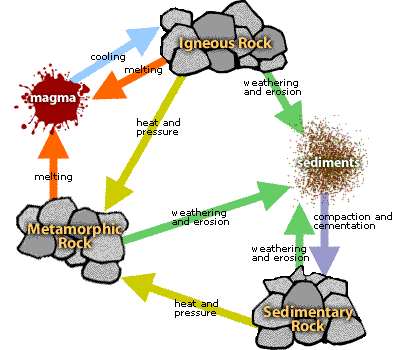
In this arts integrated lesson, students will model the rock cycle by composing small group dance compositions. Students will use the dance concepts: Body shapes and non-locomotor/locomotor movements to depict how rocks change their form based on physical and chemical changes that naturally occur over time. Groups will observe their peers and evaluate the dance pieces based on their understanding of how rocks are formed.


Learning Targets

GRADE BAND: 3,4
CONTENT FOCUS: DANCE & SCIENCE
LESSON DOWNLOADS:

Download PDF of this Lesson

"I Can" Statements

“I Can…”

  • I can identify the three types of rocks: Igneous, sedimentary, and metamorphic.
  • I can use movement to represent the rock cycle.
  • I can identify how the changes in nature result in a new type of rock forming.
  • I can identify all of the steps in the rock cycle.

Essential Questions

  • How are the three types of rocks formed?
  • How can I use movement to represent the rock cycle?
  • What is the difference between the three types of rocks?


Georgia Standards

Curriculum Standards

Grade 3:

S3E1 Obtain, evaluate, and communicate information about the physical attributes of rocks and soils.

S3E1.a Ask questions and analyze data to classify rocks by their physical attributes (color, texture, luster, and hardness) using simple tests.

S3E1.b Plan and carry out investigations to describe properties (color, texture, capacity to retain water, and ability to support growth of plants) of soils and soil types (sand, clay, loam).

S3E1.c Make observations of the local environment to construct an explanation of how water and/or wind have made changes to soil and/or rocks over time.

Arts Standards

Grade 3:

ESD3.CR.1 Demonstrate an understanding of the choreographic process.

ESD3.CR.2 Demonstrate an understanding of dance as a form of communication.


South Carolina Standards

Curriculum Standards

Grade 4:

4-ESS1-1. Identify evidence from patterns in rock formations and fossils in rock layers to support an explanation for changes in a landscape over time.

Arts Standards

Anchor Standard 1: I can use movement exploration to discover and create artistic ideas and works.

Anchor Standard 2: I can choreograph a dance.


Key Vocabulary

Content Vocabulary

  • Rock - A naturally occurring solid substance composed of one or more minerals, mineraloids, or organic materials
  • Sedimentary rocks - A type of rock that forms from the accumulation, compaction, and cementation of sediments over time
  • Metamorphic rocks - A type of rock that forms when existing rocks—either igneous, sedimentary, or other metamorphic rocks—are subjected to high heat, pressure, and/or chemically active fluids over long periods of time
  • Igneous rocks - A type of rock that is formed from the cooling and solidification of molten rock (magma or lava)
  • Magma - Molten rock that is found beneath the Earth's surface
  • Weathering - The process by which rocks and minerals break down into smaller pieces or change chemically due to exposure to environmental conditions such as wind, water, temperature changes, and biological activity
  • Sediments - Small particles of rock, minerals, organic materials, or other substances that have been broken down or weathered from larger rocks over time

Arts Vocabulary

  • Body shapes - Refers to an interesting and interrelated arrangement of body parts of one dancer; the visual makeup or molding of the body parts of a singular dancer; the overall visible appearance of a group of dancers (they may be curved/angular, symmetrical/asymmetrical, positive/negative)
  • Levels - One of the aspects of movement (there are three basic levels in dance: high, middle, and low)
  • Locomotor movement - A movement that travels through space
  • Non-locomotor movement - A movement that does not travel through space
  • Choreography - The art of designing and arranging sequences of movements, steps, and gestures to create a dance piece


Materials


Instructional Design

Opening/Activating Strategy

Dance Warm-Up

  • Students will move freely through the space of the classroom while the teacher plays instrumental music.
  • When the music stops, have students make a body shape. It may help to give them some directions, such as to make a curved or angular shape. Encourage students to use their whole bodies when making shapes.
  • Direct students to make shapes at high (standing fully erect), middle, and low levels (low to the ground).
  • Next, tell students that locomotor movements in dance are movements that travel from one place to another. Create a class list of examples of locomotor movements with students (ie. zig-zag, skip, slither, jump).

Next, call out a few of the locomotor movements from the created list, and have the students move freely through the room demonstrating the movements.

Work Session

  • Place students in small groups and go over the expectations for the dance composition they will create together.
  • Stress that each group must have three group body shapes that depict the three types of rocks and three locomotor movements that depict the chemical/physical changes that occur during the rock cycles that transform the rock into the next type (ie. weathering, heat and pressure).
  • Go over the Choreography Planning Document with students.
  • You may need to scaffold the planning of student dances by first having them create three body shapes for their three different rocks.
  • Then, have students create the locomotor movements that transform them into each new rock.
  • Allow time for the small groups to create and rehearse their choreography.

Closing Reflection

  • Groups will perform their dance pieces for the class. Review audience etiquette and expectations prior to performances.
  • The students in the audience will observe and determine which body shapes represent which types of rock. They will also look for the locomotor movements that represent the changes in nature.
  • Ask students to reflect on the following after the performances:
    • How did you know which body shape represented which rock?
    • Did the movement choices that the group selected accurately depict the rock cycle?
    • Are there any changes we might suggest these dancers make to their choreography to more effectively show the rock cycle?


Assessments

Formative

  • Teachers will observe student discussion, reflection questions, and the choreographic process and planning guide.

Summative

  • Students’ dances demonstrate that they understand the attributes of each type of rock and the process each rock undergoes in its formation through their use of body shapes and locomotor movements.
  • Students demonstrate that they can use body shapes and locomotor movements as tools of communication.


Differentiation 

Accelerated: 

  • Have students add a beginning and ending frozen shape to their choreography.
  • Have students draw a simple diagram of the rock cycle and annotate it with the movements and body shapes they used for each rock.
  • Have students add narration or spoken word in between the dances to explain what’s happening in the rock cycle (weathering, melting, cooling, etc.).

Remedial:

  • Have students choreograph a dance composition for one type of rock instead of three.


Additional Resources

  • The Rock Cycle By Base 12 Innovations, Open iTunes to buy and download apps. Free Category: Education Updated: Apr 03, 2013 Version: 1.3 Size: 28.0 MB Language: English Seller: Sivaraman Sivaswami © 2011 Base 12 Innovations
  • Rock Cycle - BrainPOP


Credits

U.S. Department of Education- STEM + the Art of Integrated Learning

U.S. Department of Education Arts in Education--Model Development and Dissemination Grants Program Cherokee County (GA) School District and ArtsNOW, Inc.

Ideas contributed and edited by: Diane McMullen, Edith Alexander, Liz Pendlington, Jessica Espinoza, Richard Benjamin Ph.D., Michele McClelland, Mary Ellen Johnson, Jane Gill

*This integrated lesson provides differentiated ideas and activities for educators that are aligned to a sampling of standards. Standards referenced at the time of publishing may differ based on each state’s adoption of new standards.

Revised and copyright:  June 2025 @ ArtsNOW


ARTFUL EARTH–EXPLORING ROCKS AND SOILS: WORD ART AND ROCK RIDDLES 3-4

WORD ART AND ROCK RIDDLES

ARTFUL EARTH–EXPLORING ROCKS AND SOILS: WORD ART AND ROCK RIDDLES

Learning Description

In this arts integrated lesson, students will use visual arts and theatre to demonstrate their understanding of rocks. Students will create a Word Art illustration focusing on one of the three types of rocks. Students will then create and perform a riddle and or monologue in which the class (audience) tries to guess which rock it represents. Students will compare and contrast the attributes/characteristics of igneous, sedimentary, and metamorphic rocks.


Learning Targets

GRADE BAND: 3,4
CONTENT FOCUS: THEATRE & SCIENCE
LESSON DOWNLOADS:

Download PDF of this Lesson

"I Can" Statements

“I Can…”

  • I can identify the three types of rocks: Igneous, sedimentary, and metamorphic.
  • I can create and perform a monologue/riddle describing the three types of rocks: Igneous, sedimentary, and metamorphic.
  • I can compare and contrast the three types of rocks: Igneous, sedimentary, and metamorphic.

Essential Questions

  • How are the three types of rocks formed?
  • How are the three types of rocks alike and different?
  • What is the difference between the three types of rocks?


Georgia Standards

Curriculum Standards

Grade 3:

S3E1 Obtain, evaluate, and communicate information about the physical attributes of rocks and soils.

S3E1.a Ask questions and analyze data to classify rocks by their physical attributes (color, texture, luster, and hardness) using simple tests.

S3E1.b Plan and carry out investigations to describe properties (color, texture, capacity to retain water, and ability to support growth of plants) of soils and soil types (sand, clay, loam).

S3E1.c Make observations of the local environment to construct an explanation of how water and/or wind have made changes to soil and/or rocks over time.

Arts Standards

Grade 3:

THEATRE: TA3.PR.1 Act by communicating and sustaining roles in formal and informal environments.

VISUAL ARTS:

VA3.RE.1 Use a variety of approaches for art criticism and to critique personal works of art and the artwork of others to enhance visual literacy.

VA3.CN.3 Develop life skills through the study and production of art (e.g. collaboration, creativity, critical thinking, communication).


South Carolina Standards

Curriculum Standards

Grade 4:

4-ESS1-1. Identify evidence from patterns in rock formations and fossils in rock layers to support an explanation for changes in a landscape over time.

Arts Standards

THEATRE: Anchor Standard 3: I can act in improvised scenes and written scripts.

Anchor Standard 8: I can relate theatre to other content areas, arts disciplines, and careers.

VISUAL ARTS:Anchor Standard 5: I can interpret and evaluate the meaning of an artwork.

Anchor Standard 7: I can relate visual arts ideas to other arts disciplines, content areas, and careers.


Key Vocabulary

Content Vocabulary

  • Rock - A naturally occurring solid substance composed of one or more minerals, mineraloids, or organic materials
  • Sedimentary rocks - A type of rock that forms from the accumulation, compaction, and cementation of sediments over time
  • Metamorphic rocks - A type of rock that forms when existing rocks—either igneous, sedimentary, or other metamorphic rocks—are subjected to high heat, pressure, and/or chemically active fluids over long periods of time
  • Igneous rocks - A type of rock that is formed from the cooling and solidification of molten rock (magma or lava)
  • Magma - Molten rock that is found beneath the Earth's surface
  • Weathering - The process by which rocks and minerals break down into smaller pieces or change chemically due to exposure to environmental conditions such as wind, water, temperature changes, and biological activity
  • Sediments - Small particles of rock, minerals, organic materials, or other substances that have been broken down or weathered from larger rocks over time

Arts Vocabulary

  • Voice - Actors use their voice to be heard by the audience clearly. Actors must also apply vocal choices such as pitch, tempo, and volume to the character they are dramatizing.
  • Pitch - The highness or lowness of sound
  • Body - Actors use their bodies to become a character through body posture and movement. What your mind thinks, what your emotions feel, all of this is supposed to show up in your body.
  • Texture - When referring to an actor's voice, texture describes the unique quality, feel, or timbre of the voice. Just as texture in visual art or touch refers to the surface characteristics (smooth, rough, gritty, etc.), vocal texture relates to the way the voice sounds and the impressions it conveys.
  • Word art - A form of visual art that uses words, letters, or text as the main medium to create an artistic representation
  • Color - An element of art with three properties: 1) Hue: The name of the color, e.g. red, yellow, etc., 2) Intensity: The purity and strength of the color (brightness or dullness), 3) Value: The lightness or darkness of the color (shades and tints)
  • Texture - The surface quality, or "feel" of an object, such as roughness, smoothness, or softness. Actual texture can be felt while simulated textures are implied by the way the artist renders areas of the picture.


Materials


Instructional Design

Opening/Activating Strategy

  • Each table/group will be given three samples/examples of rocks.
  • Using a Three-Column Blank Chart, the groups will discuss and fill in their chart writing down their observations.
    • Students should note the attributes in size, texture, color, hardness, softness, etc.
    • They should be able to identify all three rocks: Igneous, sedimentary, and metamorphic.
    • The students should also explain how each rock is created in a different manner than the others.

Each group will share their observations with the rest of the class. The teacher will compile the group observations into one large three column chart paper.

Work Session

Part 1:

  • Ask each small group to create a riddle for an assigned rock (igneous, sedimentary, metamorphic).
    • The riddle must be written in first person.
    • Students must decide what kind of voice they think that rock would have and how they think that rock would move if it came to life.
      • Ask students to think about the pitch (how high or low) and texture (rough, smooth, etc.) of their rock’s voice.
    • Teacher will demonstrate and share an example of a rock riddle: I am smooth to the touch. I am round in size and gray in color. Where you may find me is in the river. What type of rock am I?

Part 2:

  • Each group will perform their riddle for the class in character using their voices and bodies.
  • The class will then try to guess which type of rock is being demonstrated by the words given in the riddles along with any movement that may assist in better understanding.

Part 3:

  • Give students a piece of blank paper.
  • Students should create Word Art to express the type of rock that they wrote the riddle about: Igneous, sedimentary, metamorphic.
    • Students should consider the color and texture of the rock and include this in their lettering.
    • Students should consider the type of chemical/physical change that takes place in order for nature to create the rock.
      • As part of their Word Art, they should illustrate this change in a way that demonstrates the type of new rock that forms. This may look like the letters changing from the beginning of the word to the end of the word.
      • Project Word Art Examples to help students understand the expectations of the artwork.

Closing Reflection

  • Students should create a written reflection explaining the type of rock they chose, how it is formed, how they used their voices and body movements when performing their riddle to describe the rock, and how they used color and texture to demonstrate characteristics of their rock and how it’s formed in their Word Art.


Assessments

Formative

  • Teacher observation of students while writing their riddles and creating their rock characters to assess their knowledge of the three different types of rocks

Summative

  • Students’ rock riddles contain accurate information about the attributes of their type of rock.
  • Students’ use their voices and bodies to embody the attributes of their rocks.
  • Students use color and texture to communicate the attributes of their rocks and how they are formed in their Word Art.


Differentiation 

Accelerated: 

  • Allow your higher-level learners as well as gifted students an extension research activity. Put these students in pairs. The small groups will be given a mineral. They should identify the attributes of their mineral, where their mineral is found, and what the mineral is used for or its purpose.
    • They can then write a short informational essay using the above information. Then they can create a “Who Am I” riddle for their assigned mineral. They can then teach this new information to other students.
      • Example of a “Who Am I” mineral riddle: I am yellow and soft. I smell really bad. I leave a yellow stain. I am a mineral. Who am I? Answer = sulfur
    • Students can write an informational piece demonstrating their knowledge of the following: the three different types of rocks, their attributes, as well as how each type of rock is created. Informational Writing Rubric

Remedial:

  • Provide these students with photographs/pictures of the three types of rocks so they are able to refer back to the three different types of rocks and are using the correct terminology as much as possible while working on the project. These photographs/pictures could be of the three types of rocks in their natural settings so these learners are able to make better connections.
  • Allow students to orally present their reflection rather than writing it.
  • Format the written reflections as a question and answer.


Credits

U.S. Department of Education- STEM + the Art of Integrated Learning

U.S. Department of Education Arts in Education--Model Development and Dissemination Grants Program Cherokee County (GA) School District and ArtsNOW, Inc.

Ideas contributed and edited by: Diane McMullen, Edith Alexander, Liz Pendlington, Jessica Espinoza, Richard Benjamin Ph.D., Michele McClelland, Mary Ellen Johnson, Jane Gill

*This integrated lesson provides differentiated ideas and activities for educators that are aligned to a sampling of standards. Standards referenced at the time of publishing may differ based on each state’s adoption of new standards.

Revised and copyright:  June 2025 @ ArtsNOW