
Thank You, Omu 2 (Visual Arts)

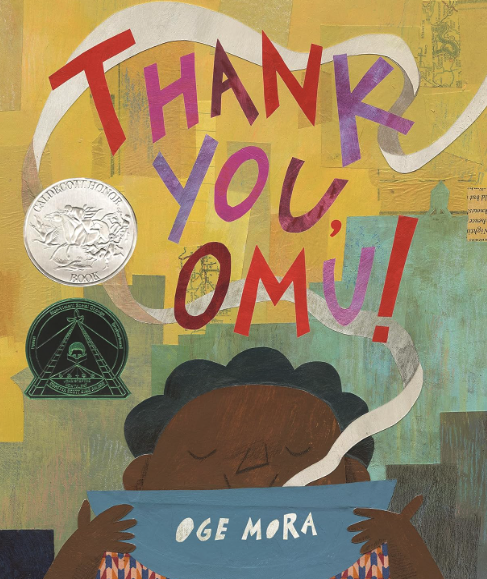
A colorful banner featuring the book "Thank You Omu!" on the left, "Creativity Task Cards" in a green circle at the center, and a large number "2" on a yellow circle to the right—perfect for inspiring Visual Arts activities.

Art Form: Visual Arts


Supplies Needed

-Thank You, Omu book
-Paper
-Crayons, colored pencils, markers,
or paint in warm colors (red, orange,
yellow, pink)
-Scraps of tissue paper, magazines,
string, other items to add texture

Vocabulary

Warm Colors - colors that feel cozy and bright like red, orange, and yellow (and shades of each)

Abstract Art - art that uses shapes, colors, and lines instead of real-life pictures

Emotion - a feeling like happy, mad, kind, or thankful

Texture - the surface quality, or "feel" of an object, such as roughness, smoothness, or softness

Balance - This is a sense of stability in the body of work. Balance can be created by repeating same shapes and
by creating a feeling of equal visual weight.

Generosity - giving to others and sharing what you have

Characters - a person in a story or play, or an animal or object that has human qualities

Setting - where the story takes place

Central Message - the big idea or lesson of the story

Instructions

1. Read the book. Who are the characters? What is the setting? What happened in the beginning, middle, and end of the story? What is the central message of the book?

2. Think about how Omu made people feel with her kindness. On your paper, use warm colors to draw shapes, lines, and swirls that show the warm feelings from the story.

3. Fill the page with your colors and textures. Add optional symbols like hearts, bowls, or smiling faces. Add scraps of fabric, tissue paper, or other items like string to create texture for your artwork and create a collage.

4. Share your abstract artwork with others.

Extensions

Write an artist statement about your artwork describing how it relates to the story.

Create another version using only cool colors (blues, greens, purples), and compare how they make you feel.
About

The REimagining and Accelerating Literacy through Arts Integration (REALAI) grant supports the literacy achievement of 3,200 students and 170 teachers, media specialists, and literacy coaches across six schools in Georgia and South Carolina.

In addition to professional learning for educators, this project contributes significantly to school library collections through the purchase of developmentally appropriate and culturally relevant books.

This grant also includes parent events to provide families with access to books and other content about how to support their child’s reading development.

Be You! 1 (Theatre)

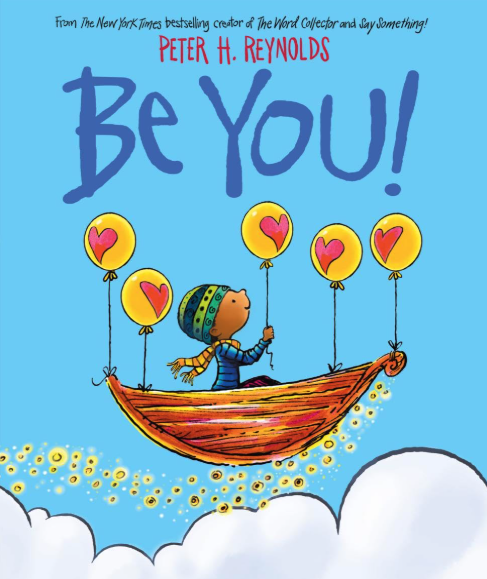
A banner with the book cover "Be You!" by Peter H. Reynolds on the left, and the text "Creativity Task Cards 1" in large, white, playful letters on colorful circles—perfect for inspiring theatre activities or connecting with The Big Umbrella.

Art Form: Theatre


Supplies Needed

Be You! book

Vocabulary

Character - a person in a story or play, or an animal or object that has human qualities; also, a person’s personality, and how they make choices, or what makes a person unique

Character trait - an aspect of a person’s character or personality; a characteristic

Adjective - a describing word; a word that tells the color, shape, size, smell, taste, sound, or feeling of a person or object

Vocal expression - the way an actor uses their voice to portray a character or to convey feelings

Pantomime - a style of acting that involves pretending to hold, touch, or use things that you are not holding, touching or using; also, sometimes it is done silently.

Instructions

1. Look at the first two pages of the book, where it says,“You were born to BE so many things,” and features an illustration of a baby. Look at all of the words on the page. They are adjectives; they convey character traits. Read the book.

2. Choose a word that describes you. It might describe you all the time or only sometimes. Think of a time when that word describes you.

3. Make up a sentence that includes the character trait and when you exhibit it, with the format,  “I am ______ when I see _____". For example, it could be, "I am excited when I jump rope with my friend Chelsea," or "I am curious when I see a picture of an animal I’ve never seen before”

4. Decide on an action you can pantomime to go with your statement about your character trait. Think about how to use your body to act it out. Think about how to use your hands to pretend you are holding or doing something imaginary. Think about the size, shape and weight of the objects you are pretending to use.

5. As you pantomime the action, use your voice to express the feeling of the character trait. For example, you could pantomime drying dishes and say, with a very strong, proud voice, “I am helpful when I dry the pots and pans after a big dinner”.

6. Repeat the process with several adjectives from the book. Continue to make your pantomime actions feel and look real.

Extensions

Find or identify two opposite adjectives. Write a new sentence putting them together, and act it out. For example, “I am generous when I share my snack with my friends at school, but I am selfish when my sister asks for some of my popcorn on Movie Night”.

Make a collage using copies of family photos or simply draw a picture of yourself with all your various character traits and the actions that go with them.

About

The REimagining and Accelerating Literacy through Arts Integration (REALAI) grant supports the literacy achievement of 3,200 students and 170 teachers, media specialists, and literacy coaches across six schools in Georgia and South Carolina.

In addition to professional learning for educators, this project contributes significantly to school library collections through the purchase of developmentally appropriate and culturally relevant books.

This grant also includes parent events to provide families with access to books and other content about how to support their child’s reading development.

Be You! 1 (Visual Arts)

A banner with the book cover "Be You!" by Peter H. Reynolds on the left, and the text "Creativity Task Cards 1" in large, white, playful letters on colorful circles—perfect for inspiring theatre activities or connecting with The Big Umbrella.

Art Form: Visual Arts


Supplies Needed

-Be You! book
-Paper
-Crayons, colored pencils, or markers

Vocabulary

Self Portrait - an artist’s visual portrayal of him or herself

Character - a person in a story or play, or an animal or object that has human qualities

Unique - one of a kind; special

Expression - a way to show feelings or ideas

Color - an element of art with three properties: 1) Hue: the name of the color, e.g. red, yellow, etc.; 2) Intensity: the purity and strength of the color (brightness or dullness); 3) Value: the lightness or darkness of the color (shades and tints)

Shape - a flat, enclosed line that is always two- dimensional and can be either geometric or organic

Confidence - believing in yourself

Instructions

1. Read Be You!. Who is the character in the story? Where might this story take place? Give the character a name. What are the some of the things the character is encouraging you to be?

2. Think about what makes you special, kind, or brave. Use lines and shapes to draw a picture of yourself, illustrating your style, your smile, and your favorite things!

3. Think about your smile, your talents, and your favorite things. Add words or symbols that show who you are (like hearts, stars, or books).

4.Write your name and a sentence to describe one thing you love about yourself. Use one of these sentence starters, “I am me because..., ” or My favorite thing about me is...”.

Extensions

Make a "Be You!" book with more pictures of what you like, feel, and dream about.

Talk about what makes your friends or family unique too!

About

The REimagining and Accelerating Literacy through Arts Integration (REALAI) grant supports the literacy achievement of 3,200 students and 170 teachers, media specialists, and literacy coaches across six schools in Georgia and South Carolina.

In addition to professional learning for educators, this project contributes significantly to school library collections through the purchase of developmentally appropriate and culturally relevant books.

This grant also includes parent events to provide families with access to books and other content about how to support their child’s reading development.

Be You! 1 (Music)

A banner with the book cover "Be You!" by Peter H. Reynolds on the left, and the text "Creativity Task Cards 1" in large, white, playful letters on colorful circles—perfect for inspiring theatre activities or connecting with The Big Umbrella.

Art Form: Music


Supplies Needed

-Be You! book

Vocabulary

Tempo - the speed of the beat

Rhythm - long and short sounds and silences

Steady beat - the consistent pulse or "heartbeat" of music

Form - the organization of a piece (how the music is put together)

Dynamics - loud and soft sounds; volume

Instructions

1.  Read the book, Be You!. Discuss the events in the book. Who are the characters? What is the setting? What is the main idea or central message of the book?

2.  What word is repeated? (“be”). Notice that every “be” is followed by a different word or words.

3.  Pat the steady beat at a moderate tempo. Practice saying each “be” phrase rhythmically in two beats—some words and syllables will be short!

4.  Read the book, inserting each “be” phrase spoken rhythmically. Since the other parts of the book can’t be read rhythmically, pat the beat only while you say the “be” phrases.

5.  Some parts of the book have a steady beat (the “be” phrases) while others don’t (the phrases that don’t start with “be”). The book is organized in parts that aren’t read rhythmically and parts that are—it had a specific form!

6.  What other words could make a “be” sentence (for example, “be generous” and “be strong”)? Write those words on a card and add these to the story— you choose where!

Extensions

Experiment with different punctuation at the end of the “be” phrases. How would the dynamics change if the “be” phrase ended with an exclamation mark (as happens on the second page)? Would it be loud or quiet?

For extra challenge, change the beat from pat-pat to pat-clap.

About

The REimagining and Accelerating Literacy through Arts Integration (REALAI) grant supports the literacy achievement of 3,200 students and 170 teachers, media specialists, and literacy coaches across six schools in Georgia and South Carolina.

In addition to professional learning for educators, this project contributes significantly to school library collections through the purchase of developmentally appropriate and culturally relevant books.

This grant also includes parent events to provide families with access to books and other content about how to support their child’s reading development.

Be You! 1 (Dance)

A banner with the book cover "Be You!" by Peter H. Reynolds on the left, and the text "Creativity Task Cards 1" in large, white, playful letters on colorful circles—perfect for inspiring theatre activities or connecting with The Big Umbrella.

Art Form: Dance


Supplies Needed

-Be You! book

Vocabulary

Movement - how you use your body to do a dance or action

Choreographer - the person who designs or creates a dance piece

Sequence - order of events in a story; order of shapes or movements in a dance

Body Shape - refers to an interesting and interrelated arrangement of body parts of one dancer; the visual makeup or molding of the body parts of a singular dancer; the overall visible appearance of a group of dancers

Gesture - an expressive movement of the body or limbs

Instructions

1.  Read the book Be You!. As you read, notice the book’s message: to be yourself. Begin thinking about all of the things that make you, you!

2.  After you’ve read the book, use body shapes to spell out your name! For each letter, you can:

  • Make the shape of the letter with your body (Ex: “T” with arms
    out wide),
  • Make a body shape that represents something that you like
    starting with that letter (Ex: “D” for “dog”
    – crouching on all
    fours).
  • Make body movements that reflect what the book encourages
    you to be.

3.  Practice posing the shapes of your name in order.

  • Freeze in each body shape for a few seconds/beats.

Extensions

Write a sentence that explains why you chose each movement in your sequence. Be sure to describe the size of your movement.

Teach your sequence to someone else.

About

The REimagining and Accelerating Literacy through Arts Integration (REALAI) grant supports the literacy achievement of 3,200 students and 170 teachers, media specialists, and literacy coaches across six schools in Georgia and South Carolina.

In addition to professional learning for educators, this project contributes significantly to school library collections through the purchase of developmentally appropriate and culturally relevant books.

This grant also includes parent events to provide families with access to books and other content about how to support their child’s reading development.
