
All Are Welcome 3 (Theatre)

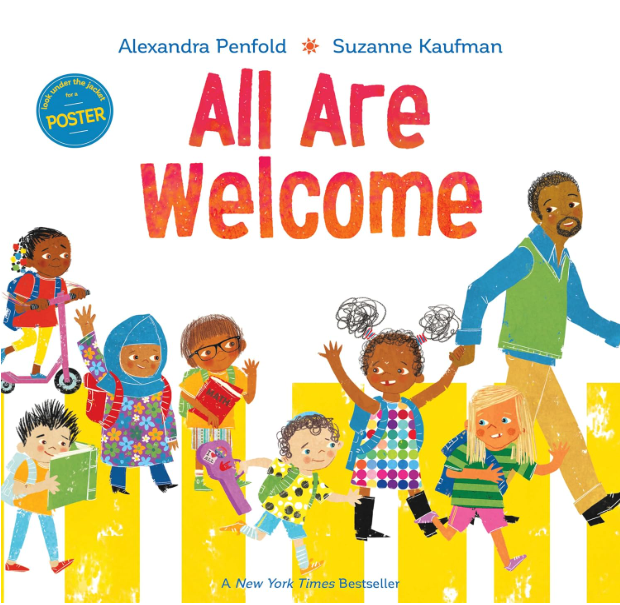
A banner with the book cover "All Are Welcome," the words "Creativity Task Cards," and a large number 3 on a colorful teal and yellow background.

Art Form: Theatre


Supplies Needed

-All Are Welcome book
-Paper and pencil

Vocabulary

Character - a person in a story or play, or
an animal or object that has human qualities

Monologue - a long speech by a single character

First-Person - a narrative ‘voice’ in which
the person or character telling the story is talking about their own experience

Dialogue - a conversation between two or more persons

Instructions

1. Choose one of the students that you see on the cover or the first page of the story. You can choose one that you identify with, or one that is different from you. Imagine a name for that character.

2. Read the story. As you read through the book track your character. Most of the students appear on most of the pages.

3. Make notes about at least five activities, emotions, or situations that your character is shown doing, expressing, or being involved in (for example, “sharing a pretzel with a friend” or “swinging on a swing”).

4. Write a short monologue for your character about their day. Use first-person writing – don’t write about the character, but write as the character. For example, the character could say, “I was so excited to show everyone what we learned about bugs!”. Describe what the character has done and also how they feel about it.

5. Practice and then perform your monologue for a friend or family member. You could perform without telling them which character you chose, and then see if they can find the character in the book based on your monologue.

Extensions

Choose one of the activities from your monologue where your character is talking to another child or adult. Write a short dialogue of what they might say each other.

Talk with a family member or friend about what makes you feel welcome in your school or community. How could you help others feel welcome?
About

The REimagining and Accelerating Literacy through Arts Integration (REALAI) grant supports the literacy achievement of 3,200 students and 170 teachers, media specialists, and literacy coaches across six schools in Georgia and South Carolina.

In addition to professional learning for educators, this project contributes significantly to school library collections through the purchase of developmentally appropriate and culturally relevant books.

This grant also includes parent events to provide families with access to books and other content about how to support their child’s reading development.

All Are Welcome 3 (Visual Arts)

A banner with the book cover "All Are Welcome," the words "Creativity Task Cards," and a large number 3 on a colorful teal and yellow background.

Art Form: Visual Arts


Supplies Needed

-All Are Welcome book
-Paper (any kind)
-Scissors
-Glue or Tape
-Old magazines, newspapers, or colored paper (optional)
-Crayons, colored pencils, or markers

Vocabulary

Collage - a composition developed by gluing colored paper, photographs, magazine pictures, fabric, and other two-dimensional materials onto a flat surface

Community - a group of people who live, work, or play together

Welcome - to show kindness and openness to
others

Symbol - a picture or object that stands for
something else (like a heart for love)

Character - a person in a story or play, or an animal or object that has human qualities

Central Message - the big idea or lesson of the story

Instructions

1. Read All Are Welcome. Discuss the central message of the story. Who are the characters in the story? Are they similar to the people in your community? How?

2. Think about how you or your community shows welcome and kindness. Cut-out pictures from magazines to make a collage showing people being kind and welcoming to others. Glue them down to make the collage. Add other paper or fabrics to your artwork. Think about how you can be kind and welcoming to others in your community.

3. Add symbols like hearts, open doors, or smiling faces to your collage. Add colors with markers, crayons, or colored pencils. Fill the entire space on your paper.

4. Write an artist statement describing your collage. Why did you select the pictures in your collage? How does it demonstrate being kind and welcoming?

Extensions

Write a short poem about feeling welcome.

Interview a family member about what makes them feel part of a group.

About

The REimagining and Accelerating Literacy through Arts Integration (REALAI) grant supports the literacy achievement of 3,200 students and 170 teachers, media specialists, and literacy coaches across six schools in Georgia and South Carolina.

In addition to professional learning for educators, this project contributes significantly to school library collections through the purchase of developmentally appropriate and culturally relevant books.

This grant also includes parent events to provide families with access to books and other content about how to support their child’s reading development.

Thank You, Omu 2 (Music)

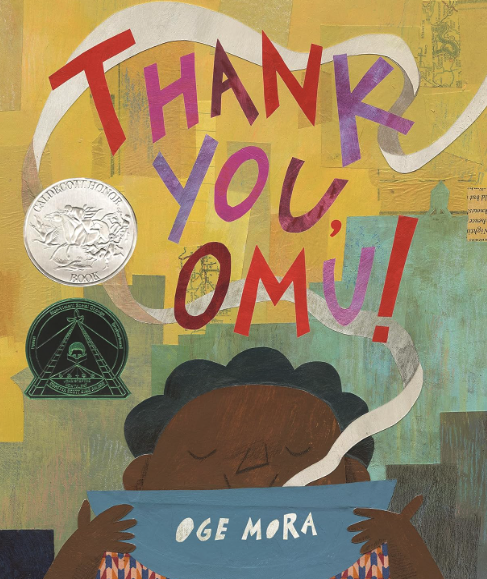
A colorful banner featuring the book "Thank You Omu!" on the left, "Creativity Task Cards" in a green circle at the center, and a large number "2" on a yellow circle to the right—perfect for inspiring Visual Arts activities.

Art Form: Music


Supplies Needed

-Thank You, Omu book

Vocabulary

Dynamics - loud and soft sounds; volume

Steady Beat - the consistent pulse or “heartbeat”
of music

Tempo - the speed of the beat

Character - a person in a story or play, or an
animal or object that has human qualities
movements are added one at a time and repeated in sequence (Ex: A, A+B, A+B+C…)

Setting - where the story takes place

Main Idea or Central Message - the main
message of the story

Punctuation - the marks at the end of a sentence
to clarify meaning

Instructions

1. Read the book. Talk about the main idea or central message of the story. Whoare the characters? How do people thank Omu?

2. Find words written in a larger font. Notice that many of these words are repeated throughout the story.

3. Practice reading what Omu says to each new character (“Little boy,” “Ms. Police Officer,” etc.). Notice the punctuation!

4. How would each character’s voice sound (high, low, medium, high to low, low to high, fast, slow, etc.)? Use the character’s special voice to read the response each character gives Omu (“ooooo, stew!”). Notice the punctuation!

5. Find “knock” each time it appears. How could you make a knocking sound? Notice that the number of knocks changes during the story. Will the knocking have a steady beat? Will it be at a fast, medium, or slow tempo?

6. Read the book, using different voices, dynamics, and sounds for the special words (greeting for each character, each character’s response to learning Omu has stew to share, and knocking).

Extensions

Find other parts of the story where sounds could make the book more interesting. For example, what would it sound like when Omu is stirring stew or when she puts down her spoon? What would it sound like when she spoons out the stew? Read the book, adding these special sounds.

About

The REimagining and Accelerating Literacy through Arts Integration (REALAI) grant supports the literacy achievement of 3,200 students and 170 teachers, media specialists, and literacy coaches across six schools in Georgia and South Carolina.

In addition to professional learning for educators, this project contributes significantly to school library collections through the purchase of developmentally appropriate and culturally relevant books.

This grant also includes parent events to provide families with access to books and other content about how to support their child’s reading development.

Thank You, Omu 2 (Dance)

A colorful banner featuring the book "Thank You Omu!" on the left, "Creativity Task Cards" in a green circle at the center, and a large number "2" on a yellow circle to the right—perfect for inspiring Visual Arts activities.

Art Form: Dance


Supplies Needed

-Thank You, Omu book
-Index cards or small slips of
paper and a pencil

Vocabulary

Movement - how you use your body to do a dance or action

Sequence - the order of events in a story or dance

Movement Sequence - a series of movements
performed in a specific order

Accumulation - a choreographic structure where
movements are added one at a time and repeated in sequence (Ex: A, A+B, A+B+C…)

Gesture - an expressive movement of the body or limbs

Characters - a person in a story or play, or an
animal or object that has human qualities

Instructions

1. Read Thank You, Omu. As you read, notice how more and more people come to Omu’s door. Today, you’ll be creating a movement sequence that uses accumulation. Bonus: What else is building up or accumulating in this story
besides people? What does the accumulation help to show us?

2. Read the book a second time. While reading, create a movement to represent each character in the order that they appear at Omu’s door.

3. Start with one gesture or movement for the first person. Then, each time a new character appears, add a new movement to your sequence using accumulation. (Ex. When the first character appears, perform one movement. When the second appears, perform the first movement and a new second movement.)

4. Repeat your sequence each time, adding one new movement to the end—just like the story builds.

5. Once you’ve reached the end of Thank you, Omu, perform your movement sequence with accumulation: A, AB, ABC, ABCD, and so on.

Extensions

Choose one movement to represent Omu’s kindness. Try repeating at the beginning and end of your accumulation sequence.

How does it feel to layer that one gesture into your movement sequence? How does it help to better tell the story of Thank you, Omu?

About

The REimagining and Accelerating Literacy through Arts Integration (REALAI) grant supports the literacy achievement of 3,200 students and 170 teachers, media specialists, and literacy coaches across six schools in Georgia and South Carolina.

In addition to professional learning for educators, this project contributes significantly to school library collections through the purchase of developmentally appropriate and culturally relevant books.

This grant also includes parent events to provide families with access to books and other content about how to support their child’s reading development.

Thank You, Omu 2 (Theatre)

A colorful banner featuring the book "Thank You Omu!" on the left, "Creativity Task Cards" in a green circle at the center, and a large number "2" on a yellow circle to the right—perfect for inspiring Visual Arts activities.

Art Form: Theatre


Supplies Needed

-Thank You, Omu book

Vocabulary

Character - a person in a story or play, or an
animal or object that has human qualities

Vocal Expression - the way an actor uses their
voice to portray a character or to convey feelings, often involving choices about pitch or volume

Pitch - how high or low/deep an actor’s voice is
to portray a character

Volume - how loud or soft/quiet an actor’s voice
is to portray a character

Posture - how an actor stands or positions their
body to portray a character

Instructions

1. Read the book, Thank You, Omu. Look at Omu and the three characters that first come to Omu’s door – the boy with the red car, the police officer, and the hot dog vendor.

2. With a family member or friend, decide who will be Omu and who will be the boy with the red car. Each actor should think about how to change their voice and what posture to adopt to become their character.

3. Reread the page where the boy comes to Omu’s door. Reread what they say to each other. The actor playing the boy can go to a doorway and knock. Then, act out the scene, using your vocal expression and posture choices to be the characters.

4. Repeat the process for the pages with the police officer and the hot dog vendor. You can switch roles so that each actor gets to play both Omu and a visitor.

5. Find simple costume pieces or props (a shawl for Omu, a toy car for the boy, a cap for the police officer, an apron for the hot dog vendor) to use to add to the scene.

Extensions

Choose three more characters from the page with all the other people that came and enact scenes when they came to Omu’s door. Try to make each character’s voice and posture different. Do they talk fast or slow? Do they have an accent or a particular way of talking?

Choose a character and think about how they know Omu. Act out when they met. What would they say to each other? What would they say to each other if they met somewhere else?

About

The REimagining and Accelerating Literacy through Arts Integration (REALAI) grant supports the literacy achievement of 3,200 students and 170 teachers, media specialists, and literacy coaches across six schools in Georgia and South Carolina.

In addition to professional learning for educators, this project contributes significantly to school library collections through the purchase of developmentally appropriate and culturally relevant books.

This grant also includes parent events to provide families with access to books and other content about how to support their child’s reading development.
