
Dance Graphs

DANCE GRAPHS

DANCE GRAPHS

Learning Description

Students will interpret data on graphs and use the information to explore dance composition, form, and order of choreography.


Learning Targets

GRADE BAND: K-1
CONTENT FOCUS: Dance & Math
LESSON DOWNLOADS:

Download PDF of this Lesson

"I Can" Statements

“I Can…”

  • I can group and interpret data.
  • I can recognize different types of graphs.
  • I can interpret data in a graph to create choreography.

Essential Questions

  • How can dance and movement be used to demonstrate understanding of graphs and data interpretation?


Georgia Standards

Curriculum Standards

Kindergarten:

MGSE2.MD.10 Draw a picture graph and a bar graph (with single-unit scale) to represent a data set with up to four categories. Solve simple put-together, take-apart, and compare problems using information presented in a bar graph.Grade 1:

MGSE3.MD.3 Draw a scaled picture graph and a scaled bar graph to represent a data set with several categories. Solve one- and two-step “how many more” and “how many less” problems using information presented in scaled bar graphs. For example, draw a bar graph in which each square in the bar graph might represent 5 pets.

Arts Standards

Kindergarten:

ESDK.CR.1 Demonstrate an understanding of the choreographic process.

ESDK.CR.2 Demonstrate an understanding of dance as a form of communication

ESDK.PR.1 Identify and demonstrate movement elements, skills, and terminology in dance.

ESDK.RE.1 Demonstrate critical and creative thinking in dance

ESDK.CN.3 Identify connections between dance and other areas of knowledge

Grade 1:

ESD1.CR.1 Demonstrate an understanding of the choreographic process.

ESD1.CR.2 Demonstrate an understanding of dance as a form of communication

ESD1.PR.1 Identify and demonstrate movement elements, skills, and terminology in dance.

ESD2.CN.3 Identify connections between dance and other areas of knowledge.


South Carolina Standards

Curriculum Standards

Kindergarten:

K.MDA.3 Sort and classify data into 2 or 3 categories with data not to exceed 20 items in each category.

K.MDA.4 Represent data using object and picture graphs and draw conclusions from the graphs.

Grade 1:

1.MDA.4 Collect, organize, and represent data with up to three categories using object graphs, picture graphs, t-charts and tallies.

1.MDA.5 Draw conclusions from given object graphs, picture graphs, t-charts, tallies, and bar graphs.

Arts Standards

Anchor Standard 1: I can use movement exploration to discover and create artistic ideas and works.

Anchor Standard 2: I can choreograph a dance.

Anchor Standard 3: I can perform movements using the dance elements.

Anchor Standard 5: I can describe, analyze, and evaluate a dance.


Key Vocabulary

Content Vocabulary

Graph - A diagram that shows the relationship between two or more things.

Data - A collection of individual facts or statistics.

Analyze - Examine a subject methodically and in detail, typically in order to explain and interpret it.

Arts Vocabulary

Choreography - The art of composing dances and planning and arranging the movements, steps, and patterns of dancers.

Choreographer - A person who creates dances.

Level - The vertical distance from the floor that a dancer occupies during a movement

Plane - An imaginary flat surface running through the body.


Materials

  • Music source and speakers
  • Graphs/Data, printed or projected


Instructional Design

Opening/Activating Strategy

Teacher tallies the number of students born each month. Students group birthdays into seasons.

As a group, lead students in a warm up that includes these dance elements:

  • Levels, body shapes, plane
  • Locomotor and non-locomotor movements
  • Identify these dance elements so that students learn dance vocabulary.


Work Session

Movement Discovery
Look at a variety of types of graphs and discuss:

  • The basic, overall shapes of each graph, i.e., a bar graph may be described as rectangular while a pie chart may be called a circle
  • Looking inside the graphs, how different shapes and symbols express data in each example, i.e., a pie chart contains angles while a picture graph may contain hearts and stars.

Collaboration:

  • Divide the class into small groups and assign either a picture or a bar graph to each group, using various examples of graphs.
  • Students describe the graph form (overall form and form of value symbols) using the dance vocabulary and concepts from warm-up
  • Students assign dance movements to the visual expression of the form of the graph, i.e., bars on a bar graph may be jumps; stars on a picture graph may be spins.

Choreographic Process:

  • Students analyze the data that the teacher gathered at the beginning of class: How many students have birthdays in each season?
  • Students draw the data in their assigned graph.
  • Create a graph dance by sequencing the movements from the previous step so that they reflect the data, i.e., a bar graph with data of 5 and 2 may include a person standing on their toes and extending their arms overhead 5 times and another person repeating the movement 2 times.
  • Students decide how to order the data, such as least to most or progression of seasons in the calendar year.
  • Students decide how to demonstrate the type of graph, as well as data.

Performance and discussion:

  • Perform each group dance.
  • The audience identifies which type of graph the peer group is presenting.
  • The teacher asks questions about the data represented in each graph dance (How many? How many more? How many fewer? Which season had more birthdays? the most? fewer? the least?).


Closing Reflection

The audience explains how movement observed represents the form of the graph, as well as the data.

Groups explain why they chose certain movements to express the data and form of their graph.


Assessments

Formative

  • Students engage in a collaborative discussion about movement choices, graph form, and data.
  • Students correctly use dance vocabulary during the discussion.


Summative

  • Students correctly interpret their assigned data.
  • Students present choreography that accurately portrays their assigned data.
  • Students/audience will accurately identify and interpret the data expressed in peer choreography.


Differentiation

Acceleration: Show dance photos that contain multiple dancers; count the dancers and then express the data in scaled picture or bar graphs. Suggested photos in Additional Resources, below.

Remediation: Analyze data and draw it in different types of graphs as a whole class and then divide into small groups to create choreographies.

Additional Resources

Classroom Tips:

Set up chairs and tables in a circular format to maximize students’ engagement and ability to see their peers during the activity and performance. Also establish parameters for acceptable movement choices and discuss audience behavior/etiquette with students.

Suggested dance photos for first grade acceleration:

Two dancers:
https://commons.wikimedia.org/wiki/File:MX_MM_BALLET_FOLKL%C3%93RICO_DE_M%C3%89XICO_-_40289925045.jpg

Four dancers
https://commons.wikimedia.org/wiki/File:Ballet_Flamenco_de_Andaluc%C3%ADa19_(48628989227).jpg

Six dancers
https://commons.wikimedia.org/wiki/File:Opening_Performance_and_Address_(52146422509).jpg

Eight dancers
https://commons.wikimedia.org/wiki/File:Dance_Ensemble_Sofia_6_Women.jpg

Ten dancers
https://commons.wikimedia.org/wiki/File:NIGERIA_Group_Dance1.jpg

Remediation: Analyze data and draw it in different types of graphs as a whole class and then divide into small groups to create choreographies.

*This integrated lesson provides differentiated ideas and activities for educators that are aligned to a sampling of standards. Standards referenced at the time of publishing may differ based on each state’s adoption of new standards.

Ideas contributed and updated by: Julie Galle Baggenstoss and Melissa Dittmar-Joy

Revised and copyright: August 2022 @ ArtsNOW

Explore Geometry with Abstract Imagery K-1

EXPLORE GEOMETRY WITH ABSTRACT IMAGERY

EXPLORE GEOMETRY WITH ABSTRACT IMAGERY

Learning Description

Delve into the abstract world of Wassily Kandinsky! Allow your imagination to soar as you discover mathematical connections within Kandinsky images that explore the relationships between geometric shapes and polygons.


Learning Targets

GRADE BAND: K-1
CONTENT FOCUS: VISUAL ARTS & MATH
LESSON DOWNLOADS:

Download PDF of this Lesson

"I Can" Statements

“I Can…”

  • I can use geometry to create original artwork inspired by Wassily Kandinsky.

Essential Questions

  • How can you utilize visual images to learn about shapes?


Georgia Standards

Curriculum Standards

Kindergarten: 

K.GSR.8 Identify, describe, and compare basic shapes encountered in the environment, and form two-dimensional shapes and three-dimensional figures.

Grade 1: 

1.GSR.4 Compose shapes, analyze the attributes of shapes, and relate their parts to the whole.

1.GSR.4.1 Identify common two dimensional shapes and three dimensional figures, sort and classify them by their attributes and build and draw shapes that possess defining attributes.

1.GSR.4.2 Compose two-dimensional shapes (rectangles, squares, triangles, half-circles, and quarter-circles) and three dimensional figures (cubes, rectangular prisms, cones, and cylinders) to create a shape formed of two or more common shapes and compose new shapes from the composite shape.

Arts Standards

Kindergarten: 

VAK.CR.1 Engage in the creative process to generate and visualize ideas by using subject matter and symbols to communicate meaning

VAK.CR.2 Create works of art based on selected themes.

VAK.CR.3 Understand and apply media, techniques, and processes of two-dimensional art.

VAK.RE.1 Discuss personal works of art and the artwork of others to enhance visual literacy. 

VAK.CN.2 Integrate information from other disciplines to enhance the understanding and production of works of art. 

VAK.CN.3 Develop life skills through the study and production of art (e.g. collaboration, creativity, critical thinking, communication).

Grade 1: 

VA1.CR.1 Engage in the creative process to generate and visualize ideas by using subject matter and symbols to communicate meaning

VA1.CR.2 Create works of art based on selected themes.

VA1.CR.3 Understand and apply media, techniques, and processes of two-dimensional art.

VA1.RE.1 Discuss personal works of art and the artwork of others to enhance visual literacy. 

VA1.CN.2 Integrate information from other disciplines to enhance the understanding and production of works of art. 

VA1.CN.3 Develop life skills through the study and production of art (e.g. collaboration, creativity, critical thinking, communication).


South Carolina Standards

Curriculum Standards

Kindergarten:

K.G.4 Analyze and compare two- and three-dimensional shapes of different sizes and orientations using informal language. 

K.G.5 Draw two-dimensional shapes (i.e., square, rectangle, triangle, hexagon, and circle)

Grade 1: 

1.G.4 Identify and name two-dimensional shapes (i.e., square, rectangle, triangle, hexagon, rhombus, trapezoid, and circle)

1.G.2 Combine two-dimensional shapes (i.e., square, rectangle, triangle, hexagon, rhombus, and trapezoid) or three-dimensional shapes (i.e., cube, rectangular prism, cone, and cylinder) in more than one way to form a composite shape.

Arts Standards

Anchor Standard 1: I can use the elements and principles of art to create artwork.

Anchor Standard 2: I can use different materials, techniques, and processes to make art.

Anchor Standard 4: I can organize work for presentation and documentation to reflect specific content, ideas, skills, and or media

Anchor Standard 5: I can interpret and evaluate the meaning of an artwork.


Key Vocabulary

Content Vocabulary

Geometry - Branch of mathematics that deals with deduction of the properties, measurement, and relationships of points, lines, angles, and figures in space from their defining conditions by means of certain assumed properties of space.

Polygon - A closed plane figure with at least three straight sides and angles, and typically five or more.

Arts Vocabulary

Abstract - Process of art-making that has reference to the real world but is distorted or manipulated in some way. 

Non-objective - Process of art-making that has no reference to the real world; strictly 

composed of design elements. 

Contrast - Exhibiting unlikeness in comparison to something else. 

Line – One of the seven elements of art; a mark made by a pointed tool such as a brush pen or stick; a moving point

Shape (Geometric and Organic) – One of the seven elements of art; a flat, enclosed area that has two dimensions, length and width


Materials

  • Kandinsky prints of your choice 
  • Tag board (9” x 12” sheets) or drawing paper
  • Pencils 
  • Pastels, colored pencils, and/or tempera paint 
  • Wassily Kandinsky images


Instructional Design

Opening/Activating Strategy

  • Introduce this activity by having students look at an image of “Color Study: Squares with Concentric Circles” by Russian artist, Wassily Kandinsky.
  • Have students draw or write down as many shapes as they see in the artwork.
  • Students should turn to a partner and compare answers.


Work Session

Process 

  • Project Kandinsky’s Composition VIII and Red, Blue and Yellow (linked above in materials). Direct students to use math vocabulary and concepts to describe the shapes and polygons found within these abstract and non-objective masterpieces. Students should draw these images on sticky notes.
  • Using the sticky notes, direct students to identify shapes within these images according to size, shape, and color and sort according to the number of sides and angles.
  • Students will then create Venn diagrams that compare and contrast the two different Kandinsky prints. 
  • Next, direct students to generate their own abstract or non-objective design in the style of Kandinsky according to criteria set by the teacher. (For example, criteria might include designs housing a minimum of 10 circles that overlap, 5 straight lines, number of corners and sides, etc.) 
  • Students will then draw their shapes lightly on a tag board in pencil and embellish with bright contrasting colors using colored pencils, pastels, or tempera paint. 

Upon completion of these designs, ask students to identify shapes according to the number of sides, faces, and vertices within their compositions.  


Closing Reflection

Display students’ artwork on walls or place on tables/desks. Give students a “scavenger hunt” to find objects in each other’s artwork. Objects could include different types of shapes, lines, and angles.


Assessments

Formative

  • Students will recognize and identify two-dimensional shapes and figures within a given art piece. 
  • Students will sort objects within an art piece according to size, shape, and color. 
  • Students will identify shapes according to the number of sides, faces, and vertices. 
  • Students will discover the way artists compose abstract imagery.


Summative

  • Students will create an artwork inspired by Wassily Kandinsky that demonstrates their mastery of mathematical concepts including geometry, line, and angle.
  • Students will be able to identify types of shapes, lines, and angles in each other’s artwork.


Differentiation

Acceleration: Instead of using basic geometric shapes, artwork requirements should include students dividing and combining shapes to create new shapes (i.e. - circle into semicircle; two triangles into rectangle, etc.).

Remediation: 

  • Provide students with specific objects to look for in Kandinsky’s artwork. Partner students will identify shapes, lines, and angles.
  • Reduce criteria in artwork to focus on fewer shapes at a time.
  • Provide visuals with examples of each shape and its attributes for supporting students.

 ADDITIONAL RESOURCES

Wassily Kandinsky images

Types of shapes handout

*This integrated lesson provides differentiated ideas and activities for educators that are aligned to a sampling of standards. Standards referenced at the time of publishing may differ based on each state’s adoption of new standards.

 Ideas contributed by: Darby Jones and updated by Shannon Green and Katy Betts.

 Revised and copyright:  August 2022 @ ArtsNOW
Explore Time with Theater K-1

EXPLORE TIME WITH THEATRE

EXPLORE TIME WITH THEATRE

Learning Description

In this lesson, students will explore the concepts of time and sequence by acting out various activities performed at different times of the day. They will then become "Story Detectives," investigating the beginning, middle, and end of different nursery rhymes. By using theatre techniques, students will immerse themselves in the concept of sequence and time, experiencing a deeper level of learning.


Learning Targets

GRADE BAND: K-1
CONTENT FOCUS: THEATRE, MATH & ELA
LESSON DOWNLOADS:

Download PDF of this Lesson

"I Can" Statements

“I Can…”

  • I can correctly identify and sequence the activities of the day based on the time that they occur.
  • I can correctly identify and sequence the beginning, middle and end of simple stories.
  • I can use my voice and body to act out events and characters.

Essential Questions

  • How can theatre techniques be used to understand time and sequence?


Georgia Standards

Curriculum Standards

Kindergarten: 

Math

K.PAR.6: Explain, extend, and create repeating patterns with a repetition, not exceeding 4 and describe patterns involving the passage of time.

K.PAR.6.2 Describe patterns involving the passage of time using words and phrases related to actual events.


ELA

ELAGSEKRL3 With prompting and support, identify characters, settings, and major events in a story.

Arts Standards

Kindergarten:

TAK.CR.1 Organize, design, and refine theatrical works.


TAK.PR.1 Act by communicating and sustaining roles in formal and informal environments.


TAK.PR.2 Execute artistic and technical elements of theatre.


TAK.CN.1 Explore how theatre connects to life experience, careers, and other content.


South Carolina Standards

Curriculum Standards

Kindergarten: 

Math

K.MDA.3 Sort and classify data into 2 or 3 categories with data not to exceed 20 items in each category. K.MDA.4 Represent data using object and picture graphs and draw conclusions from the graphs.


ELA

READING - Literary Text

Meaning and Context

Standard 7: Analyze the relationship among ideas, themes, or topics in multiple media and formats, and in visual, auditory, and kinesthetic modalities.

7.1 With guidance and support, retell a familiar text; identify beginning, middle, and end in a text heard or read.

Arts Standards

Anchor Standard 3: I can act in improvised scenes and written scripts.

Anchor Standard 4: I can direct and organize work for a performance to reflect specific content, ideas, skills, and media.

Anchor Standard 8: I can relate theatre to other content areas, arts disciplines, and careers.


Key Vocabulary

Content Vocabulary

  • Morning - Early/first part of the day
  • Afternoon - Daytime, between midday and evening
  • Night - Dark time between bedtime and waking
  • Beginning - The start or first part
  • Middle - Halfway between the beginning and end, center part
  • End - Final part or stop
  • Story - An account or report that tells you what is happening to someone or something with a beginning, middle and an end

Arts Vocabulary

  • Theater - Dramatic literature or its performance; drama
  • Character - A person, an animal or other figure assuming human qualities, in a story
  • Voice – An actor’s tool, which we shape and change to portray the way a character speaks or sounds
  • Body – An actor’s tool, which we shape and change to portray the way a character looks, walks, or moves
  • Improvisation - A creation that is spoken or written without prior preparation


Materials


Instructional Design

Opening/Activating Strategy

Classroom Tips: This activity works best in an open space with room for students to move. Review audience etiquette and expectations before students perform for their classmates.


  • Start with a general physical warm-up to get the students' bodies ready. Use exercises such as:
    • Stretching: Stretch all major muscle groups.
    • Shaking Out Limbs: Shake out arms, legs, and the whole body to release tension.
    • Energy Passes: Stand in a circle and pass a clap or a simple motion around to build group focus and energy.
  • Explain that students will explore different characters using movement and sound Use simple prompts to get students thinking about different ways to move. Call out various types of characters and ask students to walk around the space embodying those characters. Examples include:
    • A bird searching for a worm to eat
    • A tree blowing in the wind
    • A hungry lion
    • A happy dog
  • Next, ask students to add sound to their characters. Allow time for students to move around the room as the characters, using their bodies and voices.
  • Have students return to the carpet; ask them to share what it was like to use their voices and bodies to become someone else.


Work Session

My Day Play

  • Ask students what comes to their minds when you say the following words: morning, afternoon and night.
  • Ask students what the beginning, middle and end of the day is called (morning, afternoon and night).
  • Display visuals with morning/afternoon/night written on them while discussing that particular time of day.
  • When finished, tape the visuals on the wall to designate that area for that time of day in the following exercise.
  • Ask students to tell you what activities are done at different times of the day.
    • Show visuals of some activities performed at different times of the day. [Note: Have visuals stacked in groups by the three times of the day.]
      • Morning (ex: brushing teeth, sun rising, rooster crowing, eating breakfast, getting on the school bus)
      • Afternoon (ex: eating lunch in the cafeteria at school, playing outside with friends, getting off the school bus at home)
      • Night (ex: eating dinner, putting on pajamas, going to bed, looking at the stars)
  • Say to students, “Now we are going to bring these activities to life using sound and movement. When I call out an activity, you will start acting like you are doing it. When I say freeze, you will stop all sound and movement. Ready. Set. Go!”.
    • Call out “eating breakfast” and let the students perform. Follow up with asking what time of day that activity happens.
    • Repeat the process calling out at least three different activities, one from each of the three times of day.
    • Ask three students to come to the front of the room. Have each student pick one activity from one of the times of day. All three times of the day should be represented.
    • Ask each student, one at a time, to show you his/her activity using sound and movement.
    • Now ask another student to come up and play the director. Ask the director to put the three students in order from beginning, middle and end of the day when the students bring their activity to life.
    • Continue until every student gets to perform or direct.


Story Detectives 

  • Tell the students, ”We just talked about our days having a beginning, middle and an end.”
  • Say, “What else in our lives has a beginning, middle and end?”.
    • Trains (front car, middle cars and caboose)
    • Games (we set them up, play them and then put them away)
    • School (arrive/bell rings, class/lunch/recess, bell rings/go home)
  • Ask the class, “Do stories that we read and tell have a beginning, middle and end?”.
  • Ask the class, “What is a story?” A story usually tells about what happens to someone or something with a beginning, middle and an end.
  • Place the three cards (beginning, middle and end) on the wall.
  • Say, “We can always figure out what happens at the beginning, in the middle and at the end of a story. Are nursery rhymes stories?”.
  • Read “Humpty Dumpty” aloud while holding up a visual: Humpty Dumpty sat on a wall. Humpty dumpty had a great fall. All the king’s horses and all the king’s men couldn’t put Humpty together again.
    • Read Humpty Dumpty one more time and tell the students to become Humpty by using their bodies and arms.
  • Tell students, “I need some help today. Do you think you could be detectives? What does a detective do? He/she investigates something. I need to find the beginning, middle and end of some nursery rhymes that you might know. We are going to be Beginning, Middle and End Detectives.”
  • Have the students pretend to take out their magnifying glasses and put on their detective hats.
  • Read “Humpty Dumpty” aloud again while holding up the visual of the story.
    • Ask, “What happened at the beginning of the story? Humpty sat on a wall.”
    • “What happened in the middle of the story? Humpty fell off the wall.”
    • “What happened at the end of the story? Humpty was broken and could be fixed by his horsemen.”
  • Repeat this process with “Itsy Bitsy Spider” and “Jack and Jill”.
    • Read “Itsy Bitsy Spider” aloud while holding up the visual and follow-up with questions. The Itsy Bitsy Spider went up the waterspout. Down came the rain and washed the spider out. Out came the sun and dried up all the rain, And the Itsy Bitsy Spider went up the spout again.
    • Read “Jack and Jill” aloud while holding up the visual and follow-up with questions. Jack and Jill went up the hill To fetch a pail of water. Jack fell down and broke his crown And Jill came tumbling after.
  • Ask three students to come to the front of the room. Have each student pick one activity from one of the three parts of the nursery rhyme. All three parts of the story should be represented.
  • Ask each student, one at a time, to show you their activity using sound and movement.
  • Now ask for another student to come up and play the director. Ask the director to put the three students in the order from beginning, middle and end of the nursery rhyme when the students performing the activities come to life.
  • Continue until every student gets to perform or direct.


Closing Reflection

  • Close the lesson with reflection questions. Ask students to connect the concept of beginning, middle and end to the different parts of the day–morning, afternoon and night. Ask students how our days are like stories.
  • Pass out paper with three sections–morning/beginning, afternoon/middle and night/end. Have students draw and label a picture showing one activity that occurs at each time of day. Have students write a “story” at the bottom of the paper saying what happens at the beginning of the day, what happens at the middle, and what happens at the end of the day.


Assessments

Formative

Teachers will assess students’ understanding of the content throughout the lesson by observing students’ participation in the activator, discussion of time of day and parts of a story, participation and contributions in My Day Play and Story Detectives, and conferencing during the writing process.


Summative

CHECKLIST

  • Students can correctly identify and sequence the activities of the day based on the time that they occur.
  • Students can correctly identify and sequence the beginning, middle and end of simple stories.
  • Students can use their voices and bodies to act out events and characters.


DIFFERENTIATION 

Acceleration: Provide students with a story that is out of order. Students will determine the appropriate order and rearrange the story to make logical sense. The student will pick one activity from each section of the story (beginning, middle, and end) to represent and perform through movement.

Remediation: Begin with one nursery rhyme. Provide a sound and movement and encourage students to match it with the correct beginning, middle or end illustration of the nursery rhyme. Discuss student choices. Repeat with each section of the rhyme. Assess students by determining if they can accurately identify the beginning, middle and end of a nursery rhyme by providing the correct movement as the section is read.

ESOL Modifications and Adaptations: Introduce vocabulary and discuss what activities happen for each of the following words: morning, afternoon, night, beginning, middle and end. Have picture cards of different activities that happen during different times of the day. Students can perform the activity as the cards/pictures are shown. For the nursery rhymes, make should they have cards/pictures that illustrate the nursery rhyme for students to put in sequence order.

WIDA English Language Proficiency Standards 

Standard 1: English language learners communicate for Social and Instructional purposes within the school setting.

Standard 3: English language learners communicate information, ideas, and concepts necessary for academic success in the content area of Mathematics.

Standard 4: English language learners communicate information, ideas, and concepts necessary for academic success in the content area of Science.

*This integrated lesson provides differentiated ideas and activities for educators that are aligned to a sampling of standards. Standards referenced at the time of publishing may differ based on each state’s adoption of new standards.

Ideas contributed by: Susie Spear Purcell Modifications, Extensions, and Adaptations Contributed by: Peggy Barnes, Candy Bennett, Lindsey Elrod, Jennifer ​​Plummer, and Vilma Thomas. Updated by: Katy Betts.

Revised and copyright: July 2024 @ ArtsNOW


Exploring Plane Figures Through Music Composition 2-3

EXPLORING PLANE FIGURES THROUGH MUSIC COMPOSITION

EXPLORING PLANE FIGURES THROUGH MUSIC COMPOSITION

Learning Description

In this lesson, students will compose speeches to demonstrate their understanding of plane figures and perform them using body percussion in rondo form as whole-class composition.


Learning Targets

GRADE BAND: 2-3
CONTENT FOCUS: MUSIC & MATH
LESSON DOWNLOADS:

Download PDF of this Lesson

"I Can" Statements

“I Can…”

  • I can create and accurately perform an original speech composition about a plane figure and perform it in rondo form.
  • I can create and accurately perform a body percussion ostinato.

Essential Questions

  • How can music composition help us understand mathematical concepts?
  • What is rondo form in music?


Georgia Standards

Curriculum Standards

Grade 2:

Math

2.GSR.7: Draw and partition shapes and other objects with specific attributes and conduct observations of everyday items and structures to identify how shapes exist in the world.

2.GSR.7.1 Describe, compare and sort 2-D shapes including polygons, triangles, quadrilaterals, pentagons, hexagons, and 3-D shapes including rectangular prisms and cones, given a set of attributes.


ELA

ELAGSE2W2 Write informative/explanatory texts in which they introduce a topic, use facts and definitions to develop points, and provide a concluding statement or section.


Grade 3:

Math

3.GSR.6: Identify the attributes of polygons, including parallel segments, perpendicular segments, right angles, and symmetry.

3.GSR.6.1 Identify perpendicular line segments, parallel line segments, and right angles, identify these in polygons, and solve problems involving parallel line segments, perpendicular line segments, and right angles.


ELA

ELAGSE3W2 Write informative/explanatory texts to examine a topic and convey ideas and information clearly. 

  1. Introduce a topic and group related information together; include illustrations when useful to aiding comprehension. 
  2. Develop the topic with facts, definitions, and details. 
  3. Use linking words and phrases (e.g., also, another, and, more, but) to connect ideas within categories of information. 
  4. Provide a concluding statement or section.

Arts Standards

Grade 2:

ESGM2.PR.1b. Echo simple singing and speech patterns.

ESGM2.PR.2b. Perform steady beat and simple rhythmic patterns with appropriate technique using body percussion and classroom instruments.

ESGM2.RE.1 Listen to, analyze, and describe music.


Grade 3:

ESGM3.PR.1b. Echo simple singing and speech patterns and perform call and response songs.

ESGM3.PR.2b. Perform steady beat and simple rhythmic patterns with appropriate technique using body percussion and classroom instruments.

ESGM3.RE.1 Listen to, analyze, and describe music.


South Carolina Standards

Curriculum Standards

Grade 2:

Math

2.G.1 Identify triangles, quadrilaterals, hexagons, and cubes. Recognize and draw shapes having specified attributes, such as a given number of angles or a given number of equal faces.


ELA

WRITING - Meaning, Context, and Craft

Standard 2: Write informative/explanatory texts to examine and convey complex ideas and information clearly and accurately through the effective selection, organization, and analysis of content.

2.1 Explore print and multimedia sources to write informative/explanatory texts that introduce a topic, use facts and definitions to develop points, and provide a concluding statement or section.


Grade 3:

Math

3.G.1 Understand that shapes in different categories (e.g., rhombus, rectangle, square, and other 4-sided shapes) may share attributes (e.g., 4-sided figures) and the shared attributes can define a larger category (e.g., quadrilateral). Recognize rhombuses, rectangles, and squares as examples of quadrilaterals, and draw examples of quadrilaterals that do not belong to any of these subcategories.


ELA

WRITING - Meaning, Context, and Craft

Standard 2: Write informative/explanatory texts to examine and convey complex ideas and information clearly and accurately through the effective selection, organization, and analysis of content.

2.1 Write informative/explanatory texts that: 

  1. introduce a topic clearly; 
  2. use relevant information from multiple print and multimedia sources; 
  3. provide a general observation and focus; 
  4. group related information logically; 
  5. develop the topic with facts, definitions, concrete details, quotations, or other information and examples related to the topic; k. use precise language and domain-specific vocabulary to inform or explain the topic

Arts Standards

Anchor Standard 1: I can arrange and compose music.

Anchor Standard 3: I can sing alone and with others.

Anchor Standard 6: I can analyze music.


Key Vocabulary

Content Vocabulary

  • Plane figure - A flat, closed figure that is in a plane; may be composed of straight lines, curved lines, or both 
  • Vertices - A vertex (plural: vertices) is a point where two or more lines, edges, or rays meet
  • Polygon - A geometric shape that has more than two sides


Arts Vocabulary

  • Rondo - A form of composition in which the first section recurs throughout the piece, alternating with different sections (e.g., A-B-A-C-A, etc.); found especially in compositions of the Baroque and Classical eras
  • Ostinato - A repeated pattern (plural: ostinati)
  • Body Percussion - Sounds produced by striking or scraping parts of the body; typically includes snapping, clapping, patting, and stamping
  • Phrase - Musical sentence or unit, commonly a  passage of four or eight measures; a dependent division of music, much like a single line of poetry in that it does not have a sense of completion in itself


Materials

  • Plane figure cards (individual cards with one figure on each) 
  • Large paper and markers 
  • Visual of four 8-beat phrases
  • Visual of text for section A of the rondo to be displayed after chant is learned
  • Sound source (iPod, iPhone, computer, speakers, etc.) 
  • Recording of musical composition in rondo form (or create your own using found sounds or body percussion)


Instructional Design

Opening/Activating Strategy

  • Perform two sounds, some of which are the same (e.g., clap-clap) and some of which are different (e.g., tap-clap). 
  • Have students identify what they hear as the same or different. 
    • Explain that students will be focusing on hearing parts that are the same and parts that are different.
  • Play a musical composition in rondo form, challenging students to listen for repeated sections. 
    • To help students hear the same and different sections, you may want to have them keep the beat one place for the A sections, a different place for the B section, and a different place for the C section (e.g., A = pat legs, B = clap, C = tap shoulders).
  • Identify the form heard in composition as rondo form. Use letters to help students understand the same and different sections (e.g., A B A C A). Explain that students will now become composers of their own piece to illustrate rondo form.


Work Session

  • Have students establish a simple 2- or 4-beat body percussion ostinato (e.g., pat-clap or pat-clap-clap-clap). 
  • While students perform the body percussion ostinato, teach the following chant by rote (teacher speaks, students echo). You may also want to have a visual displayed to aid reading. 


Plane figures are around us everyday. 

Just count the sides and angles to see what’s on display. 

Vertices and angle size, they’re important too, 

So let’s gather ‘round and see what you can do! 


  • To facilitate student success in learning the chant aurally, begin by speaking the entire chant, then speak the first phrase (first 8 beats) and have students echo. 
  • Continue speaking each phrase and having students echo. 
  • Then combine two phrases (16 beats) and have students echo. 
  • Once students are comfortable with 8- and 16-beat phrases, speak the entire chant. 
    • This becomes the A section of the class composition. 

*Teacher note: If maintaining the body percussion ostinato while saying the chant is too difficult, have one group perform the ostinato while the other group speaks.

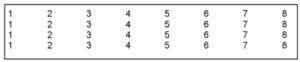
  • Analyze the structure of the chant (32 beats long with the last word on the last beat 7). A visual such as follows may be helpful in guiding students’ analysis. 

  • To help students understand the chant’s length and structure, point to each number while speaking the chant. 
  • Analyze the rhyme scheme of the chant, marking on the visual of the chant to          facilitate understanding. 
    • Teachers may want to use one color marker for “everyday” and “display” and a different color marker for “too” and “do.”
  • Divide students into small groups. Give each group a card with a plane figure on it. 
    • Have students create a chant about their plane figure (rectangle, triangle, square, trapezoid, quadrilateral, hexagon, etc.). 
      • Their chant should be the same length and use the same rhyme scheme as the A section (e.g., 4 phrases of 8 beats each; rhyming words at the end of phrases 1 and 2; different rhyming words at the end of phrases 3 and 4).
      • Have ample space in the room so student groups can move far enough apart during the creating process to enable careful listening and minimize distraction from other groups. 
      • Have students write their chants (text only) on large paper. Writing their composition in 4 lines may facilitate understanding of the 4 phrases. 
    • Combine compositions with the original chant to create a rondo form. The original chant is the A section while the student creations become the alternating sections.


Closing Reflection

  • Have students find a “rondo” pattern in the classroom (e.g., poster - wall - poster - window - poster = A B A C A). 
  • Have students describe rondo form in their own words. 
  • Challenge students to find other examples of rondo form in music.


Assessments

Formative

Teachers will assess students’ learning by observing students’ engagement and participation while the class identifies the same and different sections of music, performs a body percussion ostinato to accompany speech, identifies the rhyme scheme of a chant, and creates sentences and say them over 8 beats.


Summative

CHECKLIST

  • Students can create and accurately perform an original speech composition about a plane figure using the prescribed form. 
  • Students can create and accurately perform a body percussion ostinato to accompany the speech composition.


Differentiation

Acceleration: 

  • Have students record their creations. 
  • Have students create additional sections about different plane figures.
  • Challenge students to create and notate simple melodies for their text. 
  • Have students listen to music in rondo form to discern the different sections. 
  • Have students transfer their spoken text to body percussion (e.g., clap the rhythm of the words rather than speaking the words).
  • Experiment with and discuss various textures in music. For example, have half the students maintain the ostinato while the other group performs their chant on body percussion; then have only the chant performed on body percussion. Discuss what happens to the texture as other parts are added or deleted.
  • To connect to dance, have students create movement compositions to share while they say their chant.

Remediation: 

    • Rather than creating a rondo, have students work together to create one section about a plane figure. The form then becomes A B A (with the A section being the chant initially presented and the B section being the newly created chant).
    • If writing a 32-beat chant is too challenging, use the first half of the chant as the A section, thereby making the chant 16 beats long. Alternating sections then will be 16 beats long (rather than 32 beats).  
    • If keeping the body percussion ostinato on two levels (pat-clap) is challenging, have students keep the beat on one level (e.g., pat legs).

ADDITIONAL RESOURCES

  • Websites such as rhymezone.com may be helpful in finding rhyming words.
  • Short pieces in rondo form include “Fossils” by Camille Saint-Saens (ABACA), “La Raspa” (ABACADA), “Für Elise” by Ludwig van Beethoven (ABACA), “Rondo alla Turca” by Wolfgang Amadeus Mozart, and “The Entertainer” by Scott Joplin (Introduction ABACA).
  • YouTube includes recordings of music that also show the rondo form.
  • Rondo Form video 


*This integrated lesson provides differentiated ideas and activities for educators that are aligned to a sampling of standards. Standards referenced at the time of publishing may differ based on each state’s adoption of new standards.

Ideas contributed by and updated by: Maribeth Yoder-White 

Revised and copyright:  June 2024 @ ArtsNOW

Fun with Fractions 2-3

FUN WITH FRACTIONS

FUN WITH FRACTIONS

Learning Description

In this lesson, students will use fractions to describe the sounds that they hear in music. Students will then use fractions to create their own music.


Learning Targets

GRADE BAND: 2-3
CONTENT FOCUS: MUSIC & MATH
LESSON DOWNLOADS:

Download PDF of this Lesson

"I Can" Statements

“I Can…”

  • I can create music to represent fractions.
  • I can identify and write fractions based on musical examples.

Essential Questions

  • How can musical composition help us understand fractions?


Georgia Standards

Curriculum Standards

Grade 3: 

3.NR.4: Represent fractions with denominators of 2, 3, 4, 6 and 8 in multiple ways within a framework using visual models.

Arts Standards

Grade 3: 

ESGM3.CR.2 Compose and arrange music within specified guidelines.


ESGM3.PR.2a. Perform steady beat and simple rhythmic patterns using body percussion and a variety of instruments with appropriate technique.


ESGM3.RE.1b. Describe music using appropriate vocabulary (e.g. upward/downward, forte/piano, presto/largo, long/short), appropriate mood (e.g. happy/sad), and timbre adjectives (e.g. dark/bright, heavy/light).


South Carolina Standards

Curriculum Standards

Grade 3:

3.NSF.1 Develop an understanding of fractions (i.e., denominators 2, 3, 4, 6, 8, 10) as numbers. 

  1. A fraction (called a unit fraction) is the quantity formed by one part when a whole is partitioned into equal parts; 
  2. A fraction is the quantity formed by parts of size

Arts Standards

Anchor Standard 1: I can arrange and compose music.

Anchor Standard 4: I can play instruments alone and with others.

Anchor Standard 6: I can analyze music.


Key Vocabulary

Content Vocabulary

  • Numerator -  The top number of a fraction
  • Denominator - The bottom number of a fraction

Arts Vocabulary

  • Found sound - Sounds created from unexpected sources; for example, using classroom objects (rulers, pencils, chairs, etc.) as musical instruments
  • Timbre - The quality of sound; the component of a tone that causes different instruments to sound different from each other, even when playing the same note; for example, instrumental timbre and vocal timbre
  • Body percussion - Sounds produced using the body (e.g., claps, snaps, pats, stamps)
  • Unpitched Instruments - Instruments that are tuned to specific pitches (e.g., drum, maracas, rhythm sticks, triangle, etc.)


Materials

  • Assortment of unpitched instruments (or found sound objects like an empty can or tapping two pencils together)  
  • Writing utensils  
  • Paper (or individual white boards) for students
  • Fraction cards


Instructional Design

Opening/Activating Strategy

  • Have students listen to various classroom instruments, body percussion, and/or found sounds and label them as same and different. 
    • For example, perform two claps and have students identify these as “same.” Tap a chair once and a water bottle once and have students identify as “different.”
  • Explain to students that timbre is the component of a tone that causes different instruments to sound different from each other, even when playing the same note; for example, instrumental timbre and vocal timbre.
    • Extend the opening to have students listen to various sounds performed on classroom instruments, body percussion, and/or found sound and describe the timbres, grouping instruments into families. 
    • Families could be woods, metals, and drums (or other “families,” such as if sounds were produced by tapping, scraping, or shaking as appropriate).


Work Session

  • Model the “sound detective” game. 
    • Have students draw a short horizontal line on their whiteboard or blank paper. 
    • Using a steady beat, play four of the same sounds on the same instrument. 
      • Have students write the number “4” on their whiteboard under the line. 
        • Identify this as the denominator indicating that there were four total sounds. 
      • Lead students to understanding that 4 identical sounds were heard; thus, to represent the sound fractionally, they would write a 4 on top of the line as well (that is, 4 of the 4 sounds were the same). 
        • Identify top number as numerator.
  • Follow this same process for additional 4-beat patterns, changing the number of “different” sounds and challenging students to represent these sounds fractionally. 
    • For example, if 3 of the 4 beats were played on a metal instrument, the sound could be represented as 3/4. 
  • Explore other ways of making sounds different from each other (e.g., loud and soft sounds—dynamics). 
  • Divide students into small groups. Distribute fraction cards to groups. 
    • Have students create a rhythm representing the fraction on their card and perform for peers. 
    • Have classmates identify what is heard. The denominator will need to be identified beforehand.


ELA Extension:

  • Use children’s poems to further explore fractions. 
    • Examples: 
      • “Mary Had a Little Lamb” has two lines that include rhyming words, so 2/4 lines (or 1/2) of the poem uses rhyming words. 
      • “Rain, Rain, Go Away” has four lines that use rhyming words, so 4/4 of the lines of the poem use rhyming words. 
    • To aid musical skill development, have students play the rhythm of the poem on their instruments.
    • Assign rhyming words to the same instrument so students make the connection between the sounds in the words and the sounds the instrument makes.
    • Suggested poems include:


Rain, Rain go away.                            Mary had a little lamb.

Come again another day.                     Its fleece was white as snow.

All the children want to play.             And everywhere that Mary went,

Rain, rain, go away.                           The lamb was sure to go.


Cock-a-doodle-doo,                           A wise old owl lived in the oak;

My dame has lost her shoe,               The more he saw the less he spoke.

My master’s lost his fiddling stick,   The less he spoke the more he heard.

        Sing cock-a-doodle-doo.           Why aren’t we all like that wise old bird?


Closing Reflection

  • Facilitate a class discussion reflecting on the process. 
  • Ask students how music helped them understand fractions.
  • Ask students if they can think of other things from the lesson that they could represent in terms of fractions. 
    • Examples could include three out of four students liked the sound of tapping on a can better than tapping two pencils together.


Assessments

Formative

Teachers will assess students’ learning by observing whether students can identify body percussion, found sound, and/or unpitched percussion instrument sounds as the same and different and whether students can count sounds and represent them with numbers.


Summative

CHECKLIST

  • Students can create music to accurately represent fractions.
  • Students can identify and write fractions based on musical examples.


Differentiation

Acceleration: 

  • Challenge students to use higher denominators (beats in the musical composition) and more than two types of instruments.
  • Students can create their own compositions and then represent them by writing the equation showing the addition of all fractions in their composition.
  • Have students write poetry using rhyme schemes illustrating fractions. 
  • Divide students into pairs. Have them create rhythms representing the two fractions they are holding. Have classmates identify the two fractions heard. 


Remediation:

  • Have students work with a partner to write numbers describing the sounds heard. 
  • Have students work with a partner to identify rhyming words.
  • Perform body percussion and other sounds in front of students so they can see and hear the same and different sounds and sound sources.

*This integrated lesson provides differentiated ideas and activities for educators that are aligned to a sampling of standards. Standards referenced at the time of publishing may differ based on each state’s adoption of new standards.

 Ideas contributed and updated by:  Maribeth Yoder-White

 Revised and copyright:  June 2024 @ ArtsNOW