PLACE VALUE: 2D MIXED MEDIA DRIP ARTWORK 3

2D MIXED MEDIA DRIP ARTWORK

PLACE VALUE: 2D MIXED MEDIA DRIP ARTWORK

Learning Description

Students will be able to read and write multi-digit whole numbers up to 10,000 using mixed media, patterns, line, and size to model different place value digits in a number. Students will demonstrate their understanding by creating a 2D line artwork with different media to represent the different place values with each media will represent a different place value.


Learning Targets

GRADE BAND: 3
CONTENT FOCUS: VISUAL ARTS & MATH
LESSON DOWNLOADS:

Download PDF of this Lesson

"I Can" Statements

“I Can…”

  • I can explain what place value is.
  • I can tell the place value of digits in numbers up to 10,000.
  • I can write numbers in expanded form, word form, and standard form.
  • I can represent place value up to 10,000 using mixed media and line weight.
  • I can use warm, cool, and neutral colors to create a mixed media art piece

Essential Questions

  • What is place value?
  • What is the standard and word form?
  • How can I represent place value in expanded form?
  • How can we compare numbers?
  • How can I represent place value using base ten blocks?
  • How can we use line weight to show different place values?


Georgia Standards

Curriculum Standards

3.NR.1.1 Read and write multi-digit whole numbers up to 10,000 to the thousands using base-ten numerals and expanded form.

3.NR.1.2 Use place value reasoning to compare multi-digit numbers up to 10,000, using >, =, and < symbols to record the results of comparisons.

Arts Standards

VA3.CR.2 Create works of art based on selected themes.

b. Create works of art emphasizing multiple elements of art and/or principles of design.

VA3.CR.3 Understand and apply media, techniques, processes, and concepts of two-dimensional art.

a. Develop drawings and paintings with a variety of media (e.g. pencil, crayon, pastel, tempera, watercolor).

VA3.CN.2 Integrate information from other disciplines to enhance the understanding and production of works of art.

a. Apply art skills and knowledge to improve understanding in other disciplines.


South Carolina Standards

Curriculum Standards

3.NSBT.5 Compare and order numbers through 999,999 and represent the comparison using the symbols >, =, or <.

Arts Standards

Anchor Standard 1: I can use the elements and principles of art to create artwork.

Anchor Standard 2: I can use different materials, techniques, and processes to make art.

Anchor Standard 7: I can relate visual arts ideas to other arts disciplines, content areas, and careers.


Key Vocabulary

Content Vocabulary

  • Place value - The value of each digit in a number based on its position
  • Ten-thousands - The fifth position represents the number of ten-thousands
  • Thousands - The fourth position represents the number of thousands
  • Hundreds - The third position represents the number of hundreds
  • Tens - The second position represents the number of tens
  • Ones - The rightmost position (1st place) represents the number of ones
  • Expanded form - A way of writing numbers to show the value of each digit according to its place value; it breaks down a number by expressing it as the sum of each digit multiplied by its place value
  • Standard form - The way of writing numbers using digits, without breaking them down by place value or expanding them
  • Numerical - Using digits to represent quantities, values, or amounts
  • Digits - Symbols used to represent numbers in a numeral system

Arts Vocabulary

  • Color
    • Warm - Red, pink, orange, and yellow
    • Cool - Blue, green, purple, teal
    • Neutral colors - Gray, brown, tan, black
  • Value - The lightness or darkness of a color
  • Pattern - The repeated use of elements like shapes, lines, colors, textures, or forms in a consistent and organized manner
  • Line - A path connecting two points
  • Line weight - How thick or thin a line is
  • Texture - How something feels or looks like it feels
  • Two-dimensional - Containing height and width
  • Three-dimensional - Containing height, width, and depth


Materials

  •  


Instructional Design

Opening/Activating Strategy

  • Teacher will show students an example of a paper chain link that represents a number with four values. Each place value will be represented with a different color of paper.
    • Example: 1,427
      • One link of green paper
      • Four links of yellow paper
      • Two links of blue paper
      • Seven links of red paper
    • Teacher will show students how to create a paper chain using tape and strips of colored paper.
    • Project a key for which place values are represented by which color.
    • Students will be put into small groups. Students will be given a number that they will represent with their chain links.
      • Each place value will be represented with its corresponding color.
    • Teacher will model how to write the expanded form and word form of a number. Students will then write the expanded form and word form of their number on a note card.
    • Chain links will then be displayed in the classroom.
      • During sharing time, groups will compare their chain sculptures with each other using visuals to understand greater than and less than based upon the value of digits represented.
    • Students will identify the place value of another group’s chain link and compare their paper chain links.
      • Students should notice the longest chain does not always represent the largest number!
      • The chain links will be hung in the classroom such as the picture below.

Colorful paper chains in yellow, purple, and pink hang from the ceiling like 2D mixed media. Attached beneath are numbered math cards showing addition problems 10 to 29 for place value practice. A chalkboard sign below reads,


Work Session

  • Next, lead students through the See, Think, Wonder artful thinking routine about Jen Stark’s artwork (images below).
    • First, students will identify what they see in the image. Emphasize that they should make objective observations about the image (i.e. physical features, colors, textures, etc.).
    • Next, ask students to identify what they think about the image. Emphasize that students should be creating inferences using visual evidence from the image.
    • Finally, ask students what they wonder about the image.
  • Facilitate a class-wide discussion around students’ observations, inferences, and questions.
  • Show students a color wheel and draw their attention to cool colors, warm colors, and neutral colors. Ask them to observe the kinds of colors that Jen Stark uses in her work. Does she only use one color scheme?

Two colorful abstract 2D mixed media artworks with wavy, zigzag patterns. The left features vibrant rainbow colors, while the right combines similar hues with bold black-and-white zigzags. Both create a swirling, dynamic effect.

A woman with braided blonde hair smiles in front of a vibrant, multicolored, drip artwork wall. She is wearing a floral top with bright red, purple, and green colors.

  • Teacher note: The purpose of introducing Jen Stark is for students to see how she creates two-dimensional pieces using pattern, line, and color. She uses warm, cool, and neutral colors with a drip pattern. Her work also catches the eye of students and serves as a great way to show how different line weights can represent different place values.
  • Tell students that they will use Jen Stark’s artwork as inspiration to create 2D mixed media artwork, using different thicknesses of lines and different media to represent place values.
  • Review place value with students. Ask students how thicker lines and thinner lines can be used to represent the place value of digits.
  • Teacher and students will work together to identify the value of a given number.
    • Draw three lines of different weight (thickness). Ask students which line would represent the hundreds place? Tens place? Ones place?
      • Students should make the connection that the line will get thicker as the place value gets larger.
    • Using markers, students will draw different thicknesses of lines in their STEAM journals in a wavy pattern to show how the lines in our 2D Mixed Media Drip Artwork will show the difference between each place value of a number.
      • For example, if the number is 463, students would draw four thick wavy lines, six medium wavy lines, and three thin wavy lines.
    • Then students will write the number in standard form, expanded form, and word form under their mini art piece.
  • Students will be provided with mixed media paper, colored pencils, thin markers, thick markers, different sized paint brushes, and paint.
  • Together the class will create a guide to what each media will represent when they get to the artmaking portion of the lesson.
    • For example: Colored pencils represent the ones place, thin markers represent tens place, thick markers represent hundreds place, paint using a thin paintbrush to represent the thousands place, and paint using a thick paintbrush to represent the ten thousands place.
  • Students will then be given a number and will plan their artwork in their STEAM journals. Students should draw out a prototype of what their artwork would look like labeling the line sections with colors and mediums.
  • Students will then begin by drawing the outline of their drip artwork in pencil on their paper. Students will need to fill in most of the space of the paper, remembering that the colored pencils represent the ones place, thin markers represent tens place, thick markers represent hundreds place, paint using a thin paintbrush to represent the thousands place, and paint using a thick paintbrush to represent the ten thousands place.
  • Students will be able to choose the color scheme for their artwork. Remind students of the different color schemes using a color wheel.
  • Provide students with a notecard to write their number in standard form, expanded form, and word form.

Closing Reflection

Students share their artwork and discuss their creation process. They will also discuss and reflect on the creation process, the place value significance of the task, their personal feelings, and what they learned from the task in their STEAM journals.


Assessments

Formative

  • Informal teacher observation and questioning throughout the lesson
  • Observations of students’ drawings and reflections in their STEAM journals
  • Students will create a key for their drip artwork in their STEAM journals to demonstrate their knowledge and understanding of place value as represented in their artwork through line weight.

Summative

A 2D mixed media drip artwork checklist with sections for name and comments. It lists three expectations: line weight for numbers within 10,000, writing numbers in standard and word form, and visual place value.


Differentiation

Accelerated: 

  • Students will incorporate technology to model any "number" and its "place values" by representing the value of digits using pixel art.
  • Students will cut the drip out of their paper. Then starting at the bottom, place the drips on a butcher paper, overlapping each other, and create a collaborative artwork.

Colorful, wavy, drip-like patterns in layered rainbow shades blend with black-and-white zigzag lines, creating a vibrant mixed media art piece with psychedelic flair.

Remedial:

Students will be given three digit numbers to create drip art.


Additional Resources


Credits

U.S. Department of Education- STEM + the Art of Integrated Learning

Ideas contributed by: SAIL Grant Teacher Leaders, Shannon Green, Katy Betts

*This integrated lesson provides differentiated ideas and activities for educators that are aligned to a sampling of standards. Standards referenced at the time of publishing may differ based on each state’s adoption of new standards.

Revised and copyright:  June 2025 @ ArtsNOW
 

PERCUSSIVE PLACE VALUE 3

PERCUSSIVE PLACE VALUE

PERCUSSIVE PLACE VALUE

Learning Description

Students will be able to read and write multi-digit whole numbers up to 10,000 using sound to model base-ten numerals and expanded form. Students will demonstrate their understanding by creating a sound for different numbers to represent the different place values of each. The larger the value, the louder the sound.


Learning Targets

GRADE BAND: 3
CONTENT FOCUS: MUSIC & MATH
LESSON DOWNLOADS:

Download PDF of this Lesson

"I Can" Statements

“I Can…”

  • I can explain what place value is.
  • I can determine the value of digits based on their place.
  • I can represent place value in multiple ways (concrete and abstract).
  • I can represent values of digits using musical concepts.

Essential Questions

  • What is place value?
  • How can we compare numbers?
  • How can I use musical concepts to represent place value?


Georgia Standards

Curriculum Standards

Grade 3: 

3.NR.1.1 Read and write multi-digit whole numbers up to 10,000 to the thousands using base-ten numerals and expanded form.

3.NR.1.2 Use place value reasoning to compare multi-digit numbers up to 10,000, using >, =, and < symbols to record the results of comparisons.

Arts Standards

Grade 3: 

ESGM3.CR.2 Compose and arrange music within specified guidelines.

ESGM3.PR.2 Perform a varied repertoire of music on instruments, alone and with others.

  1. Perform rhythmic patterns with body percussion and a variety of instruments using appropriate technique.
  2. Arrange rhythmic patterns to create simple forms and instrumentation.

ESGM3.RE.1 Listen to, analyze, and describe music.

ESGM3.CN.1 Connect music to the other fine arts and disciplines outside the arts.


South Carolina Standards

Curriculum Standards

Grade 3: 

3.NSBT.5 Compare and order numbers through 999,999 and represent the comparison using the symbols >, =, or <.

Arts Standards

Anchor Standard 1: I can arrange and compose music.

Anchor Standard 4: I can play instruments alone and with others.

Anchor Standard 6: I can analyze music.

Anchor Standard 9: I can relate music to other arts disciplines, other subjects, and career paths.


Key Vocabulary

Content Vocabulary

  • Place value - The value of each digit in a number based on its position
  • Ten-thousands - The fifth position represents the number of ten-thousands
  • Thousands - The fourth position represents the number of thousands
  • Hundreds - The third position represents the number of hundreds
  • Tens - The second position represents the number of tens
  • Ones - The rightmost position (1st place) represents the number of ones
  • Expanded form - A way of writing numbers to show the value of each digit according to its place value; it breaks down a number by expressing it as the sum of each digit multiplied by its place value
  • Standard form - The way of writing numbers using digits, without breaking them down by place value or expanding them
  • Numerical - Using digits to represent quantities, values, or amounts

Arts Vocabulary

  • Musical phrase - A short musical idea or "thought" that functions similarly to a sentence in language
  • Steady beat - The continuous, consistent pulse in music that you can tap your foot or clap along to; it serves as the foundation of the rhythm, like the heartbeat of a piece of music
  • Dynamics - The loudness or softness of a sound
  • Timbre - The characteristic quality of a sound that distinguishes it from other sounds, even when they have the same pitch and loudness


Materials

  • Dry-erase boards and markers or smart board
  • Cards with numbers written on them
  • Steady Beat Practice
  • Optional: Assorted unpitched percussion instruments (drums, rhythm sticks, triangle, etc.)
  • Optional: Boomwhackers
  • Optional extension: Up-Town Funk.


Instructional Design

Opening/Activating Strategy

  • Introduce "echoing" body percussion sound and steady beat.
  • Teacher will demonstrate a four beat pattern using body percussion, and students will echo the pattern.
    • Examples of body percussion include snapping, clapping, patting, stomping, etc.
  • Compare visual representations of both steady beat and non steady beat patterns.

Steady        vs.         Non Steady

| | | | | | |                     |    |||   |  ||  |

Warm-up extension:

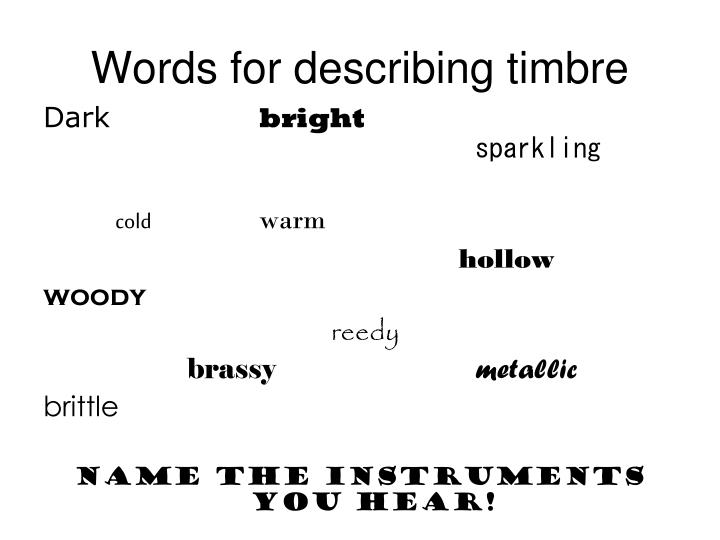
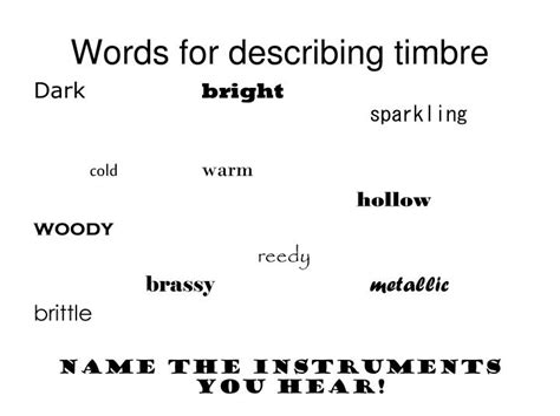
  • Students will recognize timbre by listening to various instruments and describing the sounds.

A collection of words describing timbre, such as dark, bright, sparkling, cold, warm, and metallic—plus “percussive place value” for rhythmic sounds. “Name the instruments you hear!” appears at the bottom.

  • Allow students to demonstrate steady and non steady beats using body percussion. Play Up-Town Funk to assist students.

Work Session

  • The teacher will demonstrate dynamics and steady beat while creating a composition illustrating place value (such as the example below). The students will then guess what the number is and how they understood the value of it.
    • Example:
      • 1,324
      • 1,000 = 1 loud stomps
      • 300 = 3 medium claps
      • 20 = 2 snaps
      • 4 = 4 shhh sounds
  • Assign each student a number. Have students think about how they can represent the number using body percussion and dynamics.
  • Put students into pairs. Students will stand/sit back to back and take turns listening to each other's performances. They will record the number they hear in standard form.
  • Next, assign each pair a new number. Together, they will compose a musical phrase using body percussion that they will perform for the class.
    • Each sound will represent a given place value and its dynamics will identify its value.
    • Example:
      • 1,324
      • 1,000= 1 loud stomps
      • 300= 3 medium claps
      • 20= 2 snaps
      • 4= 4 shhh sounds

Closing Reflection

  • Two groups will perform their musical phrases for their classmates consecutively. Discuss appropriate audience participation and etiquette prior to performances.
  • Audience members should try to decipher both the performers’ numbers.


Assessments

Formative

Teachers will assess students’ understanding of place value by observing students' participation in the activator, ability to interpret a number based on dynamics, and collaboration with their partners to compose a musical phrase that uses dynamics to express place value.

Summative

CHECKLIST:

  • Students can compose and perform a musical phrase that uses dynamics to represent place value.
  • Students can compare the values of two numbers and determine the number that has the greater value.


Differentiation 

Accelerated: 

  • Students will compose a musical phrase for two numbers. Then, they will find the sum of numbers and compose a musical phrase for the new number.
  • Students will use pitched instruments (like boomwhackers). Here, the pitch will determine the place value.
  • Students will notate (visually or on paper) their sound pattern so others can reproduce the same number.

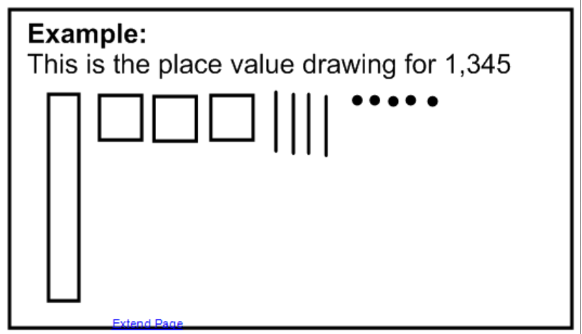
An example of place value for 1,345: one large rectangle, three squares, four vertical lines, and five dots, representing thousands, hundreds, tens, and ones—perfect for visualizing numbers in place value games or percussive math activities.

Remedial:

  • Scaffold the lesson by composing a musical phrase to represent a number together as a class prior to having partners compose.
  • Reduce the size of the number.


Additional Resources

●      What Is Timbre In Music, Sound And Voice? With Examples - Music Industry How To

●      Words for describing timber


Credits 

U.S. Department of Education- STEM + the Art of Integrated Learning

Ideas contributed by: SAIL Grant Teacher Leaders, Maribeth Yoder White

*This integrated lesson provides differentiated ideas and activities for educators that are aligned to a sampling of standards. Standards referenced at the time of publishing may differ based on each state’s adoption of new standards.

Revised and copyright:  June 2025 @ ArtsNOW
 

PLACE VALUE: KANDINSKY-INSPIRED PLACE VALUE COLLAGE 3

KANDINSKY-INSPIRED PLACE VALUE COLLAGE

PLACE VALUE: KANDINSKY-INSPIRED PLACE VALUE COLLAGE

Learning Description

Students will be inspired by the abstract artwork of Vasily Kandinsky to demonstrate their understanding of place value using shape and proportion in a two-dimensional collage artwork.


Learning Targets

GRADE BAND: 3
CONTENT FOCUS: VISUAL ARTS & MATH
LESSON DOWNLOADS:

Download PDF of this Lesson

"I Can" Statements

“I Can…”

  • I can explain what place value is.
  • I can tell the place value of digits in numbers up to 10,000.
  • I can write numbers in expanded form, word form, and standard form.
  • I can represent place value up to 10,000 using shape and proportion.
  • I can use place value reasoning to compare two numbers and determine which number is larger.

Essential Questions

  • What is place value?
  • What is the standard and word form?
  • How can I represent place value in expanded form?
  • How can we compare numbers?
  • How can we use shape and proportion to show different place values?
  • How can we use place value reasoning to determine which number has the greater value when comparing two numbers?


Georgia Standards

Curriculum Standards

3.NR.1.1 Read and write multi-digit whole numbers up to 10,000 to the thousands using base-ten numerals and expanded form.

3.NR.1.2 Use place value reasoning to compare multi-digit numbers up to 10,000, using >, =, and < symbols to record the results of comparisons.

Arts Standards

VA3.CR.2 Create works of art based on selected themes.

b. Create works of art emphasizing multiple elements of art and/or principles of design.

VA3.CR.3 Understand and apply media, techniques, processes, and concepts of two-dimensional art.

VA3.CN.2 Integrate information from other disciplines to enhance the understanding and production of works of art.

a. Apply art skills and knowledge to improve understanding in other disciplines.


South Carolina Standards

Curriculum Standards

3.NSBT.5 Compare and order numbers through 999,999 and represent the comparison using the symbols >, =, or <.

Arts Standards

Anchor Standard 1: I can use the elements and principles of art to create artwork.

Anchor Standard 2: I can use different materials, techniques, and processes to make art.

Anchor Standard 7: I can relate visual arts ideas to other arts disciplines, content areas, and careers.


Key Vocabulary

Content Vocabulary

  • Place value - The value of each digit in a number based on its position
  • Ten-thousands - The fifth position represents the number of ten-thousands
  • Thousands - The fourth position represents the number of thousands
  • Hundreds - The third position represents the number of hundreds
  • Tens - The second position represents the number of tens
  • Ones - The rightmost position (1st place) represents the number of ones
  • Expanded form - A way of writing numbers to show the value of each digit according to its place value; it breaks down a number by expressing it as the sum of each digit multiplied by its place value
  • Standard form - The way of writing numbers using digits, without breaking them down by place value or expanding them
  • Numerical - Using digits to represent quantities, values, or amounts
  • Digits - Symbols used to represent numbers in a numeral system

Arts Vocabulary

  • Abstract - Artwork not representing anything in the real world
  • Shape - One of the seven elements of art; an enclosed line that is two-dimensional
  • Proportion - One of principles of design; how one thing relates to another in terms of size
  • Two-dimensional - Contains height and width
  • Collage - A composition developed by gluing colored paper, photographs, magazine pictures, fabric, and other two-dimensional materials onto a flat surface


Materials


Instructional Design

Opening/Activating Strategy

  • Show students an image of one of Vasily Kandinsky’s artworks, such as Yellow Accompaniment.
  • Ask students to work with a partner to engage in the Colors / Shapes / Lines Artful Thinking Routine.
    • Instruct students to look at the artwork or object for at least 30 seconds..
      • What colors do you see?
      • What shapes do you see?
      • What lines do you see?
    • Allow time for students to share their observations.
    • Direct students’ attention to Kandinsky’s use of shapes, proportion, and overlapping in his artwork.

Work Session

  • Review place value with students.
  • Next, draw three different shapes in different sizes on the board. Ask students if each shape represents one place value, which shape would represent the ones place? The tens place? The hundreds place?
    • Students should make the connection that the smaller the shape the lower the place value.
  • Show students an example collage artwork (see below). Ask students if they can interpret the number based on the types of shapes and size of shapes.
    • Students should arrive at 354 because there are three large shapes, five medium sized shapes, and four small shapes.

Colored paper shapes on a black background form a Kandinsky-inspired place value collage: rectangles and vibrant triangles and semicircles in blue and orange create an abstract, playful arrangement across the canvas.

  • Tell students that they will be making a collage artwork to demonstrate their numbers. Share that collage is a medium in art in which the artist uses pieces of material, such as paper, to create a new two-dimensional image or design by gluing them onto a flat surface.
  • Group students with a partner to create their collaborative collage.
  • Pass out a note card to students. Have them begin by writing a five digit number on it in standard form (alternatively, assign students a number).
    • Then, have students create a key on their notecard for their artwork in which each place value is represented by a different shape.
      • For example: Ten-thousands place = star; thousands place = square; hundreds place = trapezoid; tens place = triangle; ones place = circle
    • Students should create a prototype of their artwork in their STEAM journals before beginning their collage.
    • Pass out materials to students: One sheet of construction paper for the base of their artwork, various colors of construction paper for them to cut shapes out of, scissors, and glue sticks.
    • Students will create their collage artwork demonstrating their number using shape and proportion to demonstrate place value.
    • Finally, students should write their number in standard form, expanded form, and word form on a notecard or the back of their artwork.

Closing Reflection

  • Have students partner with another group. Students should see if they can interpret each other’s numbers. Then, students should arrange the numbers from smallest to largest using place value reasoning.
  • Students will reflect on the creation process, how their artwork changed from the prototype in their journals to their collage artwork, and what they learned from the task in their STEAM journals.


Assessments

Formative

  • Teachers will assess student learning through observing:
    • Students’ participation and comments in the activator
    • Whether students can connect place value to proportion
    • Students’ collaboration with partners to create collage artwork that demonstrates their number using shape and proportion

Summative

CHECKLIST

  • Students can demonstrate their understanding of place value through proportion and shape.
  • Students can write a number in standard form, expanded form, and word form.
  • Students can use place value reasoning to compare two numbers and determine which number is larger.


Differentiation 

Accelerated: 

  • Have students interpret their artwork and number as a sculpture (three-dimensional).

Remedial:

  • Students will be given three digit numbers to create their artwork.
  • Provide shape templates for students to trace.
  • Provide markers, oil pastels, colored pencils, or crayons to create their artwork instead of collage.
  • Determine the place value key as a class.
  • Allow students to draw their shapes on paper rather than collage.


Credits

U.S. Department of Education- STEM + the Art of Integrated Learning

Ideas contributed by: Katy Betts

*This integrated lesson provides differentiated ideas and activities for educators that are aligned to a sampling of standards. Standards referenced at the time of publishing may differ based on each state’s adoption of new standards.

Revised and copyright:  June 2025 @ ArtsNOW


DANCING NUMBERS 3

DANCING NUMBERS

DANCING NUMBERS

Learning Description

Students will be able to read and write multi-digit whole numbers up to 10,000 using choreography to model base-ten numerals and expanded form. Students will demonstrate their understanding by creating leveled choreography to represent the different place values in a number. Each level will represent a different place value.


Learning Targets

GRADE BAND: 3
CONTENT FOCUS: DANCE & MATH
LESSON DOWNLOADS:

Download PDF of this Lesson

"I Can" Statements

“I Can…”

  • I can explain what place value is.
  • I can tell the value of digits in different place value positions.
  • I can write numbers in standard form.
  • I can represent place value in multiple ways (concrete and abstract).
  • I can use levels to express place value.
  • I can create a movement or shape with my body to represent a number.

Essential Questions

  • What is place value?
  • How can I create a movement to represent a number?
  • How can levels in dance be used to represent place value?


Georgia Standards

Curriculum Standards

Grade 3: 

3.NR.1.1 Read and write multi-digit whole numbers up to 10,000 to the thousands using base-ten numerals and expanded form.

3.NR.1.2 Use place value reasoning to compare multi-digit numbers up to 10,000, using >, =, and < symbols to record the results of comparisons.

Arts Standards

Grade 3: 

ESD3.CR.1 Demonstrate an understanding of the choreographic process.
a. Collaborate with others to create and perform movement phrases.
b. Create a sequence of three or more movements utilizing body, space, time, and energy.
ESD3.CR.2 Demonstrate an understanding of dance as a form of communication.
ESD3.PR.1 Identify and demonstrate movement elements, skills, and terminology in dance.
ESD3.RE.1 Demonstrate critical and creative thinking in dance.


South Carolina Standards

Curriculum Standards

Grade 3: 

3.NSBT.5 Compare and order numbers through 999,999 and represent the comparison using the symbols >, =, or <.

Arts Standards

Anchor Standard 1: I can use movement exploration to discover and create artistic ideas and works.
Anchor Standard 2: I can choreograph a dance.
Anchor Standard 3: I can perform movements using the dance elements.


Key Vocabulary

Content Vocabulary

  • Place value - The value of each digit in a number based on its position
  • Ten-thousands - The fifth position represents the number of ten-thousands
  • Thousands - The fourth position represents the number of thousands
  • Hundreds - The third position represents the number of hundreds
  • Tens - The second position represents the number of tens
  • Ones - The rightmost position (first place) represents the number of ones
  • Expanded form - A way of writing numbers to show the value of each digit according to its place value; it breaks down a number by expressing it as the sum of each digit multiplied by its place value
  • Standard form - The way of writing numbers using digits, without breaking them down by place value or expanding them
  • Numerical - Using digits to represent quantities, values, or amounts
  • Digits - Symbols used to represent numbers in a numeral system

Arts Vocabulary

  • Choreography - The art of composing dances and planning and arranging the movements, steps, and patterns of dancers
  • Body - The physical instrument through which movements and expressions are conveyed; it encompasses how dancers use their whole body or specific body parts to perform movements and communicate ideas, emotions, or stories
  • Space - An element of movement involving direction, level, size, focus, and pathway
  • Level - One of the aspects of the movement element space; in dance, there are three basic levels: high, middle, and low
  • Shape - This refers to an interesting and interrelated arrangement of body parts of one dance; the visual makeup or molding of the body parts of a single dancer; the overall visible appearance of a group of dancers
  • Dance sequence - A specific order of movements or steps performed in a particular pattern or progression


Materials

  • Music
  • Sound source and speakers
  • Cards with four digit numbers written on them (one per group of four students)
  • Name tags with four digit numbers written on them (one per student)


Instructional Design

Opening/Activating Strategy

  • The teacher will lead students in the Freeze Game.
    • Give students name tags with different numbers 1-999.
    • Turn the music on and have students walk through space.
    • When the music stops, students must find someone near them to partner with and freeze in a pose to show who has the higher number.
    • Continue so students have multiple opportunities to compare numbers and pose on a high and low level depending on which number is greater than or less than.
    • Pause periodically to make observations and discuss how students are demonstrating the value of a number using their bodies.
  • Have students return to their seats. Facilitate a discussion around how students compared the values of two numbers using their bodies.
  • Tell students that when we pose at different levels, we are using a concept called “levels” in dance.
    • Have students stand at their desks.
    • Model different levels of dance–high, middle, and low. Have students mirror your movements.


Work Session

  • Introduce place value in math.
  • Once students are familiar with the concept, provide directions for creating Place Value Choreography.
  • Model the activity to show what is expected of the students during the work session time.
  • Students will be put into groups of five.
  • Each group will be assigned a five digit number written on a card.
  • Students will first determine the place value of each digit.
  • Next, students will use the number cards to choreograph a dance sequence that shows each digit in its place value. Each student will represent one digit and its place value (ten thousands, thousands, hundreds, tens, ones).
    • Students should use levels to demonstrate the place value and should create a shape or movement with their body to represent the digit.
    • The higher the movement or shape, the greater the value of the corresponding digit.


Closing Reflection

  • Students will perform their dance sequences. Discuss appropriate audience participation and etiquette prior to performances.
  • While groups perform, the audience members will use their peer reflection form to record the performing group’s number.
  • After two performances, the audience will compare the groups’ numbers.
  • They will reflect on their choreographic choices in their STEAM journals.


Assessments

Formative

  • Teachers will assess students’ understanding of place value by observing how students use their bodies and levels in dance to represent place value.
  • Provide students with a copy of the self-checklist to use as they choreograph their sequences.

A self-checklist for dance inspired by Dancing Numbers, with columns labeled Ten-thousands, Thousands, Hundreds, Tens, and Ones. Each column has space for movement and level, plus an area below to explain. A number space is at the top.


Summative

  • Students can accurately use levels to represent place value.
  • Students can create movements and shapes with their bodies to represent digits.
  • Students can compare two numbers and determine which is larger using place value.
  • Provide students with a copy of the peer-checklist to evaluate their peers during the performances.

A worksheet titled


Differentiation

Accelerated: 

  • Students will create choreography using larger numbers.
  • Two groups will create a new choreographic sequence that compares their numbers to each other, digit by digit.

Remedial:

  • Students will create choreography using smaller numbers representing fewer place values.


 Credits

U.S. Department of Education- STEM + the Art of Integrated Learning

Ideas contributed by: SAIL Grant Teacher Leaders, Melissa Joy

*This integrated lesson provides differentiated ideas and activities for educators that are aligned to a sampling of standards. Standards referenced at the time of publishing may differ based on each state’s adoption of new standards.

Revised and copyright:  June 2025 @ ArtsNOW


MUSIC AND ACOUSTICS THROUGH GRAPHING 2-3

MUSIC AND ACOUSTICS THROUGH GRAPHING

MUSIC AND ACOUSTICS THROUGH GRAPHING

Learning Description

Students will work together creatively to compose a rhythmic piece using cups, demonstrating their ability to identify and understand different sounds. Then, they will then graph the data they observe in their peers’ performances. Throughout the lesson, students will apply musical skills such as improvisation, composition, listening, and playing.


Learning Targets

GRADE BAND: 2-3
CONTENT FOCUS: MUSIC & MATH
LESSON DOWNLOADS:

Download PDF of this Lesson

"I Can" Statements

“I Can…”

  • I can identify high, medium, and low sounds aurally.
  • I can verbally describe the impact of size on sound.
  • I can create and perform an 8-beat rhythmic pattern.
  • I can identify pitch elements of my peers’ compositions verbally and through notation.
  • I can graph data that I record.

Essential Questions

  • How can music listening and composing support learning in other curricular areas?
  • How can I represent musical data graphically?


Georgia Standards

Curriculum Standards

Grade 2: 

2.MDR.5.4 Ask questions and answer them based on gathered information, observations, and appropriate graphical displays to solve problems relevant to everyday life.


Grade 3: 

3.MDR.5.1 Ask questions and answer them based on gathered information, observations, and appropriate graphical displays to solve problems relevant to everyday life.

Arts Standards

Grade 2:

ESGM2.CR.1 Improvise melodies, variations, and accompaniments.


ESGM2.CR.2 Compose and arrange music within specified guidelines.


ESGM2.PR.2 Perform a varied repertoire of music on instruments, alone and with others.


ESGM2.RE.1 Listen to, analyze, and describe music.


ESGM2.CN.1 Connect music to the other fine arts and disciplines outside the arts.


Grade 3:

ESGM3.CR.1 Improvise melodies, variations, and accompaniments.


ESGM3.CR.2 Compose and arrange music within specified guidelines.


ESGM3.PR.2 Perform a varied repertoire of music on instruments, alone and with others.


ESGM3.RE.1 Listen to, analyze, and describe music.


ESGM3.CN.1 Connect music to the other fine arts and disciplines outside the arts.


South Carolina Standards

Curriculum Standards

Grade 2: 

2.MDA.8 Generate data by measuring objects in whole unit lengths and organize the data in a line plot using a horizontal scale marked in whole number units.


2.MDA.9 Collect, organize, and represent data with up to four categories using picture graphs and bar graphs with a single-unit scale.


Grade 3: 

3.MDA.3 Collect, organize, classify, and interpret data with multiple categories and draw a scaled picture graph and a scaled bar graph to represent the data.

Arts Standards

Anchor Standard 1: I can arrange and compose music. 

Anchor Standard 2: I can improvise music. 

Anchor Standard 4: I can play instruments alone and with others. 

Anchor Standard 6: I can analyze music.

Anchor Standard 9: I can relate music to other arts disciplines, other subjects, and career paths.


Key Vocabulary

Content Vocabulary

  • Graphing - The process of representing data or mathematical relationships visually using charts or graphs
  • Bar graph - A visual representation of data where rectangular bars are used to compare different categories or groups
  • Line plot - A type of graph that displays data along a number line, where each data point is marked with an "X" or dot above its corresponding value
  • Data - Facts, figures, or information collected for analysis, reference, or study

Arts Vocabulary

  • Acoustics - The branch of physics that deals with sound and sound waves
  • Body percussion - Sounds produced by striking or scraping parts of the body; typically includes snapping, clapping, patting, and stamping
  • Dynamics - Volume of sound (loudness, quietness)
  • Texture - The thickness or thinness of sound
  • Pitch - The highness or lowness of sound


Materials

  • Audio recording of drum composition (examples can be found on iTunes, Spotify, YouTube, etc.)
  • Sound source (computer and speakers)
  • Drums of three different sizes (improvise with other objects, such as buckets or pots, that can be used in place of a drum if you do not have drums available)
  • Plastic cups of three different sizes
  • 8-beat visual (numbers 1-8 spaced evenly)
  • Pencils
  • “Pitch detective” charts for each student
  • “Pitch detective” visual on board


Instructional Design

Opening/Activating Strategy

Classroom Tips: Arrange student groups throughout the room so that they can move far enough apart during the creating process to enable careful listening and minimize distraction from other groups. Perform compositions out of sight of “audience,” so students rely on listening rather than sight to identify sounds heard. 


  • Play a recording of drums as students enter the room.
  • Have students listen and then discuss with a partner what they heard.
  • Introduce musical terms (e.g., instrument names, dynamics, pitch, texture, etc.) as students make observations.


Work Session

  • Take out three different sized drums (or buckets turned over). Demonstrate different pitches (high, medium, low) of various size drums (using the same relative force when you hit each drum).
  • Ask students if they can determine the relationship between sound and drum size.
  • Now, transfer these acoustical principles to various size plastic cups.
  • Play a listening game with students. Out of students’ sight, perform 4- or 8-beat rhythmic patterns (or beats) on different drums and/or cups.
  • Challenge students to identify what was heard (e.g., three sounds on a small drum and one sound on a medium drum).
  • Have students echo the pattern, using body percussion (e.g., clap for high drum, pat for medium drum, stamp for large drum).
  • Perform an 8-beat rhythmic pattern using low, medium, and/or high sounds, and have students identify what they heard (high, medium, and low).
    • Keep the patterns simple by using quarter notes (one sound for each beat) and eighth notes (two sounds on each beat only).
    • Using an 8-beat visual (see below) may be helpful to guide student responses.

1    2    3    4    5    6    7    8

  • Divide students into groups of four to six students, with each student having a cup. Have students create an 8-beat pattern using cups.
    • Remind them to include everyone in the composing and performing process.
  • Distribute pencils and “pitch detective” charts. While each group performs (out of the sight of their classmates), the other students will be “pitch detectives” and notate what they hear on their charts.
    • For example, using a blank 8x3 table (such as appears below), students could write an “X” in the appropriate boxes based on what they hear. The boxes below would demonstrate four high sounds, two medium sounds, and two low sounds.


Closing Reflection

  • Compare and contrast student compositions, discussing the differences in pitches and rhythms.
  • Finally, have students graph the data that they recorded on their “pitch detective” charts.


Assessments

Formative

Teachers will assess students’ understanding of the content throughout the lesson by observing students’ participation in the activator; ability to use musical vocabulary to describe music; ability to identify high, medium, and low sounds; and collaboration with group members to create an 8-beat pattern using cups.


Summative

CHECKLIST

  • Students can identify high, medium, and low sounds aurally.
  • Students can verbally describe the impact of size on sound.
  • Students can create and perform an 8-beat rhythmic pattern.
  • Students can identify pitch elements of peers’ compositions verbally and through notation.
  • Students can graph the data that they recorded.


DIFFERENTIATION 

Acceleration: 

  • Provide students with a variety of materials (including but not limited to cardboard boxes, plastic hangers, foil, rubber bands in different sizes, etc). Ask students to build (or design) new instruments that play different pitches. Allow students to research and explore how instruments are made. Having different students research different instruments will allow for discussion on how they make different sounds.
  • Combine two student compositions into a 16-beat phrase.
  • Combine two student compositions simultaneously, producing a thicker texture.
  • Alter dynamics and/or tempo of student compositions.
  • Have students write compositions for others to perform using various notational systems.
    • Write 1-2 Xs in each cell of a 3x8 table.
    • Use other symbols (triangle, square, circle) to represent high, medium, and low sounds.
  • Have students write sequential steps for generating new compositions.

Remediation:

  • When performing rhythmic patterns, have students perform a four beat pattern.
  • Group students into pairs as they complete their “pitch detective” charts.
  • Make the “pitch detective” charts 4x3.

ESOL Modifications and Adaptations:

  • Ensure that students have a clear understanding of the concepts of steady beat and pitch, along with the music vocabulary words texture, dynamics, acoustics, and body percussion prior to teaching this lesson.


*This integrated lesson provides differentiated ideas and activities for educators that are aligned to a sampling of standards. Standards referenced at the time of publishing may differ based on each state’s adoption of new standards.

Ideas contributed by: Maribeth Yoder-White. Modifications, Extensions, and Adaptations Contributed by: Candy Bennett, Patty Bickell, Vilma Thomas, and Lori Young. Updated by: Katy Betts.

Revised and copyright: September 2024 @ ArtsNOW