
MINDFUL MANDALAS
Learning Description
Students will create mindful mandalas that use radial balance, pattern, and variety to calm the mind.
Learning Targets
"I Can" Statements
“I Can…”
- I can use and identify radial balance.
- I can use color, pattern, and variety to create harmony.
- I can use positive self-talk to change my mindset.
Essential Questions
- What is radial balance?
- How can we use color, pattern, and variety to create harmony?
- How can positive self-talk change your mindset?
Georgia Standards
Curriculum Standards
HE5.1 Students will comprehend concepts related to health promotion and disease prevention to enhance health.
HE5.1.c Describe and apply the basic health concept of mental and emotional well-being.
HE5.7 Students will demonstrate the ability to practice health-enhancing behaviors and avoid or reduce health risks.
HE5.7.a Practice responsible personal health choices.
Arts Standards
VA5.CR.1 Engage in the creative process to generate and visualize ideas by using subject matter and symbols to communicate meaning.
VA5.PR.1 Plan and participate in appropriate exhibition(s) of works of art to develop identity of self as artist.
VA5.CR.5 Demonstrate an understanding of the safe and appropriate use of materials, tools, and equipment for a variety of artistic processes.
VA5.RE.1 Use a variety of approaches for art criticism and to critique personal works of art and the artwork of others to enhance visual literacy.
VA5.CN.3 Develop life skills through the study and production of art (e.g. collaboration, creativity, critical thinking, communication).
South Carolina Standards
Curriculum Standards
Standard 1: “Students will comprehend concepts related to health promotion and disease prevention to enhance health” (NHES, 2007).
M-5.1.1 Describe coping strategies to promote mental health.
Standard 6: “Students will demonstrate the ability to use goal-setting skills to enhance health” (NHES, 2007).
M-5.6.1 Develop a plan to reduce and manage stress.
Arts Standards
Anchor Standard 1: I can use the elements and principles of art to create artwork.
Benchmark VA.CR I can combine several elements of art to express ideas.
Indicator VA.CR NM.1.2 I can combine several elements of art to construct 2D or 3D artwork.
Anchor Standard 2: I can use different materials, techniques, and processes to make art.
Benchmark VA.CR NM.2 I can use some materials, techniques, and tools to create artwork.
Indicator VA.CR NM.2.1 I can use two-dimensional art materials to explore ways to make art.
Anchor Standard 4: I can organize work for presentation and documentation to reflect specific content, ideas, skills, and or media.
Benchmark VA.P NL.4 I can show and describe the idea of my artwork.
Indicator VA.P NL.4.2 I can describe my artwork.
Key Vocabulary
Content Vocabulary
- Mindfulness - The practice of paying full, non-judgmental attention to the present moment—your thoughts, feelings, bodily sensations, and surroundings
Arts Vocabulary
- Mandala - A geometric design—often circular—that organizes patterns, symbols, and shapes around a central point, usually in a symmetrical or radial arrangement
- Radial balance - A type of visual balance in which elements are arranged around a central point and radiate outward in a circular or spiral pattern
- Variety - The differences in a work, achieved by using different shapes, textures, colors and values
- Pattern - Repetition of specific visual elements such as a unit of shape or form
- Unity - This is seen in a painting or drawing when all the parts equal a whole. Similar to harmony, which is achieved in a body of work by using similar elements throughout the work, such as color harmony.
Materials
- 9X12 paper
- Pencils
- Markers or colored pencils
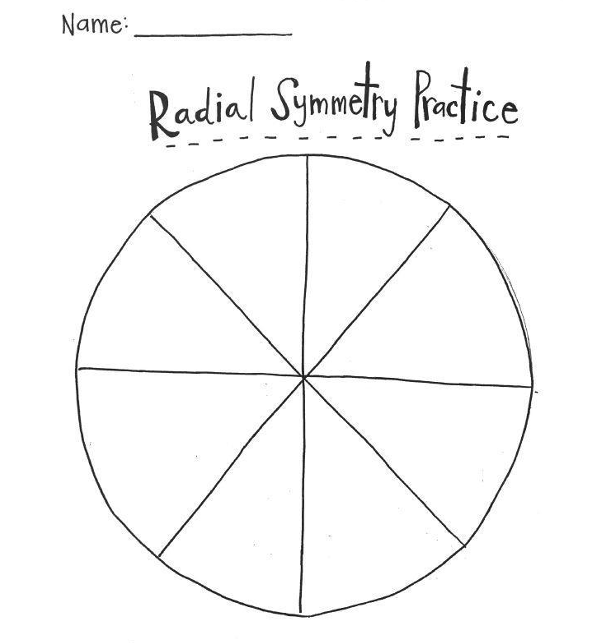
- Mandala template
- Video of sand mandala
- What is a Mandala? About Mandala art - Bing video
- Examples of mandalas
- Mandala planning guide
Instructional Design
Opening/Activating Strategy
- Show the introductory video: Video of sand mandala
- Ask students: “What is a mandala? Have you seen one before?”.
- Lead a class discussion:
- Mandalas are circular designs found in many cultures (Tibetan, Hindu, Native American, etc.).
- They often represent unity, balance, and mindfulness.
- Show students examples of mandalas. Ask students what is similar and different about them. Students should see that all mandalas have radial balance, pattern and repetition, and a color scheme.
- Discuss how these things contribute to the unity of the mandala.
- Tell students that they will create their own mandalas using symmetry, pattern, and repetition.
Work Session
- Begin by demonstrating to students how to create a mandala.
- Demonstrate how to trace a circle (use a paper plate or compass).
- Fold it in half three times to create eight sections (like a pizza).
- Draw guidelines through the folds with a ruler.
- On a whiteboard or projector, demonstrate how to repeat simple patterns (shapes, lines, symbols) around the circle.
- Emphasize radial balance—what’s on one side should mirror around the circle. All patterns should radiate out from the center.
- Have students practice/plan for their mandala using a planning guide.
- Students should draw at least four repeating shapes/patterns in each section.
- Encourage students to use variety in shapes and lines, remember to show radial balance, and draw lightly for clean pencil sketches.
- Before moving to the final product, students must:
- Turn in their practice sheet.
- Receive teacher approval for:
- Radial balance
- Creativity
- Pattern and repetition
- Variety
- Completion of design
- Students should follow the steps to create their final mandala.
- Trace a large circle on the final paper.
- Fold in half three times to get eight symmetrical sections.
- Use a ruler to trace the fold lines lightly.
- Begin drawing the approved practice design.
- Once the full design is complete, trace carefully with black Sharpie.
- Select a color scheme.
- Add color using markers or colored pencils.
- Encourage thoughtful color choices.
- Remind students about color balance and repetition for unity.
- Add color using markers or colored pencils.
Closing Reflection
- Have students reflect by creating a brief reflection/artist statement. Students can include the following:
- How did creating your mandala make you feel? Did you practice mindfulness?
- What was challenging or calming about the process?
Assessments
Formative
- Observe students’ discussion responses and whether students can identify and create radial balance, patterns, variety, and color schemes.
- Conference with students during the art-making process.
Summative
Differentiation
|
Accelerated:
Remedial:
|
Additional Resources
- Examples of various lines and shapes that work for mandala designs
Credits
U.S. Department of Education- STEM + the Art of Integrated Learning
Ideas contributed by: SAIL Grant Teacher Leaders–Chad Itnyre, Kristen Alvarez, Leah Patel, Lucerito Gonzalez, Tamu Clayton, Sandra Cash, Erin Smullen
*This integrated lesson provides differentiated ideas and activities for educators that are aligned to a sampling of standards. Standards referenced at the time of publishing may differ based on each state’s adoption of new standards.
Revised and copyright: August 2025 @ ArtsNOW