
A MATTER OF ISOLATION
Learning Description
Students will create a game in which players use movement to show how changes in thermal energy change the behavior of particles.
Learning Targets
"I Can" Statements
“I Can…”
- I can demonstrate the effect of thermal change on particles through choreography.
- I can relate the elements of dance to states of matter.
- I can use the elements of dance to vary movements to communicate multiple ideas in one choreography.
Essential Questions
- How does dance movement demonstrate states of matter and change in thermal energy?
Georgia Standards
Curriculum Standards
Grade 8:
S8P1.b Develop and use models to describe the movement of particles in solids, liquids, gases, and plasma states when thermal energy is added or removed.
Arts Standards
Grade 8:
MSD.CR.1 Demonstrate an understanding of the choreographic process.
MSD.RE.1 Demonstrate critical and creative thinking in dance.
MSD.CN.3 Demonstrate an understanding of a dance as it relates to other areas of knowledge.
South Carolina Standards
Curriculum Standards
Grade 6:
6-PS1-4. Develop and use a model that predicts and describes changes in particle motion, temperature, and state of a pure substance when thermal energy is added or removed
Arts Standards
Anchor Standard 1: I can use movement exploration to discover and create artistic ideas and works.
Anchor Standard 2: I can choreograph a dance.
Anchor Standard 3: I can perform movements using the dance elements.
Anchor Standard 5: I can describe, analyze, and evaluate a dance.
Anchor Standard 7: I can relate dance to other arts disciplines, content areas, and careers.
Key Vocabulary
Content Vocabulary
- Particle – A small object which can be described by several physical or chemical properties; matter is made up of particles
- Thermal Energy – The motion of particles within a substance that is responsible for its temperature
Arts Vocabulary
- Isolation – Movement created by moving one part of their body while keeping the rest of the body still or controlled
- Axial – Movement that occurs in place, without traveling to a new location
- Locomotor – A movement that travels through space
- Choreographic process - The steps taken to create movement sequences for dancers, which include testing, revising, and editing work
- Choreography - The art of designing and arranging sequences of movements, steps, and gestures to create a dance piece
- Engineering Design Process -
- Ask – What is the problem? What do we need to do?
- Imagine – What are some possible solutions?
- Plan – Which idea will we try? How will we build it?
- Create – Build the solution.
- Test & Improve – Does it work? How can we make it better?
Materials
- Blank index cards, blank paper
- A variety of music selections
- Music source and speakers
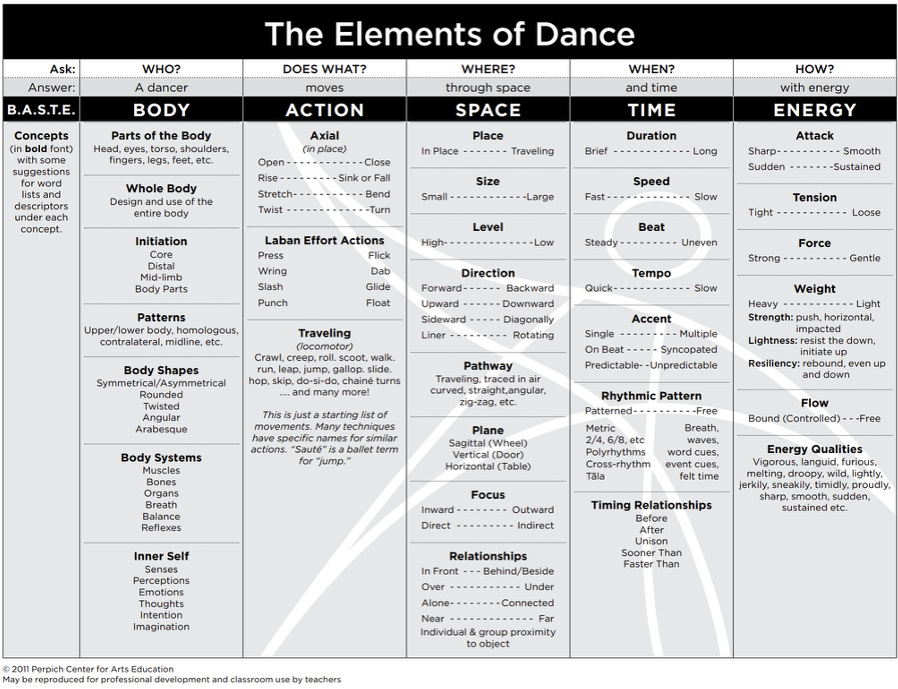
- Word bank of dance vocabulary:
- From the “Time” column of the Elements of Dance
- Speed: fast/slow
- Beat: steady/uneven
- Rhythm: predictable/unpredicable
- From the “Energy” column of the Elements of Dance
- Tension: tight/loose
- Flow: bound/free
- Elements of Dance handout
- From the “Time” column of the Elements of Dance
Instructional Design
Opening/Activating Strategy
- Students improvise movements in a hand dance. Using only their hands and fingers, students work in pairs, with one being the leader and the other the follower. Students sit facing one another so that when they extend their arms in front of them their hands do NOT touch.
- The leader extends one arm and faces the palm of the hand to the other student. The follower extends one arm and faces the palm of one hand to the leader to create a mirror image of the other student’s hand. The leader moves the one hand and fingers in slow steady motions while the follower imitates the movement. The teacher plays music and students move in silence, without talking or making any noise, until the music stops.
- The teacher pauses the music. Partners change roles and repeat the process.
- Partners should mentally note which movements are successful or when they find a movement that they would like to remember for use later in the lesson.
Work Session
PART 1
- Divide students into small groups of three members. Each group will create a game in which players earn points when they use their hands and fingers to show how particles move in reaction to increasing or decreasing thermal energy.
- For the game, participants should be organized into teams. Team members isolate their hands and fingers to create dance movements that represent states of matter to successfully earn points.
- Students list a few of their favorite games and think about the strategy/rules of those games.
- Give each group a few sheets of paper and index cards to use as game materials.
PART 2
- Students list the information that they need to know in order to create the game. In other words, they list questions and answers about scientific concepts, dance concepts, and game rules.
- Students gather the details that they need to plan the game.
PART 3
- Students brainstorm different ways in which players could move their fingers and hands to play the game. They write down dance terms from a word bank derived from the Energy or Time columns of the Elements of Dance to describe the movements.
- Students correlate the dance vocabulary with descriptions of how particles move when matter is a solid, liquid, or gas.
PART 4
- Students imagine how teams could interact in a game so that players earn points by showing the movement of particles when thermal energy is applied, removed, increased, or decreased. Students should consider the different ways that players could describe the presence/absence/increase/decrease of thermal energy, including using words such as warmer or cooler, or absolute measures of temperature, i.e., 32 degrees F or 212 degrees F.
- Students write down the rules of the game.
PART 5
Students test their games by playing them. They note where improvements need to be made and revise their rules.
Closing Reflection
- Ask students to explain how moving their bodies in this lesson helps them to understand and describe the properties of thermal energy and how it impacts matter.
- Ask students to describe how the process of asking questions up front helped them create the game.
- Ask students to describe how brainstorming movements first helped them imagine the play strategy (writing the rules).
- Ask students how they revised their games after the testing phase.
Assessments
Formative
Visually observe the students during the process of creativity.
- Teacher observes students discussing and writing questions during PART 2.
- Teacher observes students using vocabulary of the elements of dance and vocabulary of states of matter and thermal energy together, as they brainstorm ways that teams will move to earn points and as they imagine the rules of the games.
Summative
A MATTER OF ISOLATION CHECKLIST
- Movements are limited to hands and fingers.
- Game options contain variation of time and energy elements.
- The game rules effectively use dance to communicate changes in thermal energy so that observers can identify distinct states of matter.
Differentiation
|
Accelerated:
Remedial:
|
Additional Resources
Classroom Tip: Use the opening activity as an opportunity for students to identify movements that they will use later in the lesson.
Credits
Ideas contributed by: Julie Galle Baggenstoss
*This integrated lesson provides differentiated ideas and activities for educators that are aligned to a sampling of standards. Standards referenced at the time of publishing may differ based on each state’s adoption of new standards.
Revised and copyright: January 2026 @ ArtsNOW