
DATA PORTRAIT
Learning Description
This lesson will focus on achieving accurate self perception as well as recognizing strengths, needs and values. Students will create a data-based self portrait that focuses on their unique aspects.
Learning Targets
"I Can" Statements
“I Can…”
- I can create a self portrait using symbols.
- I can use the Elements of Art and Principles of Design to add detail and interest to my portrait.
Essential Questions
- How can I represent myself through symbols?
- How can I use the Elements of Art to convey meaning?
Georgia Standards
Curriculum Standards
HE4.1 Students will comprehend concepts related to health promotion and disease prevention to enhance health.
HE4.1.c Describe basic health concepts of mental and emotional well-being
Arts Standards
VA4.CR.1 Engage in the creative process to generate and visualize ideas by using subject matter and symbols to communicate meaning.
VA4.PR.1 Plan and participate in appropriate exhibition(s) of works of art to develop identity of self as artist.
VA4.CR.5 Demonstrate an understanding of the safe and appropriate use of materials, tools, and equipment for a variety of artistic processes.
VA4.RE.1 Use a variety of approaches for art criticism and to critique personal works of art and the artwork of others to enhance visual literacy.
VA4.CN.3 Develop life skills through the study and production of art (e.g. collaboration, creativity, critical thinking, communication).
South Carolina Standards
Curriculum Standards
Standard 2: “Students will analyze the influence of family, peers, culture, media, technology, and other factors on health behaviors” (NHES, 2007).
I-4.2.1 Analyze ways that protective factors promote health and safety (e.g., positive outlook, healthy self-concept, good relationships with parents).
M-4.2.1 Explain ways that peers can influence an individual’s self-concept.
Arts Standards
Anchor Standard 1: I can use the elements and principles of art to create artwork.
Benchmark VA.CR I can combine several elements of art to express ideas.
Indicator VA.CR NM.1.2 I can combine several elements of art to construct 2D or 3D artwork.
Anchor Standard 2: I can use different materials, techniques, and processes to make art.
Benchmark VA.CR NM.2 I can use some materials, techniques, and tools to create artwork.
Indicator VA.CR NM.2.1 I can use two-dimensional art materials to explore ways to make art.
Anchor Standard 4: I can organize work for presentation and documentation to reflect specific content, ideas, skills, and or media.
Benchmark VA.P NL.4 I can show and describe the idea of my artwork.
Indicator VA.P NL.4.2 I can describe my artwork.
Key Vocabulary
Content Vocabulary
- Self-awareness - Knowing your own thoughts, feelings, strengths, and challenges; understanding who you are and how you react to things
- Strength - Something someone is good at or a positive quality someone possesses that helps them in life
- Needs - The important things you must have to live and feel well—like food, water, safety, love, and support
- Values - The beliefs and ideas that matter most to you
- Unique - Being one of a kind
Arts Vocabulary
- Symbols - Visuals that represent meaning
- Balance - This is a sense of stability in the body of work. Balance can be created by repeating the same shapes and by creating a feeling of equal visual weight.
- Portrait - A visual representation of a person
- Self-portrait - A visual representation of oneself
- Space - The distance or area between, around, above or within things. Positive space refers to the subject or areas of interest in an artwork, while negative space is the area around the subject of an artwork. It can be a description for both two and three-dimensional portrayals.
- Proportion - The size relationships between different parts of an artwork. It determines how each element relates to the others in terms of size, scale, and placement.
Materials
- 5x11.5 mixed media paper
- Pencils
- Markers
- Sharpies
- Crayons
- Portrait examples: “The Frame” by Frida Kahlo, “Portrait of Pablo Picasso” by Juan Gris, and “Mystic Head: Ravenwings IV” by Alexej Von Jawlensky
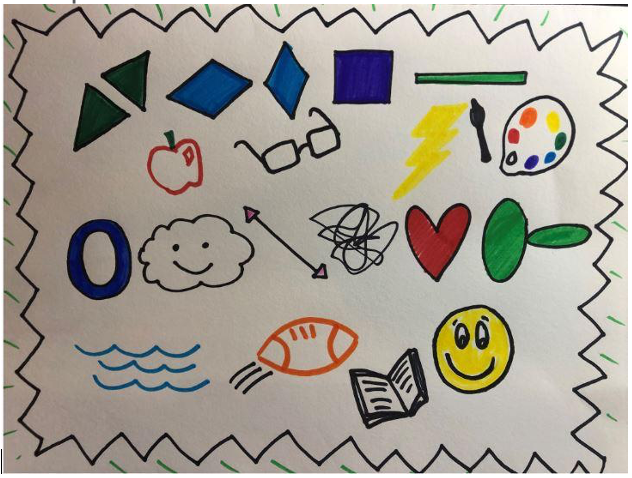
- Example:
Instructional Design
Opening/Activating Strategy
- Students will view examples of portraits that are more traditional versus abstract.
- Examples: “The Frame” by Frida Kahlo, “Portrait of Pablo Picasso” by Juan Gris, and “Mystic Head: Ravenwings IV” by Alexej Von Jawlensky
- Next, discuss how using symbols is an alternative way to represent oneself.
- Ask students for some examples of personal strengths and symbols that could represent them (i.e. a heart for kindness, a brain for intelligence, etc.).
- Tell students that they will be creating a self-portrait using symbols to represent personal strengths.
Work Session
- Students will create a list of characteristics that make them unique. Students should try to generate at least eight ideas.
- Students will then create symbols that represent those characteristics.
- Students should spend time developing their symbols. These symbols could be abstract or representational.
- Students will need to create a master key showing what each symbol represents.
- Show students an example of a finished “data portrait”.
- Discuss with students how the space is used; emphasize that students should use the whole space to create their portrait.
- Ask students to brainstorm how they could represent the characteristics that are most important. Students may say that these symbols might be in the middle of the artwork or might be the largest.
- Discuss how to create balance in the artwork so that it feels unified.
- Students should plan their artwork before beginning. Students should be intentional with how they use the space.
- Next, students will choose their materials and begin creating their artwork.
Closing Reflection
- Students will share their portraits either in small groups or through a gallery walk.
- Ask students to try to “read” and analyze what each symbol represents.
- Facilitate a discussion about what students learned about themselves and each other through this project.
- Provide time for students to share why they chose some of their symbols and what they visually represent.
Assessments
Formative
Assess students’ learning by observing students’ responses to discussion questions and conferencing with students throughout the planning and artmaking process.
Summative
Differentiation
|
Accelerated:
Remedial:
|
Credits
U.S. Department of Education- STEM + the Art of Integrated Learning
Ideas contributed by: SAIL Grant Teacher Leaders–Chad Itnyre, Kristen Alvarez, Leah Patel, Lucerito Gonzalez, Tamu Clayton, Sandra Cash, Erin Smullen
*This integrated lesson provides differentiated ideas and activities for educators that are aligned to a sampling of standards. Standards referenced at the time of publishing may differ based on each state’s adoption of new standards.
Revised and copyright: August 2025 @ ArtsNOW