
COLOR AND EMOTION
Learning Description
Students will create an Andy Warhol inspired artwork that demonstrates their knowledge of emotions through facial expressions and color.
Learning Targets
"I Can" Statements
“I Can…”
- I can discuss how different artists use color to express emotions in their artwork.
- I can use color to express emotion.
- I can create different facial expressions to express emotions and feelings.
Essential Questions
- How do artists express emotions in their artwork?
- How can facial expressions show emotions?
- What is color psychology and how can it be used to express emotions?
Georgia Standards
Curriculum Standards
HE3.1 Students will comprehend concepts related to health promotion and disease prevention to enhance health.
HE3.1.c Prevent and manage emotional stress and anxiety in healthy ways.
HE3.1.e Identify behaviors that show respect for themselves and others.
Arts Standards
VA3.CR.1 Engage in the creative process to generate and visualize ideas by using subject matter and symbols to communicate meaning.
VA3.PR.1 Plan and participate in appropriate exhibition(s) of works of art to develop identity of self as artist.
VA3.CR.5 Demonstrate an understanding of the safe and appropriate use of materials, tools, and equipment for a variety of artistic processes.
VA3.RE.1 Use a variety of approaches for art criticism and to critique personal works of art and the artwork of others to enhance visual literacy.
VA3.CN.3 Develop life skills through the study and production of art (e.g. collaboration, creativity, critical thinking, communication).
South Carolina Standards
Curriculum Standards
Standard 1: “Students will comprehend concepts related to health promotion and disease prevention to enhance health” (NHES, 2007).
M-3.1.1 Identify examples of mental, emotional, social, and physical health.
M-3.1.3 Identify healthy ways to communicate (e.g., verbal, nonverbal, written).
Arts Standards
Anchor Standard 1: I can use the elements and principles of art to create artwork.
Benchmark VA.CR I can combine several elements of art to express ideas.
Indicator VA.CR NM.1.2 I can combine several elements of art to construct 2D or 3D artwork.
Anchor Standard 2: I can use different materials, techniques, and processes to make art.
Benchmark VA.CR NM.2 I can use some materials, techniques, and tools to create artwork.
Indicator VA.CR NM.2.1 I can use two-dimensional art materials to explore ways to make art.
Anchor Standard 4: I can organize work for presentation and documentation to reflect specific content, ideas, skills, and or media.
Benchmark VA.P NL.4 I can show and describe the idea of my artwork.
Indicator VA.P NL.4.2 I can describe my artwork.
Key Vocabulary
Content Vocabulary
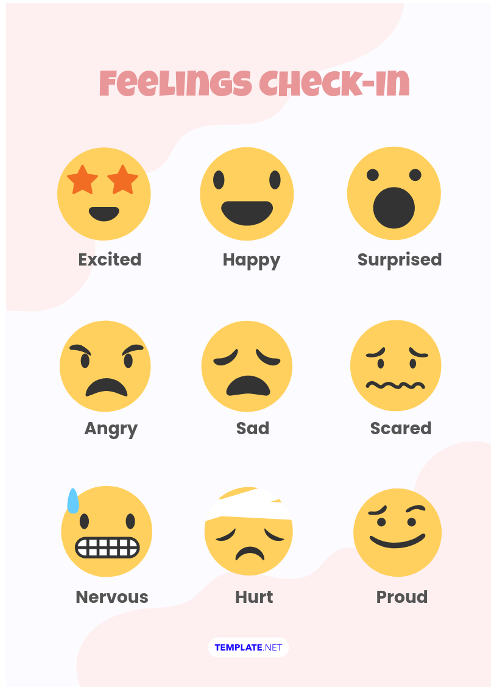
- Emotions - Also called feelings, like being happy or mad or scared
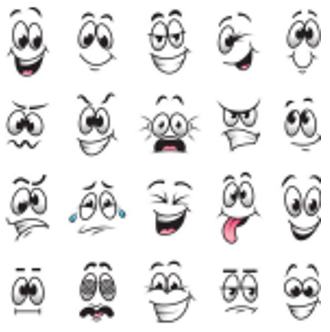
- Facial expressions - A form of nonverbal communication; one or more motions made with the face
Arts Vocabulary
- Pop Art - A style of art based on simple, bold images of everyday items, such as soup cans, painted in bright colors. Pop artists created pictures of consumer product labels and packaging, photos of celebrities, comic strips, and animals.
- Andy Warhol - An artist who was part of the Pop Art movement. He is famous for exploring popular culture in his work. Popular culture is anything from Coca Cola to pop stars to the clothes people like to wear. Warhol liked to use bright colors and silk-screening techniques.
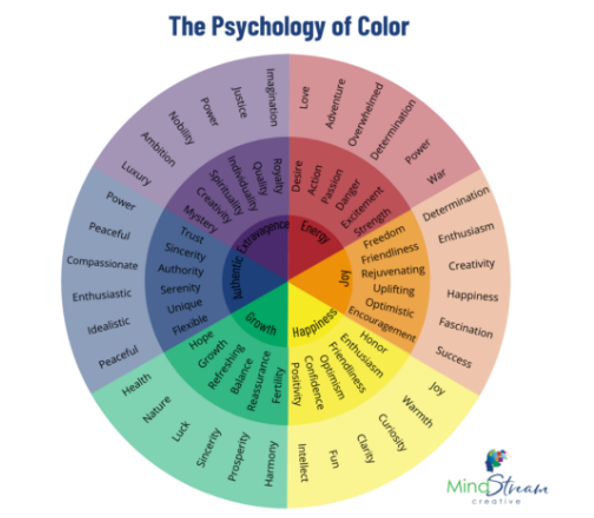
- Color psychology - Color psychology connects colors with emotions and behaviors.
- Composition - How an artist arranges the Elements of Art (line, shape, form, value, color, space, texture) to create an artwork
- Variety - The differences in a work, achieved by using different shapes, textures, colors and values
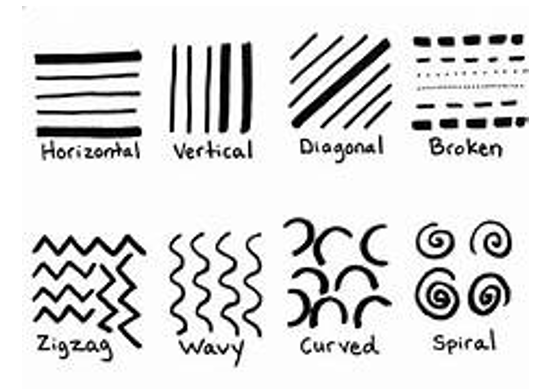
- Line - A continuous mark made on some surface by a moving point. It may be two dimensional, like a pencil mark on a paper or it may be three dimensional (wire) or implied (the edge of a shape or form) often it is an outline, contour or silhouette.
Materials
- Sketchbooks/practice paper
- Pencils
- 9X9 paper divided into four sections
- Markers, colored pencils, or paint (students may choose their preferred medium)
- Black permanent markers
- Black construction paper cut 11X11 for mounting
- Glue or double-sided tape
- Various artworks that express emotions (ex: Van Gogh, Picasso, André Derain, Jim Dine)
- Examples: “Four Hearts” by Jim Dine, “Sunflowers” by Van Gogh, and “The Old Guitarist” by Picasso
- Video about Pop Art and Andy Warhol (Watch only the first four minutes)
- Examples of Warhol’s work:

- Emotions and feeling chart:
- Color psychology and emotions chart:
- Red – love, mad, angry, happy, energetic
- Yellow – excited, happy, hopeful
- Orange – excited, energetic
- Blue – sad, cool, calm
- Green – cool, calm, growth, nature
- Purple – creative, luxury, wealth, lonely
- Black – power, evil, madness, anger
- Gray – bored, tired, sad
- Brown – sleepy, lonely, nature
Instructional Design
Opening/Activating Strategy
- Students will begin this lesson by discussing a variety of artists and how they use color to express or evoke emotions.
- Examples: Van Gogh used yellow to show hope and joy, Picasso used blue to show sadness and despair, Derain used color to show noise and activity, Dine used color and line to show fun and excitement, and Monet used color to show calm and tranquil.
- Show examples of artwork that use color to evoke emotion and ask students to reflect on how each makes them feel. Provide time for students to discuss with a partner.
- Examples: “Four Hearts” by Jim Dine, “Sunflowers” by Van Gogh, and “The Old Guitarist” by Picasso.
- Engage students in a discussion about what colors they identify with when they are sad, happy, mad, sick, etc.
- Discuss color psychology and how this can help artists add emotion to their work.
- Ask students what other colors artists used to convey emotions.
- Next, look at and discuss artworks by Andy Warhol. Observe how he used contemporary objects in our everyday life in his work and how he used color to transform them.
- Show students images of different facial expressions used when conveying emotions. Discuss how changing the angle of the brow can make a face go from happy to sad, surprised to angry.
- Say different emotions and have students respond by making expressions to show that emotion.
Work Session
- Ask students to provide an example of an emoji that displayed a particular emotion (sad face, happy face, mad face, etc.) and ask them how they could change or manipulate this emoji using facial expressions or colors to make this emoji appear to have more meaning.
- Example: Using tints and shades of blue to color the sad emoji, using bright reds, yellows and oranges to show anger, etc.
- Students will use their sketchbooks to design four emoji inspired characters that show different feelings or emotions through color and expression.
- Next, they will use crayons to practice using the appropriate colors throughout the piece to further express each character’s emotion.
- After students have had time to sketch out their ideas, have them do a think-pair-share activity with the students around them to get constructive criticism.
- Have students focus on communicating and expressing their concerns or thoughts about their peers’ artwork. The purpose is to gain other’s perspectives on their artwork and to make sure their classmates are communicating effectively.
- Tell students that their peers should not have to guess what emotions they are trying to convey. It should be understood; if it is not, discuss what could be done differently to make it clearer.
- Show students examples of Andy Warhol’s artwork. Ask students to discuss the composition and colors that Warhol used.
- When the students are ready, pass out 9X9 inch project paper and have them fold it vertically and horizontally to create four equal sections.
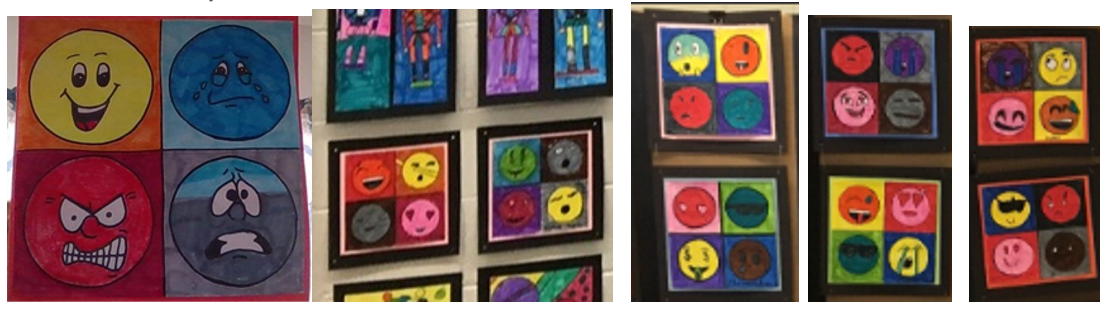
- Have students trace or draw a large circle in each of the four sections. Students will then sketch out their four characters (one in each section) in a grid pattern like many of Warhol’s pieces.
- Once they have a sketch on the paper that they are happy with, have them outline their work with a black permanent marker.
- Students can use their choice of markers, colored pencils, or paint to finish their work. Remind them that the colors and facial expressions they use should express or convey a specific emotion.
- When the students are finished with their artwork, mount them on black paper giving them a clean border.
Student Examples:
Closing Reflection
- In closing, have students do a gallery walk. Have them determine what emotions are being conveyed. Students should be able to justify their answers using the knowledge they have gained from the lesson.
- Have students reflect on their own artwork and discuss what they thought they did well on and what they would change.
Assessments
Formative
- Teachers will assess students throughout the lesson through observations, questioning, responses to class discussion, sketching/practice, and conferencing.
- Suggestion: Use a Think-Pair-Share activity with students at the beginning, middle and end of the project so that they can give each other feedback.
Summative
Differentiation
|
Accelerated:
Remedial:
Differentiation in art can be seen through variations in content, process, products, and learning environment. Content can be varied through things such as step-by-step instructions, supplementary text, art prints, student choice, curriculum compacting, technology and various other resources. The process in which the art is made can vary by medium, levels of support, challenge, complexity, or time. Products will vary based on how the students demonstrated their learning or expressed their ideas and knowledge of the project. Teachers can use a rubric to match or extend students’ skill level. Products can also vary based on whether the students worked alone, in small groups, or as a school to create artworks. Lastly, learning environments can be altered to accommodate different learning styles and objectives. The art teacher can create a safe, engaging, and positive setting by establishing clear rules and guidelines. |
Additional Resources
- Andy Warhol (Getting to Know the World's Greatest Artists) by Mike Venezia
- Art & Emotions - YouTube (watch the first 2 ½ minutes)
- How Artists Use Color to Express Emotion (this can be used as a hook or a supplemental resource for kids that need more information or support)
Credits
U.S. Department of Education- STEM + the Art of Integrated Learning
Ideas contributed by: SAIL Grant Teacher Leaders–Chad Itnyre, Kristen Alvarez, Leah Patel, Lucerito Gonzalez, Tamu Clayton, Sandra Cash, Erin Smullen
*This integrated lesson provides differentiated ideas and activities for educators that are aligned to a sampling of standards. Standards referenced at the time of publishing may differ based on each state’s adoption of new standards.
Revised and copyright: August 2025 @ ArtsNOW